
TL;DR

Get business pricing on tools and workshop supplies
- Business-only prices and quantity discounts
- Tax-exempt purchasing
- Multiple users, one account, clear invoices
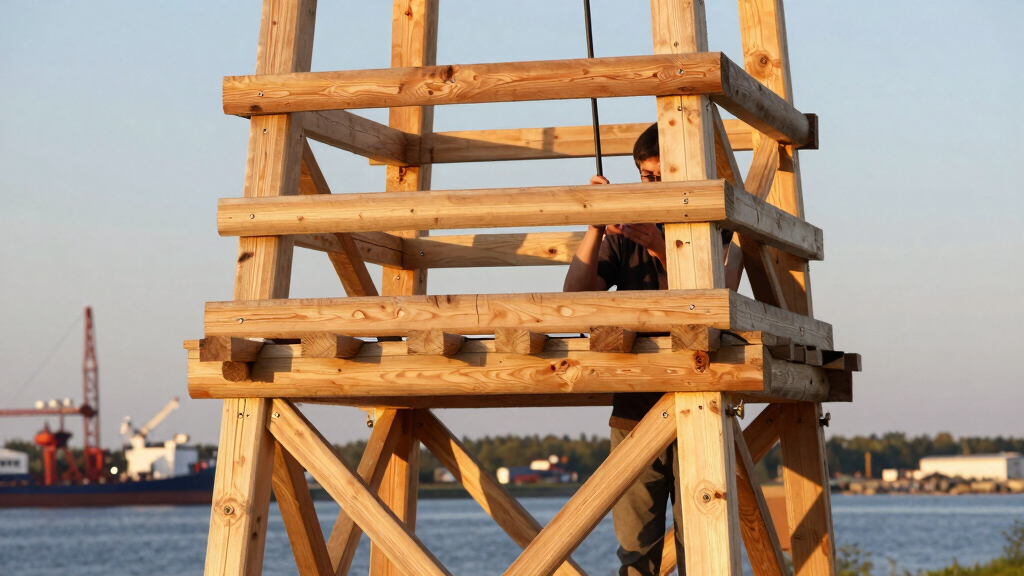
Design Wood Home has completed a timber observation tower overlooking Kola Bay in Murmansk, Russia. The structure reinterprets local industrial forms and enhances public access to the waterfront, responding to the region’s harsh climate and industrial heritage.
A timber observation pavilion overlooking Kola Bay in Murmansk, Russia, has been completed by Design Wood Home. The structure reinterprets local industrial forms and serves as a new public landmark, connecting the waterfront’s industrial history with contemporary design.
The Kola Bay Lighthouse, situated on a hillside near Murmansk, is a timber structure commissioned by the Murmansk Regional Government as part of the ‘Living in the North’ program. The pavilion’s silhouette references port cranes and lighthouses, translating their geometric forms into a timber construction that emphasizes renewable materials and resilience against the region’s harsh climate.
The pavilion includes an observation deck across two levels: a lower sheltered terrace with seating and a pet waiting shelter, and an upper platform offering panoramic views of Kola Bay. Its design minimizes metal fasteners through intricate wooden joinery, highlighting craftsmanship and environmental sustainability. Surrounding landscape design aims to reduce environmental impact while facilitating public access, with circulation routes carefully planned to protect Arctic mosses. The structure’s elevated position makes it a visible landmark, fostering a stronger connection between the local neighborhood and the waterfront.
Cultural and Environmental Impact of the Kola Bay Landmark
This project matters because it transforms an industrial shoreline into a public space that celebrates local heritage while respecting environmental constraints. The use of timber and traditional joinery methods demonstrates sustainable construction practices suited for the Arctic climate. The pavilion’s design offers a new visual identity for Murmansk’s waterfront, potentially influencing future developments in the region’s public architecture and environmental stewardship.
As an affiliate, we earn on qualifying purchases.
Industrial Heritage and Contemporary Reinterpretation in Murmansk
Kola Bay’s shoreline has historically been characterized by port cranes and lighthouses, symbols of Murmansk’s industrial identity. The region’s harsh climate and fragile Arctic ecosystem have shaped local architecture and urban planning. Recent efforts aim to balance industrial legacy with environmental protection and public accessibility. The new timber pavilion by Design Wood Home responds to these themes by translating industrial forms into a sustainable, civic-scale structure that enhances the waterfront’s visual and functional landscape.
“The pavilion’s silhouette references port cranes and lighthouses, creating a visual dialogue between industrial history and contemporary design.”
— an anonymous researcher
Unclear Details on Opening and Public Access
It is not yet confirmed when the pavilion will officially open to the public or if there are any planned events or programs associated with the site. Details on visitor capacity, maintenance, and operational management remain unspecified.
Next Steps for the Kola Bay Observation Pavilion
Further information is expected to clarify the official opening date and public access arrangements. Authorities or the design team may also develop additional landscape or visitor facilities to enhance the site’s integration into the local community and tourism infrastructure.
Key Questions
What is the purpose of the timber observation tower?
The tower serves as a public lookout point, celebrating the industrial heritage of Kola Bay while providing panoramic views and a recreational space for visitors.
How does the design reflect local industrial history?
The silhouette of the pavilion references port cranes and lighthouses, translating their geometric forms into a timber structure that symbolizes Murmansk’s maritime and industrial identity.
Is the structure environmentally sustainable?
Yes, the pavilion emphasizes renewable construction methods, notably using timber with intricate joinery that minimizes metal fasteners, suitable for the Arctic climate and environmental preservation.
When will the pavilion be open to visitors?
Details about the official opening date and public access are not yet confirmed. Further announcements are expected in the coming months.
What role does landscape design play in the project?
The landscape design aims to minimize environmental impact by directing circulation routes away from sensitive Arctic mosses and integrating the structure into the hillside environment.
Source: designboom
Halloween Picks
halloween
As an affiliate, we earn on qualifying purchases.