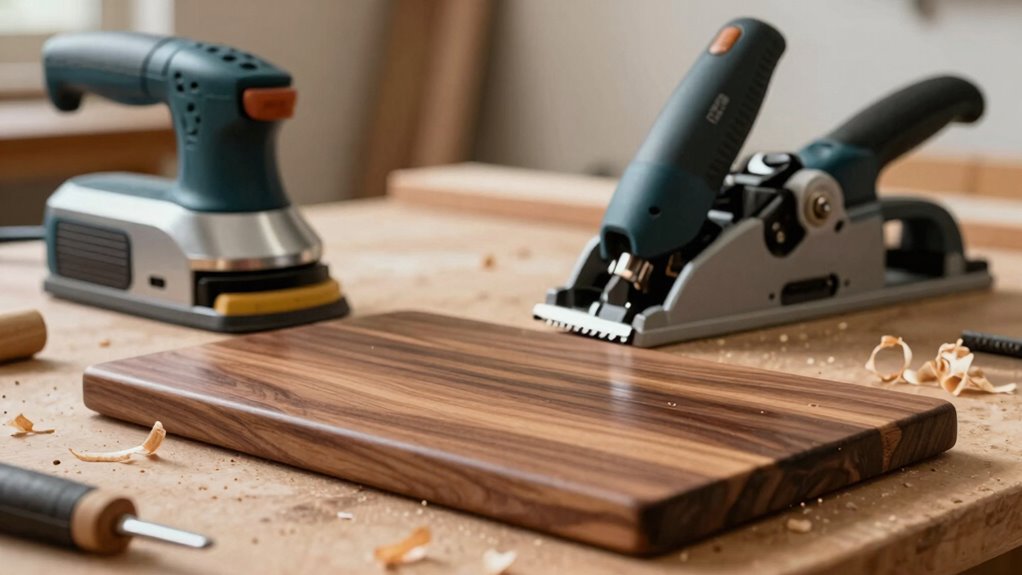

When choosing between a drum sander and a planer, consider your specific needs. If you’re focused on achieving smooth, fine finishes on large surfaces, a drum sander’s your best bet. However, if you need to adjust board thickness and achieve flat surfaces, a planer is ideal. Think about your workspace and the volume of projects you tackle, too. Each tool serves its purpose. Stick around to learn which tool might boost your woodworking workflow further.
Key Takeaways
- Assess your primary needs: Choose a drum sander for finishing large surfaces and a planer for dimensional adjustments and consistent board thickness.
- Consider workspace size: Ensure you have adequate space for the tool you select, especially for handling large panels with a drum sander.
- Evaluate project volume: If you frequently work on large projects, invest in a drum sander; for smaller tasks, a planer may suffice.
- Factor in budget: Drum sanders generally require a higher initial investment and maintenance, while planers tend to be more affordable and easier to maintain.
- Align tools with applications: Use a drum sander for preparing surfaces for finishing and a planer for achieving uniform thickness in lumber.
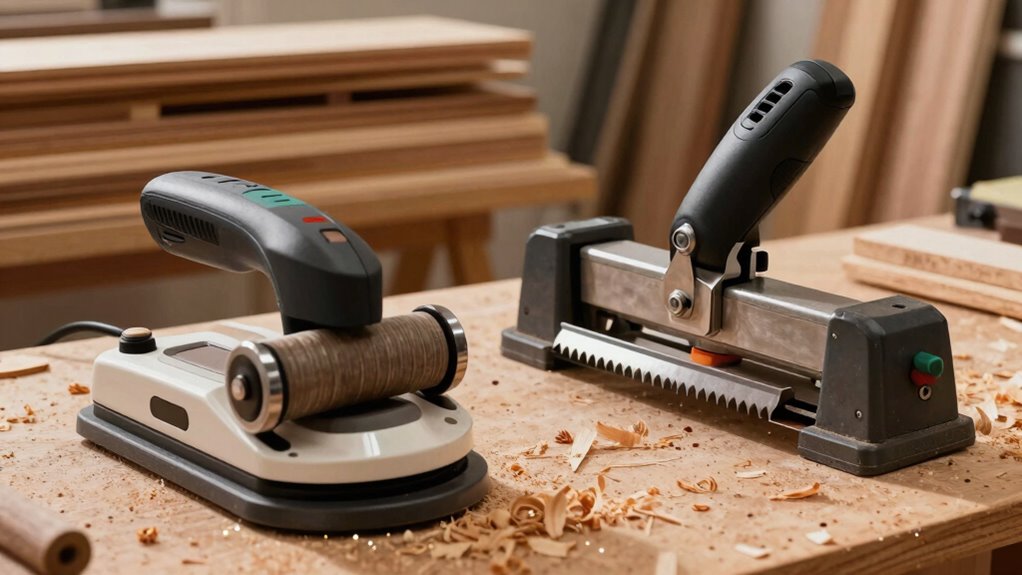
When you think about which tool to choose, reflect on the type of project you’re working on. If you’re focused on achieving a fine finish, a drum sander might be your best bet. However, if you need to dimension your lumber and achieve flat surfaces, a planer will serve you well. It’s also worth pondering your workspace and the volume of work you typically handle. If you often work with large panels, investing in a drum sander could be worthwhile. If you’re more often adjusting board thickness, a planer might be the way to go. Additionally, understanding the different functions of each tool can help clarify which one aligns better with your woodworking goals. For example, a surface finishing tool like a drum sander is designed to smooth large surfaces, making it ideal for preparing panels for finishing. Recognizing the specific applications of each tool can help you make an informed decision that complements your overall workflow. It’s also helpful to consider the cost and maintenance requirements of each tool to ensure it fits within your budget and workshop setup. Ultimately, both tools can play significant roles in your woodworking journey. By weighing the drum sander benefits against the planer advantages, you’ll find the right fit for your needs. So, take a moment to assess your projects and make a choice that aligns with your goals.

JET 16-Inch Drum Sander, Open Stand, 1-1/2 HP, 115V 1Ph (JWDS-1632)
- Sandsmart Load Monitoring: Adjusts speed for optimal feed rate
- Easy Conveyor Parallelism: Adjusts with external dial
- Integrated Dust Hood: Directs dust to collection port
As an affiliate, we earn on qualifying purchases.
As an affiliate, we earn on qualifying purchases.
Frequently Asked Questions
What Is the Cost Difference Between a Drum Sander and a Planer?
When you look at the cost difference, drum sanders usually range from $1,000 to $3,000, while planers can be found between $200 and $1,500. This price comparison reflects not just the initial investment but also tool longevity. Drum sanders tend to last longer and handle larger projects, making them a better long-term investment if you’re serious about woodworking. Ultimately, consider your needs and budget before deciding which tool to invest in.
How Much Maintenance Do Drum Sanders and Planers Require?
Drum sanders typically require more maintenance due to their complexity and need for regular belt replacements, impacting sander efficiency. On the other hand, planers usually demand less upkeep, focusing on blade sharpness and occasional adjustments, boosting planer versatility. Keeping both tools clean and properly adjusted will enhance their performance. Ultimately, you’ll want to evaluate your workflow and how much time you’re willing to invest in maintenance for either option.
Can I Use a Drum Sander for Finishing Work?
Yes, you can use a drum sander for finishing work. In fact, studies show that drum sanders can improve sanding efficiency by up to 30% compared to traditional methods. When employing finishing techniques, a drum sander gives you a smooth, even surface, making it perfect for preparing wood for stain or varnish. Just remember to choose the right grit to achieve the desired finish without damaging the wood.
What Wood Types Are Best Suited for Each Tool?
When choosing wood types for each tool, hardwoods like oak and maple work well with a drum sander due to their durability and fine finishing. For planers, you’ll find softwoods like pine and cedar easier to manage, as they cut smoothly and require less power. Each tool shines based on the material; understanding hardwood compatibility and softwood characteristics will help you achieve the best results in your projects.
Are There Portable Options for Drum Sanders and Planers?
When it comes to woodworking, you’ve hit the nail on the head—there are indeed portable options for both tools. Portable drum sanders are great for on-the-go projects, while compact planers offer flexibility without sacrificing performance. These tools make it easy to tackle various tasks, whether you’re in your workshop or out in the field. So, if portability’s your priority, you’ve got some solid choices to evaluate!
Conclusion
In the end, choosing between a drum sander and a planer isn’t just about tools; it’s about finding the right companion for your woodworking journey. Each has its charm and unique touch, like two artists vying for your affection. Embrace the one that resonates with your vision, knowing that whichever you choose will enhance your craft and bring your creations to life. After all, every masterpiece deserves the perfect partner.