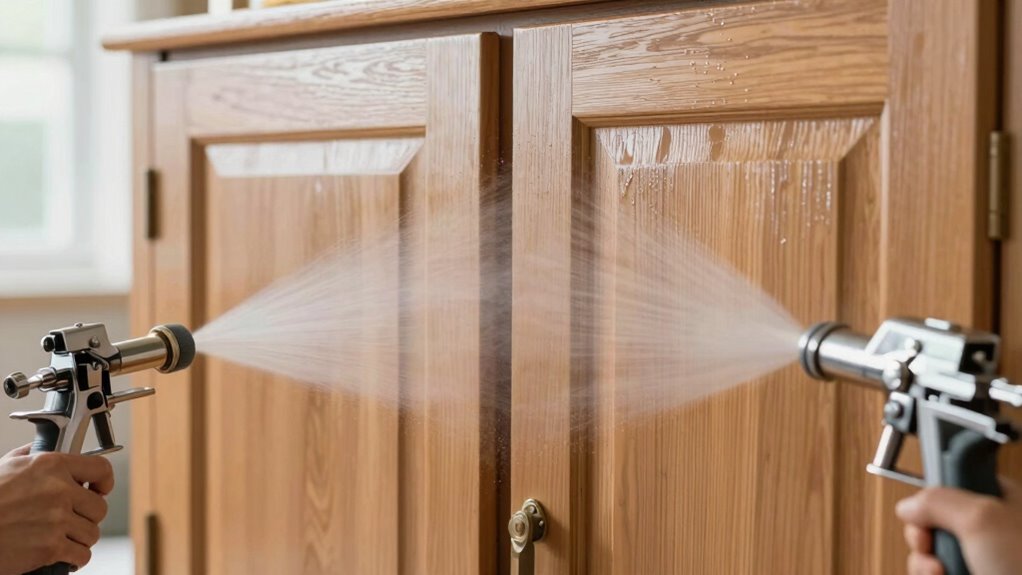

If you want a factory-quality finish on your cabinets, HVLP sprayers are your best option because they deliver fine, detailed coats with less overspray, perfect for a smooth, professional look. They work well with thinning paints and require careful technique. Airless sprayers cover large areas quickly and handle thicker paints, making them ideal for faster jobs. To perfect your finish and choose the right tool, keep exploring how each sprayer aligns with your project needs.

Get business pricing on tools and workshop supplies
- Business-only prices and quantity discounts
- Tax-exempt purchasing
- Multiple users, one account, clear invoices
Key Takeaways
- HVLP produces a smoother, more detailed finish ideal for achieving a factory-like cabinet look.
- Airless sprayers cover large surfaces quickly and handle thicker paints without extensive thinning.
- HVLP offers better control with less overspray, making it suitable for fine, high-quality cabinet finishes.
- Airless sprayers are more efficient for large projects but may require more technique to prevent uneven coverage.
- Proper paint viscosity and application technique are critical for both sprayer types to achieve a professional, smooth finish.

When choosing between HVLP and airless sprayers, understanding their differences can help you make the right decision for your project. Both options have their strengths, but the key is knowing how they handle your specific needs. HVLP sprayers excel at delivering fine, detailed finishes, especially when you’re working on cabinets that require a smooth, factory-like look. To achieve this, you’ll want to pay close attention to your brush techniques and paint viscosity. HVLP sprayers work best with thinner paints, which flow more easily through the spray gun, resulting in less overspray and a more controlled application. If your paint is too thick, you’ll need to thin it to the right consistency to prevent clogging and ensure a smooth, even coat. The right brush techniques—such as maintaining a consistent distance from the surface, overlapping strokes, and using light, even passes—will help you maximize the HVLP’s ability to produce a flawless finish. Remember, the goal is to keep the paint at the proper viscosity so it atomizes properly and lays down evenly, avoiding drips or uneven coverage. Additionally, understanding the paint viscosity and how it affects spray performance is essential for achieving professional results.
In contrast, airless sprayers are designed for faster coverage and are more forgiving when it comes to thicker paints. They use high pressure to force paint through a small tip, spraying large areas quickly and efficiently. You don’t need to worry as much about thinning the paint, but you do need to be mindful of the spray pattern and technique to prevent overspray and ensure even coverage. Airless sprayers are ideal for large projects like cabinets when you want to save time, but achieving a factory-quality finish requires practice. You’ll need to adjust your spray distance and speed, and possibly do some light sanding between coats to get that smooth surface. Since airless sprayers can handle thicker paints, they’re less sensitive to viscosity issues, but that doesn’t mean you should ignore proper technique. Proper brush techniques still matter during touch-ups or detailed areas, and understanding paint viscosity helps you avoid issues like sputtering or uneven spray patterns.
As an affiliate, we earn on qualifying purchases.
Frequently Asked Questions
Which Sprayer Is Better for Detailed Cabinet Work?
For detailed cabinet work, an HVLP sprayer is better because it offers superior sprayer precision, allowing you to achieve intricate designs and fine details effortlessly. It delivers a smoother finish quality with less overspray, ensuring your cabinets look professional and polished. You’ll find it easier to control the spray pattern, making it ideal for detailed work where precision and a flawless finish matter most.
How Much Paint Waste Does Each Sprayer Generate?
You’ll find that HVLP sprayers generate less paint waste due to their higher paint efficiency, helping you minimize overspray and save material. In contrast, airless sprayers tend to produce more waste because of higher pressure and overspray. Cleanup time also varies; HVLP sprayers usually clean up faster, reducing your overall project time. Choosing the right sprayer depends on balancing paint efficiency and how much time you want to spend on cleanup.
Can HVLP Handle Thick Paint or Stain?
HVLP sprayers struggle with thick paint or stain application because they’re designed for lower paint thickness. You’ll find it difficult to achieve a smooth, even coat on thick paints or stains, often requiring thinning beforehand. If you want to handle thicker materials effectively, consider an airless sprayer. For delicate stain applications, HVLP gives you control, but for thicker paints, it’s best to opt for equipment designed for higher viscosity materials.
What Are the Initial Costs of HVLP Vs Airless Sprayers?
The initial cost of an HVLP sprayer is generally lower, often ranging from $150 to $400, making it budget-friendly for DIY projects. In contrast, airless sprayers typically start around $200 to $600 or more, reflecting their greater power. When considering cost comparison, remember that maintenance costs for HVLP are usually lower, but you might need to replace parts more often. Overall, choose based on your project needs and budget.
Which Sprayer Is Easier for Beginners to Operate?
You’ll find HVLP sprayers easier for beginners, with about 80% of first-timers reporting a shorter learning curve. Their ease of use, thanks to lower pressure and simplified operation, makes them less intimidating. Airless sprayers, while powerful, tend to have a steeper learning curve, requiring more control and experience. If you’re new to spraying, HVLP offers a smoother, more manageable start, helping you achieve professional-looking results faster.
Conclusion
So, whether you choose HVLP or airless, remember—you’re just one paint job away from fooling everyone into thinking your cabinets came straight from a factory. Who needs perfection when you’ve got a sprayer that makes DIY look like a pro? Just pick your weapon and watch your friends marvel at your “professional” finish. After all, nothing says “I’m a cabinet-making genius” like a sprayer that’s just a little too good at hiding your amateur touch.
Evergreen bestsellers Picks
bestsellers
As an affiliate, we earn on qualifying purchases.