
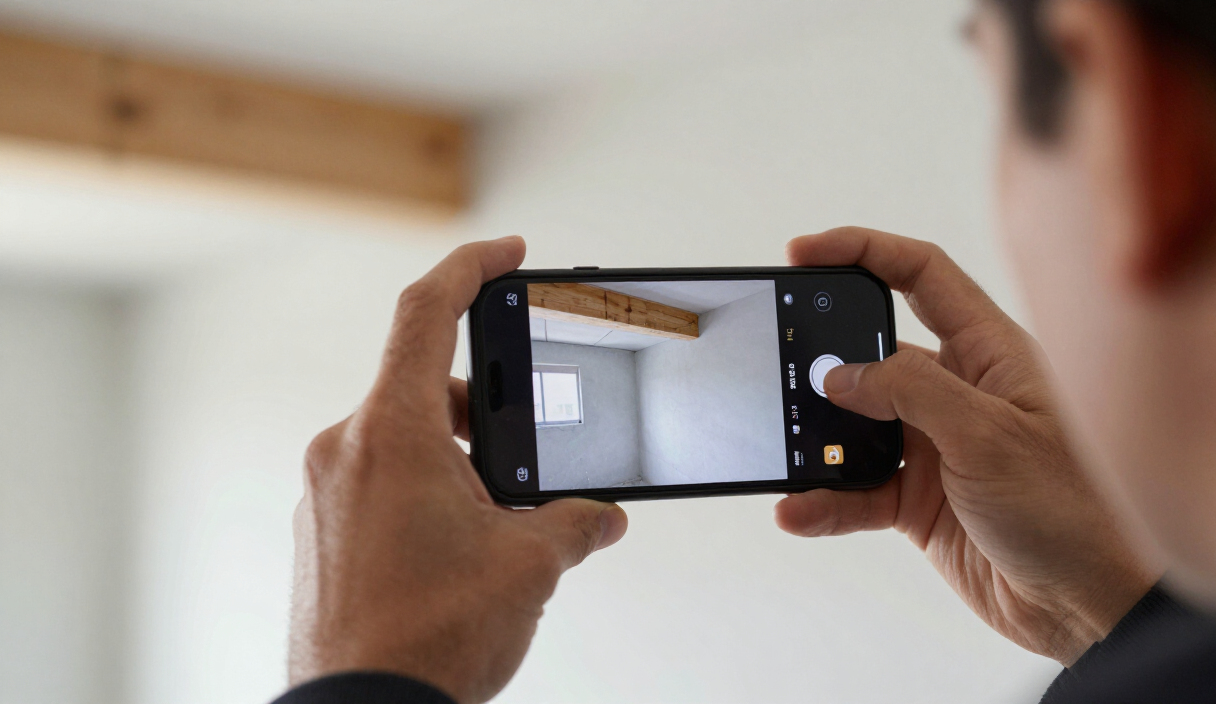
A site manager rarely loses information in one dramatic failure. It disappears through a hundred ordinary moments: the defect photographed but buried somewhere on a phone, the verbal instruction accepted by everyone within earshot but never written down, the daywork report reconstructed three weeks later from memory, messages and a few unexplained pictures.

Get tools and workshop supplies delivered free — and shop member deals
- Fast, free delivery on millions of items
- Access to Prime Big Deal Days deals on October 6–7
- Prime Video, Amazon Music and more included
Gewerkton Field · The job-site record
The evidence disappears in ordinary moments.
A photo without context, an unwritten instruction and a report reconstructed three weeks later can leave the work visible—but responsibility, timing and proof uncertain.
“On site, what counts is what’s proven.”
Field starts with speech while the work, the people and the instruction are still present.
01The context gap
What a late record can lose
The raw observation may survive while the connections around it do not.
02Speakable daywork report
Record before reconstruction begins
The site manager dictates on site. Field turns the account into structured evidence and keeps acknowledgement with handover.
03The record’s required structure
A picture becomes useful when the project knows what it means
For defects and daywork, evidence remains attached to the ordinary details that later determine action.
04Evidence under site pressure
Different projects, the same need for continuity
05One brand, three lines
From field capture to coordination
By then, the real question is no longer whether the work happened. It is whether the record still shows what happened, which trade was involved, who was responsible and when the matter was meant to be resolved. As the Gewerkton line puts it: “On site, what counts is what’s proven.”
That is the problem behind Gewerkton Field, a voice-first construction-site app built around turning dictation into evidence. Its scope includes defects, daywork reports, takt and a portal, but the daywork report is the most revealing place to start. It takes a familiar site task—explaining work while the details are still in front of you—and treats speech as the beginning of a structured record rather than an informal note to be sorted out later.
construction site digital photo documentation
As an affiliate, we earn on qualifying purchases.
As an affiliate, we earn on qualifying purchases.
The gap between seeing and recording
Site managers spend much of the day moving between trades, areas, plans, deadlines and decisions. The information that matters is often clearest at exactly the moment when typing a polished report is least practical. You can see the work, identify the trade and speak to the responsible person, but that does not mean the complete record will survive the journey back to a desk.
A photograph helps, but a photograph alone does not necessarily carry the surrounding facts. It may show an opening, a damaged surface or unfinished work without preserving the instruction that followed. A verbal agreement can be perfectly clear among the people standing together and still become uncertain once crews rotate or the project moves on. A late report may be neat, yet depend on memory rather than a contemporaneous account.
This is what really gets lost on a job site: not always the raw observation, but its context. The missing connection between an image and a trade. The deadline that was spoken but not attached to the issue. The responsible person who was obvious on Tuesday and difficult to establish three weeks later. The report that says what somebody remembers, without preserving the original evidence behind the instruction.
A voice-first workflow starts from the practical reality that speaking is often the quickest way to capture those connections. The site manager can dictate while still on site, where the work and the people involved are present. Gewerkton Field turns that dictation into structured evidence, including trade, deadline and responsible person. At handover, the report can be signed on the device.
The speakable daywork report
Daywork reports are especially vulnerable to delay because they sit at the junction of physical work and commercial record-keeping. The relevant activity may be visible today, while the formal account is left for later. Once that gap opens, reconstruction begins: which work was carried out, which instruction led to it, and which details belonged to this report rather than another day?
The speakable daywork report changes the point at which the record takes shape. Instead of treating the site visit as raw material for future administration, the site manager dictates the account on site. The report is structured around the information that will matter later: the trade, the deadline and the responsible person. The signature is collected on the device at handover.
None of those elements is exotic. That is precisely why they matter. Construction records tend to fail through missing ordinary details, not a lack of elaborate technology. A report needs to remain connected to the work it describes and the people expected to act. Capturing that structure while the situation is current reduces the dependence on later recollection.
Voice also suits the way site information naturally arrives. A manager does not encounter a project as a tidy sequence of form fields. The day comes as observations, instructions, interruptions and decisions. Dictation lets the account begin in that same mode, while Field converts it into evidence that can be organised and handed over.
The signature on the available device matters because handover is another point where a record can become detached from the event. If signing is postponed to a separate administrative stage, the report and the acknowledgement may travel on different timelines. Signing on the device keeps that step with the handover itself.
A photograph needs a place in the record
Defect photography is now routine, but the existence of a picture is not the same as the existence of a usable defect record. The camera roll can become an unlabelled archive of walls, services, openings and close-ups. Even when the photographer remembers each image, that memory is not a durable project system.
For housing and building construction, Field connects defects with a photo and a deadline. The important change is the combination. The image shows the physical condition; the structured information explains what the project needs from it. Dictation supplies context without requiring the manager to stop and compose a long written entry on a small screen.
This is the broader purpose of Gewerkton’s voice-first platform: construction documentation and defect management for global markets. It was born in the German market and has its deepest German commercial integration through GAEB, REB, XRechnung and DATEV. The working premise, however, is not limited to one national market. Projects still need evidence that remains connected to trades, deadlines, responsible people and original instructions.
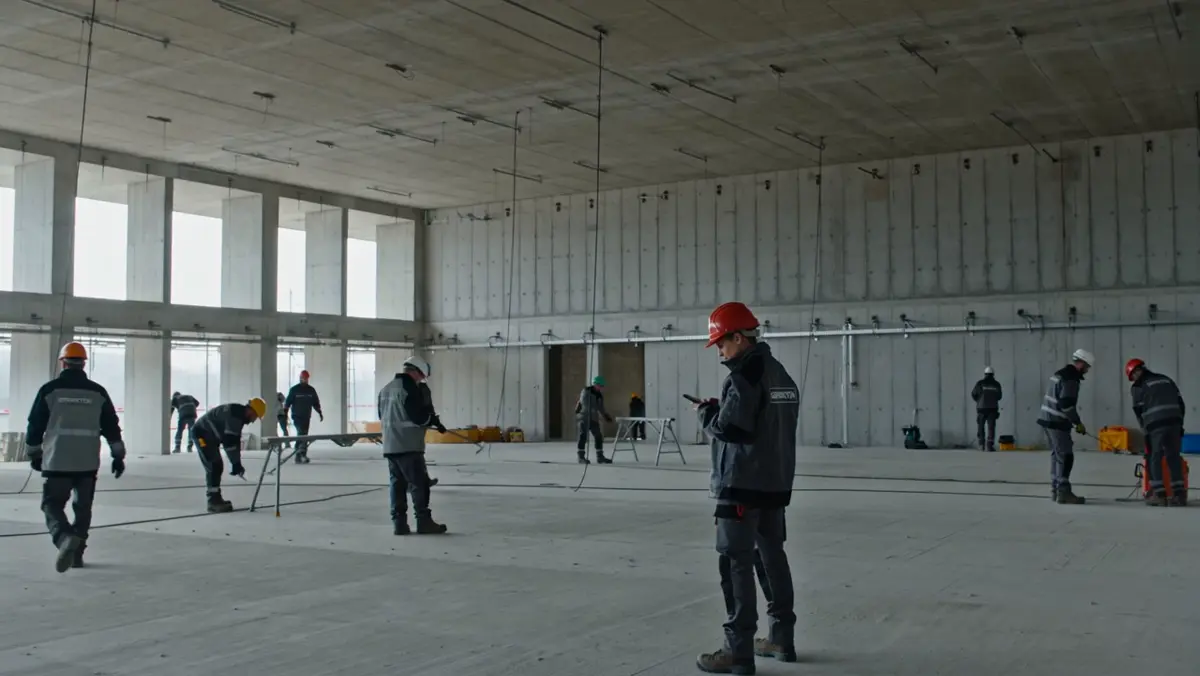
When the crew changes but the evidence must not
The record becomes even more important on distributed or long-running work. Wind farms and renewable-energy projects can involve distributed sites, rotating crews, field acceptance and dead zones. Field supports offline capture in those dead zones, allowing the evidence to begin where the work takes place rather than waiting for reliable connectivity.
Infrastructure and tunnel projects bring a different pressure: long durations and many change orders. Instructions can be backed by the original audio. That preserves a direct connection to what was said, rather than leaving every later reader dependent on a rewritten summary alone.
Data centres and industrial plants may have many trades operating in parallel under tight deadlines. Meeting decisions can become trade-sorted task lists. Again, the value lies in keeping decisions attached to the parties expected to carry them out. When several trades are active at once, a general note is less useful than a record organised around responsibility.
The same principle applies across languages. Gewerkton supports 27 content languages. EU, US and APAC teams can work on the same project in their own languages while the evidence original stays unambiguous. On projects in Asia, Chinese, Korean and Vietnamese crews can work through a multilingual path from capture to report, with data residency chosen for the project.
That multilingual capability does not remove the need for disciplined site management. It gives that discipline a common structure. The observation still needs to be captured. The responsible trade still needs to be identified. The deadline still needs to be recorded. The difference is that cross-border teams do not have to abandon their own working language to participate in the same evidence process.
Field is part of a three-part system
Gewerkton is one brand with three product lines: Field, Studio and Cloud. Field carries the site-manager story because it is the construction-site app for dictation to evidence, defects, daywork reports, takt and portal work.
Gewerkton Studio is the browser workspace for plans and models. Where no model exists, the site team can create one in the browser. That distinction is useful on real projects, where a model cannot simply be assumed to exist before site work needs to be documented.
Gewerkton Cloud handles operations and model or data coordination between Field, Studio and third parties. Together, the three lines connect field capture, browser-based plan and model work, and the coordination layer between them.
Data residency is a choice: EU cloud or the project’s own infrastructure. The platform also follows a bring-your-own-AI approach. It supports 13 AI providers, allows users to bring their own keys and offers regional selection across EU, US and Asian providers, including mainland China. The stated aim is to avoid vendor lock-in while giving projects a choice of provider region.
Beta means beta
Gewerkton is in beta now. A public beta is planned for fall 2026. Anyone assessing it should treat that status plainly, particularly if the intended workflow touches daywork reports, site evidence or coordination across active trades.
The product is being built by a solo founder directing a fleet of coding agents using Codex and Claude. In one night, that fleet shipped 21 software packages, verified with negative controls and mutation tests. That is part of how the software is being developed, but it does not change the present product status: this is beta software, not a finished public release.

The surrounding marketing site reflects a similarly technical approach. It is available in 27 languages, uses zero trackers, has no cookie banner and is built with a fully egress-free architecture. A media bank contains more than 51 self-produced clips and posters. These details describe the project’s current presentation and infrastructure; they are not substitutes for evaluating the beta against the demands of a specific construction workflow.
The small-build version of the same problem
A tinyhouse43-style self-builder works at a different scale from a wind farm, tunnel or data centre, but scale does not eliminate the information problem. A small build still produces photographs, verbal decisions, changes, deadlines and work that may need to be explained later. The same person may even be client, coordinator and hands-on builder, making it easier to assume that everything important will simply be remembered.
It will not always be remembered. A self-builder can take a useful photograph and still lose it among hundreds of others. An instruction to a trade can feel settled without being documented. Extra work can be accepted in the moment and become difficult to reconstruct once materials have covered the evidence.
The relevant lesson is not that a compact build needs enterprise-scale administration. It is that the underlying discipline scales down remarkably well: capture the issue when you see it, connect it to the responsible person or trade, attach the deadline, preserve the evidence and complete the handover while everyone still shares the same understanding.
For a self-builder, voice-first capture may be particularly natural. Hands are occupied, the work is immediate, and returning to a computer may happen only after the day’s physical tasks are finished. A dictated record made beside the work has a better starting point than a polished account attempted much later.
What the site manager is really protecting
Good site documentation is not about producing more text. It is about protecting the relationship between an event and its evidence. The defect and its photograph. The instruction and its original audio. The daywork and its report. The handover and its signature. The task and the trade responsible for it.
Field’s central proposition is that these relationships can be captured by speaking at the point of work and converted into structured evidence. That approach fits the reality of the site manager’s day because it begins with observation and speech, not with the expectation that every important moment will wait for desk time.
The honest test will come during beta: whether the workflow serves the project, its crews, its languages, its infrastructure and its evidence requirements. The public beta planned for fall 2026 will widen that test. Until then, the compelling part of the idea remains simple. A record is strongest before memory begins filling in the gaps.
The photograph you cannot find is barely better than the photograph you never took. The instruction nobody recorded becomes a dispute of recollections. The daywork report rebuilt weeks later may be complete in appearance but weak at its foundation. Capturing the evidence on site—spoken, structured and signed at handover—is an attempt to close those gaps while the facts are still within reach.
Fall yard work Picks
leaf blowers
As an affiliate, we earn on qualifying purchases.