
When choosing a guide rail, its length crucially impacts your cut accuracy and safety. Longer rails support larger projects and provide better stability, but they require proper clamping to prevent sagging or slipping. Shorter rails are easier to clamp tightly but limit your working area. The right length depends on your project size. Proper clamping techniques combined with the correct rail length ensure precise, professional results—learn more to master these essential details.
Key Takeaways
- Longer guide rails provide greater support for accurate, straight cuts on large or complex projects.
- Proper clamping along the entire length of the rail prevents slipping and maintains alignment during cutting.
- Shorter rails are easier to clamp tightly but limit working area and project size.
- Material type (aluminum, steel, composite) influences clamping technique and rail durability.
- Proper rail length and clamping strategy are more critical for precision and safety than the power of the saw.

Have you ever wondered how guardrails keep you safe on the road or around dangerous areas? The same principle applies to guide rails used in woodworking, especially on track saws. The length of the guide rail isn’t just a matter of convenience; it directly influences the accuracy and safety of your cuts. When choosing a guide rail, understanding how clamping techniques and material compatibility come into play can make all the difference. Proper clamping ensures the rail stays securely in place, preventing slips that could lead to uneven cuts or injuries. Using the right clamping techniques, such as applying even pressure along the entire length of the rail, helps maintain stability and precision. It’s vital to avoid over-tightening, which can deform softer materials or damage the rail, and under-tightening, which risks slipping during cuts. Consistent clamping along the rail’s length guarantees it won’t shift, especially when making long or intricate cuts. Additionally, considering the refresh rate of your guide rail setup can help improve cutting consistency by reducing vibrations and wobble during operation.
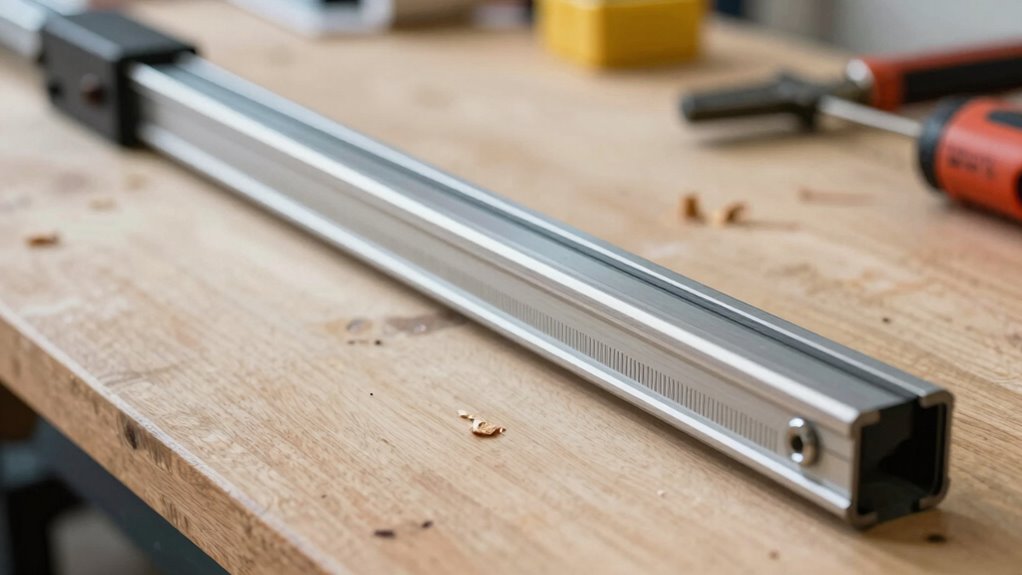
Material compatibility is equally important. Guide rails are often made from aluminum, steel, or composite materials, each with unique properties. Aluminum rails are lightweight and easy to handle but may be more susceptible to dents or deformation if paired with incompatible clamps or if over-tightened. Steel rails are more durable but heavier, requiring clamps that can exert enough force without damaging the material. Composite rails combine lightweight features with strength but may have specific clamping requirements to prevent warping. Ensuring that your clamps and fixtures are compatible with the guide rail material helps maintain its integrity, prolongs its lifespan, and preserves cutting accuracy. The length of the guide rail also influences how you approach clamping and material choice. Longer rails provide more support for larger projects but can be more challenging to clamp securely over their entire length. You’ll need to strategically place clamps at multiple points to prevent any sagging or shifting. Shorter rails, on the other hand, are easier to clamp tightly but limit your working area. In either case, selecting a guide rail with an appropriate length for your project and ensuring proper clamping techniques and material compatibility are essential for achieving professional results.
As an affiliate, we earn on qualifying purchases.
Frequently Asked Questions
How Do I Choose the Right Track Saw Rail Length for My Projects?
To select the appropriate track saw rail length, consider your typical project sizes and cutting needs. Use measuring techniques like measuring your longest cuts to guarantee the rail length is sufficient. Opt for a rail made from durable material, like aluminum, for stability and longevity. A longer rail provides more flexibility for larger projects, but confirm it’s manageable for your workspace. Balancing length and portability helps you work efficiently.
Can Longer Guide Rails Be Stored and Transported Easily?
Longer guide rails can be a challenge to store and transport, but with the right storage solutions, you’re not out of luck. You might need to think outside the box or consider carrying cases and wall-mounted racks to ease transportation challenges. While they may be bulky, proper organization makes it manageable. Don’t let size be a barrier—smart storage keeps your workflow smooth and your gear ready for any job.
Are There Compatibility Issues Between Different Brands of Guide Rails?
You might face compatibility issues between different brands of guide rails because they often have varying standards for brand compatibility and joint connectors. To guarantee a seamless fit, check if the rails you’re considering use compatible joint connectors or are designed for cross-brand use. Using adapters or specific connectors can help, but it’s best to stick with the same brand for maximum safety and performance.
How Does Rail Length Affect Cut Accuracy and Stability?
Think of your guide rail as a steadfast bridge across your workpiece. A longer rail provides better stability, helping you achieve precision alignment with less wobble. It also enhances cut accuracy and material durability by reducing flex and maintaining straight, clean cuts. Shorter rails, on the other hand, may cause inaccuracies and instability, especially on larger projects. So, choosing the right length directly impacts your cutting precision and the longevity of your tools.
What Maintenance Is Required to Keep Guide Rails in Optimal Condition?
To keep your guide rails in top condition, follow a regular lubrication schedule to prevent friction and corrosion. Inspect the rails for wear and damage frequently, especially after heavy use or cutting tough materials. Clean the rails to remove dust and debris, ensuring smooth operation. Proper maintenance extends the lifespan of your guide rails, maintains cut accuracy, and enhances safety, so stay diligent with lubrication and wear inspections.
Conclusion
So, next time you’re tempted to obsess over powerful motors, remember—it’s the length of your guide rail that truly keeps things on track. Ironically, a longer rail might just be your best friend, guiding you smoothly through every cut. After all, in the world of track saws, size really does matter—more than raw power. Keep your eye on the length, and you’ll find your projects stay straight and true, every single time.