TL;DR

Get business pricing on tools and workshop supplies
- Business-only prices and quantity discounts
- Tax-exempt purchasing
- Multiple users, one account, clear invoices
Hunker reports that architect and designer Ben Uyeda demonstrated carving smooth river rocks into bowls with an angle grinder and a diamond tile blade. The project can produce decorative vessels, but the report cautions against using untreated, untested porous stone for food because sanitation and contamination risks remain.
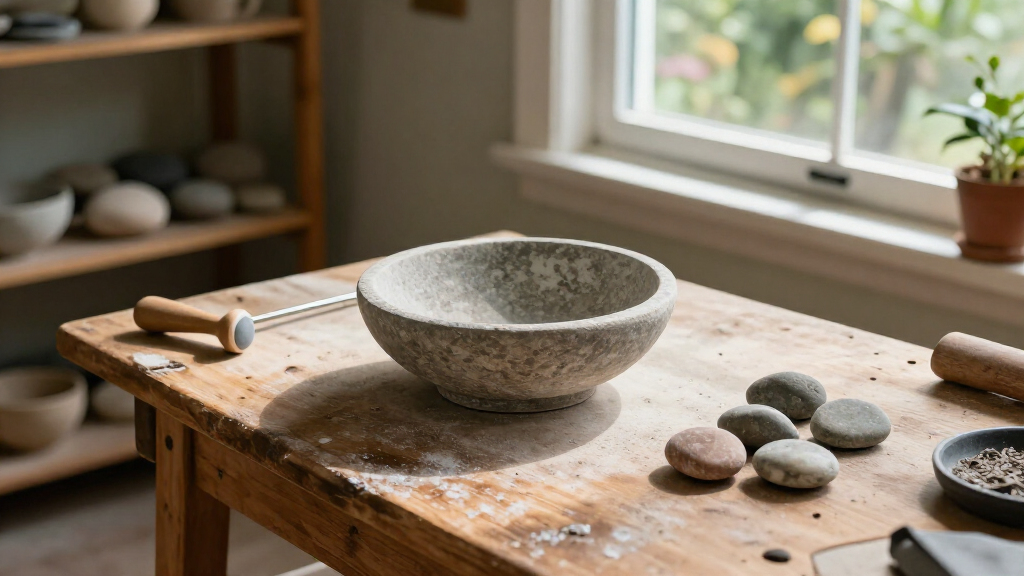
Architect and designer Ben Uyeda demonstrated carving river rocks into bowls in a TikTok video, using an angle grinder fitted with a diamond tile-cutting blade. A Hunker report describes the technique and the bowls’ decorative appeal, but warns that food use raises unresolved safety questions because porous river stone can be difficult to clean and may need laboratory testing and a food-safe finish.
In the video, Uyeda places a smooth rock in a sandbox that holds it steady while he works. He first recommends flattening the base so the finished bowl can sit securely. For a small bowl, he cuts a radial pattern into the stone, then uses a hammer and chisel to remove material and form a rough hollow. He smooths the depression with the grinder. For a larger, oblong bowl, the report says he cuts a grid to outline the area to be hollowed.
The project calls for more than an ordinary cutting disc: Uyeda’s setup uses a diamond tile blade, and the report mentions a diamond ball grinder with an extension shaft as another possible carving tool. The final shape and finish will depend on the rock and the maker’s work; the source does not give a tested time estimate, a complete tool list or a guarantee that a particular stone is suitable.
Hunker says Uyeda described the bowls as being made for a restaurant at a hotel he is building. That is the report’s account of the video’s stated purpose, not confirmation that the bowls have been installed or approved for serving food. The article also points out that similar stone objects can be made for non-food uses, including key holders, soap dishes, candle holders and decorative vessels.
Food Safety Is the Key Constraint
The technique makes an ordinary-looking stone into a handmade object, but appearance does not establish food safety. River rocks are porous, and the report says their shape and texture can make them hard to sanitize or decontaminate. A bowl intended for serving food would need more scrutiny than one used to hold keys or other household items.
Uyeda, according to Hunker, mentioned sending rock samples for laboratory testing and applying a food-safe finish. The report does not identify a testing standard, a specific stone type that has passed testing, or a coating that is suitable for every rock and food. It also notes that suitable sealants can be costly: it cites a pint of MORE Stone Sealer listed at Walmart for $55.63. That price is an example in the report, not a general market price or a recommendation.
For readers, the practical distinction is straightforward: the bowl-making method may work as a craft project, while using the result to serve food involves separate material and sanitation questions. A decorative or storage bowl avoids some of those food-contact concerns.
diamond tile cutting blade for angle grinder
As an affiliate, we earn on qualifying purchases.
As an affiliate, we earn on qualifying purchases.
From TikTok Demonstration to DIY
Hunker’s report centers on a TikTok video titled “I [am] carving rocks into bowls using my @RYOBI Tools USA angle grinder.” The footage, as described in the article, shows Uyeda making the bowls with rocks and power tools. The report presents the project as a way to create a high-end-looking object at relatively low material cost, while noting that the cost of testing, tools and a food-safe sealant could change the calculation.
The article contrasts the range of prices it gives for stone bowls—$8.99 to $2,800—with the DIY approach. Those figures are the report’s examples and are not a verified market survey. It also mentions artisans making other stone objects, including sinks, plates, mugs, vases and sculptures. That broader list shows possible forms for stonework, but it does not establish that Uyeda made those items or that his bowl process is suitable for each one.
“I [am] carving rocks into bowls using my @RYOBI Tools USA angle grinder.”
— Ben Uyeda, in the TikTok video title cited by Hunker
Stone Suitability Remains Unverified
The source does not report laboratory results for Uyeda’s rocks, identify their mineral composition, or name the food-safe finish used on the completed bowls. It therefore does not establish that the demonstrated pieces are safe for serving food. The article says sample testing and an appropriate sealant are needed, but gives no specific testing protocol or confirmation that sealing alone would address every possible contaminant.
It is also unclear whether the hotel restaurant has used or plans to use the bowls for food service. The video’s stated project connection does not confirm approval by the restaurant, a health authority or a materials-testing laboratory. Readers should treat the technique as a craft demonstration, not food-safety certification.
Test Before Any Food Use
Anyone considering the project should first decide whether the finished piece will be decorative or used with food. For a food-contact bowl, the steps described by Hunker point to testing the stone and selecting a food-safe finish before use; the report does not provide a universal product or procedure that can substitute for those checks. If those requirements are impractical, the bowl can serve as a holder for keys or other non-food items.
The source does not announce a follow-up test, product launch or restaurant opening date. Further confirmation would be needed before claiming that the bowls are approved for dining use or that the method is safe for a particular river rock.
Key Questions
What tools does the demonstrated method use?
Hunker says Ben Uyeda used an angle grinder with a diamond tile-cutting blade, along with a hammer and chisel to rough out the hollow. It also mentions a diamond ball grinder with an extension shaft as another possible carving tool.
How does the rock stay in place?
The report describes Uyeda using a sandbox to hold the smooth stone while cutting. He also recommends flattening the base so the finished bowl can sit steadily.
Can a homemade river-rock bowl be used for food?
The report does not establish that the demonstrated bowls are safe for food. It says porous stone can be difficult to sanitize and points to laboratory testing and a food-safe finish as relevant precautions.
What can the bowl hold if it is not for food?
Hunker suggests using a stone bowl for non-food purposes such as holding keys or other household items. It also lists soap dishes, candle holders and decorative vessels as possible stone objects.
Source: rss
Evergreen bestsellers Picks
bestsellers
As an affiliate, we earn on qualifying purchases.