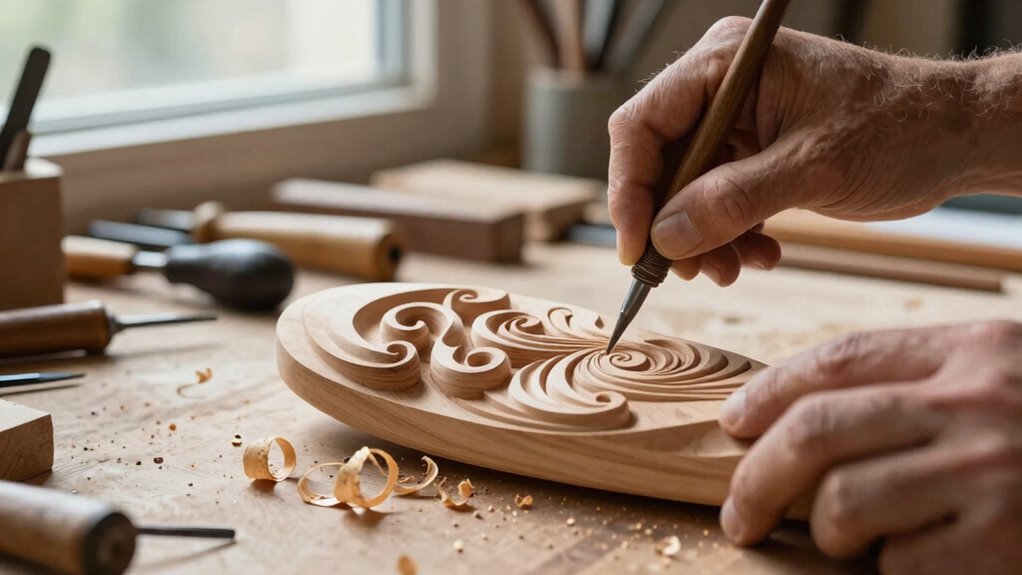

Mastering how to read and follow the wood grain is the key carving skill that makes all your other techniques easier. By understanding fiber direction, you can plan cuts that are cleaner and require less force, reducing splintering and damage. It helps you control your tools better and adapt your approach to different woods. When you get this right, your carvings become smoother and more precise. Keep going, and you’ll discover even more tips to improve your craftsmanship.

Get business pricing on tools and workshop supplies
- Business-only prices and quantity discounts
- Tax-exempt purchasing
- Multiple users, one account, clear invoices
Key Takeaways
- Understanding and reading wood grain guides precise cuts and reduces splintering across all carving techniques.
- Mastering proper tool grip and angles enhances control and effectiveness in every carving task.
- Recognizing fiber direction allows for adjustments that simplify complex or detailed carving projects.
- Developing intuition for grain and tool interaction improves overall craftsmanship and error reduction.
- Building foundational skills like grain awareness makes advanced techniques easier to learn and execute.
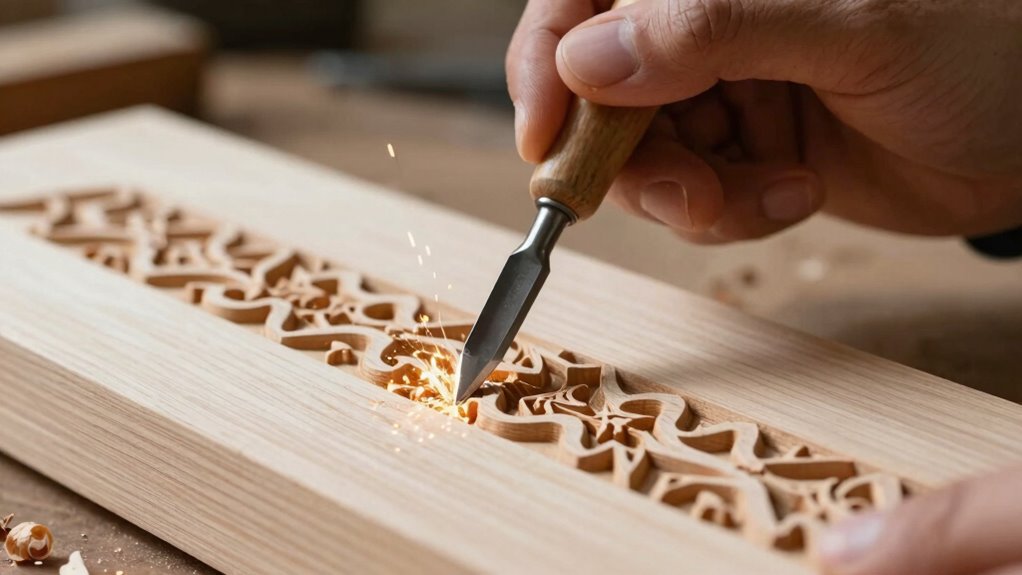
Mastering a core carving skill can substantially simplify other carving tasks, making your work more efficient and enjoyable. One of the most fundamental skills you should focus on is understanding how to read and work with the wood grain. The wood grain determines how the fibers run through the timber, and knowing its direction is essential for achieving clean cuts and avoiding splintering. When you learn to identify the grain, you can plan your cuts to follow its natural flow, reducing the force needed and minimizing the risk of damaging your work. This understanding transforms your approach from guesswork to precision, allowing you to carve with confidence and control.
Equally important is mastering the use of carving tools. These tools are your primary means of shaping and detailing the wood, so becoming proficient with them is necessary. You should learn how to hold each tool correctly, applying the right amount of pressure and maintaining sharp edges. Proper technique not only improves your control but also extends the life of your tools. When you understand the specific purpose of each carving tool—whether it’s a gouge, chisel, or V-tool—you can select the right one for the task at hand, making your carving more precise and less frustrating. Experiment with different grips and angles to find what works best for you, and always keep your tools sharp for maximum performance.
By integrating an awareness of the wood grain with skillful tool handling, you develop a more intuitive approach to carving. For example, when you encounter difficult areas, you’ll instinctively adjust your tool angle or grain direction to ease the process. As you become more comfortable with these fundamentals, you’ll notice a significant reduction in errors and rework, saving you time and effort. Developing a proper understanding of wood grain is essential for achieving cleaner cuts and smoother finishes, and it enhances your overall craftsmanship. This core carving skill also lays a solid foundation for learning more complex techniques, such as fine detailing or relief carving, because you establish good habits early on. Additionally, understanding how different woods behave and the variety of wood types can help you select materials that better suit your projects, making your work more predictable and manageable. Recognizing the characteristics of different wood types can further improve your results and prevent common pitfalls.
Ultimately, focusing on your understanding of wood grain and carving tools makes every other aspect of carving easier. It enhances your control, improves your results, and boosts your confidence. As you refine this core skill, you’ll find yourself more capable of tackling intricate designs and doing cleaner, more professional-looking work. It’s a fundamental that, once mastered, becomes the backbone of all your carving projects, empowering you to work more efficiently and enjoy the craft even more.
Products Worth Considering

Philips Hue Play Gradient Light Tube, Large, Black

Samsung 48-Inch S90F OLED 4K Smart TV (2025)

Levoit Core 600S-P Smart Air Purifier for Large Rooms
As an affiliate, we earn on qualifying purchases.
Frequently Asked Questions
What Is the Foundational Skill That Enhances All Carving Techniques?
The foundational skill that enhances all carving techniques is developing a strong carving philosophy focused on precision and control. When you prioritize technique refinement, you become more aware of your angles, pressure, and movements, which improves your overall skill. This mindset helps you adapt to different materials and styles, making every other carving skill easier. By practicing consistently and understanding your craft deeply, you’ll see continuous improvement and greater confidence in your work.
How Long Does It Typically Take to Master This Core Carving Skill?
Mastering this core carving skill typically takes several months of consistent practice, but it varies based on your dedication. As you develop this foundational skill, you’ll find it easier to progress to advanced techniques. With focused effort, you’ll notice steady skill progression, and over time, carving becomes more intuitive. Patience and regular practice are key to revealing your full potential and mastering the art of carving efficiently.
Can Beginners Easily Learn This Essential Carving Skill?
Yes, beginners can easily learn this essential carving skill, like planting a seed that blossoms into advanced techniques and artistic expression. With patience and practice, this foundational skill acts as a guiding light, illuminating your path to mastering more complex carvings. It’s designed to be approachable, allowing you to gradually build confidence and creativity. Before long, you’ll be weaving intricate designs and expressing your unique artistic voice through your carvings.
What Tools Are Best Suited to Develop This Key Carving Ability?
You should use sharp, well-maintained tools with ergonomic designs to develop this key carving ability. Quality chisels and carving knives with comfortable handles reduce fatigue and improve control, making your work more precise. Regular tool maintenance guarantees sharp blades, which make carving easier and safer. Invest in tools designed for comfort and efficiency, and keep them properly maintained to enhance your skill development and achieve better results in every project.
Are There Specific Safety Precautions Associated With Practicing This Skill?
Yes, there are safety precautions you should follow. Always wear protective gear like gloves and eye protection to prevent injuries. Make sure you work in a safe workspace that’s well-lit, clean, and free of distractions or hazards. Keep tools sharp and in good condition, and focus on your technique. By staying alert and maintaining a safe environment, you minimize risks and make your carving practice safer and more enjoyable.
Conclusion
So, here’s the irony: mastering this one carving skill might make you think you’re all set, but in reality, it’s just the beginning. Every new project will test your patience and skill even more. But don’t worry—you’ll find that the more you learn, the more you realize how much there is still to discover. Ironically, the very skill that makes everything easier also opens the door to endless, exciting challenges.