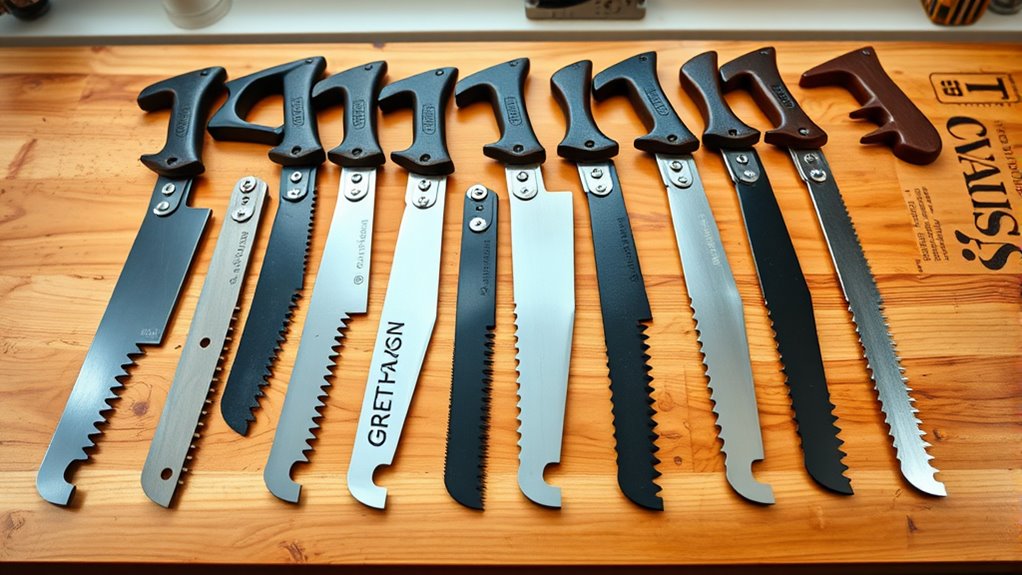

For a versatile general-purpose hand saw, I’d start with the Jorgensen 15-Inch Hand Saw: its coarse 8 TPI blade suits quick cuts in thicker wood. The HAUTMEC 14-Inch and QYQRQF 14-Inch Pro offer finer 11 TPI teeth for more controlled cuts, while the RUITOOL Ryoba stands apart with a double-edged Japanese pull-saw design. The right choice depends on what you cut most: fixed-blade saws favor reach and steady strokes, folding pruning saws pack away for outdoor work, and a hacksaw or multi-blade kit covers more specialized tasks. Those extra capabilities can mean a narrower purpose or more parts to manage. Read on for my full comparison and picks by job.

Get business pricing on tools and workshop supplies
- Business-only prices and quantity discounts
- Tax-exempt purchasing
- Multiple users, one account, clear invoices
Complete the kit


Key Takeaways
- Jorgensen’s 8 TPI blade favors faster, rougher cuts in thicker wood; the 11 TPI HAUTMEC and QYQRQF are better suited to slower, more controlled work.
- The RUITOOL Ryoba is the lineup’s distinct woodworking option: its double edge supports two cutting tasks in one saw, but its pull-stroke style may feel unfamiliar to users of Western push saws.
- Folding pruning saws solve a different problem from fixed hand saws. Fiskars, REXBETI, VRYTOR, and the 11-inch camping saw trade a long rigid blade for portability and branch-focused cutting.
- The TOOLAN multi-blade saw and CRAFTSMAN hacksaw serve specialized needs. The TOOLAN offers blade variety in one tool, while the hacksaw is the dedicated choice here for cutting metal.
- To choose between the fine-tooth 14-inch saws, compare the handle and stated construction details. Their shared tooth count makes intended cut feel similar on paper, so fit and build information may matter more than the name.
| Jorgensen 15-Inch Hand Saw with 8 TPI Coarse Blade |  | Best for Fast Rough Cuts | Blade length: 15 inches | Teeth per inch: 8 TPI | Blade material: SK5 high-carbon steel | VIEW ON AMAZON | See Our Full Breakdown |
| HAUTMEC 14-Inch Hand Saw with 11 TPI Triple-Ground Teeth |  | Best All-Purpose Panel Saw | Blade length: 14 inches | Blade thickness: 1.0 mm | Tooth count: 11 TPI | VIEW ON AMAZON | See Our Full Breakdown |
| RUITOOL Japanese Hand Saw 6 Inch Double Edge Ryoba Pull Saw |  | Best for Precise Finish Cuts | Blade length: 6 inches | Teeth per inch: 17 TPI hardwood / 14 TPI softwood | Blade material: SK5 high-carbon steel | VIEW ON AMAZON | See Our Full Breakdown |
| Folding Camping Saw 11″ – Heavy-Duty Pruning Saw with Triple-Cut SK5 Blade, 7 TPI Razor Teeth |  | Best Folding Saw for Branches | Blade length: 11 inches | Tooth count: 7 TPI | Blade shape: Curved | VIEW ON AMAZON | See Our Full Breakdown |
| TOOLAN 8-in-1 Multi-Blade Hand Saw |  | Best Multi-Material Kit | Model: SW2204N | Included components: 1 handle and 8 blades | Blade length: 6 inches | VIEW ON AMAZON | See Our Full Breakdown |
| CRAFTSMAN 12-Inch Hacksaw (CMHT20138) |  | Best for Metal Cutting | Brand: CRAFTSMAN | Model: CMHT20138 | Blade length: 12 inches | VIEW ON AMAZON | See Our Full Breakdown |
| VRYTOR 7-Inch Folding Pruning Saw with Safety Lock |  | Best Compact Pruning Saw | Brand: VRYTOR | Blade length: 7 inches | Blade material: 65Mn steel | VIEW ON AMAZON | See Our Full Breakdown |
| Fiskars 10″ Folding Pruning Saw with Dual Position Locking Blade |  | Best for Larger Pruning Cuts | Blade length: 10 inches | Blade type: Power Tooth | Blade material: Steel | VIEW ON AMAZON | See Our Full Breakdown |
| 14-inch Hand Saw with Fine-Cut Teeth and Soft-Grip Handle |  | Best for Fine Wood Cuts | Blade length: 14 inches | Teeth per inch: 11 TPI | Blade material: 65Mn steel | VIEW ON AMAZON | See Our Full Breakdown |
| QYQRQF 14-Inch Pro Hand Saw, 11 TPI |  | Best for Mixed DIY Materials | Blade length: 14 inches (350 mm) | Blade thickness: 0.9 mm | Tooth count: 11 TPI | VIEW ON AMAZON | See Our Full Breakdown |
| REXBETI 11-Inch Folding Pruning Saw |  | Best for Portable Outdoor Cutting | Blade length: 11 inches | Blade material: SK-5 alloy steel | Tooth count: 7 TPI, staggered | VIEW ON AMAZON | See Our Full Breakdown |
| hand saw | Blade length | Blade material | Handle material |
|---|---|---|---|
| Jorgensen 15-Inch Hand Saw wit | 15 inches | SK5 high-carbon steel | — |
| HAUTMEC 14-Inch Hand Saw with | 14 inches | 65Mn high-carbon steel | ABS plastic with TPR rubber |
| RUITOOL Japanese Hand Saw 6 In | 6 inches | SK5 high-carbon steel | Beechwood |
| Folding Camping Saw 11" | 11 inches | SK5 high-carbon steel | TPR rubber |
| TOOLAN 8-in-1 Multi-Blade Hand | 6 inches | Alloy steel | Plastic |
| CRAFTSMAN 12-Inch Hacksaw | 12 inches | — | Plastic |
| VRYTOR 7-Inch Folding Pruning | 7 inches | 65Mn steel | Rubber |
| Fiskars 10" Folding Pruning Sa | 10 inches | Steel | — |
| 14-inch Hand Saw with Fine-Cut | 14 inches | 65Mn steel | — |
| QYQRQF 14-Inch Pro Hand Saw | 14 inches (350 mm) | Heat-treated alloy steel | Thermoplastic rubber (TPR) |
| REXBETI 11-Inch Folding Prunin | 11 inches | SK-5 alloy steel | Rubber-coated polymer |
More Details on Our Top Picks
Jorgensen 15-Inch Hand Saw with 8 TPI Coarse Blade
The Jorgensen suits buyers who want to remove material quickly, with an 8 TPI coarse blade that favors speed over a fine finish. Its 15-inch SK5 steel blade is longer than the RUITOOL’s compact 6-inch pull saw, making it better suited to general rough cuts through larger pieces. A Teflon coating helps the blade move with less friction and resist moisture, while the aluminum handle adds built-in 45° and 90° guides for marking. The tradeoff is the same aggressive tooth spacing that helps it cut quickly: this is a poor choice for delicate finish work. The included plastic edge protector may also be less reassuring for heavy transport than a sturdy storage case.
Pros:- Aggressive 8 TPI teeth are suited to fast material removal
- Teflon-coated SK5 blade helps reduce friction and resist rust
- Aluminum handle has built-in 45° and 90° marking guides
- 15-inch blade reaches across larger workpieces more readily than the RUITOOL 6-inch saw
Cons:- Coarse teeth are not suited to fine finishing cuts
- Plastic edge protector may provide limited protection during heavy transport
Best for: Woodworkers and homeowners who need a fast, general-purpose saw for rough cuts in lumber, PVC, or pruning tasks.
Not ideal for: Users making fine furniture cuts or regularly carrying tools in demanding conditions; the coarse teeth leave a rougher cut, and the edge protector may not stand up to heavy transport.
- Blade length:15 inches
- Teeth per inch:8 TPI
- Blade material:SK5 high-carbon steel
- Blade coating:Teflon
- Handle:Aluminum with TPE/ABS grip
- Weight:0.61 kg
- Color:Black
Our verdict“Choose the Jorgensen for quick rough cuts and handy angle guides, but pick a finer-toothed saw for clean finish work.”
HAUTMEC 14-Inch Hand Saw with 11 TPI Triple-Ground Teeth
With 11 TPI triple-ground teeth and a 14-inch blade, the HAUTMEC occupies a middle ground between the Jorgensen’s faster, coarser 8 TPI cut and the RUITOOL’s compact pull-saw precision. That balance makes it a practical choice for household jobs involving wood, laminate, panels, PVC, or branches. The 1.0 mm thick blade is designed to resist bending, which can help keep a cut on course, and the ABS/TPR handle gives the grip a soft, non-slip surface. A blade cover is included for storage. The supplied product information does not identify specific drawbacks, but its conventional 90-degree cutting setup and longer fixed blade are less specialized than a folding pruning saw or a double-edge finish saw.
Pros:- 11 TPI triple-ground teeth balance cutting pace with a smoother cut than the Jorgensen’s 8 TPI blade
- 1.0 mm thick blade is designed to resist bending
- Non-slip ABS and TPR handle supports a secure grip
- Blade cover is included for storage
Cons:- Fixed 14-inch blade takes more storage space than the Craft911 folding saw
- Less specialized for precise flush cuts than the RUITOOL double-edge pull saw
Best for: DIYers who want one fixed hand saw for routine cuts across wood panels, laminate, PVC, and occasional branches.
Not ideal for: Campers who need a compact packable saw or finish carpenters seeking a short, highly controlled flush-cut tool.
- Blade length:14 inches
- Blade thickness:1.0 mm
- Tooth count:11 TPI
- Blade material:65Mn high-carbon steel
- Handle material:ABS plastic with TPR rubber
- Weight:13 ounces
- Included component:Blade cover
Our verdict“Pick the HAUTMEC for a versatile fixed saw across common home materials, especially if you want a middle ground between speed and cut control.”
RUITOOL Japanese Hand Saw 6 Inch Double Edge Ryoba Pull Saw
The RUITOOL is the precision specialist in this group: its 6-inch double-edge blade offers 17 TPI for hardwood and 14 TPI for softwood, giving the user two tooth patterns in one compact saw. Its pull-saw action is suited to controlled flush and finish cuts, unlike the Jorgensen’s coarse teeth, which favor faster rough work. Hardened SK5 steel and three-sided ground teeth are designed to keep the cut efficient while clearing chips. The beechwood handle keeps the tool light at 0.11 kg. This compact size also limits reach on larger stock, and users accustomed to push saws may need time to adapt. The thin blade can bend under sideways pressure, so it calls for a lighter touch than a thicker general-purpose saw.
Pros:- Double-edge design provides separate tooth pitches for hardwood and softwood
- Short blade supports precise flush and finish cuts
- Lightweight beechwood handle keeps the tool easy to maneuver
- SK5 steel blade is hardened to HRC 60–63
Cons:- Pull-saw technique may take adjustment for users familiar with push saws
- Thin blade can bend under excessive lateral force
- Six-inch blade is less suited to larger rough cuts than the Jorgensen or HAUTMEC
Best for: Woodworkers and trim users who need controlled flush cuts or finish work in hardwood and softwood.
Not ideal for: Anyone seeking a fast saw for large rough cuts, or users who tend to twist the blade while cutting.
- Blade length:6 inches
- Teeth per inch:17 TPI hardwood / 14 TPI softwood
- Blade material:SK5 high-carbon steel
- Blade hardness:HRC 60–63
- Handle material:Beechwood
- Weight:0.11 kg
- Warranty:Lifetime
Our verdict“Choose the RUITOOL when clean, controlled finish cuts matter more than reach or fast rough cutting.”
Folding Camping Saw 11″ – Heavy-Duty Pruning Saw with Triple-Cut SK5 Blade, 7 TPI Razor Teeth
The Craft911 is the branch-cutting and packability pick. Its curved 11-inch SK5 blade with 7 TPI razor teeth is aimed at quick cuts through green or dry wood, while the folding design keeps the blade tucked away in a backpack or tool bag. That makes it a better fit for camping and garden cleanup than the fixed-blade HAUTMEC, though the HAUTMEC’s 11 TPI teeth offer a finer pattern for panel work. A non-slip TPR handle is intended to reduce hand fatigue during longer pruning sessions. The tradeoff is its narrow focus: a coarse curved pruning blade is not the right pick for precise woodworking. No protective sheath is included, so folded storage still deserves care.
Pros:- Folding design packs more easily than the fixed-blade HAUTMEC
- Curved 11-inch SK5 blade is designed for branch and firewood cutting
- 7 TPI razor teeth favor fast, aggressive cuts
- TPR handle provides a non-slip grip
Cons:- No protective sheath is included
- Coarse curved blade is not suited to precise finish cuts
- Pruning-focused design is less versatile for panel work than the HAUTMEC
Best for: Campers, hikers, and gardeners who regularly cut branches or firewood and want a folding manual saw.
Not ideal for: Woodworkers making straight, fine cuts in panels, or buyers who need a dedicated sheath for storage and transport.
- Blade length:11 inches
- Tooth count:7 TPI
- Blade shape:Curved
- Blade material:SK5 high-carbon steel
- Handle material:TPR rubber
- Power source:Manual
- Dimensions:14.01 × 2.36 × 0.98 inches
Our verdict“Choose the Craft911 for portable branch cutting and firewood, but use a straighter, finer saw for woodworking.”
TOOLAN 8-in-1 Multi-Blade Hand Saw
The TOOLAN takes a different route from the single-purpose saws here: it pairs one compact handle with eight interchangeable blades for drywall, metal, wood, plywood, plastic, and PVC. That range can reduce the need to carry several dedicated tools for repair work. Compared with the HAUTMEC’s fixed 14-inch blade, the TOOLAN is easier to store in a toolbox, but its listed 6-inch blade is much shorter and offers less reach for larger cuts. A locking blade mechanism secures the selected blade in the handle, while the non-slip plastic grip supports control. The tradeoff is setup and blade management: users must change blades to suit the material, and replacement blades may need to be purchased separately.
Pros:- Eight interchangeable blades cover several listed materials
- Locking mechanism secures blades in the handle
- Compact 8.48-ounce set fits readily in a toolbox
- Non-slip handle supports control during manual cutting
Cons:- Six-inch blade is shorter than the HAUTMEC or Jorgensen for larger cuts
- Changing blades adds setup compared with a dedicated hand saw
- Replacement blades may need to be purchased separately
Best for: Home repair users who cut a mix of materials and want a compact handle-and-blade set in their toolbox.
Not ideal for: People who mostly cut lumber or branches and want the reach and simplicity of a dedicated full-length saw.
- Model:SW2204N
- Included components:1 handle and 8 blades
- Blade length:6 inches
- Tooth count:32
- Blade material:Alloy steel
- Handle material:Plastic
- Weight:8.48 ounces
Our verdict“Choose the TOOLAN if material variety and compact storage matter more than the reach and simplicity of a dedicated saw.”
CRAFTSMAN 12-Inch Hacksaw (CMHT20138)
For buyers cutting metal or plastic, the CRAFTSMAN 12-inch hacksaw fills a different role from the wood-focused hand saws in this roundup. Its metal frame is designed for up to 225 pounds of blade tension, while the adjustable 90- and 180-degree blade positions help reach flush cuts where a conventional fixed-frame setup may get in the way. The full-grip handle and large tension knob also make blade setup and control more straightforward. Compared with the QYQRQF 14-inch hand saw, this is the more suitable choice for metalwork, but it is much less versatile for cutting wood, drywall, or general carpentry. Its 4.375-inch cutting depth and material-specific design limit the size and range of jobs it can handle. Choose it for metal cuts and skip it as an all-purpose saw.
Pros:- Metal frame is designed to withstand up to 225 pounds of tension
- Blade adjusts to 90- and 180-degree positions for flush cuts
- Large tension knob supports blade adjustment
- Full-grip handle provides a more secure hold
Cons:- Designed for metal and plastic, limiting its usefulness on wood
- 4.375-inch cutting depth restricts the size of material it can cut
Best for: DIYers and home repairers who regularly cut metal tubing, rods, or plastic and need a hacksaw that can make flush cuts
Not ideal for: Woodworkers seeking a general-purpose saw for boards, plywood, or larger carpentry cuts
- Brand:CRAFTSMAN
- Model:CMHT20138
- Blade length:12 inches
- Cutting depth:4.375 inches
- Frame tension:Up to 225 lbs
- Adjustable blade angles:90 and 180 degrees
- Handle material:Plastic
- Warranty:Lifetime
Our verdict“Choose this hacksaw for controlled metal and plastic cuts, especially flush cuts; choose a wood hand saw for broader workshop jobs.”
VRYTOR 7-Inch Folding Pruning Saw with Safety Lock
The VRYTOR 7-inch folding pruning saw suits gardeners and campers who want a small saw they can carry with the teeth protected. Its blade locks open for cutting and folds away for storage, while the 7 TPI triple-cut teeth are designed to clear chips as they cut branches up to 4 inches thick. The rubber handle adds grip for outdoor work. Compared with the Fiskars 10-inch folding pruning saw, the VRYTOR is easier to stow but gives up blade length, which can mean more effort and less reach on thicker branches. It is also a specialized wood saw, unlike the CRAFTSMAN hacksaw, which is meant for metal and plastic. This makes sense for occasional pruning and camp chores, though manual effort and the short blade make it a poor fit for larger, frequent cutting jobs.
Pros:- Folds with the teeth covered for safer carrying and storage
- Locking blade supports use while open
- 7 TPI triple-cut teeth are designed to clear wood chips
- Non-slip rubber handle supports a steady grip
Cons:- Seven-inch blade offers less reach than the Fiskars 10-inch pruning saw
- Manual cutting takes effort, especially on thicker branches
- Limited to pruning and similar woodcutting tasks
Best for: Gardeners, campers, and landscaping hobbyists who need a compact folding saw for branches up to 4 inches thick
Not ideal for: People regularly pruning large limbs or wanting a full-length saw for substantial woodcutting
- Brand:VRYTOR
- Blade length:7 inches
- Blade material:65Mn steel
- Teeth:43
- Tooth configuration:7 TPI triple-cut
- Cutting capacity:Branches up to 4 inches thick
- Handle material:Rubber
- Dimensions:8.8 × 2.4 × 0.9 inches
Our verdict“Pick the VRYTOR for portable pruning and camp use when compact storage matters more than reach or cutting speed.”
Fiskars 10″ Folding Pruning Saw with Dual Position Locking Blade
The Fiskars 10-inch folding pruning saw is a better match than the compact VRYTOR for gardeners who want more blade length for thick branches and bushes. Its triple-ground power tooth blade is designed for efficient cutting, and the two locking positions let the blade open in different working orientations. Folding keeps the teeth contained during storage, while the non-slip grip helps maintain control outdoors. Compared with the VRYTOR, the Fiskars offers a longer blade for pruning but is still a hand-powered, folding saw rather than a tool for heavy-duty timber work. The CRAFTSMAN hacksaw is the better fit for metal and plastic; this Fiskars is specifically for wood. Its 10-inch reach remains a limit on oversized limbs, so it suits regular garden maintenance better than large-scale tree work.
Pros:- Ten-inch blade reaches farther into branches than the VRYTOR 7-inch saw
- Triple-ground power teeth are designed for efficient cuts
- Two locking positions provide alternate blade orientations
- Folding design supports safer storage and transport
Cons:- Ten-inch blade may be insufficient for very large branches
- Folding hand saw is less suited to heavy-duty cutting
- Designed for outdoor wood pruning rather than metal or plastic
Best for: Home gardeners who prune thick branches and bushes and want a folding saw with more reach than a compact 7-inch model
Not ideal for: Users cutting oversized limbs, heavy timber, or materials other than wood
- Blade length:10 inches
- Blade type:Power Tooth
- Blade material:Steel
- Locking positions:Two
- Handle:Non-slip grip
- Design:Folding
- Warranty:Lifetime
Our verdict“Choose the Fiskars for routine garden pruning when you want more reach than a compact folding saw can provide.”
14-inch Hand Saw with Fine-Cut Teeth and Soft-Grip Handle
This 14-inch, 11 TPI hand saw is aimed at buyers who want a finer tooth pattern for smoother cuts in woodworking and DIY tasks. Its 65Mn steel blade is 0.9 mm thick, and the anti-slip TPR handle is shaped to reduce fatigue during manual cutting. Compared with the QYQRQF 14-inch Pro Hand Saw, it shares the same blade length and tooth count, but the QYQRQF specifically describes a low-friction coating, deep gullets, and cutting across wood, plastic pipe, plywood, and drywall. This model’s description instead emphasizes fine cuts and general woodworking, so it is the more focused choice for wood tasks. The tradeoff is that hand power and a 14-inch blade limit its usefulness on large workpieces or heavy-duty jobs.
Pros:- 11 TPI tooth count is suited to finer cuts than coarse pruning saws
- 65Mn steel blade is specified as rust-proof
- Anti-slip TPR handle is designed to reduce fatigue
- 14-inch blade works across woodworking and DIY tasks
Cons:- Manual cutting is less suited to heavy-duty or high-volume work
- Fourteen-inch blade may be short for larger projects
- Product information gives limited detail about material-specific performance
Best for: DIY woodworkers who need a hand-powered saw for controlled cuts on smaller boards and garden projects
Not ideal for: Buyers tackling large workpieces, heavy-duty construction, or frequent cuts through varied materials
- Blade length:14 inches
- Teeth per inch:11 TPI
- Blade material:65Mn steel
- Blade thickness:0.9 mm
- Handle:Anti-slip TPR soft handle
- Cutting method:Hand powered
Our verdict“Select this saw for finer hand cuts on modest wood projects, but look to a longer or more specialized saw for larger jobs.”
QYQRQF 14-Inch Pro Hand Saw, 11 TPI
The QYQRQF 14-inch Pro Hand Saw stands apart from the other fixed-blade wood saw here by listing wood, plastic pipe, plywood, and drywall among its intended materials. Its heat-treated alloy steel blade has three cutting surfaces and deep gullets, designed to clear material and cut on both push and pull strokes; a low-friction coating is intended to help the blade move through work. Compared with the fine-cut 14-inch saw, this one makes a broader material claim, while retaining the same 11 TPI count and similar blade length. That versatility suits home repair work, but it does not make this the right tool for pruning thick branches or cutting metal, where the Fiskars pruning saw or CRAFTSMAN hacksaw has a more specific role. The product details also provide no warranty information, and its 14-inch blade limits reach on larger pieces.
Pros:- Specified for wood, plastic pipe, plywood, and drywall
- Three cutting surfaces and deep gullets are designed for fast material clearing
- Cuts on both push and pull strokes
- Low-friction coating and non-slip TPR handle support controlled cutting
Cons:- No warranty details are provided
- Fourteen-inch blade may limit reach on larger projects
- Not specialized for pruning or metal cutting
Best for: Home repair DIYers who want one hand saw for wood, plywood, drywall, and plastic pipe
Not ideal for: Gardeners cutting thick branches, metalworkers, or users who need a longer blade for large materials
- Blade length:14 inches (350 mm)
- Blade thickness:0.9 mm
- Tooth count:11 TPI
- Blade material:Heat-treated alloy steel
- Handle material:Thermoplastic rubber (TPR)
- Handle type:Ergonomic, non-slip
- Item weight:12 ounces
- Dimensions:5.3 × 1.35 × 17 inches
- Included components:Case
Our verdict“Choose the QYQRQF for varied home repair cuts across the listed materials, provided a 14-inch blade suits your work.”
REXBETI 11-Inch Folding Pruning Saw
The REXBETI 11-Inch Folding Pruning Saw suits buyers who want a longer pruning blade that can fold away between outdoor jobs. Its 11-inch SK-5 steel blade and 7 TPI staggered teeth are intended for branches, green wood, and firewood, giving it a more substantial reach than the compact VRYTOR 7-Inch Folding Pruning Saw. The tradeoff is extra weight: at 14.88 ounces, it is less compact to carry than a shorter folding option. A rubber-coated handle supports a steady grip, while the folding format helps protect the blade during storage. This is a focused wood saw, though; unlike a multi-blade option such as the TOOLAN 8-in-1 Multi-Blade Hand Saw, it does not cover other materials or cutting tasks. Manual cutting also takes physical effort.
Pros:- Folding design makes the blade easier to store and carry outdoors
- 11-inch blade reaches farther into branches than shorter folding saws
- 7 TPI staggered teeth are suited to cutting wood
- Rubber-coated handle supports a secure grip
Cons:- At 14.88 ounces, it weighs more than a compact 7-inch folding saw
- Manual cutting requires physical effort
- Designed for wood, limiting its usefulness on other materials
Best for: Campers, gardeners, and property owners who need a packable saw for pruning branches and cutting wood outdoors
Not ideal for: Buyers seeking a general-purpose saw for materials beyond wood, or those who prioritize the lightest possible carry
- Blade length:11 inches
- Blade material:SK-5 alloy steel
- Tooth count:7 TPI, staggered
- Weight:14.88 ounces
- Design:Foldable
- Handle material:Rubber-coated polymer
- Power source:Manual
- Recommended surface:Wood
- Warranty:Lifetime
Our verdict“Choose this for a foldable outdoor saw with more blade reach than compact pruning models, provided you mainly cut wood.”

How We Picked
I ranked these saws by how well their design matches a clear hand-saw job: cutting lumber, shaping or trimming wood, pruning branches, handling metal, or covering varied tasks. I weighed blade length and tooth pattern against likely cutting speed and control, then considered grip, locking or folding features, portability, and how much extra setup or maintenance a design may involve. A saw with a narrow purpose can rank highly for that task without being the strongest choice for general woodworking.
The Jorgensen leads for straightforward general cutting because its 15-inch blade and coarse 8 TPI profile make a clear case for faster cuts. The HAUTMEC and QYQRQF follow as fine-tooth fixed-blade alternatives, while the Ryoba earns a distinct spot for its two-sided pull-saw format. Folding pruners rank by their usefulness outdoors and storage convenience; the hacksaw and multi-blade tool rank for their specialty coverage, not as substitutes for a dedicated wood saw. Where the product details provide limited information, I avoid treating unlisted performance or durability claims as proven advantages.
Factors to Consider When Choosing Hand Saw
Before choosing a hand saw, start with the work rather than the longest feature list. A blade suited to lumber can be awkward for pruning, and a compact folding tool may feel limiting during repeated straight cuts. These factors help match the saw’s format to your workspace, materials, and comfort.
Match the blade to the material and cut
Think about the material you cut most often, then choose a saw designed around it. Coarser teeth can remove wood quickly, while finer teeth are generally a better fit when you want a more controlled cut and can accept a slower pace. For metal, a hacksaw’s replaceable narrow blade and frame suit a different cutting motion than a woodworking saw. A pruning saw is shaped for branches and outdoor trimming, not for replacing a bench saw on boards. One common buying mistake is choosing a general-purpose label without checking the blade’s stated use. If your work spans very different materials, separate tools may be easier to handle than one compromise saw.
Choose tooth pitch for speed or control
Teeth per inch gives a useful first comparison, but it does not describe the whole cut. In this lineup, the 8 TPI Jorgensen is the faster-cutting coarse option on paper, while the 11 TPI HAUTMEC and QYQRQF lean toward a finer tooth pattern. Consider how clean the cut needs to look and whether you will be cutting thick stock or making detail cuts. More teeth do not automatically make a saw right for every job: a fine blade can take longer through bulky material, and a coarse one may leave a rougher edge. Check whether the manufacturer describes the intended material and cut direction as well. If you are new to saws, a blade chosen for your most common material is easier to learn than a tooth pattern selected by number alone.
Pick a blade length that suits your workspace
A longer fixed blade can make long strokes more practical, especially when you have room to move the saw freely. Compact blades and folding designs are easier to carry and store, but their shorter working length may call for more strokes on a large cut. Measure your storage space and think about whether the saw will live in a workshop, toolbox, or outdoor kit. Also account for the material around the cut: a long blade may be hard to maneuver near a wall or inside a confined space. Buyers sometimes focus on folded size and overlook how the saw feels when opened and locked. Choose the smallest format that still gives you a comfortable stroke for the work you actually do.
Check grip, balance, and locking details
A comfortable handle helps you keep a steady stroke, particularly when a cut takes repeated passes. Grip material alone does not tell you whether a handle will fit your hand, so look at its shape and the way the blade sits relative to it. With a folding saw, inspect the locking mechanism and whether the blade has more than one working position; a lock should hold the blade securely during use. Fixed saws avoid a folding joint, while folding models offer safer, more compact storage when closed. Do not assume a safety lock makes any saw safe to carry carelessly: the teeth still need protection from other tools and from accidental contact. If possible, hold the tool before buying, or compare handle dimensions and return terms when shopping online.
Decide whether portability or versatility is worth the compromise
A folding pruner makes sense when you carry a saw outdoors and need a blade that closes for storage. A multi-blade tool can cover varied jobs without requiring several separate saws, but changing blades adds a step and creates more parts to keep track of. A dedicated fixed-blade saw is simpler for repeated work with one material and one cutting style. Consider where spare blades will be stored and whether replacements are available before relying on a kit for regular use. Buyers often pay for versatility they rarely use, then reach for a dedicated saw anyway. Choose the extra features when they solve a real storage or task-switching problem.
Factor in upkeep and blade replacement
Hand saws need basic care: clean off sap and debris, dry the blade after damp work, and store teeth where they will not strike other tools. Outdoor pruning can leave residue that makes a blade harder to use if it builds up. Folding pivots and locks may also need occasional cleaning so debris does not interfere with movement. For a hacksaw or multi-blade design, check what replacement blades fit and how straightforward the change is. A fixed blade can be simpler to maintain, but a damaged or dull blade may be harder to replace depending on the model. Before buying, look for clear replacement and care information, especially if the saw will see frequent use.
Frequently Asked Questions
Should I choose an 8 TPI or 11 TPI hand saw for woodworking?
Start with the wood thickness and finish you need. The Jorgensen’s 8 TPI profile is the coarser choice in this roundup and is aimed at quicker cuts, while the HAUTMEC and QYQRQF 11 TPI saws have finer teeth for a more controlled pace. Neither tooth count guarantees a clean result by itself; technique, material, and blade condition also matter. If you mostly cut thicker stock and speed matters, the coarser option is a reasonable fit. For more deliberate cuts in common woodworking tasks, compare the finer-tooth saws and choose based on handle comfort and available build details.
Can a folding pruning saw replace a full-size hand saw?
It can replace one for occasional branch trimming, especially when carrying a compact tool matters more than long strokes. It is less suitable as a single everyday saw for boards or repeated straight cuts, where a longer fixed blade offers a more natural working length. Branch diameter and access also affect the choice, so check the saw’s stated capacity before tackling larger limbs. Folding models add a joint and lock that need to stay clean and function properly. If your work includes both lumber and garden pruning, keeping a dedicated saw for each job may save effort and protect the blades.
Is a Japanese pull saw a good first hand saw?
The RUITOOL Ryoba may suit a beginner who wants a compact woodworking saw with two cutting edges and is willing to learn a pull-stroke technique. Someone accustomed to pushing a Western saw may need time to adjust how they start and guide each cut. The double edge can reduce the need to switch tools between two types of cut, but it also means paying attention to which edge is facing the work. For basic rough cuts, the Jorgensen’s familiar fixed-blade format may feel more straightforward. Choose based on the cuts you expect to make and whether the saw’s operating style feels comfortable.
When does a multi-blade saw make more sense than separate saws?
A multi-blade saw makes more sense when you regularly switch between tasks and want to carry one tool body. The TOOLAN’s appeal is the range of blades in one set, while dedicated tools such as the CRAFTSMAN hacksaw or a fixed woodworking saw are more direct for repeated work in one material. Blade changes take time and require you to keep the parts organized. Check the kit contents and replacement compatibility rather than assuming every needed blade is included. If most of your work is one kind of cut, a dedicated saw is usually easier to grab and use.
What should I check before using a hand saw to cut metal?
Use a hacksaw with a blade intended for the metal and thickness at hand; a wood saw’s teeth are not a substitute. Check that the blade is installed in the correct direction, held under tension, and secured in the frame before cutting. Support the workpiece firmly so it cannot shift, and use controlled strokes rather than forcing the blade. The CRAFTSMAN hacksaw is the lineup’s dedicated metal-cutting option, while the other saws are positioned for wood, pruning, or varied blade uses. If you are considering a multi-blade kit for metal, confirm that its included blade is explicitly suited to your material.
Conclusion
For a general-purpose fixed-blade pick, I’d choose the Jorgensen 15-Inch Hand Saw for its straightforward coarse-tooth profile and longer blade. The HAUTMEC 14-Inch is my value-oriented alternative for buyers who prefer an 11 TPI pattern, while the RUITOOL Ryoba is the premium-style pick for someone seeking a specialized double-edge woodworking format. For beginners, the Jorgensen’s conventional fixed-blade design is the simplest starting point among these options. Gardeners should look to the Fiskars folding pruner for its dual-position locking blade, while the compact VRYTOR and REXBETI are other branch-focused choices; choose the TOOLAN for varied blade needs and the CRAFTSMAN when metal cutting is the task. Match your main job first, then let portability, tooth pattern, and handle fit settle the choice.
Evergreen bestsellers Picks
bestsellers
As an affiliate, we earn on qualifying purchases.