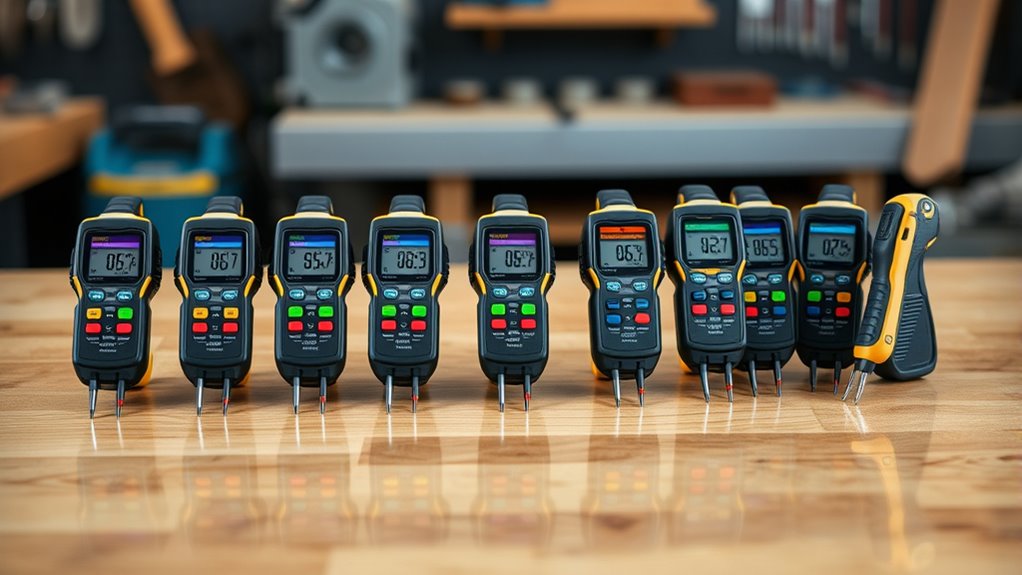
For shoppers comparing moisture meters pintype, the TopTes TS-630 is my best overall pick for straightforward wood checks, while the PREXISO 7-in-1 stands out for broader material and measurement needs. The General Tools MMH800 is a strong choice when pin readings plus temperature and humidity data matter. The main tradeoff is between direct pin contact, which leaves small marks but measures at the tips, and pinless modes, which scan without punctures but may be less suited to checking a specific spot. Read on for the full breakdown of all 13 options and how to match a meter to your work.

Get business pricing on tools and workshop supplies
- Business-only prices and quantity discounts
- Tax-exempt purchasing
- Multiple users, one account, clear invoices
Complete the kit



Key Takeaways
- The TS-630 leads for simple pin-based wood checks: its LCD and tricolor backlight make readings easier to interpret, while the lineup’s combination models are better fits when scanning or extra environmental data matters.
- Versatility comes in different forms: the PREXISO and NDI models combine pin and non-invasive functions, while the MMH800 and MMD950 add environmental or humidity-sensing features.
- Not every broad-material claim replaces material-specific guidance: buyers checking drywall, concrete, or other building materials should verify the meter’s supported materials and measurement method before relying on a reading.
- Compact, focused meters have a place: the General Tools MMP100 and Delmhorst J-LITE suit buyers who favor simpler wood measurement over a larger set of modes.
- Several entries overlap in basic function: the two RDINSCOS pin meters and multiple 2-in-1 models make it worth comparing display, material coverage, and added tools rather than choosing by feature count alone.
| TopTes TS-630 Digital Wood Moisture Meter with LCD and Tricolor Backlight |  | Best Overall for Clear Pin-Type Readings | Measurement type: Digital, pin-type | Measurement range: 0.0% to 57% | Calibration scales: 7 | VIEW ON AMAZON | See Our Full Breakdown |
| PREXISO 7-in-1 Pin-Type Wood Moisture Meter |  | Best for Multi-Point Checks | Model: PMX-57A | Measurement type: Pin-type | Moisture range: 0% to 57% | VIEW ON AMAZON | See Our Full Breakdown |
| General Tools MMP100 Compact Digital Moisture Meter |  | Best Compact Pin Meter | Measurement type: Compact pin-style | Materials: Wood, drywall, and similar building materials | Display: Tri-color backlit LCD | VIEW ON AMAZON | See Our Full Breakdown |
| NDI 7-in-1 Pin-Type and Non-Invasive Moisture Meter Scanner for Dry Wall, Cement Board, Soft Wood, and Hard Wood up to 3/4 Inch Depth |  | Best Dual-Mode Option | Measurement design: Pin-type and pinless | Measurement depth: Up to 3/4 inch | Modes: Softwood, drywall, cement board, hardwood, mildew index | VIEW ON AMAZON | See Our Full Breakdown |
| Calculated Industries 7440 AccuMASTER XT Digital Moisture Meter |  | Best for Firewood and Home Checks | Model: 7440 AccuMASTER XT | Measurement type: Handheld pin-type | Probe material: Replaceable stainless-steel pins | VIEW ON AMAZON | See Our Full Breakdown |
| General Tools MMH800 Pin and Pinless Moisture Meter with Temperature and Humidity |  | Best Overall for Pin-and-Pinless Flexibility | Model: MMH800 | Sensors: Pin and pinless | Wood moisture range: 5%–50% | VIEW ON AMAZON | See Our Full Breakdown |
| General Tools Moisture Meter MMD950 – Humidity Sensor – Pin and Pinless Modes | 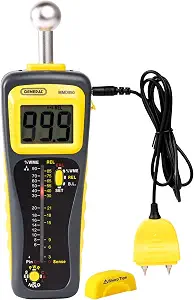 | Best for Hard-to-Reach Pin Readings | Measurement modes: Pin and pinless | Sensor: Spherical sensor with pin and pinless options | Display: Jumbo LCD and 40-dot tri-color LED bar graph | VIEW ON AMAZON | See Our Full Breakdown |
| Delmhorst J-LITE 6% to 30% Pin LED Wood Moisture Meter |  | Best for Woodworking and Job-Site Visibility | Testing type: Pin-type | Listed use: Wood moisture measurement | Moisture content range: 6%–30% | VIEW ON AMAZON | See Our Full Breakdown |
| RDINSCOS Digital Moisture Meter Pin-Type Wood Moisture Detector |  | Best Compact-Use Pin Meter for Dim Spaces | Measurement depth: 10mm | Probe length: 12mm | Display: Color LCD | VIEW ON AMAZON | See Our Full Breakdown |
| RDINSCOS Pin-Type Moisture Meter for Wood and Building Materials |  | Best Value for Straightforward Pin Checks | Model: MT19B | Testing type: Pin-type | Listed materials: Wood, firewood, and drywall | VIEW ON AMAZON | See Our Full Breakdown |
| Pinless and Pin-Type Moisture Meter for Wood, Drywall, and Concrete |  | Best for Switching Between Surface Scans and Pin Readings | Model: MT35P | Measurement types: Pin-type and pinless | Materials listed: Wood, drywall, concrete, plaster, and other materials | VIEW ON AMAZON | See Our Full Breakdown |
| LASELION MS03 2-in-1 Pin & Pinless Moisture Meter |  | Best for Low-Light Spot Checks | Brand and model: LASELION MS03 | Measurement modes: Pin and pinless | Wood moisture range: 0–75% | VIEW ON AMAZON | See Our Full Breakdown |
| Dr.meter 2-in-1 Pin & Pinless Moisture Tester |  | Best for Clearly Specified Pin-Mode Readings | Measurement modes: Pin-type and pinless | Pin-mode wood range: 5–50% | Pin-mode building-material range: 1.5–33% | VIEW ON AMAZON | See Our Full Breakdown |
| moisture meters pintype | Power |
|---|---|
| TopTes TS-630 Digital Wood Moi | 3 AAA batteries |
| PREXISO 7-in-1 Pin-Type Wood M | — |
| General Tools MMP100 Compact D | 3 volts, alkaline battery |
| NDI 7-in-1 Pin-Type and Non-In | 2 AAA batteries; inclusion is inconsistently stated in the supplied data |
| Calculated Industries 7440 Acc | 9V battery included |
| General Tools MMH800 Pin and P | — |
| General Tools Moisture Meter M | 9V battery |
| Delmhorst J-LITE 6% to 30% Pin | — |
| RDINSCOS Digital Moisture Mete | AA batteries |
| RDINSCOS Pin-Type Moisture Met | — |
| Pinless and Pin-Type Moisture | — |
| LASELION MS03 2-in-1 Pin & Pin | — |
| Dr.meter 2-in-1 Pin & Pinless | 9-volt alkaline battery |
More Details on Our Top Picks
TopTes TS-630 Digital Wood Moisture Meter with LCD and Tricolor Backlight
The TopTes TS-630 is my lead pick for buyers who want a straightforward pin meter with readings that are easy to interpret. Its seven calibration scales cover wood and building materials, while the 2.25-inch screen shows both a percentage and a bar graph. The green, orange, and red backlight adds a quick visual cue when checking several spots, and hold plus max/min functions help compare readings without relying on memory. Compared with the PREXISO PMX-57A, it skips ambient temperature and humidity readings, but its display and included carry pouch make the basic moisture-checking setup more self-contained. The tradeoff is inherent to pin testing: the stainless-steel probes leave small marks, and the range stops at 57%.
Pros:- Seven calibration scales support checks across wood and building materials.
- Large LCD presents a percentage and bar graph together.
- Tricolor backlight helps distinguish moisture levels at a glance.
- Includes a carry pouch, test pins, mini wrench, and three AAA batteries.
Cons:- Pins penetrate the material and can leave visible marks.
- The stated measurement range tops out at 57%.
- Does not measure ambient temperature or humidity.
Best for: Homeowners, woodworkers, and property inspectors who want clear pin readings across wood and common building materials.
Not ideal for: Buyers who need ambient temperature and humidity readings or must avoid leaving probe marks on finished surfaces.
- Measurement type:Digital, pin-type
- Measurement range:0.0% to 57%
- Calibration scales:7
- Material modes:Wood and building materials
- Display:2.25-inch LCD with tricolor backlight
- Functions:Data hold, max/min, auto shutoff after 10 minutes, low-battery indicator
- Power:3 AAA batteries
- Included accessories:User manual, carry pouch, test pins, mini wrench
Our verdict“Choose the TS-630 if readable, feature-rich pin measurements matter more than environmental readings or mark-free testing.”
PREXISO 7-in-1 Pin-Type Wood Moisture Meter
The PREXISO PMX-57A suits buyers who want more than a single spot reading from a pin-type meter. Its modes include single-point, average, maximum, and minimum, so a series of checks can give a more useful picture of uneven moisture in lumber or building materials. Seven calibration scales add material flexibility, and the meter also reports ambient temperature and humidity—a useful extra beside its moisture readings. Compared with the TopTes TS-630, PREXISO offers more measurement modes and environmental data, while the TopTes has a clearly specified 2.25-inch display and included carry pouch. The PMX-57A’s listed upper temperature range of 32°F is a serious limitation in the supplied specifications, and its pins still require puncturing the surface.
Pros:- Seven calibration scales cover multiple woods and building materials.
- Four modes include average, maximum, and minimum readings.
- Adds ambient temperature and humidity measurements.
- Backlit display, hold function, and rubber side grips support field use.
Cons:- The listed upper temperature range is only 32°F, limiting confidence in its environmental readings.
- Sharp pins penetrate and can mark the tested surface.
- The supplied product data does not specify the display size or power source.
Best for: Woodworkers and building inspectors who routinely compare several pin readings and want ambient humidity and temperature alongside them.
Not ideal for: Buyers who need dependable temperature readings above 32°F based on the listed specifications, or who need non-invasive measurements.
- Model:PMX-57A
- Measurement type:Pin-type
- Moisture range:0% to 57%
- Calibration scales:7
- Measurement modes:Single-point, multi-point average, maximum, minimum
- Additional measurements:Ambient temperature and humidity
- Operating humidity:30–80%
- Temperature accuracy:±1°C
Our verdict“Pick the PREXISO when multi-point pin readings and ambient humidity data matter more than a clearly documented operating temperature range.”
General Tools MMP100 Compact Digital Moisture Meter
For a tool that needs to travel in a small inspection kit, the General Tools MMP100 keeps the focus on portability and basic pin readings. Its compact body measures under seven inches tall, and the tri-color backlit display makes moisture status easy to spot when checking wood, drywall, or similar materials. A data-hold function helps when readings need to be written down, while the tethered cap protects the pins between jobs. Compared with the TopTes TS-630, the MMP100 is smaller and simpler, but it lacks the TopTes’s stated calibration scales, range, and included replacement pins. A practical drawback is that the product data says pins are sold separately, so buyers should verify what is included before planning to use it. Its material coverage is also narrower than the PREXISO’s.
Pros:- Compact 6.89-inch height fits easily in a tool bag.
- Tri-color backlit LCD gives a quick visual moisture cue.
- Data hold helps record readings in awkward locations.
- Tethered protective cap helps shield the pins during transport.
Cons:- Pins are reported as sold separately, which may delay use and add a separate purchase.
- Limited to wood, drywall, and similar building materials.
- Product data does not state a moisture measurement range or calibration count.
Best for: Inspectors, flooring installers, and DIYers who want a compact pin-style meter for routine wood and drywall checks.
Not ideal for: Buyers who need broad material calibration options or a ready-to-use kit with pins confirmed in the package.
- Measurement type:Compact pin-style
- Materials:Wood, drywall, and similar building materials
- Display:Tri-color backlit LCD
- Functions:Data hold
- Dimensions:0.98 in W × 6.89 in H
- Power:3 volts, alkaline battery
- Temperature range:32°F–122°F
- Operating humidity:Less than 90%
Our verdict“Choose the MMP100 for a small, portable pin meter for common indoor materials, but confirm pin availability before buying.”
NDI 7-in-1 Pin-Type and Non-Invasive Moisture Meter Scanner for Dry Wall, Cement Board, Soft Wood, and Hard Wood up to 3/4 Inch Depth
The NDI’s main advantage in a pin-focused roundup is that it offers pin readings and non-invasive scanning in one tool. Use the pins when you want a direct contact reading, then switch to pinless mode to survey a surface without adding more marks. Its dedicated settings for softwood, hardwood, drywall, and cement board help tailor checks to common materials, while the mildew index adds a screening cue rather than a simple moisture number. Compared with the TopTes TS-630, the NDI can scan without pins, but its stated depth is limited to 3/4 inch and its specialized modes may take more setup for a casual user. The supplied details also conflict on battery inclusion: the specs say two AAA batteries are included, while the listed cons say they are not.
Pros:- Combines pin-type testing with non-invasive scanning.
- Offers dedicated modes for softwood, hardwood, drywall, and cement board.
- Mildew index provides an additional screening indicator.
- Hold, out-of-range alarm, and low-battery indicator support field checks.
Cons:- Measurement depth is limited to 3/4 inch.
- Multiple modes and indicators may take time for new users to learn.
- Product data conflicts on whether two AAA batteries are included.
Best for: Renovation contractors and home inspectors who need both pin confirmation and surface scanning across wood, drywall, and cement board.
Not ideal for: Beginners who want a simple meter, buyers testing material deeper than 3/4 inch, or anyone who needs certainty about included batteries before purchase.
- Measurement design:Pin-type and pinless
- Measurement depth:Up to 3/4 inch
- Modes:Softwood, drywall, cement board, hardwood, mildew index
- Functions:Hold button, auto power-off, out-of-range alarm, low-battery indicator
- Design features:Ergonomic handle and surface protection
- Power:2 AAA batteries; inclusion is inconsistently stated in the supplied data
Our verdict“Choose the NDI if you need pin checks plus mark-free scanning and can work within its 3/4-inch depth limit.”
Calculated Industries 7440 AccuMASTER XT Digital Moisture Meter
The AccuMASTER XT 7440 is geared toward buyers who want pin readings for both firewood and a broad mix of household surfaces. Its sharp, replaceable stainless-steel pins measure moisture in wood and listed materials such as drywall, plaster, concrete, brick, carpet, and flooring. For firewood, the screen groups readings into low, medium, and high bands, while icons and audio alerts make a quick check easier to interpret. Compared with the General Tools MMP100, it has wider stated material coverage and includes a 9V battery and built-in calibration test pins; the MMP100 is more compact for carrying. The AccuMASTER’s broad claims are useful for general screening, but the supplied data gives no calibration-scale count or accuracy figures, and its pins can mark finished surfaces.
Pros:- Listed for wood, concrete, brick, drywall, plaster, flooring, and carpet.
- Firewood readings are grouped into low, medium, and high moisture bands.
- Backlit screen, hold key, icons, and audio alerts aid interpretation.
- Includes a 9V battery and built-in calibration test pins.
Cons:- Sharp pins penetrate surfaces and may leave marks.
- Supplied product data does not specify calibration scales or measurement accuracy.
- The stated firewood banding ends at 50%, with no broader moisture range provided.
Best for: Homeowners and firewood users who want one pin meter for routine checks across lumber and a range of household materials.
Not ideal for: Wood professionals who need documented calibration scales and accuracy figures, or users who need mark-free inspection of finished surfaces.
- Model:7440 AccuMASTER XT
- Measurement type:Handheld pin-type
- Probe material:Replaceable stainless-steel pins
- Listed materials:Wood, concrete, brick, drywall, plaster, floors, walls, carpet
- Firewood moisture bands:Low: 5–11%; medium: 12–15%; high: 16–50%
- Display:Backlit LCD
- Functions and alerts:Hold key, automatic shutoff, icons, audio alerts
- Power:9V battery included
Our verdict“Choose the AccuMASTER XT for broad household pin checks and firewood screening, but look elsewhere for detailed calibration and accuracy documentation.”
General Tools MMH800 Pin and Pinless Moisture Meter with Temperature and Humidity
The MMH800 is my lead pick for buyers who want a pin-type meter without giving up broad, non-invasive checks. Its pins provide direct spot readings in wood and building materials, while the pinless sensor helps scan a wider area before choosing where to probe. That makes it more adaptable than the RDINSCOS MT19B, which relies only on contact pins. The MMH800 also displays temperature and relative humidity, useful context when checking a room as well as a material. Audible and visual alerts and a hold function make readings easier to track, though the listed ±0.1% accuracy does not explain measurement conditions. Its tradeoffs are a 9V battery, a relatively heavy 1.95-pound listed weight, and the surface contact—and potential marking—that pin readings require.
Pros:- Pin and pinless sensors support both broad scans and direct spot checks.
- Measures wood and common building materials, including concrete and drywall.
- Shows ambient temperature and relative humidity alongside moisture readings.
- Audible and visual alerts plus a hold function support quicker checks.
Cons:- Pin readings require contact and can leave marks in finished materials.
- Uses a 9V battery rather than the AAA power used by the RDINSCOS MT19B.
- The listed weight is 1.95 pounds, making it less convenient to carry than smaller pin-only options.
Best for: Home inspectors and renovation-minded homeowners who want pin readings for confirmation plus pinless scans across wood, drywall, and concrete.
Not ideal for: Woodworkers seeking a small, wood-focused pin meter, or buyers who need to avoid making probe marks and do not need a pinless mode.
- Model:MMH800
- Sensors:Pin and pinless
- Wood moisture range:5%–50%
- Building-material moisture range:1.5%–33%
- Measurement accuracy:±0.1%
- Displays:Moisture percentage, ambient temperature, and relative humidity
- Power source:9V alkaline battery
- Included components:Battery, two sets of spare pins, lanyard, and user manual
Our verdict“Choose the MMH800 if you want one tool for pin confirmation, pinless scanning, and room humidity checks across several building materials.”
General Tools Moisture Meter MMD950 – Humidity Sensor – Pin and Pinless Modes
The MMD950 earns its place for buyers who need to take pin readings in awkward or recessed locations. Its 46-inch remote probe can reach areas that the MMH800’s built-in pin setup may not, while the deep-sensing pinless sensor offers a way to scan behind surfaces before probing. A jumbo LCD and 40-dot tri-color bar graph make the results easier to read at a glance than the more basic display described for the RDINSCOS MT19B. That extra reach and feedback suit contractors or inspectors working across varied sites, but they also bring a more involved tool than a casual homeowner may need. The description does not specify moisture ranges or accuracy, and the meter is limited to suitable surface types for dependable results. It also requires a 9V battery.
Pros:- 46-inch remote probe reaches areas that are difficult to access directly.
- Pin and pinless modes support direct checks and broader surface scanning.
- Deep-sensing pinless sensor can detect moisture behind surfaces.
- Jumbo LCD and 40-dot tri-color bar graph make readings easier to interpret.
Cons:- A remote probe and multiple modes may be more complex than casual users need.
- Requires a 9V battery.
- The supplied product data does not state measurement ranges or accuracy, and accurate use is limited to suitable surface types.
Best for: Contractors and inspectors who regularly check concealed or difficult-to-reach areas and want both pin and deep-sensing pinless modes.
Not ideal for: Occasional homeowners who only need straightforward readings on accessible wood and prefer a simpler, clearly specified meter.
- Measurement modes:Pin and pinless
- Sensor:Spherical sensor with pin and pinless options
- Display:Jumbo LCD and 40-dot tri-color LED bar graph
- Remote probe length:46 inches
- Power:9V battery
- Automatic power-off:Selectable after 3, 5, or 10 minutes
Our verdict“Pick the MMD950 if remote access and clear visual feedback matter more than a simple, fully specified pin-only meter.”
Delmhorst J-LITE 6% to 30% Pin LED Wood Moisture Meter
The J-LITE is the most focused choice here for buyers who want a dedicated pin meter for wood, rather than a general building-material scanner. Its stated 6%–30% moisture range fits routine checks by hobbyists, woodworkers, and home inspectors, while 12 bright LEDs are designed to remain readable in direct sun or dim spaces. That visual approach differs from the RDINSCOS MT19C, which uses a color LCD and flashlight; the J-LITE keeps attention on wood readings without adding those features. A microcontroller circuit is specified for reliability and accuracy, but the product data gives no accuracy figure, battery details, or included accessories. Its wood-specific range also makes it less versatile than the General Tools MMH800, which supports pin and pinless checks on several building materials.
Pros:- Pin-style wood moisture testing suits direct spot checks.
- Stated 6%–30% moisture content range covers the listed wood-testing use.
- Twelve bright LEDs are intended to aid reading in sunlight and darker areas.
- Microcontroller circuit is specified for increased reliability and accuracy.
Cons:- The supplied product data describes wood testing, not broader building-material coverage.
- No pinless mode is listed for scanning without making contact.
- Battery type, measurement accuracy, and included accessories are not specified.
Best for: Woodworkers, hobbyists, and home inspectors who mainly need visible pin readings for wood within a 6%–30% range.
Not ideal for: Buyers who need moisture readings in concrete or drywall, want pinless scanning, or need stated accuracy and power details before choosing.
- Testing type:Pin-type
- Listed use:Wood moisture measurement
- Moisture content range:6%–30%
- Indicators:12 LEDs
- Circuit:Microcontroller circuit
Our verdict“Choose the J-LITE for visible, wood-focused pin checks, but skip it if you need broad material coverage or documented measurement specifications.”
RDINSCOS Digital Moisture Meter Pin-Type Wood Moisture Detector
This RDINSCOS model is a practical match for buyers who want direct wood readings in enclosed or poorly lit spaces. Its pin probe reaches a stated 10mm measurement depth, and the replaceable electrodes offer a way to maintain the contact points over time. A color LCD and built-in flashlight address visibility in one package, unlike the LED-based Delmhorst J-LITE, which is described for wood but does not list a flashlight. The meter is still a wood-focused pin tool: it does not offer the MMH800’s pinless scanning or stated coverage of concrete and drywall. The description mentions an alarm but gives no moisture range or accuracy figures, so buyers cannot compare its measurement limits closely. Pin contact can mark finished surfaces, and AA batteries add an ongoing power requirement.
Pros:- Pin probe has a stated 10mm measurement depth for direct wood checks.
- Color LCD and built-in flashlight help in dark or enclosed work areas.
- Replaceable electrodes support continued use as pins wear.
- Alarm function is listed to alert users to readings.
Cons:- The product description limits its stated use to wood and similar materials.
- Pin contact may damage or mark finished surfaces.
- Measurement range and accuracy are not supplied, and the meter requires AA batteries.
Best for: Woodworkers and repairers checking boards or wood in cabinets, crawlspaces, and other dim areas who value a lit display and replaceable pins.
Not ideal for: Inspectors needing pinless scans or specified readings across concrete and drywall, and anyone checking finished surfaces where probe marks are unacceptable.
- Measurement depth:10mm
- Probe length:12mm
- Display:Color LCD
- Flashlight:Yes
- Replaceable pins:Yes
- Power:AA batteries
Our verdict“Choose this RDINSCOS model for illuminated, direct wood checks in tight spaces, not for broad building-material surveys.”
RDINSCOS Pin-Type Moisture Meter for Wood and Building Materials
The MT19B is the straightforward option for buyers who want a pin-only meter for wood and common building materials without the added modes of the General Tools models. Its contact pins are listed for wood, drywall, and firewood, and the included three AAA batteries and storage bag mean the basic kit is ready to carry. Compared with the MMH800, it gives up pinless scanning, temperature, and humidity readings; in return, its stated 7.4-ounce weight and compact dimensions make it easier to pack for simple spot checks. The central tradeoff is the contact method: the pins need deep insertion and good contact, which can mark material, and extremely dry wood may display 0%. The product data also gives no measurement range or accuracy specification.
Pros:- Pin-type testing provides direct contact readings inside materials.
- Listed for wood, drywall, and firewood checks.
- Three AAA batteries and a storage bag are included.
- Compact dimensions and a 7.4-ounce listed weight suit portable spot checks.
Cons:- Pins require deep insertion and good contact for accurate readings.
- Probe contact can leave marks, and extremely dry wood may display 0%.
- No measurement range or accuracy figure is provided, and it lacks pinless mode.
Best for: Firewood users and DIYers who want a light, battery-included pin meter for direct checks on wood and drywall.
Not ideal for: Inspectors who need non-invasive scanning, room humidity information, or defined accuracy and measurement ranges.
- Model:MT19B
- Testing type:Pin-type
- Listed materials:Wood, firewood, and drywall
- Power source:3 AAA batteries, included
- Item weight:7.4 ounces
- Dimensions:4.72 × 2.36 × 1.18 inches
- Included components:Moisture meter, user guide, storage bag, 3 AAA batteries, and spanner
Our verdict“Choose the MT19B for portable, direct pin checks on wood and drywall if you can accept probe marks and do not need extra sensing modes.”
Pinless and Pin-Type Moisture Meter for Wood, Drywall, and Concrete
This meter suits buyers who want pin testing for internal wood readings alongside a non-invasive scan for finished surfaces. The detachable probe gives it a clearer pin-type role than a pin-only tool such as the TopTes TS-630, while the pinless mode can check drywall, plaster, concrete, and other surfaces without leaving probe marks. An audible alarm and hold function add practical help when checking several spots or recording a reading. The tradeoff is that this listing provides no measurement range or accuracy figures, so it is harder to judge its precision against the Dr.meter 2-in-1, which states separate ranges and error limits. Pin readings still penetrate the material, and battery power means keeping batteries available. I’d choose it for mixed renovation checks, not for buyers who need published performance specifications.
Pros:- Combines pin-type readings with non-invasive pinless scanning.
- Detachable probe supports internal moisture checks in wood.
- Pinless mode is intended for drywall, plaster, concrete, and finished surfaces.
- Audible alarm and hold function support spot checks and reading capture.
Cons:- The supplied product data does not state measurement ranges or accuracy.
- Pin testing penetrates the material and can leave marks.
- Requires batteries for operation.
Best for: DIY renovators and home inspectors who need pin readings in wood plus non-invasive checks on drywall or concrete.
Not ideal for: Buyers who need stated accuracy and measurement ranges before choosing, or who want to avoid making probe marks in wood.
- Model:MT35P
- Measurement types:Pin-type and pinless
- Materials listed:Wood, drywall, concrete, plaster, and other materials
- Power source:Battery powered
- Battery cell type:Alkaline
- Included components:Moisture meter, pin and pinless components, Type-C cable, bag
- Weight:14.4 ounces
- Package dimensions:7.2 x 5.79 x 1.61 inches
Our verdict“Choose this for flexible pin and pinless checks across renovation materials, but favor the Dr.meter if published range and accuracy figures matter more.”
LASELION MS03 2-in-1 Pin & Pinless Moisture Meter
The MS03 is the most convenient pick here for checking materials in dim spaces: its built-in flashlight helps illuminate the work area, while the LCD hold function lets me retain a reading before moving on. Its pin and pinless modes cover both internal readings and non-invasive surface checks, much like the Dr.meter 2-in-1. The stated ranges—0–75% for wood and 0–25% for building materials—give buyers more guidance than the MT35P listing, which supplies no range figures. However, the MS03 lists ±4% RH accuracy, making it a less compelling choice when fine precision matters; the Dr.meter provides a tighter stated error for pin-type readings. It also needs three AAA batteries. I’d pick it for routine inspections in closets, basements, or other poorly lit areas rather than detailed diagnostic work.
Pros:- Pin and pinless modes cover internal readings and non-invasive scanning.
- Built-in flashlight helps when inspecting dark corners or utility spaces.
- LCD hold function makes readings easier to record.
- Automatic power-off after two minutes helps conserve battery life.
Cons:- Stated accuracy is ±4% RH, which may not suit precision-focused work.
- Requires three AAA alkaline batteries.
- Pin testing can leave marks on finished wood.
Best for: Homeowners and maintenance workers checking wood or building materials in basements, crawlspaces, and other dim areas.
Not ideal for: Woodworkers or inspectors who need tighter stated pin-mode accuracy or want to minimize battery changes.
- Brand and model:LASELION MS03
- Measurement modes:Pin and pinless
- Wood moisture range:0–75%
- Building-material moisture range:0–25%
- Accuracy:±4% RH
- Battery:3 x 1.5V AAA alkaline batteries
- Automatic power-off:After 2 minutes of inactivity
- Additional features:LCD display, hold function, flashlight, ambient temperature readout, manual pinless calibration
Our verdict“Choose the MS03 for convenient dual-mode checks in low light, but select the Dr.meter if tighter stated pin-mode error limits are a priority.”
Dr.meter 2-in-1 Pin & Pinless Moisture Tester
The Dr.meter earns this spot by giving pin-focused buyers the clearest performance details in this group. Its pin mode covers wood from 5–50% and building materials from 1.5–33%, with a stated ±2% error; that is a more specific basis for choosing than the MS03’s broader ±4% accuracy claim or the MT35P’s missing range data. Pinless scanning adds a way to check finished wood and building surfaces without puncturing them, though its stated error is looser at ±4%. Four scan modes—softwood, hardwood, masonry, and drywall—also help tailor the non-invasive check. The costs of that detail are more settings to understand and a 9-volt battery requirement. I’d favor it for buyers who expect to use the pins regularly and want defined ranges, not those seeking the simplest possible meter.
Pros:- Pin mode lists separate wood and building-material ranges with ±2% error.
- Pinless mode checks surfaces without probe punctures.
- Four pinless scan modes cover softwood, hardwood, masonry, and drywall.
- Includes over-range alerts, a hold function, ambient temperature measurement, and a storage bag.
Cons:- Pinless scanning has a stated ±4% error, looser than pin mode.
- Pin readings penetrate material and may mark finished surfaces.
- Requires a 9-volt battery.
Best for: Woodworkers, firewood users, and home inspectors who want stated pin-mode ranges and a pinless option for finished surfaces.
Not ideal for: Buyers who want a minimal setup or who need the pinless mode to match the stated pin-mode error limit.
- Measurement modes:Pin-type and pinless
- Pin-mode wood range:5–50%
- Pin-mode building-material range:1.5–33%
- Pin-mode error range:±2%
- Pinless wood range:0–53%
- Pinless building-material range:0–35%
- Pinless error range:±4%
- Power:9-volt alkaline battery
- Additional features:Four pinless scan modes, over-range alert, hold function, ambient temperature measurement, green backlit display, storage bag
Our verdict“Choose the Dr.meter if stated pin-mode ranges and error limits matter most, while accepting a less precise pinless mode and a more involved set of scan options.”

How We Picked
I ranked these meters around the central pintype question: how useful and understandable is a direct-contact reading for the materials and tasks the product claims to support? I weighed the stated measurement modes, material coverage, display and reading aids, and extra functions such as temperature, humidity, or pinless scanning. A feature mattered most when it addressed a real buyer need, not simply because it added another mode.
The order also reflects tradeoffs. Focused wood meters can be easier to use for routine lumber or firewood checks, while combination meters offer broader coverage at the cost of more settings and a less specialized workflow. I treated product names and feature claims as starting points, not proof of equal accuracy across materials; buyers should follow each model’s material-specific instructions. Where the listed details are limited or products appear similar, I avoid assuming an unlisted performance advantage.
Factors to Consider When Choosing Moisture Meters Pintype
Choosing a pin meter is less about collecting the most features and more about matching the pins and measurement method to the material you actually need to check. These factors can help prevent misleading comparisons between wood-focused tools and broader building-material meters.
Choose Pin Contact for the Question You Need Answered
Pins measure moisture at the points where they contact the material, which can help when you need to check a specific location rather than scan a surface. That direct contact leaves small holes, so it may be unsuitable for finished furniture, visible trim, or surfaces that must remain intact. A pinless meter avoids punctures and can quickly survey an area, but its reading represents a broader zone rather than the exact pin-tip location. Combination meters offer both approaches, though switching modes does not make their readings interchangeable. Decide whether you need a spot check, a broad scan, or both before paying for extra modes. For delicate work, test in an inconspicuous location or use a non-invasive method where appropriate.
Match Material Support to Your Job
Wood species, drywall, cement board, and concrete are not automatically measured the same way. Some meters provide material settings or specific guidance, while a general moisture reading may not translate directly between surfaces. Before buying, check whether the manufacturer lists your material and explains how to interpret readings for it. A meter advertised for multiple materials may be convenient for home inspections, but that breadth is not the same as specialized calibration for every material. For woodworking, prioritize clear wood measurement guidance; for renovation checks, confirm support for the actual wall or floor material. Avoid comparing numbers from different materials as though they share one scale.
Think About Pin Length and Access
The pins only measure where they reach, so their length and accessibility matter when checking thick stock, layered assemblies, or a damp spot beneath a surface. A surface reading can miss a wetter interior, while forcing pins too deeply can damage a finished piece or encounter hidden materials. Check the product’s stated measurement depth and use the manufacturer’s method for placing pins. If you need readings at different depths, look for a model designed for that task or compatible with suitable probes rather than assuming every pin meter can reach farther. For routine firewood or lumber screening, basic pins may be enough. For building diagnostics, access and depth can matter as much as the display.
Decide Whether Extra Sensors Will Change Your Work
Temperature and humidity readings can add useful context when you are monitoring a room or trying to understand changing drying conditions. They do not replace a material reading, and they may add controls or information you do not need for quick lumber checks. A pin-and-pinless design is most useful when you regularly switch between spot measurements and surface scans. A simpler wood meter may be easier to operate if your tasks are consistent. Before choosing a multi-function model, ask which extra feature will alter your decision on site. If the answer is none, a focused meter may be the clearer choice.
Prioritize Readability and Handling
A reading is only useful if you can see and interpret it where you work. Backlighting can help in dim areas, while color indicators may make a quick pass easier to understand; neither replaces knowing the measurement scale. Consider whether you need a hold function, a flashlight, or controls that are manageable while holding the meter against a surface. Compact designs can be convenient for tool bags and quick checks, but a small body may be less comfortable during repeated measurements. Look for clear instructions on units, material settings, and warning thresholds. Ease of reading matters most when several measurements need to be compared consistently.
Compare Repeatability, Not Just Feature Counts
Moisture can vary across a board or wall, so one reading rarely tells the whole story. Take several readings in appropriate locations and compare like with like: same material, same meter mode, and similar pin placement. Extra modes and sensors do not automatically make results more dependable, and an impressive list of supported materials is not a substitute for clear measurement guidance. If you need to document work or check a drying process, look for a readable display and a consistent procedure you can repeat. Check whether the maker explains calibration checks or care for the pins. A practical meter is one whose readings you can use reliably within its stated limits.
Frequently Asked Questions
Should I choose a pin meter or a pin-and-pinless model?
Choose a pin meter when you need a reading at a particular point and can accept small pin marks. A pinless mode is useful for surveying a larger area without puncturing the surface, but it does not measure at the exact pin-tip location. Combination meters make sense if you regularly perform both kinds of checks. If most of your work involves one material and one measurement style, a simpler dedicated meter may be easier to use. Match the method to the surface and the decision you need to make.
Can one moisture meter give comparable readings on wood, drywall, and concrete?
Not necessarily. Materials differ in how they hold moisture and how a meter interprets the signal, so the same displayed number may not mean the same thing across surfaces. Check that the model lists the material and provides the relevant setting or reading guidance. Record and compare readings using the same meter mode and material procedure. If the tool does not specify support for the surface you are checking, treat the result as a screening clue rather than a definitive measurement.
Will pin readings damage finished wood or painted walls?
Pins puncture the surface, so they can leave small holes in finished wood, paint, or other visible materials. The marks may be minor, but they can still matter on furniture, cabinetry, or a finished room. Test in a hidden area if a pin reading is needed, or use a pinless mode when the meter supports the surface and task. Do not assume a non-invasive reading answers the same question as a pin reading at a specific depth. For valuable or delicate materials, plan the measurement location before pressing in the pins.
Do temperature and humidity sensors replace a pin measurement?
No. Ambient temperature and humidity describe the surrounding conditions, while pins measure moisture at contact points within a material. Environmental readings can help explain drying conditions or track a room, but they do not establish the moisture level inside a board or wall. A model with both types of information can be useful when you need that broader context. If your only task is checking lumber or firewood, those extra sensors may add little to your decision. Use each reading for the question it is designed to answer.
How many readings should I take before deciding material is dry?
Take multiple readings at representative locations rather than relying on one spot, since moisture can vary across a board or surface. Follow the meter’s instructions for pin placement, material settings, and any recommended thresholds. Compare readings taken with the same mode and procedure; switching between pin and pinless measurements can change what area is being assessed. For building or woodworking decisions with meaningful consequences, confirm the relevant material standard or professional guidance instead of treating a single meter number as a universal pass-or-fail rule. A repeatable pattern of readings is more informative than an isolated result.
Conclusion
For most buyers focused on direct-contact wood checks, I recommend the TopTes TS-630 as best overall for its clear display and simple wood-measurement emphasis. The best value direction is a focused meter such as the General Tools MMP100 if compact, basic wood readings matter more than added modes; compare its listed functions with your needs before choosing. For a best premium or professional-leaning option, the Delmhorst J-LITE is the focused wood pick to investigate, while buyers wanting multiple measurement approaches should compare the General Tools MMH800 and MMD950. Beginners who want a readable, straightforward starting point can favor the TS-630, while those checking different materials should look closely at the PREXISO or NDI combination meters and verify material-specific guidance. Choose by the surfaces you measure, whether pin marks are acceptable, and whether extra sensors or scanning modes will see regular use.
Black Friday Picks

Philips Hue Amarant Outdoor Smart Light Bar, Black
As an affiliate, we earn on qualifying purchases.