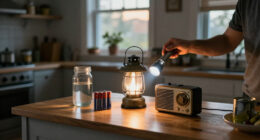
Among these digital piano keyboards, the Yamaha P71 is my best overall pick for players who want weighted keys in a simple portable instrument. The Yamaha P45B is another strong choice for straightforward home practice, while the Donner DEP-20 adds a furniture stand and three-pedal unit for a more settled setup. The main tradeoff is between realistic weighted action, a lighter portable design, and bundled accessories that help beginners get started. I also compare 61-key learning keyboards with full-size 88-key models, since they suit different practice goals. Read on for the full breakdown and recommendations by buyer type.

Get business pricing on tools and workshop supplies
- Business-only prices and quantity discounts
- Tax-exempt purchasing
- Multiple users, one account, clear invoices
Complete the kit


Key Takeaways
- Weighted action separates the piano focused picks: the Yamaha P71, Yamaha P45B, and Donner DEP-20 are the clearest fits here for players who want a more piano-like key feel.
- Portable 61-key models prioritize access and learning: the Yamaha PSR-E283 and RockJam kits trade full-range piano keys for a smaller format and beginner-oriented extras.
- Furniture-style setups favor a dedicated practice space: the UISCOM wooden desk model and Donner DEP-20 include a more permanent stand and pedal arrangement than portable boards.
- Accessory bundles vary in usefulness: stands, benches, headphones, and pedals can make a first setup simpler, but buyers should check which pieces they will actually use and whether they suit their playing posture.
- Several 88-key options use semi-weighted action: Donner and UISCOM beginner models can provide the full note range, but the key count alone does not make them equivalent to weighted-action pianos.





| digital piano keyboard | Keys | Connectivity | Key action | Skill level |
|---|---|---|---|---|
| RockJam RJ761 61 Key Keyboard | 61 | — | — | Beginner |
| RockJam RJ5061 61-Key Keyboard | 61 | USB, auxiliary, headphone jack | — | Beginner |
| Donner 88-Key Semi-Weighted Di | 88 | USB | Semi-weighted, touch-sensitive | All |
| 88-Key Semi-Weighted Digital P | 88 | Bluetooth, USB-MIDI | Semi-weighted | Beginner |
| UISCOM Digital Piano Keyboard | 88 | USB, Bluetooth audio, 3.5 mm headphone jack | Semi-weighted | Beginner |
| 88-Key Digital Piano Keyboard | 88 | Bluetooth; USB-MIDI compatibility | Semi-weighted | Beginner |
| Yamaha PSR-E283 61-Key Portabl | 61 full-size keys | — | — | Beginner |
| Yamaha P71 88-Key Weighted Act | 88 | USB; 3.5 mm headphone jack; sustain jack | Weighted hammer action | — |
| UISCOM 88-Key Weighted Home Di | 88 | — | Weighted; mechanism not specified | — |
| UISCOM Digital Piano Keyboard | 88 | USB; USB-MIDI compatibility | Semi-weighted | — |
| Yamaha 88-Key Weighted Portabl | 88 | USB | Weighted, touch-sensitive | — |
| Digital Piano 88 Key Full Size | 88 | Bluetooth, MIDI, USB | Semi-weighted | Beginner |
| Donner DEP-20 Beginner Digital | 88 | MIDI, USB; auxiliary | Full-weighted hammer action | — |
| Alesis Recital Play 88-Key Pia | 88 | USB-MIDI | — | — |
More Details on Our Top Picks
RockJam RJ761 61 Key Keyboard Piano Kit, Stand, Stool, Sustain & Headphones
The RJ761 suits a first-time player who wants the practice setup assembled in one purchase: it includes a stand, stool, headphones, and sustain pedal, while its touchscreen gives direct access to sounds and rhythms. That pedal makes it more piano-oriented than the RockJam RJ5061, which instead emphasizes its pitch-bend wheel, LED panel, and USB playback. The RJ761 also provides MIDI support, though its proprietary system and limited listed connections leave less room for app and device flexibility than the Zilvok 801, which lists Bluetooth and USB-MIDI. Its 61 keys are manageable for a beginner but offer less range than the full 88-key options in this roundup. At nearly 20 pounds, it is also a heavier choice for someone who expects to move a keyboard often.
Pros:- Includes stand, padded stool, headphones, and sustain pedal.
- Touchscreen provides direct access to tones, rhythms, and functions.
- Headphone jack supports quiet practice.
- MIDI support allows connection to compatible equipment.
Cons:- Its 61 keys provide less range than the 88-key Donner DEP-07 and Zilvok 801.
- At 19.8 pounds, it is relatively heavy for a portable keyboard.
- Proprietary operating system and listed MIDI/audio connections limit flexibility.
Best for: First-time players who want a stand, seat, headphones, and sustain pedal together for home practice.
Not ideal for: Learners focused on full-range piano repertoire or players who need a lightweight keyboard to carry between locations.
- Keys:61
- Skill level:Beginner
- Display:Touchscreen
- Built-in speaker:Yes
- Headphone jack:3.5 mm
- Supported software:MIDI
- Weight:19.8 lb
- Dimensions:12.8 × 36.2 × 4.4 in
Our verdict“Choose the RJ761 if you want a ready-to-use 61-key practice kit with a sustain pedal and touchscreen controls.”
RockJam RJ5061 61-Key Keyboard Piano Kit with Stand, Bench & Headphones
The RJ5061 is the better fit for a beginner who wants variety and simple practice aids: its panel provides access to 200 rhythms and tones, and the kit adds note stickers, a bench, headphones, and Simply Piano content. Its pitch-bend wheel also gives players an expressive control absent from the RockJam RJ761, which has a touchscreen and sustain pedal instead. The tradeoff is that the RJ5061’s supplied details do not list a sustain pedal, so it is less ready for piano-style sustained notes than the RJ761. USB playback can bring songs into practice, but the keyboard still has only 61 keys; the Donner DEP-07 offers a full 88-key range for players moving toward broader repertoire. The listed headphones are battery-powered, adding a small upkeep task.
Pros:- Includes stand, bench, headphones, note stickers, and Simply Piano content.
- Offers 200 preset rhythms and tones.
- Pitch-bend wheel adds expressive control for non-piano sounds.
- USB playback supports practice with songs.
Cons:- The provided product details do not list a sustain pedal.
- Its 61-key range is shorter than the 88-key Donner DEP-07.
- Battery-powered headphones require charging or battery replacement.
Best for: New players who want rhythms, note stickers, and lesson content to make early practice more varied.
Not ideal for: Learners prioritizing sustain-pedal technique or full 88-key piano range.
- Keys:61
- Skill level:Beginner
- Preset rhythms and tones:200
- Special features:Pitch-bend wheel, USB playback, Simply Piano content
- Connectivity:USB, auxiliary, headphone jack
- Headphone jack:3.5 mm
- Weight:3.3 kg
- Dimensions:11.2 × 36.8 × 3.1 in
Our verdict“Pick the RJ5061 if rhythm variety and guided beginner practice matter more to you than a sustain pedal or full-size range.”
Donner 88-Key Semi-Weighted Digital Piano for Beginners
For a learner who wants to practice across the full piano range, the Donner DEP-07 is the clearest step up from the two 61-key RockJam keyboards. Its 88 touch-sensitive keys give room for repertoire that reaches beyond a compact keyboard’s range, while 128-note polyphony helps notes continue sounding during layered passages. The bundle includes a stand, pedal, music rest, and carry bag, and the dual 10-watt speakers are specified more clearly than the speaker setup on the Zilvok 801, whose supplied data does not mention built-in speakers. The DEP-07 does have limits: its keys are semi-weighted, not fully weighted, and its beginner/casual positioning may not suit a player seeking a more advanced instrument. USB is the only listed connectivity, so its options are narrower than the Zilvok’s Bluetooth and USB-MIDI.
Pros:- Full 88-key range supports broader piano repertoire than either RockJam 61-key model.
- Touch-sensitive keys respond to playing strength.
- 128-note polyphony supports sustained and layered passages.
- Bundle includes a stand, pedal, music rest, and carry bag.
Cons:- Semi-weighted keys do not provide the feel of a fully weighted piano action.
- USB is the only listed connectivity, fewer options than the Zilvok 801.
- The supplied dimensions are an unusual 3.15 × 3.15 × 3.15 inches and do not clarify its actual footprint.
Best for: Beginners who want full 88-key range, touch response, and a bundled setup for home practice.
Not ideal for: Advanced players seeking a professional-grade instrument, fully weighted action, or broad device connectivity.
- Keys:88
- Key action:Semi-weighted, touch-sensitive
- Skill level:All
- Sound library:500 tones, 200 rhythms, 150 demo songs
- Polyphony:128-note
- Speakers:Dual 10 W stereo
- Connectivity:USB
- Included accessories:Carry bag, stand, pedal, music rest
Our verdict“Choose the DEP-07 if full-range practice and touch sensitivity matter more than fully weighted action or extensive connectivity.”
88-Key Semi-Weighted Digital Piano Keyboard with Stand, Pedal, Case and Accessories
The Zilvok 801 stands out for a beginner who wants an 88-key instrument with several ways to connect to learning tools and external devices. Its listed Bluetooth and USB-MIDI support give it a more flexible connection story than the USB-only Donner DEP-07, while its included case, stand, pedal, headphones, and music rest cover the basics for practice at home or on the move. The advertised library of 1,000 timbres, rhythms, and demo songs plus recording and playback offers more built-in material than the RJ5061’s specified 200 rhythms and tones. The cost of that breadth is a less piano-focused key action: it is semi-weighted rather than fully weighted, and the data does not mention built-in speakers. Buyers should plan on headphones or an external sound source unless the product setup provides one.
Pros:- Bluetooth and USB-MIDI offer more connection options than the USB-only Donner DEP-07.
- Includes stand, case, sustain pedal, headphones, and music rest.
- Offers 1,000 timbres, rhythms, and demo songs, with recording and playback.
- Full 88-key range supports more repertoire than the RockJam RJ761.
Cons:- Semi-weighted keys feel less like a fully weighted acoustic-style action.
- Built-in speakers are not listed in the supplied product details.
- The full accessory bundle may be bulky to carry and store.
Best for: Beginners who want 88 keys, app/device connections, and a bundled case for learning in different settings.
Not ideal for: Players who need fully weighted keys or want confirmed built-in speakers for standalone playing.
- Keys:88
- Key action:Semi-weighted
- Skill level:Beginner
- Connectivity:Bluetooth, USB-MIDI
- Listed library:1,000 timbres, rhythms, and demo songs
- Additional functions:Recording/playback, dual mode
- Color:Grey
- Included components:Stand, carrying case, headphones, sustain pedal, music rest
Our verdict“Choose the Zilvok 801 if connectivity and a broad feature set matter more than fully weighted keys or confirmed built-in speakers.”
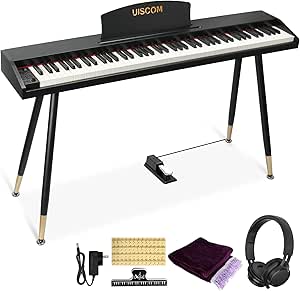
UISCOM Digital Piano Keyboard 88-Key Semi-Weighted for Beginners
The UISCOM is designed around a more settled home setup than the portable-leaning Zilvok 801: its matching wooden stand, piano cover, music stand, and triple pedal create a furniture-style practice station. Bluetooth audio and MIDI-USB pair that home feel with app and device connections, while 600 tones, 800 rhythms, demo songs, metronome, and recording/playback provide practice tools without needing a separate device. Its 88 keys give it more range than the RockJam RJ761, though the action is semi-weighted, so it does not match the feel of a fully weighted piano. The wood-grain finish contributes to the room-friendly look, but it is a cosmetic finish rather than evidence of solid-wood construction. This is a less portable choice once the stand and accessories are set up.
Pros:- Matching wooden stand, music stand, cover, headphones, and triple pedal form a complete home setup.
- Bluetooth audio and MIDI-USB support apps and connected devices.
- Metronome and recording/playback functions support structured practice.
- 88 keys provide more range than the RockJam RJ761.
Cons:- Semi-weighted keys are less piano-like than fully weighted action.
- Stand and accessories make the setup less portable than the Zilvok 801 keyboard bundle.
- Wood-grain finish is cosmetic and may not have the durability of solid wood.
Best for: Home learners who want an 88-key practice station with a triple pedal, matching stand, and Bluetooth audio.
Not ideal for: Players who need fully weighted action or a compact keyboard they can frequently carry between locations.
- Keys:88
- Key action:Semi-weighted
- Skill level:Beginner
- Connectivity:USB, Bluetooth audio, 3.5 mm headphone jack
- Pedals:Triple pedal
- Sound and rhythm library:600 tones, 800 rhythms, demo songs
- Practice functions:Metronome, recording, playback
- Included accessories:Wooden stand, music stand, headphones, piano cover, key stickers
Our verdict“Pick the UISCOM if you want a room-ready home practice station and can accept semi-weighted keys and limited portability.”
88-Key Digital Piano Keyboard for Beginners with Accessories
This bundle suits beginners who want a complete setup in one purchase, including a stand, sustain pedal, headphones, and carrying case. Its 88 semi-weighted keys cover the full piano range, while Bluetooth and USB-MIDI support give learners ways to connect with compatible devices and music software. Compared with the Yamaha PSR-E283, it offers more keys and a pedal, but the Yamaha includes built-in learning tools and battery operation. The carrying case helps with transport, though 15 pounds is heavier than the Yamaha’s 8.8 pounds. The supplied details do not confirm built-in speakers or amplification, so buyers should check how they will hear the instrument before choosing it for home practice. Its beginner focus also makes it a less convincing fit for players seeking a more developed piano action.
Pros:- 88 semi-weighted keys provide the full piano range
- Includes a stand, sustain pedal, headphones, and carrying case
- Bluetooth and USB-MIDI support device and software connections
- Carrying case makes occasional transport easier
Cons:- At 15 pounds, it is heavier than the Yamaha PSR-E283
- The provided product details do not confirm built-in speakers or amplification
- Semi-weighted action may not suit players seeking a fully weighted piano feel
Best for: Adult beginners who want a full-range keyboard, basic accessories, and a case for occasional transport
Not ideal for: Players who need confirmed built-in speakers, lighter battery-powered practice, or fully weighted keys
- Keys:88
- Key action:Semi-weighted
- Skill level:Beginner
- Connectivity:Bluetooth; USB-MIDI compatibility
- Weight:15 pounds
- Dimensions:44 x 10 x 4 inches
- Included accessories:Sustain pedal, stand, carrying case, headphones
Our verdict“Choose this bundle if you want a full-range beginner keyboard with accessories and a carrying case, and have a plan for audio output.”
Yamaha PSR-E283 61-Key Portable Keyboard for Beginners with Learning Tools, Music Rest, and Power Adapter
The PSR-E283 is the clearest choice here for a new player who values built-in learning tools over a full piano range. Quiz Mode and Smart Chord give beginners structured ways to practice, while its 61 full-size keys, preset songs, and instrument voices offer variety without requiring extra software. Unlike the 88-key starter bundle, this Yamaha is battery-operated and weighs 8.8 pounds, making it easier to move between rooms or take along. That shorter keyboard does limit two-handed repertoire compared with the Yamaha P71, which has weighted 88-key action for piano-focused practice. The supplied description says it lacks built-in speakers, so buyers should plan to use headphones or external amplification. Its feature set favors learning and portability rather than the feel of an acoustic piano.
Pros:- Quiz Mode and Smart Chord provide built-in learning support
- Battery operation allows practice away from a power outlet
- At 8.8 pounds, it is lighter than the 88-key beginner bundle
- Includes a music rest and power adapter
Cons:- 61 keys provide less range than the Yamaha P71 and other 88-key models
- The provided description says it has no built-in speakers
- Its beginner learning focus offers fewer advanced features than higher-end keyboards
Best for: Children or adults starting lessons who want guided practice features and a lightweight keyboard they can move
Not ideal for: Learners committed to full-range piano repertoire or anyone who needs confirmed built-in speakers
- Keys:61 full-size keys
- Skill level:Beginner
- Learning features:Quiz Mode; Smart Chord
- Power:AC adapter or batteries
- Headphone jack:6.35 mm
- Weight:8.8 pounds
- Dimensions:12.5 x 37 x 4.1 inches
- Warranty:1 year manufacturer warranty
Our verdict“Pick the PSR-E283 if portability and built-in beginner guidance matter more to you than a full 88-key range.”
Yamaha P71 88-Key Weighted Action Digital Piano with Sustain Pedal and Power Supply
The P71 earns its place for learners who want weighted hammer action across all 88 keys. That action gives practice a more piano-like physical response than the semi-weighted beginner bundles, which may help players build technique for an acoustic instrument. It keeps the setup focused: 10 voices, built-in speakers, a sustain pedal, and USB connectivity cover home practice and basic music-software use without a crowded control layout. Compared with the UISCOM home piano, the P71 has fewer listed tones and lacks its triple-pedal setup, but its weighted action and straightforward controls make it a more direct piano-practice option. At 25 pounds, it is also less convenient to carry than the PSR-E283, and its power is corded. USB handles data connectivity; the supplied specs list no MIDI ports.
Pros:- Weighted hammer action spans all 88 keys
- Built-in speakers support home practice without separate amplification
- Includes a sustain pedal and power supply
- USB connectivity supports music-software integration
Cons:- At 25 pounds with corded power, it is less portable than the Yamaha PSR-E283
- The listed data connection is USB, with no MIDI ports specified
- Its 10 voices offer less listed variety than the UISCOM home piano’s eight tones plus additional controls and demo songs
Best for: Piano students who want full-range weighted action and built-in speakers for home practice
Not ideal for: Buyers who need a lightweight, battery-powered keyboard or a furniture-style setup with triple pedals
- Keys:88
- Key action:Weighted hammer action
- Voices:10
- Connectivity:USB; 3.5 mm headphone jack; sustain jack
- Power:Corded electric
- Weight:25 pounds
- Dimensions:52.25 x 11.5 x 6 inches
- Included components:Sustain pedal; power supply
Our verdict“Choose the P71 if realistic weighted action and a simple home-practice setup matter more than portability or extra tones.”
UISCOM 88-Key Weighted Home Digital Piano with Wooden Desk Design and Triple Pedals
This UISCOM is aimed at buyers who want a furniture-style digital piano with more performance controls in the same setup. Weighted keys and a triple pedal unit give it a broader piano-oriented arrangement than the semi-weighted UISCOM beginner keyboard, while USB MIDI, dual headphone jacks, and an MP3 player add options for practice with another listener or accompanying tracks. It also lists eight tones, 40 demo songs, and reverb, chorus, and tempo controls. Compared with the Yamaha P71, the UISCOM offers more listed tones and three pedals, while the P71 specifies weighted hammer action and built-in speakers. The UISCOM requires corded power and may take more room, so it fits a settled home practice area better than a portable routine. The supplied data does not specify its key-action mechanism beyond weighted keys.
Pros:- Weighted 88-key layout with sustain, sostenuto, and soft pedals
- Dual headphone jacks support quiet practice with another person
- USB MIDI and MP3 playback add software and accompaniment options
- Reverb, chorus, and tempo controls allow sound and practice adjustments
Cons:- Corded electric power limits use away from a fixed setup
- The wooden desk design may be bulky in small living spaces
- The supplied specs do not identify the weighted key-action mechanism
Best for: Home players who want weighted keys, a three-pedal arrangement, and shared headphone practice in a furniture-style setup
Not ideal for: Apartment dwellers with tight floor space or players who need a portable, battery-powered piano
- Keys:88
- Key action:Weighted; mechanism not specified
- Pedals:Triple: sustain, sostenuto, soft
- Tones:8
- Demo songs:40
- MIDI connectivity:USB Type A/B
- Headphone jacks:Dual 6.35 mm
- Additional features:USB MP3 player; reverb, chorus, and tempo controls
Our verdict“Choose this UISCOM for a home piano setup with triple pedals and shared headphone practice, provided you have room for it.”
UISCOM Digital Piano Keyboard for Beginners, Full Size 88-Key Semi-Weighted Electric Piano with Stand, Power Adapter, Sheet Music Stand, Pedal, Headphone, USB-MIDI Compatibility, Wood Black
This UISCOM makes sense for a beginner who wants a full-size keyboard with a home stand and practice accessories already included. Its semi-weighted keys cover all 88 notes, while the pedal, headphones, sheet music stand, and wooden stand create a more settled practice station than the portable Yamaha PSR-E283. The tradeoff is that this package is large at 50.8 x 10.6 x 28.3 inches and lacks the Yamaha’s listed battery operation and learning tools. Compared with the other 88-key semi-weighted bundle, this model lists USB connectivity and multiple tones and rhythms, while the other bundle specifies Bluetooth and a carrying case. The supplied data does not confirm built-in speakers, so check audio needs before buying. Semi-weighted action also leaves room for a later upgrade if piano technique becomes the main priority.
Pros:- Full 88-key semi-weighted layout suits beginner piano practice
- Includes a wooden stand, sheet music stand, pedal, and headphones
- USB connectivity supports compatible music software
- Multiple tones and rhythms provide variety beyond piano practice
Cons:- Its listed dimensions make it less suitable for small rooms than the portable Yamaha PSR-E283
- Semi-weighted action may not meet the needs of advanced piano students
- The supplied product data does not confirm built-in speakers or amplification
Best for: Beginners setting up a dedicated home practice spot who want a full-range keyboard, stand, pedal, and headphones in the package
Not ideal for: Players with limited floor space, frequent travel needs, or a preference for fully weighted keys
- Keys:88
- Key action:Semi-weighted
- Connectivity:USB; USB-MIDI compatibility
- Power:Corded electric
- Dimensions:50.8 x 10.6 x 28.3 inches
- Included accessories:Wooden stand, sheet music stand, pedal, headphones
- Additional features:Multiple tones and rhythms
- Color and finish:Black; wood grain
Our verdict“Pick this UISCOM if you want a full-range beginner keyboard and accessories for a dedicated home practice area.”
Yamaha 88-Key Weighted Portable Digital Piano Keyboard (P45B)
I’d choose the Yamaha P45B for a beginner who wants a direct route to piano practice: its 88 weighted, touch-sensitive keys respond more like a traditional piano than the semi-weighted action on the Digital Piano 88 Key Full Size Semi-Weighted Keyboard. That difference matters when building control across soft and strong notes. The included sustain foot switch, music rest, and built-in speakers cover the basics without requiring a separate starter bundle. Its 10 voices and simple controls keep the focus on playing, though they offer less variety than the Donner DEP-20’s 238 tones or the Alesis Recital Play’s 480. The tradeoff is a relatively focused feature set: there’s USB connectivity, but no recording feature is specified, and its weight may make frequent transport inconvenient.
Pros:- 88 weighted, touch-sensitive keys support piano-style dynamics.
- Simple controls suit learners who want to focus on playing.
- Includes a music rest and sustain foot switch.
- USB connectivity supports connection to compatible devices.
Cons:- Only 10 instrument voices, far fewer than the Donner DEP-20 or Alesis Recital Play.
- No built-in recording feature is listed.
- Portability may be limited by its weight.
Best for: New piano students who want full-size weighted keys and a simple setup for regular home practice.
Not ideal for: Players who want many instrument sounds, built-in recording, or a lightweight keyboard to carry often.
- Keys:88
- Key action:Weighted, touch-sensitive
- Instrument voices:10
- Connectivity:USB
- Color:Black
- Included accessories:Music rest, sustain foot switch
- Sound output:Built-in speakers
Our verdict“Choose the P45B if realistic weighted keys and uncomplicated home practice matter more than a large sound library or recording features.”
Digital Piano 88 Key Full Size Semi-Weighted Electronic Keyboard with Stand
This 88-key semi-weighted keyboard is the bundle pick for beginners who want a stand, sustain pedal, headphones, and bag included, plus ways to connect to devices. Bluetooth, MIDI, and USB give it more listed connection options than the Yamaha P45B, whose description specifies USB. That flexibility can suit app-assisted practice and simple music editing. The tradeoff is in the key feel: semi-weighted action won’t provide the same resistance as the P45B’s fully weighted keys or the Donner DEP-20’s hammer action, so players focused on traditional piano technique may prefer those models. The description also mentions sounds, rhythms, and demo songs, but gives little detail about build quality or how those features are controlled. I’d favor it for an accessory-rich start over a proven piano-style action.
Pros:- Includes a stand, sustain pedal, headphones, and bag.
- Bluetooth, MIDI, and USB provide several connection options.
- Sounds, rhythms, and demo songs offer varied practice material.
- Full-size 88-key layout gives access to the complete piano range.
Cons:- Semi-weighted keys feel less like an acoustic piano than the Yamaha P45B or Donner DEP-20.
- Build quality details are not provided.
- Multiple electronic features may take time for a first-time player to set up.
Best for: Beginners or adults setting up a first practice station who want headphones, a stand, pedal, bag, and device connectivity together.
Not ideal for: Learners prioritizing a traditional weighted key feel or buyers who need clear information about construction and controls before choosing.
- Keys:88
- Key action:Semi-weighted
- Skill level:Beginner
- Connectivity:Bluetooth, MIDI, USB
- Speaker:Built-in
- Color:Black
- Included accessories:Stand, sustain pedal, headphones, bag
- Additional features:Sounds, rhythms, demo songs
Our verdict“Pick this bundle if included accessories and broad connectivity matter more to you than fully weighted piano action.”
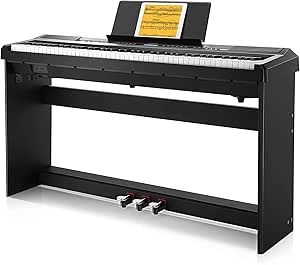
Donner DEP-20 Beginner Digital Piano
The Donner DEP-20 combines a full-weighted hammer-action keyboard with a furniture stand and three-pedal unit, making it the most home-station-oriented option here. Its 238 tones and 128-note polyphony give learners more room to explore layered sounds than the Yamaha P45B’s 10 voices, while the backlit LCD makes its broader feature set easier to navigate. Adjustable touch response lets players tailor the feel, and MIDI/USB connectivity adds options for working with compatible equipment. The main compromise is practical: at 24.75 kg and over 52 inches wide, it is much less convenient to move than the 5.5 kg Alesis Recital Play. The listed auxiliary connectivity is also less expansive than the Bluetooth, MIDI, and USB set on the semi-weighted bundle. I’d pick it for a dedicated practice space, not frequent transport.
Pros:- Full-weighted 88-key hammer action offers a piano-style response.
- 238 tones and 128-note polyphony allow layered and varied playing.
- Furniture stand and three-pedal unit support a fixed home setup.
- Backlit LCD, dual-tone mode, and MIDI/USB add control and connectivity.
Cons:- At 24.75 kg, it is difficult to move frequently.
- Its listed dimensions make it a bulky choice for small rooms.
- Bluetooth is not listed, unlike on the semi-weighted 88-key bundle.
Best for: Beginning pianists who want weighted hammer action, three pedals, and a substantial home setup with many sounds.
Not ideal for: Players who need to carry their keyboard regularly or want Bluetooth connectivity and a compact footprint.
- Keys:88
- Key action:Full-weighted hammer action
- Instrument tones:238
- Polyphony:128 notes
- Connectivity:MIDI, USB; auxiliary
- Pedals:Three-pedal unit
- Weight:24.75 kg
- Dimensions:52.36 × 11.61 × 36.99 inches
- Display:Backlit LCD
Our verdict“Choose the DEP-20 for a feature-rich weighted piano station that can stay set up at home.”
Alesis Recital Play 88-Key Piano Keyboard Bundle
The Alesis Recital Play suits beginners who want many sounds and a bundle they can move between rooms or take along. Its 480 voices, split/layer modes, and reverb give it far more sound-shaping variety than the Yamaha P45B’s 10 voices, while USB-MIDI supports connection to compatible learning software. At 5.5 kg, it is far easier to carry than the 24.75 kg Donner DEP-20, and the included stand, sustain pedal, headphones, and carry case help get a practice setup started. The key tradeoff is that its description specifies touch-sensitive keys but does not say they’re weighted; the P45B and DEP-20 are clearer choices for buyers seeking weighted action. Portable use also requires separate batteries, and recording needs an external device.
Pros:- 480 voices and split/layer modes offer broad sound variety.
- At 5.5 kg, it is more portable than the Donner DEP-20.
- Includes a stand, sheet music/tablet stand, sustain pedal, headphones, and carry case.
- USB-MIDI supports connection to compatible piano learning software.
Cons:- Weighted key action is not specified, unlike on the Yamaha P45B and Donner DEP-20.
- Batteries for portable use are not included.
- Recording requires an external device.
Best for: New players who want an easy-to-carry 88-key bundle, a wide range of sounds, and USB-MIDI for learning software.
Not ideal for: Students who specifically need weighted keys, built-in recording, or batteries included for portable playing.
- Keys:88
- Key response:Touch-sensitive
- Instrument voices:480
- Connectivity:USB-MIDI
- Weight:5.5 kg
- Headphone jack:3.5 mm
- Built-in speakers:Yes
- Display:Digital
- Included accessories:Keyboard stand, sheet music/tablet stand, sustain pedal, headphones, carry case, power supply
Our verdict“Choose the Recital Play if portability, a large voice selection, and included accessories outweigh the need for stated weighted action.”
How We Picked
I compared the 14 keyboards by how well they serve distinct digital piano needs: learning, piano practice, portability, and a ready-to-use home setup. Key count and action received close attention because a 61-key portable keyboard, an 88-key semi-weighted model, and an 88-key weighted piano support different practice habits. I also weighed useful learning features, built-in speakers, connectivity, pedal support, and the practical value of included stands, benches, and headphones.
The ranking favors instruments that match their stated role with fewer compromises. Weighted 88-key models rise for piano-focused practice, while lighter or semi-weighted options remain appealing when portability, beginner tools, or a bundled setup matters more. I give each product a distinct use case and account for drawbacks such as limited key range, less piano-like action, or a bulkier footprint; a larger bundle does not automatically outrank a better-fitting instrument.
| digital piano keyboard | Skill level | Key action |
|---|---|---|
| RockJam RJ761 61 Key Keyboard | Beginner | — |
| RockJam RJ5061 61-Key Keyboard | Beginner | — |
| Donner 88-Key Semi-Weighted Di | All | Semi-weighted, touch-sensitive |
| 88-Key Semi-Weighted Digital P | Beginner | Semi-weighted |
| UISCOM Digital Piano Keyboard | Beginner | Semi-weighted |
| 88-Key Digital Piano Keyboard | Beginner | Semi-weighted |
| Yamaha PSR-E283 61-Key Portabl | Beginner | — |
| Yamaha P71 88-Key Weighted Act | — | Weighted hammer action |
| UISCOM 88-Key Weighted Home Di | — | Weighted; mechanism not specified |
| UISCOM Digital Piano Keyboard | — | Semi-weighted |
| Yamaha 88-Key Weighted Portabl | — | Weighted, touch-sensitive |
| Digital Piano 88 Key Full Size | Beginner | Semi-weighted |
| Donner DEP-20 Beginner Digital | — | Full-weighted hammer action |
| Alesis Recital Play 88-Key Pia | — | — |
Factors to Consider When Choosing Digital Piano Keyboards
Before choosing among digital piano keyboards, decide what you want your practice setup to support over the next few years. The factors below help separate a convenient first instrument from one that can carry piano-focused practice further.
Choose key action for the music you want to learn
Key action changes how a keyboard responds under your fingers, which affects control as you learn dynamics and repeated notes. Weighted keys are generally the closer fit for piano technique, while semi-weighted and lighter actions can be easier to play casually or move around. A common mistake is treating 88 keys as proof that a model will feel like an acoustic piano; key count and action describe different things. If piano lessons or classical repertoire are likely, prioritize action before extra sounds or bundled accessories. If you mainly want a compact instrument for melodies and basic chords, a lighter action may be a sensible tradeoff. When possible, try a similar action in person, since descriptions rarely convey the full feel.
Think about key range and where you will play
A 61-key keyboard is smaller and easier to place, but the reduced range can limit some arrangements and make two-handed piano parts less comfortable. An 88-key model gives you the full standard piano range, though it demands more desk or floor space and can be less convenient to carry. Measure the intended spot, including room for a bench, music rest, and comfortable arm movement. Buyers sometimes focus on storage dimensions and overlook the space needed to sit and play properly. If you expect to take the instrument to lessons or move it between rooms, portability may outweigh having every key available. For a fixed home practice area, the wider range can be more useful over time.
Separate learning features from long-term practice needs
Beginner tools can make early sessions more inviting, especially when they help you follow a lesson or identify notes. They do not replace a sensible practice routine, clear instruction, or a key action suited to your goals. Consider whether you will use built-in lessons, accompaniment, or connectivity with a learning app before letting those features drive the purchase. A common mistake is paying attention to a long feature list while ignoring whether the keyboard has the range and feel needed for the music you want to play. For a first instrument, simple controls and an easy way to practice privately may matter more than a large sound library. Choose extras that support a habit you can picture keeping.
Check the whole setup, not just the keyboard
A keyboard is only comfortable if its stand, seat, and pedal arrangement let you maintain a relaxed playing position. Bundles can reduce setup friction, but included benches and stands may offer limited adjustment or stability. Check whether the pedal is a sustain pedal or part of a multi-pedal unit, and whether the stand leaves enough room for your legs. Headphones are useful for quiet practice, though connector type and comfort matter more than their presence in a bundle. Buyers often overlook the cost in space of furniture-style designs, which are less convenient to relocate than portable models. Match the accessories to your room and playing posture before treating a bundle as a complete solution.
Decide which connections you will actually use
USB or MIDI connections can link a keyboard to music software, notation tools, or learning apps, while audio inputs and playback features serve different needs. Bluetooth may be convenient for compatible devices, but it does not always mean wireless audio or MIDI work in the way a buyer expects. Check the specific connection type and intended function before relying on it for lessons or recording. If you only plan to practice through the built-in speakers and headphones, extra ports may add little value. For recording or computer-based learning, confirm compatibility with your device and software. A focused feature set can be easier to use than a crowded panel of connections you never touch.
Spend extra where it changes your playing
Paying more makes sense when the added feature addresses a real constraint, such as weighted action for piano technique or a stable pedal setup for sustained playing. A polished furniture stand can also be worthwhile if the keyboard will remain in one room and be used often. By contrast, a bundle of accessories has little value if the bench is uncomfortable or the headphones will be replaced. Set priorities before comparing extras, then decide which compromises are acceptable. Beginners may get more from a comfortable, reliable setup than from a broad collection of sounds. Experienced players should focus on action, pedal control, and connectivity that fits their workflow.
Frequently Asked Questions
Is a 61-key keyboard enough to learn piano?
A 61-key keyboard can support basic lessons, melodies, chords, and many beginner exercises. It may become limiting when music calls for a wider range or when you want to practice pieces that use both ends of the piano. If you are unsure how far you will take piano study, think about whether you want a small, easy-to-place instrument or a setup that follows you into more advanced repertoire. The Yamaha PSR-E283 and RockJam models fit the compact, learning-oriented side of this comparison. For piano technique and a broader range of music, an 88-key option is the safer fit.
Does an 88-key semi-weighted keyboard feel like a piano?
Not necessarily. The 88 keys provide the same broad note range as a piano, but semi-weighted action does not by itself deliver the resistance and response many players seek for piano practice. That distinction matters most when developing touch, dynamics, and finger strength. Semi-weighted models can still suit beginners who value the full range and a more accessible feel. If a piano-like response is a priority, compare the action directly and look toward weighted models such as the Yamaha P71, Yamaha P45B, or Donner DEP-20.
Should I choose a portable piano or a furniture-style setup?
Choose based on where the instrument will live and how often you expect to move it. A portable model is easier to store, transport, or reposition, but you may need to supply a stable stand and seat. Furniture-style designs create a dedicated practice station and can make pedals easier to use, though they take up more permanent space. Measure the room with the player seated, not just the keyboard footprint. If the piano will stay in one place and regular practice is the goal, a fixed setup can be more convenient; for shared or small rooms, portability often wins.
Which included accessories matter most for a first keyboard?
A stable stand and a seat at a comfortable height affect every practice session, so they deserve more attention than a long accessory list. A sustain pedal is useful for piano repertoire, while headphones help when you need to practice quietly. Check whether the included stand can support a relaxed playing posture and whether the pedal type matches your needs. Bundled headphones or benches may be adequate to start, but they can vary in comfort and fit. Compare the included pieces with what you already own before deciding that a kit offers the best overall setup.
Do I need USB, MIDI, or Bluetooth for lessons and recording?
You only need these connections if they support a specific plan, such as using a learning app, controlling music software, or recording performances. USB and MIDI can help a keyboard communicate with computers or devices, but their functions vary by model. Bluetooth may handle particular types of connection and should not be assumed to provide every form of wireless audio or MIDI. For regular lessons, check compatibility with the app and device you use before buying. If your practice is self-contained, speakers, a headphone connection, and a sustain pedal may be more useful day to day.
Conclusion
For the best overall balance of piano-focused practice and a portable format, I recommend the Yamaha P71. The RockJam RJ761 is my best value-style choice for a beginner seeking a ready-made 61-key kit, while the Donner DEP-20 is the best premium-style pick here for a full-size weighted keyboard with a furniture stand and three-pedal unit. Beginners who want learning tools in a compact instrument should look at the Yamaha PSR-E283. For a dedicated home setup, consider the UISCOM wooden desk model; for a lighter full-range option, compare the semi-weighted 88-key models. Choose according to the key feel, space, and practice setup you will use most.