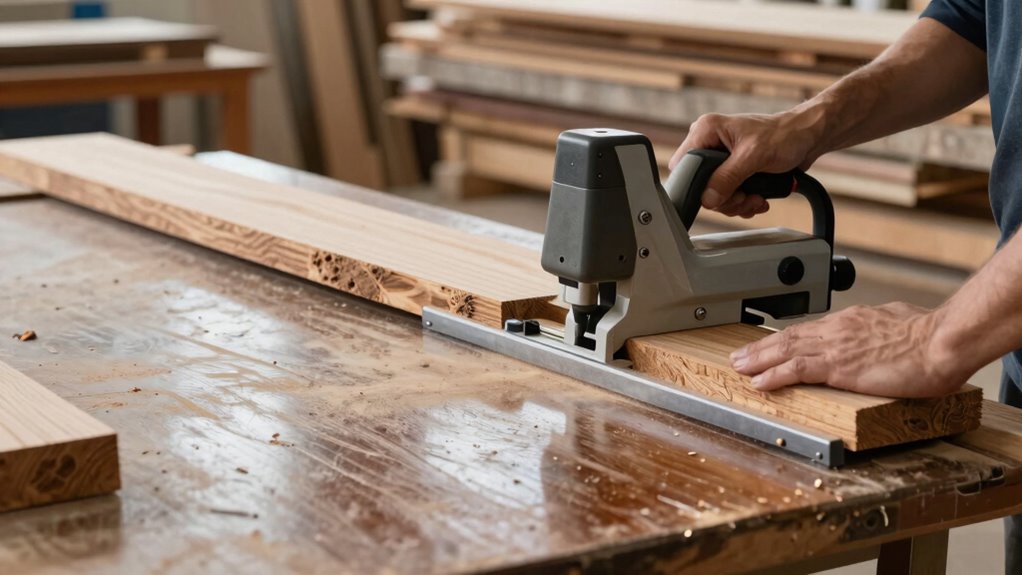

When you start buying rough lumber, the width of your jointer becomes essential. A wider jointer lets you efficiently flatten and square edges, leading to better project outcomes. Smaller jointers struggle with wider boards, causing inconsistencies and extra work. Plus, a wider jointer improves accuracy and saves time, enhancing the overall quality of your final product. Understanding how jointer width impacts your workflow can open up new possibilities for your woodworking projects. You’ll find more insights ahead.
Key Takeaways
- Wider jointers streamline the flattening process, allowing for one-pass adjustments on larger rough lumber, enhancing efficiency.
- They ensure consistent edge squaring, reducing inconsistencies often encountered with multiple passes on narrower jointers.
- Greater capacity supports a wider range of project types, accommodating both hardwood and softwood without limitations.
- Upgrading to a wider jointer can significantly improve the quality and accuracy of your finished products.
- Understanding jointer width helps in planning projects more effectively, leading to better material management and creative flexibility.
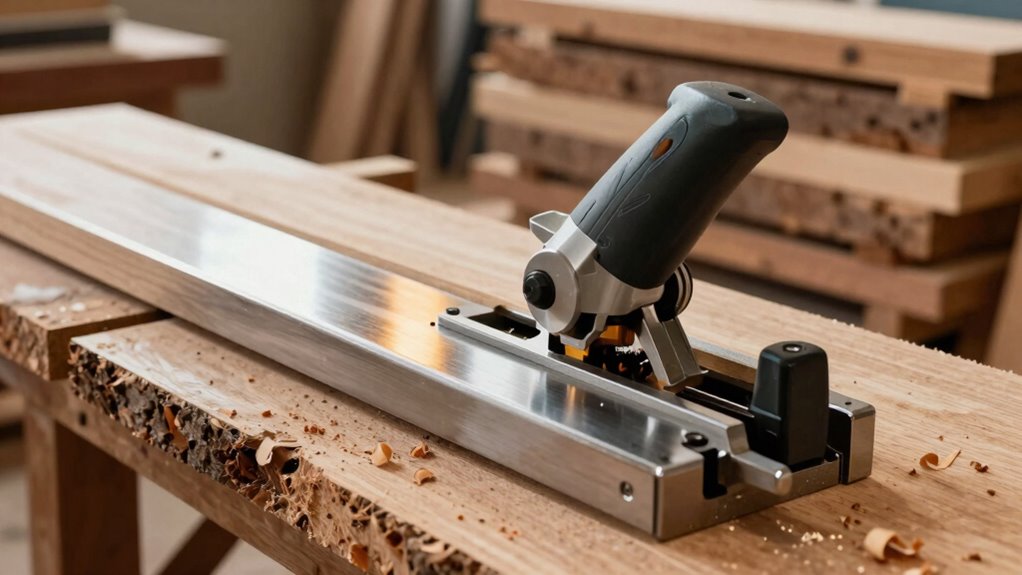
When working with rough lumber, the width of your jointer can substantially impact your project’s outcome. If you’re diving into the world of lumber preparation, understanding the relationship between jointer width and the type of rough lumber you’re using is essential. A jointer is your go-to tool for flattening and squaring the edges of your lumber, and its width can make a significant difference in your workflow and the quality of your finished product.
Different jointer types are available, each suited for specific tasks. A smaller jointer, typically with a width of around six inches, might be perfect for smaller projects or narrower boards. However, when you start working with wider rough lumber, you’ll quickly realize that a six-inch jointer can limit you. You’ll find yourself flipping and shifting larger boards, which can lead to inconsistencies and extra work. If you plan on using wider lumber frequently, investing in an eight-inch jointer or larger can save you time and effort, making your lumber preparation smoother and more efficient. Understanding jointer capacity is crucial for optimizing your setup and project planning.
With wider jointers, you can handle larger boards in one pass, ensuring that you achieve a flat, square edge without the hassle of multiple passes. This is especially important when you’re dealing with rough lumber, as it often comes with irregularities that need addressing. A wider jointer allows you to tackle these issues head-on, providing a more accurate and uniform surface right from the start. Additionally, jointer width is a key factor in determining the overall capacity of your woodworking setup, influencing what projects you can undertake. Knowing the limitations of your equipment can help you plan projects more effectively and avoid unnecessary frustrations. Recognizing the importance of proper blade alignment can further improve the quality of your cuts and extend the lifespan of your tools.
Moreover, the benefits of a wider jointer extend beyond just handling wide boards. They also allow for greater versatility in your projects. You can easily shift between different types of rough lumber, whether it’s hardwood or softwood, without worrying about the limitations of your tool. This flexibility can enhance your overall woodworking experience, freeing you to focus on creativity rather than battling equipment constraints. Selecting the right jointer size can also impact your future project possibilities and scalability. In addition, understanding the different jointer sizes available can help you make more informed decisions based on your specific needs and workspace.
Ultimately, your jointer’s width plays a significant role in how efficiently you can prepare rough lumber. It influences not only the time spent on lumber preparation but also the quality of the final product. As you consider your next project, think about the jointer types available and how they align with your needs. A wider jointer might just be the upgrade you need to elevate your woodworking game, ensuring that every piece of rough lumber you work with transforms into a masterpiece.

Cutech 40180HI 8-Inch Spiral Cutterhead Benchtop Jointer with Cast Iron Tables, 16 TC Inserts, Extra Long 24" Aluminum Fence, Additional 7-3/8" Fence Brackets, and a 10-amp Motor
- Spiral Cutterhead: 6-row tungsten carbide inserts for smooth cuts
- Two-sided Inserts: Aligned inserts with non-cutting edge for precision
- Adjustable Aluminum Fence: 24-inch fence with quick stops at 90° and 135°
As an affiliate, we earn on qualifying purchases.
As an affiliate, we earn on qualifying purchases.
Frequently Asked Questions
How Do I Choose the Right Jointer for My Needs?
Choosing the right jointer for your needs starts with considering wood thickness. If you plan to work with thicker stock, opt for a wider jointer to accommodate it. Look for features like adjustable fences and powerful motors, which enhance precision and ease of use. Make certain the jointer can handle the types of projects you’ll tackle, whether it’s furniture or cabinetry. Prioritize quality to guarantee it meets your long-term woodworking goals.
What Are the Benefits of a Wider Jointer?
A wider jointer gives you the advantage of making wider cuts, which means you can flatten larger boards in one pass. This saves you time and effort, letting you focus on your project instead of multiple passes. Plus, it often leads to smoother finishes, enhancing the overall quality of your work. With a wider jointer, you’ll find it easier to handle rough lumber, resulting in better craftsmanship and more professional-looking results.
Can I Flatten Rough Lumber Without a Jointer?
Absolutely, you can flatten rough lumber without a jointer! Consider clever, creative flattening techniques using alternative tools like a planer or hand plane. Start by securing your board and using a straightedge to identify high spots. Then, employ a hand plane or a router with a sled to achieve that smooth surface. With patience and practice, you’ll transform your rough lumber into beautifully flat boards, all while honing your skills in the process!
How Does Jointer Maintenance Affect Performance?
Jointer maintenance directly affects performance by ensuring ideal blade alignment and feed rate. If the blades aren’t aligned properly, you’ll end up with uneven surfaces, making your work more difficult. Keeping the feed rate consistent is essential, too; if it’s too fast or slow, you might experience tear-out or snipe. Regularly checking and adjusting these elements will help you achieve smoother results and enhance the overall efficiency of your jointer.
What Types of Wood Are Best for Jointing?
For jointing, hardwoods like oak, maple, and cherry are excellent choices due to their density and stability. Softwoods like pine and cedar can also work, but they’re more prone to warping. You’ll want to use proper jointing techniques to guarantee a smooth finish, regardless of the wood species. Always check for knots and defects, as they can complicate the process and affect the final outcome. Happy woodshop adventures!
Conclusion
When you start working with rough lumber, the width of your jointer becomes essential. You might think a smaller jointer is just fine, but imagine this: wrestling with wide, uneven boards on a narrow bed—it’s a frustrating dance. A wider jointer not only saves you time but also guarantees you get perfectly flat surfaces that make your projects shine. Investing in the right width lets you tackle any lumber with confidence, transforming rough pieces into stunning creations.