
TL;DR

Get business pricing on tools and workshop supplies
- Business-only prices and quantity discounts
- Tax-exempt purchasing
- Multiple users, one account, clear invoices
A team of researchers has demonstrated how a conventional pen plotter can be used to create holographic images. This breakthrough could make hologram production more accessible and affordable. The development is still in experimental stages, with further refinement needed.
Researchers have demonstrated a method to produce holographic images using a standard pen plotter, a device typically used for drawing on paper. This development, announced in October 2023, could significantly lower the barriers to creating holograms, which traditionally require expensive and complex equipment. The breakthrough was achieved by combining precise control of the plotter with specialized projection techniques, according to the research team.
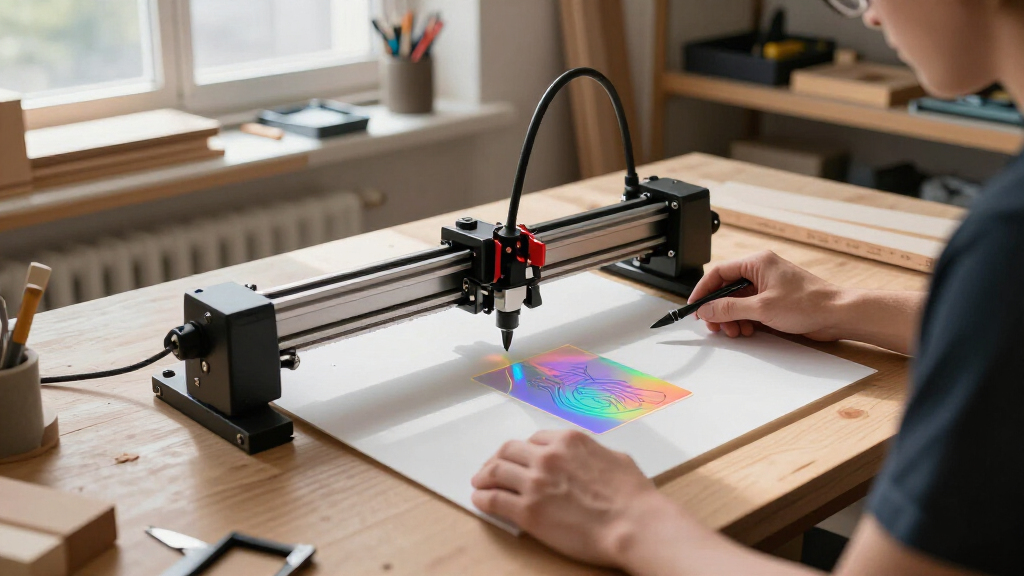
The research team, led by scientists at a university laboratory, adapted a common pen plotter to draw patterns that, when combined with a projection system, produce three-dimensional holographic images. Unlike traditional holography, which often relies on laser interference or costly optical setups, this method uses accessible hardware and software. The process involves plotting multiple layers with fine precision, then projecting light through these layers to generate a hologram visible from different angles.
According to the researchers, the setup includes a modified pen plotter equipped with a light source and a digital control system. The plotter draws complex patterns on a surface, which are then illuminated and viewed through a specially designed optical system. The team demonstrated this technique by creating simple floating objects and animated figures, showcasing its potential for artistic, educational, and commercial applications.
While the concept is promising, the researchers emphasized that the current prototypes are limited in resolution and size. They noted ongoing efforts to improve image clarity, stability, and scalability, with plans to develop a more user-friendly version for broader use.
Potential Impact on Accessible Holography
This innovation could democratize hologram creation by using inexpensive, widely available equipment. Unlike traditional holography, which requires specialized lasers and optical components, this approach leverages common office technology, potentially enabling artists, educators, and small businesses to produce holograms without prohibitive costs. If further developed, it could lead to new forms of visual communication, interactive displays, and artistic expression, making holography more accessible than ever before.
As an affiliate, we earn on qualifying purchases.
Background on Hologram Development and Plotter Technology
Holography has historically depended on complex optical setups involving lasers, beam splitters, and photographic plates. Recent advances have explored digital and computational methods, but these remain costly and technically demanding. Pen plotters, originally designed for drawing with ink or pencil, have been repurposed in various art and engineering projects due to their precision and affordability. This latest development builds on prior research into using plotters for laser engraving and light-based art, extending their application into holography.
The idea of creating holograms with simple devices is not new, but practical implementations have been limited. The recent breakthrough combines the mechanical precision of plotters with innovative optical techniques, marking a significant step forward in making holography more accessible and adaptable for different fields.
Limitations and Technical Challenges Remaining
It is not yet clear how well this method will scale for larger or higher-resolution holograms. The current prototypes produce relatively simple images with limited depth and clarity. Researchers are still working to improve image stability, viewing angles, and the complexity of the holograms. Additionally, the process requires precise calibration and specialized projection systems, which may complicate widespread adoption.
Next Steps for Development and Commercialization
The research team plans to refine the technology by enhancing image quality and expanding the size and complexity of the holograms. They aim to develop a more integrated, user-friendly system that could be marketed to artists, educators, and hobbyists. Further testing will also focus on making the process more reliable and scalable, with potential demonstrations at upcoming technology expos or academic conferences.
Key Questions
Can I create holograms with a regular pen plotter at home?
Currently, the process requires modifications and specialized projection equipment. While the concept is promising, it is not yet ready for typical home use. Future developments may make it more accessible.
What materials or equipment are needed for this hologram creation method?
Besides a standard pen plotter, the setup includes a light source, a digital control system, and optical components for projection. Researchers are working on simplifying these requirements.
How does this compare to traditional holography techniques?
This method is less expensive and technically simpler than laser-based holography, but currently produces lower-resolution images. It offers a new approach that could complement existing technologies.
What applications could benefit from this technology?
Potential uses include artistic installations, educational displays, advertising, and interactive exhibits, especially where low-cost and easy-to-implement holograms are desirable.
Source: hn
Fall yard work Picks
leaf blowers
As an affiliate, we earn on qualifying purchases.