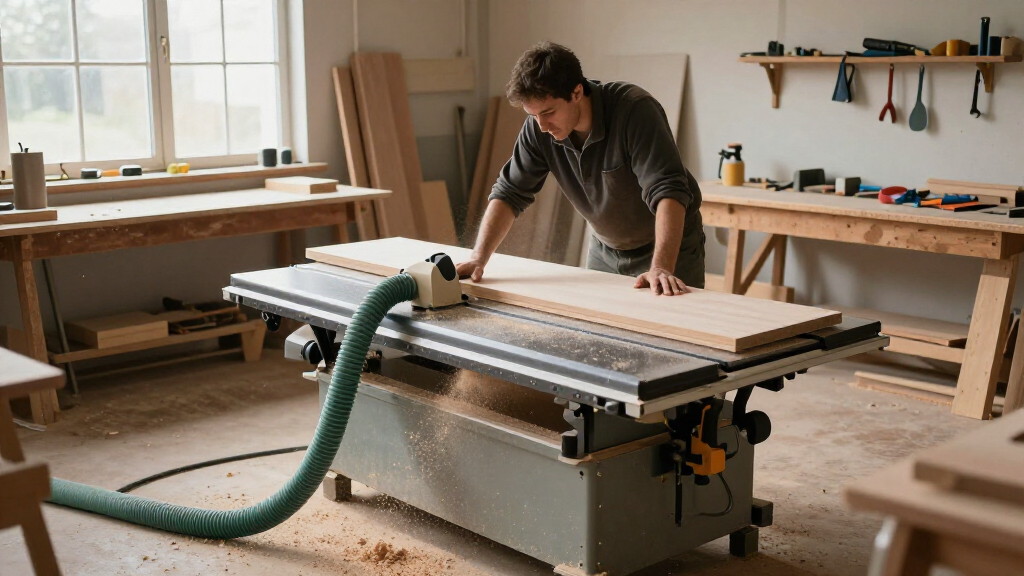

Among these woodworking dust collection systems, I’d choose the WEN DC1300 as the best overall for a shop that needs substantial airflow and a large collection bag. The POWERTEC 1 HP wall-mount collector stands out for saving floor space, while the compact WEN 12-gallon collector suits light-duty work and smaller shops. The main tradeoff is between higher-capacity stationary collectors, which take up room, and compact or wall-mounted models, which can limit collection capacity or the number of tools served. Filtration, duct layout, and the type of woodworking tools you use also affect how well a system works in practice. Read on for my full comparison, buying criteria, and guidance on choosing a setup that fits your shop.

Get business pricing on tools and workshop supplies
- Business-only prices and quantity discounts
- Tax-exempt purchasing
- Multiple users, one account, clear invoices
Complete the kit



Key Takeaways
- The WEN DC1300 leads for a larger shop. Its listed 1,300 CFM airflow and 50-gallon collection bag give it a capacity advantage over the 560 CFM wall-mount options, but it needs more floor space.
- Wall-mounted models solve a footprint problem, not every collection problem. The POWERTEC and VEVOR 1 HP wall-mount collectors both list 560 CFM, so their appeal rests on compact placement rather than the highest stated airflow.
- Filter and bag details matter alongside airflow. The POWERTEC 1 HP mobile-base model lists 1-micron bags and 800 CFM, while the VEVOR 1100 CFM unit lists a 2.5-micron vortex cone; buyers should compare filtration and collection design, not CFM alone.
- The WEN 12-gallon model is the light-duty outlier. Its compact capacity can suit occasional tool cleanup, but it is not the same class of shop-wide collector as the larger units.
- Air filtration and source collection serve different jobs. The DeWalt DWXAF101 is an ambient air-filtration unit, so it complements a tool-connected collector rather than replacing one.


| woodworking dust collection system | Weight | Airflow | Dimensions | Motor power |
|---|---|---|---|---|
| DeWalt Air Filtration System D | 20.9 pounds | — | 10.2 x 15.9 x 20 inches | — |
| WEN DC1300 1,300 CFM 14-Amp Wo | — | Up to 1,300 CFM | — | — |
| POWERTEC 1 HP Wall Mount Dust | — | 560 CFM | — | 1 HP |
| VEVOR Dust Collector | 68.1 pounds | 1,100 CFM | 36.22 x 29.13 x 75.59 inches | 1.5 HP |
| WEN 12-Gallon Woodworking Dust | 17 pounds | Up to 660 CFM | 34.25 x 13 x 14.2 inches | — |
| VEVOR Wall Mount Dust Collecto | 24 lb | 560 CFM | 40.94 × 13.78 × 15.75 in | 1 HP induction motor |
| Powertec 1 HP Dust Collector w | 55 lb | — | — | 1 HP |
More Details on Our Top Picks
DeWalt Air Filtration System Dust Collector for Woodworking DWXAF101
The DeWalt DWXAF101 is the air-cleaning pick in this group, rather than a replacement for a tool-connected collector. Its two-stage HEPA filtration is described as capturing over 95% of particles as small as 0.3 microns, a finer stated particle size than the 1-micron bag on the POWERTEC 1 HP Wall Mount Dust Collector. That makes it a better fit for reducing airborne fine dust after or alongside cutting and sanding, while the WEN DC1300 is designed to move chips and dust from connected tools. Ceiling mounting keeps floor space open, and the remote and timer add convenience when it is out of reach. The tradeoff is its role: it does not provide a stated tool hose or collection bag, and it needs a suitable mounting location.
Pros:- Two-stage HEPA filtration is specified to capture over 95% of 0.3-micron particles.
- Ceiling mounting frees up floor and bench space.
- Remote control and timer settings make operation easier from across the shop.
- Multiple operating modes offer flexibility for different shop conditions.
Cons:- Does not replace a ducted or hose-connected collector for capturing dust at a tool.
- Requires overhead mounting space and a suitable ceiling attachment point.
- Listed noise level is 64 dB, which may be noticeable in a small workshop.
Best for: Woodworkers who already have tool-connected dust collection and want a ceiling-mounted system to filter fine airborne dust in a garage or workshop.
Not ideal for: Buyers seeking one machine to connect directly to saws or sanders and collect chips in a bag; this unit is an air filtration system, not a listed source-capture collector.
- Filter type:Two-stage system with HEPA filter
- Particle retention:Captures over 95% of 0.3-micron particles
- Power:105 watts
- Control:Remote control
- Noise level:64 dB
- Dimensions:10.2 x 15.9 x 20 inches
- Weight:20.9 pounds
- Included components:Remote control, chains, hooks, user manual
- Warranty:3 years
Our verdict“Choose the DeWalt for fine airborne dust control alongside a separate tool-connected collector, not as your main sawdust collection system.”
WEN DC1300 1,300 CFM 14-Amp Woodworking Dust Collector with 50-Gallon Collection Bag
The WEN DC1300 earns its place for shops that need a larger collector serving more than one machine. Its up to 1,300 CFM airflow, 14-amp motor, and two 4-inch inlets give it a broader tool-connection setup than the single 4-inch-port WEN 12-Gallon collector. The 50-gallon collection bag also means less frequent emptying during extended work, while four swivel casters help when the collector needs to move between stations. Compared with the POWERTEC wall-mounted model, this WEN favors capacity and mobility over a compact fixed footprint. The tradeoff is that its large bag and wheeled base need room, and the supplied details do not specify filtration performance or the collection setup needed to make the two inlets useful at once. It suits a busy shop better than a cramped corner workspace.
Pros:- Airflow is rated up to 1,300 CFM.
- Two 4-inch inlets provide connection options for multiple tools.
- 50-gallon collection bag supports longer runs between emptying.
- Four swivel casters make repositioning around the shop easier.
Cons:- Large collection capacity and mobile base require more floor space than the POWERTEC wall-mounted collector.
- The listed specifications do not provide a filter micron rating.
- The two inlets may require compatible ducting or gates to suit the intended tool setup.
Best for: Woodworkers with multiple stationary machines, room for a mobile collector, and enough shop work to benefit from a 50-gallon bag.
Not ideal for: Small-shop owners who need a wall-mounted footprint or primarily want fine airborne filtration; the product data does not specify a micron rating.
- Airflow:Up to 1,300 CFM
- Motor:14 amps
- Impeller:10-inch steel, up to 3,450 RPM
- Air inlets:Two 4-inch inlets
- Collection bag capacity:50 gallons
- Mobility:Mobile base with four swivel casters
Our verdict“Pick the DC1300 when high stated airflow and a large bag matter more than compact placement or a specified fine-dust rating.”
POWERTEC 1 HP Wall Mount Dust Collector with 560 CFM and 1 Micron Filter Bag
The POWERTEC is a practical choice when floor space is scarce but a collector still needs to connect to a woodworking tool. Its wall-mounted design and 4-inch inlet make it more directly suited to source collection than the DeWalt DWXAF101, which filters room air rather than drawing dust through a tool hose. The included reusable 1-micron cloth bag gives buyers a stated filtration level that the WEN DC1300 listing does not provide. At 560 CFM, though, it sits below the DC1300’s stated 1,300 CFM and is better matched to a focused, smaller-shop setup than broad multi-machine collection. Wall mounting saves floor area but fixes the unit’s location, and the 80 dB noise rating plus inlet maintenance are real compromises for a compact shop.
Pros:- Wall mounting keeps the collector off the floor.
- 560 CFM airflow and a 4-inch inlet suit a focused tool connection.
- Reusable cloth filter bag is rated at 1 micron.
- Supports 120V or 240V operation according to the listed specifications.
Cons:- Lower stated airflow than the WEN DC1300’s 1,300 CFM.
- The 80 dB noise level may be intrusive in a small or shared workspace.
- The inlet requires regular maintenance to help prevent clogging.
Best for: Small-shop woodworkers who can dedicate wall space near a machine and want a tool-connected collector with a stated 1-micron bag.
Not ideal for: Owners who need to move one collector between distant machines or want higher stated airflow and a large mobile collection setup like the WEN DC1300.
- Motor power:1 HP
- Airflow:560 CFM
- Voltage:120V or 240V
- Current:12 amps at 120V; 6 amps at 240V
- Motor speed:3,450 RPM
- Inlet size:4 inches
- Filter:Reusable cloth bag, 1 micron
- Height with bag inflated:44 inches
- Noise level:80 dB
Our verdict“Choose the POWERTEC when a fixed wall location and a stated 1-micron bag matter more than high airflow or portability.”
VEVOR Dust Collector, 1100 CFM, 2.5 Micron Vortex Cone, 1.5HP Sawdust Collection System with 35-Gallon Dust Collector Bag & 42-Gallon Filter Bag
The VEVOR pairs 1,100 CFM airflow with a 1.5 HP motor and separate collection and filter bags, making it a substantial floor-standing option for shops that produce a steady volume of sawdust. Its listed 2.5-micron filtration is finer than the WEN 12-Gallon collector’s 5-micron bag, though coarser than the POWERTEC’s 1-micron bag. That places it between those models on the stated particle ratings, while its 35-gallon collection bag offers much more capacity than the compact WEN. The 42-gallon filter bag and vortex-cone design are aimed at longer collection runs, but the 75.59-inch listed height and 68.1-pound weight make this a poor fit for tight spaces or frequent repositioning. It prioritizes capacity over a small footprint and quiet operation.
Pros:- 1,100 CFM airflow and a 1.5 HP motor suit higher-volume collection needs.
- Separate 35-gallon collection and 42-gallon filter bags support extended use.
- The stated 2.5-micron filtration rating is finer than the WEN 12-Gallon model’s 5-micron bag.
- Q235A and non-woven fabric are listed construction materials.
Cons:- At 68.1 pounds and 75.59 inches tall, it demands substantial space and is not convenient to move often.
- The product description notes noisy operation at high RPM.
- Its 2.5-micron rating is less fine than the POWERTEC’s stated 1-micron filter bag.
Best for: Woodworkers with a dedicated floor area who generate substantial sawdust and want larger bags with a stated 2.5-micron filtration rating.
Not ideal for: Apartment, garage, or compact-shop users who need a lightweight, quiet, wall-mounted unit or frequent easy movement.
- Airflow:1,100 CFM
- Motor power:1.5 HP
- Filtration:2.5 microns
- Collection capacity:35-gallon dust collection bag and 42-gallon filter bag
- Speed:3,400 RPM
- Voltage:120 volts
- Weight:68.1 pounds
- Dimensions:36.22 x 29.13 x 75.59 inches
- Materials:Q235A and non-woven fabric
Our verdict“Choose this VEVOR for high-volume floor collection when shop space and noise are less of a concern than bag capacity.”
WEN 12-Gallon Woodworking Dust Collector with 5.7-Amp Motor
For a small shop or a collector that needs to move between tools, the WEN 12-Gallon keeps the setup simple: 17 pounds, four lockable swivel casters, and an optional wall mount. Its stated airflow of up to 660 CFM exceeds the POWERTEC wall-mounted model’s 560 CFM, but its 5-micron bag has a coarser listed rating than the POWERTEC’s 1-micron bag and the VEVOR’s 2.5-micron system. The 12-gallon capacity also fills sooner than the WEN DC1300’s 50-gallon bag, so this is a better match for intermittent work than a high-output production shop. A single speed and 4-inch dust port keep the system straightforward, though buyers need a compatible hose and should not mistake its compact size for a multi-tool, high-capacity setup.
Pros:- Light 17-pound build and carrying handle support easy repositioning and storage.
- Up to 660 CFM airflow is a relatively strong stated figure for a compact unit.
- Lockable casters and optional wall mounting offer flexible placement.
- Two-year warranty is included.
Cons:- The 12-gallon capacity needs more frequent emptying than the WEN DC1300’s 50-gallon bag.
- The 5-micron bag is coarser than the listed filtration on the POWERTEC and VEVOR models.
- Single-speed operation offers less adjustment, and tool connection requires a 4-inch hose.
Best for: Hobbyist woodworkers with limited space who need a lightweight collector for one 4-inch tool connection at a time.
Not ideal for: Busy shops that need long runs between emptying or finer stated filtration; the WEN DC1300 offers a much larger bag, while the POWERTEC lists a finer filter rating.
- Motor:5.7-amp brushed motor
- Airflow:Up to 660 CFM
- Dust port:4 inches
- Collection bag:12 gallons, 5-micron
- Dimensions:34.25 x 13 x 14.2 inches
- Weight:17 pounds
- Wheels:Four lockable swivel casters
- Power source:AC
- Warranty:2 years
Our verdict“Pick the WEN 12-Gallon for portable, occasional tool collection in a small shop, but choose a larger system for sustained production work.”
VEVOR Wall Mount Dust Collector 1 HP, 560 CFM for Woodworking and Industrial Use
The VEVOR wall-mount collector suits a small or medium shop where floor space matters more than mobility. Its 560 CFM airflow and 2.5-micron filtration are aimed at collecting dust at connected woodworking tools, while the 21-gallon bag means fewer pauses to empty it than a compact collector such as the WEN 12-Gallon model. The bottom zipper also makes bag emptying straightforward. Compared with the mobile Powertec 1 HP collector, this VEVOR is lighter and keeps its footprint off the floor, but it gives up the Powertec’s stated 800 CFM and finer 1-micron filtration. Wall mounting takes planning and a secure installation, and its 120-volt supply and medium-shop capacity limit where it fits. I’d choose it for space-conscious shops, not large industrial setups.
Pros:- Wall-mounted design leaves floor space open for tools and movement.
- 21-gallon capacity reduces how often the bag needs emptying.
- Bottom zipper allows collected debris to be removed with less hassle.
- Specified operating noise of no more than 90 dB may be more manageable during longer sessions than louder equipment.
Cons:- Requires suitable wall structure and installation space.
- 560 CFM and 2.5-micron filtration trail the Powertec 1 HP collector’s stated 800 CFM and 1-micron bag.
- 120-volt operation and medium-to-small-shop positioning limit its fit for some facilities.
Best for: Small and medium woodworking shops with suitable wall space that want a roomy collection bag without using floor area.
Not ideal for: Large production shops, or renters and buyers who cannot securely mount equipment; also a poor fit where 120-volt power is unavailable.
- Motor power:1 HP induction motor
- Airflow:560 CFM
- Filtration:2.5 microns
- Collection capacity:21 gallons (80 L)
- Voltage:120 V
- Noise level:≤ 90 dB
- Weight:24 lb
- Dimensions:40.94 × 13.78 × 15.75 in
Our verdict“Choose this VEVOR when you want a wall-mounted collector with a large bag for a space-conscious small or medium shop, and skip it if you need a mobile unit or higher airflow.”
Powertec 1 HP Dust Collector with 1 Micron Bags and Mobile Base, 800 CFM
The Powertec 1 HP collector is the more flexible choice for a shop where tools move or share a single dust collector. Its four-caster steel base lets you reposition the unit, while the 4-inch intake fits common dust-collection hose sizes. The stated 800 CFM airflow is higher than the wall-mounted VEVOR’s 560 CFM, and its 1-micron bag offers finer filtration than that model’s 2.5-micron system. Quick-release clamps make bag changes simpler, though the listed data does not specify collection capacity. The tradeoff is a 55-pound unit that is awkward to lift, plus a single-speed motor that cannot tailor airflow to different tools. Compared with the WEN DC1300, this Powertec is more compact in scope but has lower stated airflow; it makes most sense when mobility and finer bag filtration matter more than maximum capacity.
Pros:- Four casters make it practical to move between machines.
- 1-micron filtration bag is finer than the VEVOR wall-mount model’s 2.5-micron filtration.
- Stated 800 CFM airflow exceeds the VEVOR wall-mount model’s 560 CFM.
- Quick-release bag clamps simplify setup and bag changes.
Cons:- At 55 lb, it can be difficult to lift over obstacles or onto raised platforms.
- Single-speed operation offers no airflow adjustment for different tools.
- Collection capacity is not specified in the supplied product data.
Best for: Woodworkers who move a collector between benchtop tools and want a wheeled base with finer bag filtration.
Not ideal for: Shops needing a high-capacity, high-airflow central collector, or buyers who need adjustable airflow or must frequently lift the unit.
- Motor power:1 HP
- Air suction capacity:800 CFM
- Filtration:1-micron bag
- Intake port:4 in
- Voltage:120/240 V
- Motor speed:3450 RPM
- Weight:55 lb
- Wheels:4
- Base dimensions:15.25 × 25.5 in
Our verdict“Pick the Powertec if you want a wheeled 1 HP collector with 1-micron bag filtration for moving between tools, but look elsewhere for adjustable speed or a stated large-capacity bag.”

How We Picked
I compared the seven options by their stated airflow, filtration details, collection capacity, mounting or mobility, motor information, and the type of dust-control task each design appears suited to handle. A collector’s listed CFM is only one part of the decision: hose diameter, duct runs, tool ports, and filter loading can all affect actual performance. I also separated source collection at a machine from ambient air filtration, since those functions are not interchangeable.
The ranking favors useful coverage for common shop needs, then weighs space, capacity, and specialization. The WEN DC1300 ranks first for its high stated airflow and large bag; wall-mount and mobile models follow for buyers with tighter layouts or different placement needs. The DeWalt air-filtration unit ranks as a complementary solution, not a substitute for a collector at the tool. I treat stated specifications as comparison points rather than proof of performance in a particular duct setup.
Factors to Consider When Choosing Woodworking Dust Collection Systems
Before choosing a collector, I’d map the tools and work areas it needs to serve rather than starting with the largest airflow figure. The right system depends on how dust leaves each machine, where the collector can sit, and how often you are willing to empty and clean it.
Match the system to the dust source
Table saws, planers, sanders, and routers produce different volumes and patterns of dust, so one connection style may not suit every machine. Check each tool’s dust port size and whether it has one port or separate upper and lower collection points. A collector connected to one machine at a time has different demands from a duct network serving several machines. A common mistake is buying for a future multi-tool layout before checking whether the collector and ducting can support it. I’d prioritize the tools that produce the most waste or run most often, then plan for less demanding connections. Ambient filtration can help capture airborne fines, but it does not replace extraction at the tool.
Treat airflow numbers as a starting point
Advertised CFM helps compare models, but it does not tell the whole story once air moves through hoses, bends, fittings, and filters. Narrow hoses and long duct runs can reduce the flow reaching a machine, while a clogged filter can further limit collection. For that reason, a high listed CFM is not a guarantee that a distant tool will collect well. Keep duct paths short where practical and use connections suited to the tool’s port. If the system will serve multiple machines, check whether gates will let you isolate unused branches. I’d choose a setup based on the complete route from tool to collector, not the headline number alone.
Choose filtration for the work and the cleanup routine
Filter ratings indicate the particle size a filter is designed to capture, but they do not describe every aspect of workshop exposure or system performance. Finer filtration may be useful for sanding and other fine-dust tasks, while bag and filter design also affects cleaning and airflow over time. A collector’s filter needs regular attention; neglect can reduce suction even when the motor and ducting are unchanged. Check how the filter is accessed and whether replacement parts are available for the model you choose. Don’t assume an ambient air cleaner captures chips at a saw or planer. For a complete dust-control plan, pair source collection with appropriate room filtration and housekeeping.
Plan around floor space, access, and storage
A floor-standing collector can offer a larger bag or more capacity, but it also occupies space and needs room for emptying and filter service. A wall-mounted design clears the floor, though the mounting surface must support the unit and leave enough access for bags and connections. A mobile base makes it easier to move a collector between machines, but moving it can mean disconnecting and repositioning hoses. Measure the collector, its service clearance, and the path it must travel before purchase. Think about where chips and bags will go during disposal, not just where the machine will sit. A compact unit only saves space if its hoses and accessories also fit the shop layout.
Size collection capacity for your work rhythm
Bag or bin capacity determines how often collection has to stop for emptying, not how effectively dust is captured at the tool. A larger container can suit extended runs or machines that generate substantial chips, while a smaller collector may be easier to store and manage for occasional projects. Underestimating capacity can turn routine work into repeated interruptions. Oversizing can leave a bulky system taking up valuable room when the tools rarely produce much waste. Consider the material you process, the length of typical sessions, and whether bags are easy to remove without spilling. Choose capacity around your actual work pattern rather than assuming the biggest bag is always the best fit.
Budget for the whole setup, not just the collector
The collector is only one part of a functioning system: hoses, reducers, gates, fittings, ducting, and replacement filters can all affect the finished setup. A low-footprint machine may still need extra fittings to reach a tool, while a powerful collector can disappoint if paired with restrictive connections. Before buying, list the accessories needed for the machines you plan to connect and check their port sizes. I’d also factor in filter and bag upkeep, since maintenance affects both ongoing effort and airflow. Pay more when added capacity, finer listed filtration, or mobility solves a real shop constraint. If the system will serve only one small tool occasionally, a large collector may add complexity without a useful return.
Frequently Asked Questions
Can the DeWalt DWXAF101 replace a dust collector connected to my tools?
No. The DeWalt DWXAF101 is an ambient air-filtration unit, intended to filter airborne particles in the workshop rather than pull chips and dust directly from a machine port. A tool-connected collector captures waste near its source, before it spreads through the room. For sawing, planing, or sanding, I’d treat the DeWalt as a possible complement to source collection, not a replacement. Check the unit’s installation and room-coverage guidance against your shop before relying on it for ambient filtration. Good housekeeping and appropriate respiratory protection remain relevant for dusty work.
Is 560 CFM enough for a woodworking shop?
It can be suitable for a limited setup, but the number alone does not determine whether collection will be adequate. Tool-port size, hose length, bends, filter condition, and whether more than one branch is open all affect airflow at the machine. The two 560 CFM wall-mount models in this roundup make the most sense when compact placement is a priority and the tool layout is modest. For larger machines or longer duct runs, compare the complete system requirements rather than assuming a listed figure will carry through the ductwork. Check the dust-port and collector guidance for the specific machines you plan to connect.
Should I choose a wall-mounted collector or a mobile floor model?
Choose based on how your machines are arranged and how often the collector needs to move. A wall-mounted unit frees floor space and can work well when tools stay in fixed positions, but it requires a suitable mounting surface and careful hose routing. A mobile model is more flexible for a shop where machines move or share one collector, though repositioning and reconnecting hoses can interrupt work. The POWERTEC and VEVOR wall-mount units list 560 CFM, while the POWERTEC mobile-base model lists 800 CFM, but placement and duct design still affect the result. Measure clearances and map hose paths before deciding.
Do I need both a tool-connected collector and an air-filtration unit?
They address different parts of dust control, so some workshops benefit from both. Tool-connected collection targets chips and dust at the machine, while an ambient filtration unit handles airborne particles that remain in the room. A collector alone may leave fine dust suspended, especially during sanding or cleanup, but an air cleaner cannot capture heavy waste before it leaves a tool. The DeWalt DWXAF101 belongs to the ambient-filtration category in this roundup. Start with effective source collection for your machines, then decide whether room filtration fits your work and shop conditions.
When is a compact 12-gallon collector enough?
A compact collector can make sense for light, occasional work where storage space matters more than long run time or a large waste container. Its smaller capacity means more frequent emptying if you use it with a chip-producing machine or for extended sessions. Before choosing one, check that its connections and stated capabilities suit the tool you intend to run; the gallon figure alone does not reveal collection performance. For regular work across several machines, a larger stationary or mobile collector is likely to reduce interruptions. The WEN 12-gallon model is best viewed as a small-shop or light-duty option, not a direct substitute for the higher-capacity systems here.
Conclusion
For the broadest mix of capacity and stated airflow, I’d pick the WEN DC1300 as best overall, especially for a larger shop with room for a floor-standing collector. The best value for a compact layout is the POWERTEC 1 HP wall-mount model: it lists 560 CFM and a 1-micron filter bag while keeping the floor clear. For a premium-style upgrade focused on capacity and mobility, the POWERTEC 800 CFM collector with 1-micron bags and a mobile base is the more flexible choice, provided its floor footprint fits. Beginners or occasional woodworkers should look at the WEN 12-gallon collector for light-duty needs, while buyers who need more substantial chip collection can compare the VEVOR 1100 CFM vortex-cone system. Choose the DeWalt DWXAF101 for ambient air filtration only as a complement to source collection, not as the collector for your saw or planer. My final pick depends on shop layout and tool demands: prioritize the DC1300 for capacity, a wall model for floor space, and the DeWalt when airborne dust control is the separate need.
Halloween Picks
halloween
As an affiliate, we earn on qualifying purchases.