As your woodworking skills grow, jointers become invaluable tools that help you achieve precision and flat, straight edges on your boards. You’ll notice the difference when you tackle more advanced projects and create perfectly square edges, boosting your confidence. Regular maintenance guarantees peak performance, reducing frustration with blunt blades. Experimenting with various wood types further enhances your craftsmanship. By mastering jointers, you elevate your work and satisfaction. Discover more ways to enhance your skills and projects.
Key Takeaways
- Jointers enable the creation of flat, straight edges, enhancing precision as woodworking skills develop.
- Mastering advanced techniques expands capabilities, making jointers indispensable for complex projects.
- Proactive maintenance ensures optimal performance, highlighting the jointer’s value in achieving desirable finishes.
- Experimenting with various wood types showcases a woodworker’s growth and adaptability, increasing appreciation for jointers.
- A deeper understanding of jointer operation fosters confidence, making the tool more valuable as skills progress.
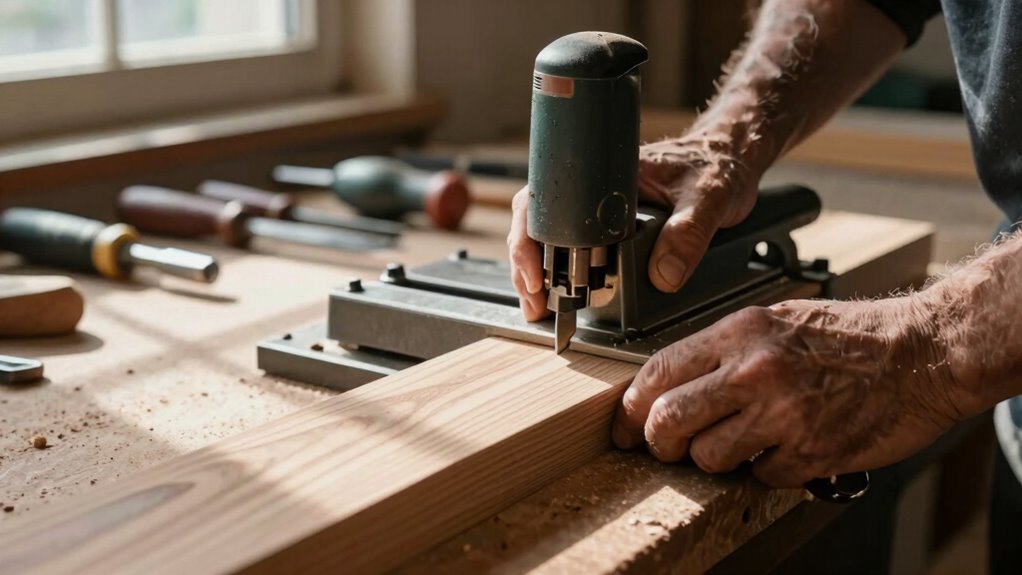
Jointers are vital tools that can elevate your woodworking skills as you grow. When you first start, you might see them as just another piece of equipment, but as you dive deeper into the craft, their true value becomes apparent. A jointer allows you to create flat, straight edges on boards, which is important for any project requiring precision. As your skills progress, you’ll find that using a jointer effectively can transform your work from ordinary to extraordinary.
As you become more familiar with jointers, you’ll start to explore advanced techniques. You might begin with basic edge jointing, but soon you’ll want to tackle more complex projects. The ability to joint wider boards and create perfectly square edges will open up new possibilities. The accuracy of your cuts will improve as you learn to adjust the infeed and outfeed tables to guarantee perfect alignment, enhancing your overall precision. This attention to detail will not only improve your projects but also boost your confidence as you see your skills develop. Regularly maintaining and calibrating your tools ensures the optimal performance necessary for high-quality craftsmanship.
As you master jointers, you’ll unlock advanced techniques that elevate your woodworking projects and boost your confidence.
Tool maintenance plays a significant role in maximizing the value of your jointer. Regularly checking the blades for sharpness and alignment can make a world of difference in your work quality. Dull blades can lead to tear-out, which can ruin the look of your wood. As you become more skilled, you’ll appreciate the nuances of keeping your tools in top shape. You’ll learn to clean the tables and adjust the settings, ensuring that your jointer operates smoothly. This proactive approach will save you time and frustration in the long run, especially as you start working with a wider variety of woods and projects.
Moreover, as your woodworking capabilities expand, you’ll find yourself experimenting with different types of wood. Each species has its characteristics, and understanding how to adjust your jointer settings accordingly will enhance your results. You might discover that certain woods require specific techniques to achieve the best finish. This knowledge not only showcases your growth as a woodworker but also enriches your projects with a level of craftsmanship that sets your work apart. Developing a solid understanding of jointer operation and maintenance will ensure your success and satisfaction over time.
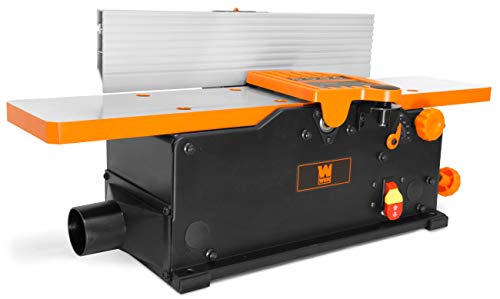
WEN JT630H 10-Amp 6-Inch Spiral Benchtop Jointer
- Spiral cutterhead with 12 HSS blades: Ultra-fine finish
- Large 30×6-inch work table: Spacious workspace
- Adjustable cut depth: Removes 0 to 1/8 inch per pass
As an affiliate, we earn on qualifying purchases.
As an affiliate, we earn on qualifying purchases.
Frequently Asked Questions
What Types of Jointers Are Best for Beginners?
For beginners, a good choice is a bench jointer or a portable jointer. These beginner jointers typically come with essential features like easy adjustments, a sturdy fence, and a solid motor. Look for models with a simple setup and smooth operation to help you get started. Don’t forget to take into account the width of the cut; a 6-inch model is often perfect for most projects as you build your skills.
How Often Should Jointers Be Maintained?
You should perform jointers maintenance regularly, ideally after every few uses, to guarantee peak performance. Check the blades for sharpness and alignment, and clean the table to prevent debris buildup. Regular maintenance not only enhances the jointer’s performance but also extends its longevity. By staying on top of these tasks, you’ll keep your jointer in top shape, making your woodworking projects smoother and more enjoyable.
Can Jointers Be Used for Different Wood Types?
Yes, jointers can be used for different wood types. However, you’ll need to take into account wood density and grain patterns. Softer woods like pine are easier to work with, while hardwoods require more care due to their density. If you’re jointing a dense wood, adjust your technique to accommodate its grain patterns. Experimenting with various woods will help you understand how each behaves, enhancing your skills and making your work more enjoyable.
What Safety Gear Is Essential When Using Jointers?
When using a jointer, don’t skip on safety gear—it’s essential for protecting yourself. Start with protective eyewear to shield your eyes from flying debris. You’ll also want to wear ear protection, as jointers can be loud. A dust mask is a good idea to avoid inhaling sawdust. Though some might think safety gear’s a hassle, it’s worth it to keep you safe and focused on your work.
Are There Alternative Tools to Jointers for Similar Tasks?
Yes, there are several jointer alternatives for similar tasks. You can use a planer, which smooths surfaces and can flatten boards with the right technique. A table saw with a sled also works for edge jointing. Tool comparisons show that while jointers are efficient, these alternatives can achieve similar results, especially for DIY projects. Experimenting with different tools lets you find what suits your needs best and enhances your woodworking skills.
Conclusion
As your skills grow, jointers become invaluable tools in your woodworking arsenal. Imagine a beginner who, after mastering the basics, transforms a rough board into a perfectly flat surface for a stunning dining table. That sense of accomplishment and precision not only elevates your projects but also boosts your confidence. The more you practice, the more you’ll appreciate how jointers can unleash your creativity and enhance your craftsmanship. Embrace the journey, and watch your skills flourish!