
Pinless moisture meters give quick, non-invasive readings of moisture levels, making them useful for checking surfaces without damage. These measurements are relative, so they help you compare areas or monitor changes over time, but they don’t show exact moisture content deep within materials. Surface coatings or irregularities can affect results, so it’s best to verify suspicious signals. Keep reading to discover how to interpret these figures accurately and know when to trust them.
Key Takeaways
- Readings indicate relative moisture levels, useful for comparing spots or tracking changes, not absolute moisture content.
- Proper calibration and correct device usage are essential for trustworthy measurements.
- Surface conditions, finishes, or coatings can affect electromagnetic signals, impacting accuracy.
- Use pinless meter readings as a quick comparison tool, corroborating with other methods if results seem inconsistent.
- They are most reliable for superficial moisture assessment; deep or thick materials may require additional testing.

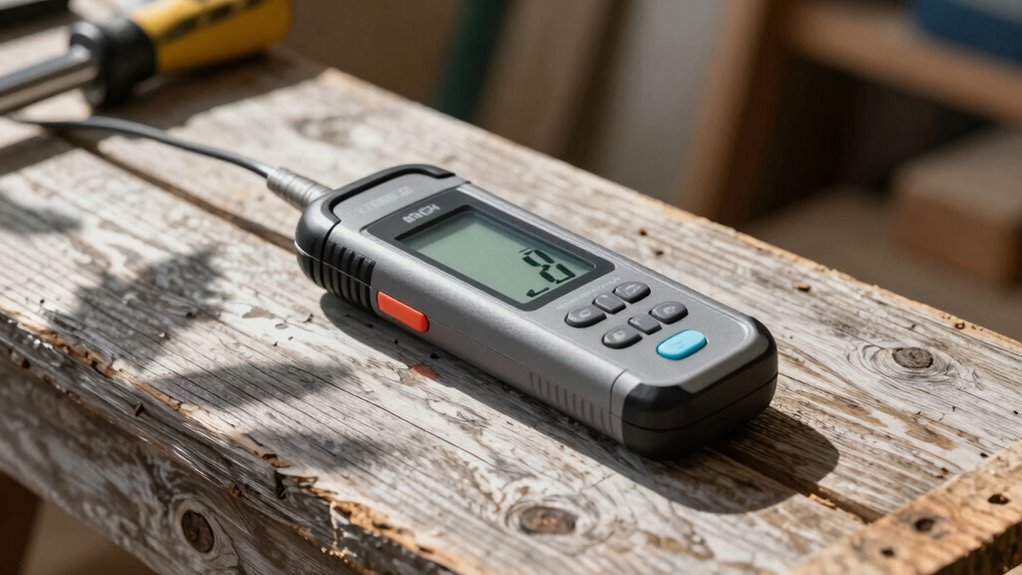
Pinless moisture meters are essential tools for quickly and non-invasively detecting moisture levels in various materials. They allow you to evaluate moisture content without damaging or penetrating the surface, making them ideal for delicate or finished surfaces. When it comes to moisture detection, these devices offer a significant advantage: they provide immediate readings, enabling you to make informed decisions in real time. However, understanding what these readings mean and knowing when to trust them is crucial for accurate assessments.
Pinless moisture meters provide quick, non-invasive moisture readings ideal for delicate surfaces.
The key to reliable moisture detection with pinless meters lies in their tool accuracy. Unlike pin-type meters, which insert probes into the material, pinless meters use electromagnetic signals to measure moisture content through the surface. This method tends to be quicker and less invasive but can sometimes be affected by surface conditions or the material’s density. The accuracy of your readings depends on several factors, including the calibration of your device, the type of material you’re testing, and how well you follow manufacturer instructions. For example, some materials, like dense hardwood or concrete, may require different calibration settings to yield precise results.
When you take a reading, keep in mind that the numbers displayed are relative measurements, not absolute moisture content. They are most useful for comparative purposes—such as determining if a spot is wetter than another or assessing whether a material has dried sufficiently. Trusting these readings requires understanding their context. If your device is properly calibrated and you’re testing appropriate materials, the readings can be quite accurate. However, if surface finishes, coatings, or contaminants are present, they might interfere with electromagnetic signals and skew results. In such cases, it’s wise to interpret readings cautiously and consider corroborating them with other methods or tools.
It’s also essential to recognize the limitations of pinless moisture meters. They might not detect moisture deep within thick materials or in areas with irregular surfaces. When readings are inconsistent or suspicious, it’s prudent to verify with additional testing or specialized equipment. Additionally, proper calibration and familiarity with your specific device are crucial for ensuring the accuracy and reliability of your readings. By understanding what your pinless meter’s readings indicate and being aware of their limitations, you can confidently use these tools to make sound decisions in construction, restoration, or inspection projects.
As an affiliate, we earn on qualifying purchases.
Frequently Asked Questions
Can Pinless Moisture Meters Measure Moisture in All Materials?
You can’t depend on pinless moisture meters to measure moisture in all materials because of material limitations. These meters work best on non-porous, flat surfaces like wood and drywall, but may give inaccurate readings on dense or irregular materials. Always follow proper calibration practices for each material type to guarantee accuracy. When measuring unfamiliar or challenging materials, double-check with other methods to confirm moisture levels.
How Do Environmental Conditions Affect Pinless Moisture Readings?
Environmental conditions like humidity interference and temperature effects can impact your pinless moisture readings. High humidity can cause false high readings, while extreme temperatures may skew results by affecting the meter’s sensors. To guarantee accuracy, avoid testing in very humid or hot environments, and allow materials to acclimate to room temperature first. Regular calibration and understanding these environmental influences help you trust your readings more reliably.
Are Pinless Moisture Meters Suitable for Commercial or Industrial Use?
You’ll find pinless moisture meters are well-suited for industrial applications, acting like a trusty lighthouse guiding you through complex material compatibility challenges. Their non-invasive nature makes them ideal for commercial and industrial use, allowing quick, accurate readings across diverse surfaces without damaging materials. Whether evaluating wooden beams or concrete walls, these meters help guarantee safety and quality, making them a reliable tool in your toolkit for large-scale projects.
What Is the Maximum Material Thickness That Pinless Meters Can Evaluate?
You can typically measure materials up to about 1 to 2 inches thick with pinless moisture meters. Beyond this material limitation, your reading accuracy may decline, especially with denser or thicker materials. Always check your device’s specifications to guarantee peak performance. If you need to evaluate thicker materials, consider using pin-type meters or alternative methods to get more reliable moisture readings.
How Often Should Calibration Be Performed on a Pinless Moisture Meter?
You should perform calibration on your pinless moisture meter at least once every six months to guarantee accuracy. Regular calibration frequency helps maintain the device’s accuracy assurance, especially if you use it frequently or in different environments. Keep an eye on any inconsistent readings, and calibrate more often if you notice discrepancies. Proper calibration ensures reliable measurements, so don’t skip this essential step for peak performance.
Conclusion
So, next time you use a pinless moisture meter, remember that understanding its readings is key to making informed decisions. Trust these tools for quick, non-invasive checks, but also consider their limitations. Are you ready to confidently assess moisture levels and protect your materials? With proper use and interpretation, pinless meters become invaluable in your toolkit, helping you prevent damage and ensure quality—are you prepared to make smarter, more accurate moisture measurements?