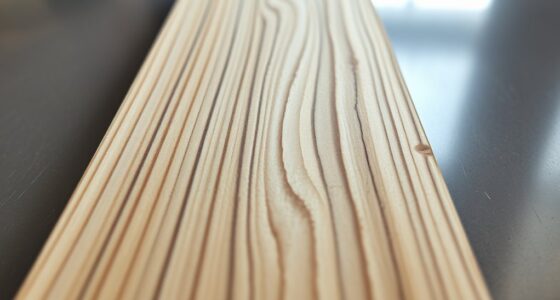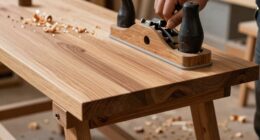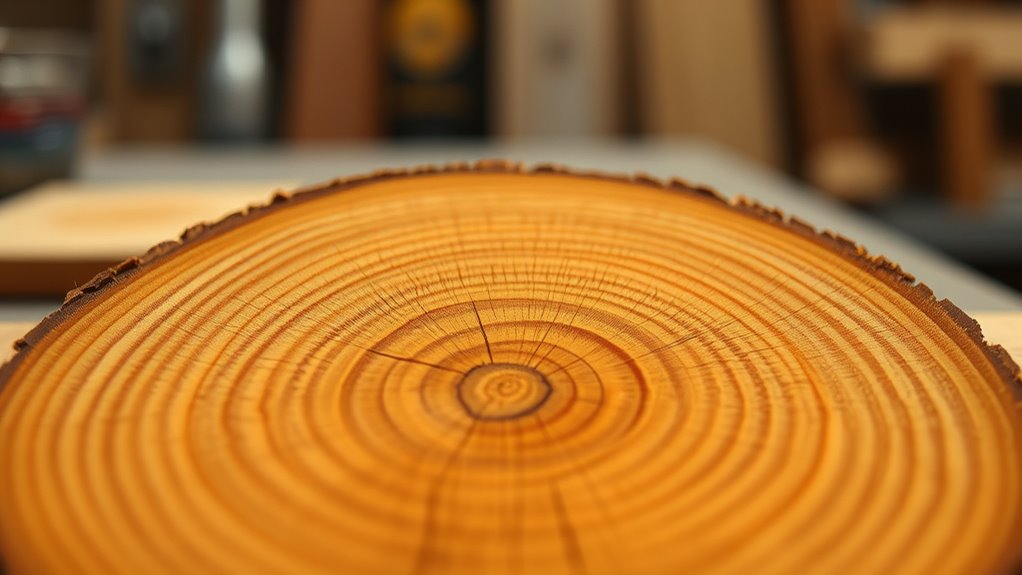

To establish reference faces and edges in lumber, start by identifying the flattest, most stable surface as your reference face, guaranteeing it’s free of warps or knots. Use a straightedge or planer to flatten it if needed. Then, check the edges with a square, smoothing out any twists or unevenness. Proper reference surfaces ensure accurate cuts and assembly, so mastering these steps will set you up for successful woodworking projects. Continue to explore these techniques further to improve your craftsmanship.
Key Takeaways
- Identify the flattest, most stable surface as the reference face, free of warps and knots.
- Use a straightedge or planer to flatten and establish the reference face if needed.
- Check edges for squareness using a carpenter’s square, planing or sanding to correct misalignments.
- Always verify reference surfaces with a reliable square for measurement accuracy.
- Maintain the reference face and edges throughout the project to ensure precise cuts and assembly.

When working with lumber, establishing accurate reference faces and edges is essential for precise cuts and measurements. Your first step is to identify the grain orientation, which notably influences how you handle the board. Grain runs along the length of the wood, and understanding its direction helps in making cuts that are both strong and visually appealing. If you cut against the grain, you risk splintering or weakening the finished piece. Hence, before marking your reference face, examine the board carefully to determine the natural flow of the grain, ensuring your cuts align with it.
Next, focus on establishing a consistent reference face. This face becomes the foundation for all your measurements and cuts. To find it, look for the flattest, most stable surface — often the side that’s free of warps, bows, or knots. Use a straightedge or a planer if needed to flatten it further. Once you’ve identified this face, you can designate it as your primary reference. This face should be kept as the top or front surface during your work, providing a reliable baseline for all subsequent measurements.
Edge alignment is equally important and involves ensuring your edges are straight and true. After establishing the reference face, use a square to check the edges for squareness. If an edge isn’t aligned properly, plane or sand it until it’s straight and perpendicular to your reference face. Proper edge alignment guarantees that your panels fit together accurately and that your measurements are consistent. Keeping edges straight also aids in clamping and helps prevent material waste due to inaccuracies.
Throughout this process, always double-check your reference surfaces against a reliable square or straightedge. Misaligned edges or an uneven reference face can lead to cumulative errors, throwing off your entire project. Remember, the grain orientation impacts how the wood reacts to cutting and planing, so always work with the grain when possible. When you align the edges properly, you create a solid foundation for your project, ensuring that your cuts are precise and your assembly fits seamlessly. Additionally, understanding the importance of a reference face can help ensure the stability and accuracy needed for high-quality woodworking.

Peachtree Woodworking Supply Stainless Steel Center Finding Ruler. Ideal for Woodworking, Metal Work, Construction and Around The Home (24" Ruler)
When trying to find the center on rectangular, square or even round objects it can sometimes be challenging…
As an affiliate, we earn on qualifying purchases.
As an affiliate, we earn on qualifying purchases.
Frequently Asked Questions
How Do I Choose the Best Reference Face for Different Lumber Types?
When choosing the best reference face for different lumber types, you should prioritize grain orientation and surface flatness. Pick a face where the grain runs parallel to your cut, ensuring stability and strength. Also, select a surface that’s flat and smooth to provide a reliable reference point. This helps maintain accuracy during your project and reduces the risk of warping or uneven cuts, making your work more precise and professional.
What Tools Are Essential for Establishing Reference Edges Accurately?
Ever wondered how you can guarantee your edges are perfectly straight? You’ll need essential tools like measuring tools—such as a combination square or a straightedge—and marking implements like a pencil or marking knife. These help you mark precise reference edges. Using these tools, you can accurately establish reference edges that serve as reliable guides for your cuts and further woodworking steps. Don’t skip their importance for a clean, professional finish.
How Does Wood Moisture Content Affect Reference Face Stability?
Moisture content considerably impacts reference face stability because moisture variation causes wood shrinkage or swelling. When the moisture content fluctuates, the reference face can warp or crack, making it less reliable for precise measurements. You should always check for consistent moisture levels before establishing reference faces. Controlling moisture content helps maintain stability, ensuring your reference edges stay true and accurate during machining or assembly.
Can Reference Faces Be Re-Established After Initial Surfacing?
Yes, you can restore reference faces and re-establish edges after initial surfacing. To do this, you’ll need to carefully plane or sand the surface to create a flat, stable reference face again. Re-establishing edges involves jointing or planing to ensure they’re straight and square. This process helps maintain accuracy for subsequent work, especially if moisture content or other factors have caused movement or warping.
What Are Common Mistakes to Avoid When Establishing Reference Edges?
Think of establishing reference edges like aligning a picture frame; one crooked corner throws everything off. Avoid measurement errors by double-checking your tools and marking carefully. Don’t rush, or you’ll risk misaligned edges, which can lead to inaccuracies in your project. Always verify your reference edges before proceeding, as small missteps can snowball into bigger problems later. Precision now saves headaches later.

3.8"Mini 3D Multi-Angle Measuring Square Ruler, WT102A High Precision Hole Scribing Woodworking Tools, 0-90° Aluminum Alloy Carpenter Square Wood Working Tools, Carpenter Pencils 6 Refills.
Multi-Functional Woodworking Tools: Crafted by combining a rafter square ruler and a triangle ruler with imperial scales, the…
As an affiliate, we earn on qualifying purchases.
As an affiliate, we earn on qualifying purchases.
Conclusion
So, after all that effort to establish perfect reference faces and edges, it turns out precision isn’t always necessary. Ironically, your carefully aligned cuts often don’t matter as much as you’d think—until they do. In the end, a little deviation adds character, right? But don’t forget, those reference surfaces are the backbone of your project. Without them, it’s a gamble—so enjoy the process, even if perfection isn’t always the goal.

DEWALT Thickness Planer, 13-inch Wood Planer, Three Knife Two Speed, 15 Amp, 20,000 RPM Motor (DW735X)
Electric planer for wood has powerful 15 amp, 20,000 rpm motor (10,000 rpm cutterhead speed) handles larger cuts…
As an affiliate, we earn on qualifying purchases.
As an affiliate, we earn on qualifying purchases.
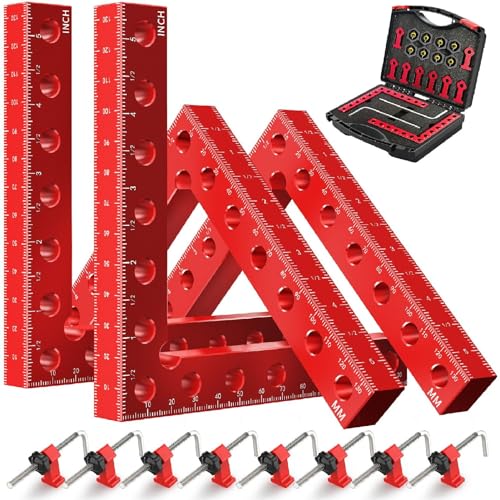
WETOLS Corner Clamps for Woodworking, 4Pcs 5.5" Aluminum Alloy Right Angle Clamp, Spreader Positioning Squares with 6-Sided Scales, 90 Degree Clamp for Cabinets, Drawers, Shelves, Frames
Stable and Consistent Right-Angle Control: CNC-machined from a single block of high-density aluminum alloy, these angle clamps for…
As an affiliate, we earn on qualifying purchases.
As an affiliate, we earn on qualifying purchases.