Finding the best 2 stage dust collector in 2026 involves balancing power, filtration, capacity, and price. The VEVOR 2 HP Dust Collector stands out as the overall top choice because of its high airflow and large collection capacity. The JET Cyclone Dust Collector, 2-Micron Filter offers superior filtration for those prioritizing cleaner air, while the WEN DC1300 provides excellent value for smaller workshops. Each of these options presents different tradeoffs—higher power units tend to be more expensive and less portable, while smaller models may struggle with larger dust loads. Continue reading for a detailed breakdown of each product to find the best fit for your workspace.
Complete the kit

Key Takeaways
- High CFM airflow is essential for large workshops with multiple machines, as seen with the VEVOR and JET cyclone models.
- Filtration quality, especially 2-micron filters, significantly impacts air cleanliness and health, favoring JET cyclone options.
- Capacity varies widely; larger capacity units reduce emptying frequency but tend to be bulkier and pricier.
- Portability is a key factor for mobile workshops, with models like the Grizzly G1028Z2 excelling in this area.
- Price often correlates with power and features, but the best choice depends on specific workshop size and dust load.
| VEVOR 2 HP Dust Collector with 1167 CFM, 39-Gallon Collection Bag, and Mobile Base |  | Best Overall for Versatile Heavy-Duty Use | Motor Power: 2 HP | Airflow: 1167 CFM | Collection Capacity: 39 Gallon | VIEW LATEST PRICE | See Our Full Breakdown |
| JET Cyclone Dust Collector, 2-Micron Filter, 2 HP, 230V 1Ph |  | Best for Fine Dust Extraction and Ease of Control | Filter Size: 2 Micron | Motor Power: 2 HP | Voltage: 230V | VIEW LATEST PRICE | See Our Full Breakdown |
| JET Cyclone Dust Collector, 2-Micron Filter, 1-1/2 HP, 115V |  | Best for Mobility and Compact Indoor Use | Power: 1.5 HP | Voltage: 115V | Capacity: 20 gallons | VIEW LATEST PRICE | See Our Full Breakdown |
| WEN DC1300 1,300 CFM 14-Amp 5-Micron Woodworking Dust Collector with 50-Gallon Collection Bag and Mobile Base |  | Best for Woodworking Shops with High Airflow Needs | Airflow: 1,300 CFM | Motor Power: 14 Amps | Collection Capacity: 50 Gallons | VIEW LATEST PRICE | See Our Full Breakdown |
| JET Cyclone Dust Collector, 2-Micron Filter, 3 HP, 230V 1Ph |  | Best for Heavy-Duty Industrial-Grade Dust Collection | Filter Efficiency: 99% of 2-micron particles | Particle Capture: 86% of 1-micron particles | Power: 3 HP | VIEW LATEST PRICE | See Our Full Breakdown |
| Grizzly Industrial G1028Z2 1-1/2 HP Portable Dust Collector |  | Best Portable Power for Versatile Dust Collection | Motor Power: 1-1/2 HP | Voltage: 120V/240V | Motor RPM: 3450 RPM | VIEW LATEST PRICE | See Our Full Breakdown |
| ALORAIR 580/780 CFM 2-Stage Air Filtration System for Woodworking |  | Best Air Filtration for Indoor Workspace Comfort | Air Flow: 580/780 CFM | Filtration: MERV-13 | Weight: 17.4 pounds | VIEW LATEST PRICE | See Our Full Breakdown |
| Dayton Wood Dust Collector, 1310 CFM Max Flow, 2 HP, Three Phase |  | Best Heavy-Duty Professional Dust Collector | Max Flow: 1310 CFM | Horsepower: 2 HP | Power Supply: Three Phase | VIEW LATEST PRICE | See Our Full Breakdown |
| Dayton Wood Dust Collector, 1100 CFM Max Flow, 1.5 HP, Single Phase |  | Best Reliable Budget-Friendly Dust Collector | Max Flow: 1100 CFM | Horsepower: 1.5 HP | Phase: Single Phase | VIEW LATEST PRICE | See Our Full Breakdown |
More Details on Our Top Picks
VEVOR 2 HP Dust Collector with 1167 CFM, 39-Gallon Collection Bag, and Mobile Base
This portable cyclone dust collector stands out for its impressive airflow of 1167 CFM and a large 39-gallon drum, making it ideal for demanding woodworking or industrial environments. Its vortex cone technology enhances separation efficiency, similar to the JET 3 HP model, but with added mobility thanks to lockable wheels and a flexible hose. While it offers powerful suction and extensive capacity, its bulkiness might challenge smaller workshops, and setup can be complex for first-time users. Compared to the smaller WEN 50-gallon unit, this model provides greater capacity and more robust filtration, but at a higher cost and with increased space requirements.
Pros:- Powerful suction with 1167 CFM airflow
- Large 39-gallon collection drum for extended use
- Efficient 3μm filtration captures 99% of dust
- Highly portable with lockable wheels and flexible hose
Cons:- Bulky size may hinder small workshop setups
- Requires 120V power, which may limit flexibility
- Initial setup can be complex for inexperienced users
Best for: Large workshops needing high capacity and mobility for heavy-duty dust collection
Not ideal for: Small garages or tight spaces where size and portability are constrained
- Motor Power:2 HP
- Airflow:1167 CFM
- Collection Capacity:39 Gallon
- Voltage:120V
- Speed:3400 RPM
- Filter:3μm Canister Filter Kit
Our verdict“This model suits large, busy workshops that prioritize capacity and mobility over compactness.”
JET Cyclone Dust Collector, 2-Micron Filter, 2 HP, 230V 1Ph
The JET Cyclone Dust Collector excels with a 2-micron pleated filter and remote operation, offering superior fine dust capture down to 1 micron. Its cyclone separation system boosts airflow efficiency compared to single-stage units like the WEN DC1300, making it better suited for environments with high dust loads. However, its 230V power requirement limits portability, and its weight and size may be a challenge for smaller spaces. Compared with the 1.5 HP JET model, the 2 HP version delivers higher airflow, making it a strong choice for serious dust management, although it comes with a steeper price and installation complexity.
Pros:- Efficient two-stage separation improves airflow
- Captures particles down to 1 micron
- Remote control with timer adds convenience
- 30-gallon drum accommodates heavy debris
Cons:- Requires 230V power, reducing portability
- Heavy and less maneuverable without proper setup
- Setup may be complex for beginners
Best for: Professionals handling fine dust in larger or dedicated workshops
Not ideal for: Small hobbyists or garages with limited electrical capacity
- Filter Size:2 Micron
- Motor Power:2 HP
- Voltage:230V
- Capacity:30 gallons
Our verdict“Ideal for serious users needing high filtration efficiency and remote control features in larger workshops.”
JET Cyclone Dust Collector, 2-Micron Filter, 1-1/2 HP, 115V
This JET model provides a compact yet effective solution with a 20-gallon drum and remote control, making it ideal for smaller workshops or indoor environments. Its two-stage cyclone separation ensures efficient debris removal, comparable to larger units but on a smaller scale, making it suitable for hobbyists or light-duty applications. The swivel casters facilitate mobility, but its noise level of 75 dB and limited capacity mean it isn’t suited for heavy, continuous use. Compared to the 2 HP models, it sacrifices airflow for size and ease of handling, perfect for those prioritizing portability and space-saving design.
Pros:- Efficient two-stage separation
- Remote operation for convenience
- Swivel casters for easy mobility
- Captures dust down to 1 micron
Cons:- Limited to indoor use, not suitable for outdoor workshops
- Lower capacity at 20 gallons
- Relatively noisy at 75 dB
Best for: Small workshops or hobbyists needing a portable, efficient dust collector
Not ideal for: High-volume industrial settings or users requiring maximum capacity
- Power:1.5 HP
- Voltage:115V
- Capacity:20 gallons
- Noise Level:75 dB
Our verdict“Perfect for small-scale, indoor applications where space and portability matter most.”
WEN DC1300 1,300 CFM 14-Amp 5-Micron Woodworking Dust Collector with 50-Gallon Collection Bag and Mobile Base
The WEN DC1300 offers a solid balance of airflow and capacity, boasting 1300 CFM with a 50-gallon collection bag, making it ideal for large woodworking operations. Its dual 4-inch inlets support multiple tools simultaneously, and the mobile base improves setup flexibility. Compared to the smaller JET or the less powerful models, it provides higher airflow and larger capacity, but its bulkiness and weight could pose challenges in tight spaces. Its 14-amp motor and relatively straightforward setup make it a practical choice for serious woodworking shops prioritizing airflow and capacity without overcomplicating installation.
Pros:- High airflow capacity of 1300 CFM
- Large 50-gallon collection bag reduces emptying frequency
- Dual 4-inch inlets support multiple tools
- Mobile base enhances flexibility
Cons:- Heavy and bulky, challenging in small spaces
- Requires significant setup space
- Power consumption may be high for some users
Best for: Large woodworking shops requiring high volume dust collection with multiple tool connections
Not ideal for: Small hobbyist workshops or spaces with limited room for large equipment
- Airflow:1,300 CFM
- Motor Power:14 Amps
- Collection Capacity:50 Gallons
- Inlet Size:4 inches
Our verdict“Tailored for large woodworking environments where airflow, capacity, and tool versatility are priorities.”
JET Cyclone Dust Collector, 2-Micron Filter, 3 HP, 230V 1Ph
The JET 3 HP cyclone dust collector offers the highest power and largest capacity in this lineup, with a 66-gallon drum and 99% efficiency at capturing 2-micron particles. Its two-stage cyclone system enhances separation, similar to the 2 HP models but with added power for demanding environments. Remote RF control adds convenience, but its weight of 268 pounds and complex setup make it less suitable for small workshops or mobile use. This model is a clear choice for industrial applications or large-scale manufacturing where maximum dust removal performance outweighs portability.
Pros:- High dust collection efficiency with 99% of 2-micron particles
- Large 66-gallon drum reduces emptying frequency
- Remote RF control for ease of operation
- Two-stage cyclone separation enhances performance
Cons:- Heavy, demanding significant space and setup effort
- Higher price point reflects industrial-grade features
- Complex initial setup for new users
Best for: Industrial workshops or large-scale operations requiring maximum dust filtration and capacity
Not ideal for: Small or mobile workshops with space or electrical constraints
- Filter Efficiency:99% of 2-micron particles
- Particle Capture:86% of 1-micron particles
- Power:3 HP
- Voltage:230V
- Collection Capacity:66 gallons
- Warranty:5 years (industrial use: 2 years)
Our verdict“Best suited for large, industrial environments where maximum filtration and capacity are essential.”
Grizzly Industrial G1028Z2 1-1/2 HP Portable Dust Collector
This portable dust collector stands out for its robust 1-1/2 HP motor delivering a high airflow of 1300 CFM, making it well-suited for medium to larger woodworking shops. Compared with the Dayton 1100 CFM unit, this model offers greater suction capacity, which means more efficient dust collection for demanding tasks. Its dual 4-inch inlets allow flexible hose connections, accommodating various setups. However, its size and motor power mean it can be noisy and requires sufficient space for mobility, which might be a drawback for tight workshops. The unit’s portability is a significant advantage, but it demands a dedicated power outlet and careful placement. Overall, this dust collector is ideal for users needing powerful, mobile dust control in a sizable workshop, despite its noise and space considerations.
Pros:- Powerful 1-1/2 HP motor delivers effective dust extraction
- High airflow capacity of 1300 CFM for demanding dust collection
- Dual inlet design offers flexible setup options
Cons:- Requires ample space for mobility and operation
- Potentially noisy during extended use
Best for: Woodworking professionals or serious hobbyists needing high airflow with portability.
Not ideal for: Small workshops with limited space or users with noise sensitivity, due to its size and operational noise.
- Motor Power:1-1/2 HP
- Voltage:120V/240V
- Motor RPM:3450 RPM
- Air Suction Capacity:1300 CFM
- Static Pressure:9 inches
- Inlet Size:6 inches with two 4-inch openings
Our verdict“This model is perfect for larger workshops where mobility and power are priorities, even if noise and space are concerns.”
ALORAIR 580/780 CFM 2-Stage Air Filtration System for Woodworking
The ALORAIR 580/780 CFM system excels in indoor air quality, especially for those who prioritize cleaner air over raw dust collection power. Its 2-stage filtration with high-efficiency MERV-13 filters captures 90% of 3-10 micron particles, outperforming many single-stage systems like the Dayton 1100 CFM unit. Its compact design and lightweight build make it easy to move around, and the quiet operation at 58 dBA means it won’t disrupt a workshop environment. However, it’s limited to spaces up to 800 sq.ft., and filter replacements can add ongoing costs. Unlike larger dust collectors that focus on debris removal, this device targets air quality, making it ideal for workshops where dust containment and health are priorities. It complements a basic dust collection setup, not replace it.
Pros:- High-efficiency MERV-13 filter reduces 90% of fine particles
- Compact and portable with handle for easy movement
- Quiet operation at 58 dBA minimizes noise disturbance
Cons:- Filter replacement may be needed frequently
- Limited to spaces up to 800 sq.ft.
- No smart features or connectivity options
Best for: Woodworkers or hobbyists seeking improved air quality and quiet operation in small to medium workshops.
Not ideal for: Large shops requiring high-volume debris removal, as its airflow maxes at 780 CFM and space coverage is limited.
- Air Flow:580/780 CFM
- Filtration:MERV-13
- Weight:17.4 pounds
- Dimensions:14.57 x 11.81 x 9.48 inches
- Noise Level:58 dBA
- Additional Features:Anti-slip rubber stands, extra socket for power tools
Our verdict“Ideal for users prioritizing indoor air quality and quiet operation in small to medium workshops, despite limited airflow capacity.”
Dayton Wood Dust Collector, 1310 CFM Max Flow, 2 HP, Three Phase
This Dayton 2 HP, three-phase dust collector offers a maximum airflow of 1310 CFM, making it a top choice for large, professional woodworking shops that need serious debris removal power. It surpasses the Dayton 1100 CFM single-phase model in capacity, providing a more robust solution for demanding environments. The three-phase power requirement, however, limits its use to facilities with appropriate electrical infrastructure, which might exclude many small workshops. Its high airflow ensures efficient dust extraction but also means it consumes more energy and may require soundproofing. Designed for heavy-duty applications, this collector delivers reliability and power, but only where three-phase power is readily available and budget allows for the higher installation cost.
Pros:- High airflow capacity of 1310 CFM for maximum debris removal
- Powerful 2 HP motor for demanding tasks
- Ideal for large, professional environments
Cons:- Requires three-phase power, not suitable for all shops
- Higher installation and operational costs
Best for: Large-scale professional workshops or commercial woodworking operations with three-phase power access.
Not ideal for: Small or hobbyist workshops without three-phase electrical supply, due to installation constraints.
- Max Flow:1310 CFM
- Horsepower:2 HP
- Power Supply:Three Phase
Our verdict“Best suited for large, professional woodworking environments with three-phase power, where maximum airflow and durability are essential.”
Dayton Wood Dust Collector, 1100 CFM Max Flow, 1.5 HP, Single Phase
The Dayton 1100 CFM, 1.5 HP model offers a practical balance of airflow and affordability for smaller workshops or hobbyists. Its single-phase operation makes it accessible for most residential setups, and with a solid airflow of 1100 CFM, it can handle typical dust collection tasks effectively. Compared to the larger 1310 CFM unit, this model is less powerful but more versatile for shops without three-phase power. Its straightforward design and reliable performance make it a dependable choice, though limited details on noise levels and size may require buyers to seek additional information before purchasing. Overall, it provides a cost-effective solution for maintaining a clean workspace without sacrificing too much suction power.
Pros:- Effective airflow of 1100 CFM for typical dust collection needs
- Single-phase operation compatible with most homes
- Reliable brand with proven performance
Cons:- Limited detailed specs on noise and size
- Less powerful than three-phase models like Dayton 1310 CFM
Best for: Hobbyists or small workshop owners seeking a dependable, easy-to-install dust collector on a budget.
Not ideal for: Heavy industrial shops or users needing maximum airflow, as its capacity is slightly below larger models and may struggle with very fine dust in larger spaces.
- Max Flow:1100 CFM
- Horsepower:1.5 HP
- Phase:Single Phase
- Made in:China
Our verdict“A solid, budget-friendly choice for small workshops and hobbyists, providing reliable dust collection without complex electrical requirements.”
How We Picked
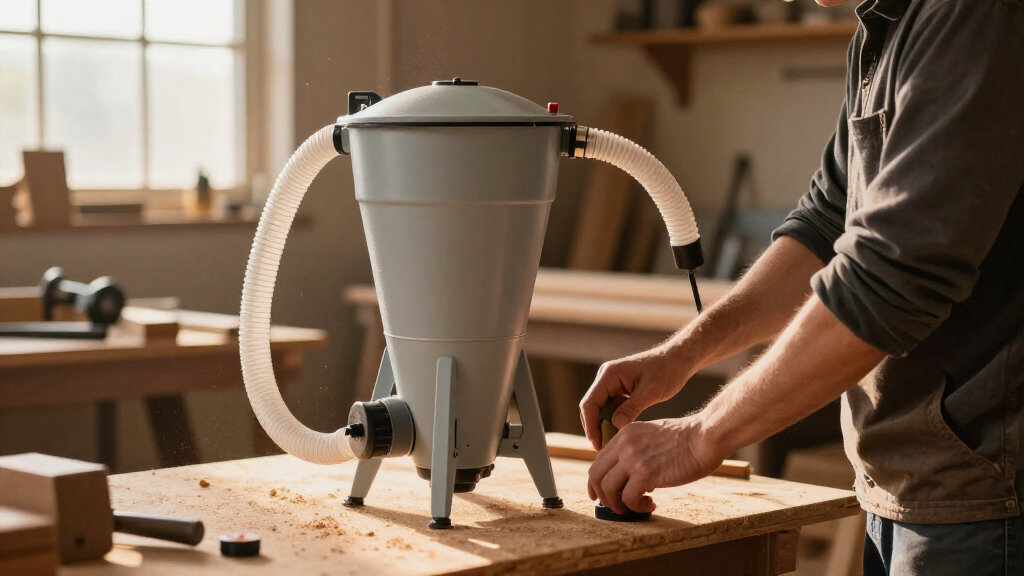
To evaluate these dust collectors, I focused on critical factors relevant to buyers: performance, build quality, filtration efficiency, capacity, ease of use, and value for money. I compared airflow ratings (CFM), motor power, filter micron size, and tank capacity to determine which models can handle different workshop demands. Maintenance features, portability, and user reviews also played roles in ranking. The goal was to identify options that balance power and practicality, highlighting those that excel in real-world woodworking scenarios while considering budget considerations.Factors to Consider When Choosing Best 2 Stage Dust Collector
Choosing the best 2 stage dust collector requires understanding several key factors that impact performance and usability. Beyond raw power, filtration efficiency and capacity determine how clean your air remains and how often you need to empty the unit. Portability can be crucial if your workshop layout changes frequently. Considering the motor size and airflow helps match the dust collector to your workshop size and dust load, preventing undersized units from struggling or oversized units from wasting energy. Thinking about maintenance and ease of filter replacement can save you time and frustration in the long run. Finally, budget constraints influence whether you prioritize high-end features or more economical options.Power and Airflow (CFM)
Airflow, measured in CFM, directly affects your dust collection efficiency. A higher CFM means more air is moved through the system, capturing dust at multiple machines simultaneously. Larger workshops or setups with several power tools benefit from units with 1300+ CFM, like the VEVOR or JET cyclone models. However, more power often comes with increased energy consumption and cost. Choosing the right CFM depends on your workshop size and the number of machines—undersized units will struggle, while overly powerful ones may be unnecessary and more expensive.
Filtration Quality
Filtration is vital for maintaining a healthy, dust-free environment. A 2-micron filter captures fine dust particles, which are most harmful when inhaled. The JET cyclone models excel here, providing superior filtration compared to units with 5-micron filters like the WEN DC1300. Better filtration not only improves air quality but also prolongs the lifespan of your dust collector by reducing filter clogging. Keep in mind that higher-grade filters may require more careful maintenance and can be more costly to replace.
Capacity and Size
Tank capacity influences how often you need to empty your dust collector. Larger tanks, such as the 39-gallon in the VEVOR model, suit large workshops but add to the unit’s bulk. Smaller tanks are easier to move and fit into tighter spaces but require more frequent emptying, which can interrupt workflow. Consider your workshop’s space and dust load when selecting capacity—larger tanks are typically more cost-effective over time but may demand additional space and handling effort.
Portability and Ease of Use
For workshops where mobility is a concern, features like wheels, handles, and compact size matter. The Grizzly G1028Z2, with its portable design, is ideal for moving between different workstations. Conversely, larger units like the JET cyclone models are better suited for fixed installations. Ease of filter replacement, user interface, and maintenance access should also be considered to reduce downtime and simplify ongoing upkeep.
Budget and Value
Budget influences almost every decision; higher-end models offer better filtration, larger capacity, and more power, but at a premium. Cheaper units like the WEN DC1300 provide decent performance for small workshops but may lack advanced features and durability. Balance your expected workload, long-term maintenance costs, and initial investment to find a model that offers the best value for your specific needs. Remember, spending more upfront on a reliable, powerful unit can save money and headaches later.
Frequently Asked Questions
How do I know if a 2 stage dust collector is powerful enough for my workshop?
Assess your workshop size and the number of tools you use simultaneously. A dust collector with at least 1200 CFM is recommended for larger setups with multiple machines, while smaller workshops with a single or few tools can often suffice with units around 900 CFM. Consider your dust load and whether you need high filtration or larger capacity. Matching the power to your needs prevents underperformance and ensures cleaner air and more efficient dust collection.
Is a higher micron filter always better?
Not necessarily. While a 2-micron filter captures finer dust particles, which are better for health and air quality, it may require more maintenance and can clog faster if not properly maintained. Some users prefer a 5-micron filter for easier cleaning and longer lifespan, but it won’t trap the finest dust. The choice depends on your health priorities, the type of dust produced, and your willingness to maintain the filter regularly.
Should I prioritize portability or raw power?
This depends on your workshop layout and workflow. If your workspace changes frequently or you need to move the dust collector between locations, portability features like wheels and handles are essential. However, if your setup is fixed and you need maximum dust collection capacity, a larger, more powerful unit makes more sense. Balance mobility with performance to match your specific workshop needs.
How often should I replace or clean the filters?
Filter maintenance frequency depends on usage and dust load. Typically, filters should be checked monthly and cleaned or replaced when airflow drops significantly. For high-volume workshops, more frequent maintenance may be necessary to prevent clogging and maintain filtration efficiency. Proper upkeep ensures your dust collector performs at its best and prolongs its lifespan, making regular checks a worthwhile habit.
Can I upgrade a dust collector’s filter or motor later?
Many dust collectors have options for upgrading filters or motors, but compatibility depends on the specific model. Upgrading filters is usually straightforward and can improve filtration, while motor upgrades are less common and may require technical adjustments. Before purchasing, check if the manufacturer offers compatible upgrade parts and consider long-term maintenance and replacement costs to ensure your investment remains effective over time.