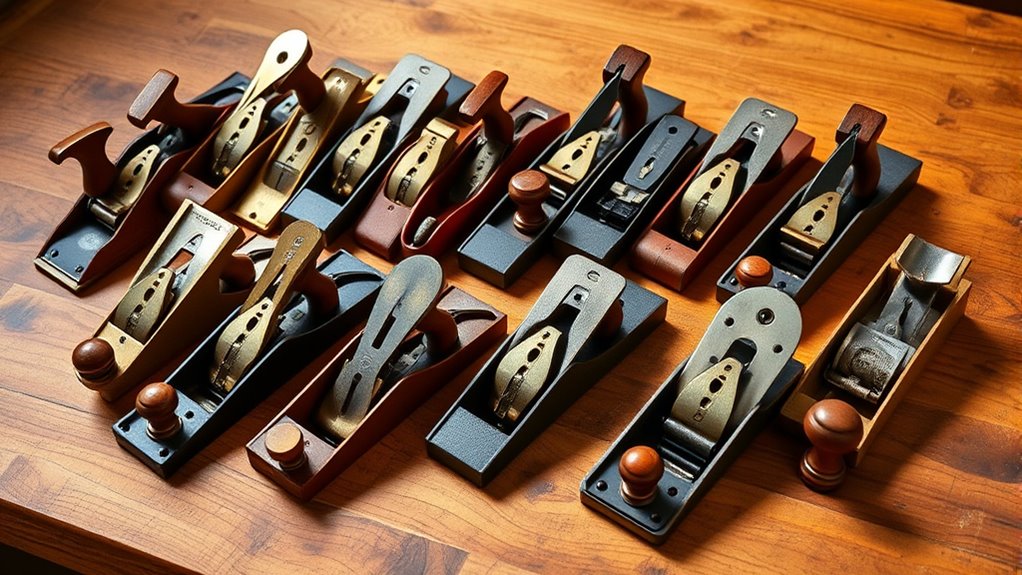
Woodworking planes are essential tools for shaping, smoothing, and refining wood surfaces. With a wide variety of designs and features, choosing the right plane can significantly impact your work quality and efficiency. The best overall pick offers a blend of precision and durability, like the Jorgensen No.5, while the Stanley 1-12-137 excels for those seeking a traditional, reliable option. Meanwhile, electric alternatives like the WEN 6530 cater to quick, power-assisted projects but may lack the finesse of manual planes. Tradeoffs typically involve balancing price, ease of use, and craftsmanship. Keep reading for a detailed breakdown to help you find the perfect woodworking plane for your needs.
Complete the kit


Key Takeaways
- Manual planes like the amazon.com/dp/B07V3QLZ5Y?tag=woodnbits-20&ascsubtag=dc-275633″ target=”_blank” rel=”nofollow sponsored noopener”>amazon.com/dp/B0BVZK331X?tag=woodnbits-20&ascsubtag=dc-275633″ target=”_blank” rel=”nofollow sponsored noopener”>Jorgensen No.5 and Stanley Jack offer superior control and finish but require more skill and effort.
- Japanese planes such as the KAKURI models excel in precision and smooth finishes, often at a higher price point.
- Electric planers like the WEN provide faster material removal but sacrifice some surface accuracy and control.
- Versatility varies: some planes are specialized for chamfering or detailing, while others serve as all-purpose tools.
- Build quality and material (like ductile iron bodies) significantly influence the tool’s longevity and performance.


More Details on Our Top Picks
Saker Chamfer Plane with Auxiliary Locator and 6 Cutter Heads
I rank the Saker Chamfer Plane as the lineup’s edge-profile specialist because its six interchangeable cutter heads provide more shaping choices than the four-head JORGENSEN Chamfer Plane. Adjustable cutting depth and an auxiliary locator help maintain a steadier reference when rounding or flattening corners, while the compact body suits quick work away from a bench. I would not choose it instead of the KAKURI 60mm plane for smoothing faces: its short base cannot bridge uneven areas or produce broad finishing passes. Changing heads also adds setup time, and consistent results depend on seating each cutter correctly. The bubble levels are useful visual guides, but they do not replace careful marking. I place this purpose-built edge profiler above simpler chamfer tools for variety, though below conventional planes for all-purpose woodworking.
Pros:- Six cutter heads provide more edge-profile choices than many chamfer-plane kits
- Adjustable cutting depth supports light finishing passes and deeper shaping
- Auxiliary locator and bubble levels provide visible alignment references
- Compact aluminum-alloy body is easy to carry between projects
Cons:- Short sole cannot flatten boards or smooth wide surfaces effectively
- Head changes add setup time and may introduce profile inconsististency if seated poorly
- Specialized design offers less value to buyers who only need a basic 45-degree chamfer
Best for: DIY woodworkers who want several repeatable chamfers and rounded edge profiles from one portable manual tool
Not ideal for: Furniture makers seeking a primary plane for flattening panels or smoothing broad faces, since its short body is dedicated to edge work
- Plane type:Manual chamfer and edge plane
- Cutter heads:6 interchangeable heads
- Cutting depth:Adjustable
- Blade material:High-strength carbon steel
- Base material:Aluminum alloy
- Alignment aids:Horizontal and vertical bubble levels
- Dimensions:6.08 x 0.79 x 1.97 in
- Color:Black
- Model:RM
Our verdict“I recommend the Saker to buyers who prize edge-profile variety more than broad-surface planing ability.”
KAKURI Japanese Block Plane Large 60mm
I place the KAKURI 60mm Japanese Block Plane highest among the traditional kanna options because its larger, two-handed body and 50mm cutting width cover stock faster than the smaller KAKURI 42mm. The pull stroke can provide controlled, thin shavings, while the laminated high-carbon-steel blade pairs a hard cutting layer with softer iron that is easier to sharpen. A chipbreaker also makes this model better suited to finishing than a basic single-blade kanna. That performance comes with a learning curve: blade depth and alignment are adjusted with a hammer, not a screw mechanism like the JORGENSEN No.5. Its wooden sole may also need periodic inspection as humidity changes. I rank it for fine surface finishing, not rapid flattening, and buyers must be willing to learn traditional setup.
Pros:- Large two-handed white-oak body supports stable smoothing passes
- Laminated Japanese high-carbon-steel blade combines edge retention with easier sharpening
- Two-blade arrangement includes a chipbreaker to help control splitting
- Oil-finished wooden body is designed to glide smoothly over wood
Cons:- Hammer-based blade adjustment has a steeper learning curve than Western screw adjusters
- Wooden sole can require tuning as moisture and humidity change
- Pull-plane technique may feel unfamiliar to woodworkers trained on Western planes
Best for: Woodworkers who want a traditional pull-style kanna for producing fine finishing cuts across medium and larger surfaces
Not ideal for: Beginners who want screw-based blade adjustment and a metal sole that requires less seasonal attention
- Plane type:Japanese kanna smoothing plane
- Cutting action:Pull stroke
- Blade material:Laminated Japanese high-carbon steel and soft iron
- Blade width:60 mm (2.36 in)
- Cutting width:50 mm (1.97 in)
- Blade configuration:Two blades with chipbreaker
- Body material:Oil-finished white oak
- Dimensions:10.2 x 3.0 x 2.8 in
- Country of manufacture:Japan
Our verdict“I favor this KAKURI for buyers who value fine kanna finishing and accept the setup work that traditional performance requires.”
Jorgensen No.101 Mini Wood Planer
I assign the Jorgensen No.101 Mini the pocket-size role because its compact format targets localized trimming, polishing, and deburring without the bulk of a bench plane. The ductile-iron body gives it more durability and mass than a lightweight novelty plane, while the adjustable O1-steel blade lets buyers choose between fine shavings and more assertive cuts. Compared with the Jorgensen No.102, the No.101 favors minimal size; the No.102’s low-angle layout is the stronger choice for frequent end-grain work. This mini model also ranks below the Amazon Basics No.4 for broad smoothing because its short sole follows surface dips instead of bridging them. O1 steel can take a keen edge, but it needs protection from moisture. I see this as a secondary detail plane, not the foundation of a hand-plane kit.
Pros:- Miniature format provides close control around small workpieces
- Ductile-iron body offers better durability than lightweight hobby planes
- Adjustable cutting depth handles both fine cleanup and more visible trimming
- O1 tool-steel blade can take a keen working edge
Cons:- Short sole follows surface irregularities rather than flattening them
- Small body provides limited hand support during long planing sessions
- O1 steel requires drying and rust protection after use
Best for: Model makers, craft woodworkers, and mobile DIY users who need controlled trimming on small parts
Not ideal for: Cabinetmakers flattening panels or jointing long edges, since the miniature sole cannot register across broad uneven surfaces
- Plane type:Mini block plane
- Blade material:O1 tool steel
- Body material:Ductile iron
- Lever-cap material:Zinc alloy
- Cutting depth:Adjustable
- Included component:Blade
- Model number:70700
- UPC:044295707008
Our verdict“I recommend the No.101 as a compact detail companion for small work, not as a substitute for a full-size block or bench plane.”
Jorgensen No.102 Low-Angle Block Plane
I rank the Jorgensen No.102 above the No.101 for buyers who want a compact plane with a low-angle cutting layout. That geometry makes this model the more natural pick for trimming end grain, fitting doors, and refining small joinery, while its ductile-iron body provides a stable platform for controlled cuts. The polished flat bottom also matters because reliable sole contact helps prevent rocking on narrow edges. The No.101 remains easier to justify when minimum size is the main goal, while the larger JORGENSEN No.60-1/2 offers an expressly adjustable mouth for finer shaving control. No adjustable mouth is listed for the No.102, which limits tuning options, and its short sole cannot correct long-board waviness. I position it as the compact all-rounder for detail trimming, with greater reach than a mini plane but less versatility than a premium block plane.
Pros:- Low-angle format is well suited to end-grain and detail trimming
- Ductile-iron body provides rigidity and useful working mass
- Adjustable cutting depth supports fine fitting and heavier cleanup
- Polished flat sole supplies a stable reference on small workpieces
Cons:- No adjustable mouth is listed, reducing control over shaving support
- Short sole is unsuitable for correcting long or broadly uneven surfaces
- O1 blade needs regular rust prevention in damp workshops
Best for: Furniture repairers and DIY woodworkers who frequently trim end grain, doors, small joints, and narrow edges
Not ideal for: Hand-tool specialists who want adjustable-mouth control or a longer sole for flattening and straightening stock
- Plane type:Low-angle block plane
- Blade material:O1 tool steel
- Body material:Ductile iron
- Lever-cap material:Zinc alloy
- Cutting depth:Adjustable
- Sole:Polished flat bottom
- Included component:Blade
- Model number:70708
- UPC:044295707084
Our verdict“I would choose the No.102 for compact low-angle versatility, unless adjustable-mouth precision or full-size flattening is the priority.”
POWERTEC 72162 Chisel Plane with Flat Blade
I give the POWERTEC 72162 Chisel Plane the flush-trimming slot because its flat SKD11 blade is shaped for paring plugs, dried glue, and joinery surfaces where a conventional plane body can obstruct access. Compared with the Jorgensen No.101 Mini, this model is more specialized and less versatile: it reaches tight, flat areas more readily, but it is not intended for routine face smoothing or edge straightening. The 58–62 HRC blade should retain sharpness well, and the machined aluminum body keeps the tool manageable during delicate cleanup. A single screw and alignment pin simplify blade mounting, although the exposed cutting format demands careful handling. The included wrench helps with setup, while alternate flat and spear-point blades cost extra. I rank it as a joinery cleanup tool for buyers who already own a general-purpose plane.
Pros:- Flat blade reaches plugs, glue residue, and joinery areas that block planes may obstruct
- SKD11 tool-steel blade has a stated hardness of 58–62 HRC
- Machined aluminum body and resin-infused maple handle support controlled detail work
- Single-screw mounting with an alignment pin keeps blade setup straightforward
Cons:- Specialized chisel-plane design cannot replace a block or bench plane
- Exposed blade requires more cautious handling than an enclosed plane iron
- Compatible spear-point and replacement flat blades are separate purchases
Best for: Furniture builders and trim carpenters who need to pare plugs, remove dried glue, and clean small joinery surfaces
Not ideal for: First-time plane buyers seeking one tool for smoothing faces, flattening boards, and straightening long edges
- Plane type:Compact chisel plane
- Included blade:Flat blade
- Blade material:High-carbon SKD11 tool steel
- Blade hardness:58–62 HRC
- Body material:One-piece machined aluminum
- Handle material:Resin-infused maple
- Blade mounting:Single screw and alignment pin
- Included accessory:Wrench
- Compatible blades:POWERTEC 72164 flat and 72165 spear point
Our verdict“I recommend the POWERTEC 72162 as a precise flush-cutting companion for an established tool kit, not as a buyer’s only plane.”
KAKURI Japanese Hand Plane 42mm for Woodworking, KANNA Block Plane Small Hand Planer Tool for Wood Chamfering and Smoothing, 5.9 x 2.1 x 1.6 inches, ECO Oak Body, Made in JAPAN
This compact Japanese plane stands out for its ability to produce very smooth finishes, especially on detailed or delicate projects. Compared with the JORGENSEN No.5, which is better suited for rougher flattening, the KAKURI excels at fine chamfering and smoothing edges with less effort due to its pull-style design. The high-carbon steel blade is razor-sharp and ready to use, though it requires some fine-tuning before initial use, which might challenge first-timers. The ECO oak body offers durability and a traditional feel, but the smaller size limits its use for larger surfaces. Its pull mechanism provides more control over cuts, making it ideal for detailed craftsmanship. However, its size makes it less suitable for removing large amounts of wood quickly.
bestFor: Woodworkers focusing on intricate finishing and edge detailing.
notIdealFor: Those needing to rapidly flatten large panels or remove substantial material.
pros: Precise control with pull-stroke design, razor-sharp Japanese steel blade, lightweight and easy to handle, eco-friendly durable body.
cons: Small size limits broad surface planing, requires fine-tuning before use, less effective for heavy material removal.
verdict: Perfect for detail-oriented tasks and fine finishing, but less suited for large-scale flattening.Pros:- Pull-stroke design offers smooth, controlled cuts
- High-quality Japanese high-carbon steel blade is razor-sharp
- Lightweight, compact, ideal for intricate work
- Durable ECO oak body with authentic craftsmanship
Cons:- Limited size restricts use for large surfaces
- Requires fine-tuning of blade before first use
- Not suitable for removing large amounts of wood quickly
Best for: Woodworkers needing precise edge chamfering and smoothing on detailed projects.
Not ideal for: Beginners seeking a versatile tool for rough flattening or large surface work.
Our verdict“This pick is best for detailed finishing and chamfering, especially on small or delicate projects.”
JORGENSEN Chamfer Plane, Edge Corner Plane with 4 Cutter Heads, Storage Space – Hand Plane for Woodworking, Carpenter Woodworking Tools for Edge Trimming of Wood, Edge Corner Flattening
This versatile chamfer plane offers four different cutter heads, making it highly adaptable for trimming, shaping, and smoothing edges and corners. Its professional-grade O1 steel blades stay sharp longer and are easily sharpened, providing consistent results. Compared with the JORGENSEN No.5, which is better suited for flattening and smoothing large surfaces, this model excels at precise edge work and corner finishing. The built-in storage for blades keeps tools organized and prevents loss, adding convenience. The polished bottom ensures smooth gliding, and the ergonomic shape fits comfortably in hand. However, its focus on edges means it’s less effective for flattening large surfaces or heavy material removal. Adjustability of the blade depth and angle makes it suitable for both hobbyists and professionals.
bestFor: Carpenters and detailed woodworkers focusing on edges and corners.
notIdealFor: Those needing to flatten large panels or perform heavy stock removal.
pros: Multiple cutter options, professional steel blades, organized blade storage, ergonomic design for precision.
cons: Not designed for large surface flattening, limited to edges and corners, requires understanding of blade adjustments.
verdict: Excellent for edge shaping and corner detail, but not for rough flattening or large surface work.Pros:- Four cutter heads for versatile edge shaping
- High-grade O1 steel blades with long-lasting sharpness
- Built-in blade storage for organization
- Ergonomic and polished for smooth handling
Cons:- Limited to edge and corner work only
- Less effective for flattening large surfaces
- Requires understanding of blade adjustment for optimal results
Best for: Woodworkers specializing in precise edge trimming and detailed corner work.
Not ideal for: Beginners or those needing a tool for broad, heavy-duty flattening tasks.
Our verdict“Ideal for precise edge and corner work, providing versatility with multiple cutter heads.”
JORGENSEN No.5 Wood Planer, Hand Planer for Woodworking, Jack Plane for Flattening, Smoothing – Professional Hand Plane with Ductile Iron Body, Adjustable Cutting Depth, Ergonomic Handle
This jack plane is designed for larger surface work, offering a robust ductile iron body that withstands heavy use. Its adjustable cutting depth allows for precise removal of material, making it suitable for flattening, smoothing, and shaping larger panels. Compared with the compact KAKURI, which excels at fine detail, the JORGENSEN No.5 is better suited for tackling bigger tasks efficiently. The sharp O1 steel blade can be sharpened repeatedly, extending its lifespan. The ergonomic handle provides comfort during prolonged use, and the flat bottom ensures smooth operation across wide surfaces. Its weight and size make it less ideal for precision or delicate work, but it shines in tasks requiring more material removal.
bestFor: Woodworkers needing to flatten large surfaces or perform rough smoothing.
notIdealFor: Fine detail work or tight corner shaping requiring a smaller, more precise tool.
pros: Heavy-duty ductile iron construction, adjustable blade and depth, ergonomic handle, capable of removing large amounts of wood efficiently.
cons: Bulky for delicate tasks, less suited for detailed edge work, requires proper blade maintenance.
verdict: This planer is a strong choice for heavy-duty flattening and smoothing of large surfaces.Pros:- Durable ductile iron body for heavy-duty use
- Adjustable cutting depth for precision control
- Ergonomic handle for comfort
- Ideal for large, flat surface work
Cons:- Heavier and bulkier than smaller planes
- Not suitable for fine detail or corner work
- Requires proper blade sharpening for best results
Best for: Woodworkers focused on flattening and smoothing large panels or rough shaping surfaces.
Not ideal for: Those seeking a small, precise tool for fine finishing or tight corners.
Our verdict“A reliable choice for efficiently flattening large surfaces, though less capable for detailed or delicate tasks.”
Amazon Basics Woodworking Hand Planer – No.4 Adjustable Bench Plane with 2-Inch Steel Blade for Quality Wood Smoothing Cuts, Grey/Black
This affordable hand plane offers a solid option for hobbyists and casual woodworkers seeking reliable smoothing. The 2-inch steel blade provides good control for trimming and finishing edges, comparable to the more expensive #4 planes like the one in the same lineup. Its cast-iron body offers stability and dampens vibrations, resulting in cleaner cuts. Adjustability of the mouth and depth gauge helps fine-tune performance, though the overall build is less refined than premium models like the Stanley 1-12-137. The ergonomic handles improve control, making it suitable for extended use. The main tradeoff is that its lower-cost components may wear faster under intensive use, and it might require more frequent blade sharpening. Still, it delivers decent performance for light to moderate woodworking projects.
bestFor: DIYers and hobbyists looking for an affordable smoothing plane for occasional use.
notIdealFor: Professional woodworkers needing a tool for heavy or frequent use.
pros: Cost-effective, stable cast-iron construction, adjustable mouth and depth, ergonomic handles, easy to fine-tune.
cons: Less durable under heavy use, requires frequent sharpening, lighter feel may impact precision for demanding tasks.
verdict: A budget-friendly plane suitable for light smoothing and finishing work.Pros:- Affordable price point for casual use
- Cast-iron body provides stability
- Adjustable mouth and depth gauge
- Comfortable ergonomic handles
Cons:- Less durable for intensive or frequent use
- May require more frequent sharpening
- Build quality not as refined as premium models
Best for: Casual woodworkers and DIYers needing a reliable, affordable smoothing plane.
Not ideal for: Professionals or heavy-duty shop environments requiring durable, long-lasting tools.
Our verdict“A sensible choice for hobbyists who want decent smoothing performance without breaking the bank.”
JORGENSEN NO.60-1/2 6-1/4″ Wood Planer, Hand Planer for Woodworking, Low Angle Block Plane, Small Hand Plane for Trimming, Wood Planing, Craft – Professional Ductile Iron Body, Adjustable Mouth
This low-angle block plane is designed for fine trimming and detailed work, with a compact form that excels in tight spots or where precision is critical. The ductile iron body ensures durability, while the adjustable mouth allows for fine-tuning of cut depth, making it versatile for various small-scale tasks. Compared to larger jack planes like the JORGENSEN No.5, this model is better suited for trimming edges, cleaning up joints, or preparing small pieces. Its sharp O1 steel blade is easily sharpened, maintaining performance through repeated use. The ergonomic handle provides comfort, but its small size limits it for larger flattening or heavy stock removal. This plane is ideal for finishing touches and intricate shaping.
bestFor: Woodworkers needing a compact, precise tool for trimming, fitting, or detailing in small spaces.
notIdealFor: Large surface flattening or heavy stock removal tasks.
pros: Small, maneuverable, adjustable mouth for precision, durable ductile iron body, easy blade sharpening, ergonomic handle.
cons: Not suitable for large-scale flattening, limited in scope to fine detail work, small size can be limiting for bigger projects.
verdict: Excellent for finishing, trimming, and detailed shaping in tight or delicate areas.Pros:- Compact, maneuverable size for tight spaces
- Adjustable mouth for fine control
- High-quality ductile iron body for durability
- Easily sharpened blade for consistent performance
Cons:- Limited to small, detailed tasks
- Not designed for large surface flattening
- Size may feel restrictive for bigger projects
Best for: Woodworkers focused on detailed trimming, fitting, and finishing tasks in confined spaces.
Not ideal for: Those needing to flatten large panels or remove significant amounts of material quickly.
Our verdict“This plane excels at precision trimming and finishing in small or intricate work areas.”
Amazon Basics No.4 Adjustable Precision Smoothing Bench Hand Plane with 2-Inch Blade and Wooden Handles for Woodworking, Brown
This Amazon Basics No.4 stands out for its solid cast iron body that offers excellent stability, making it a reliable choice for a range of smoothing tasks. Compared with the Stanley 1-12-137, it provides comparable durability but at a more accessible price point, making it ideal for hobbyists and DIYers. The adjustable gear allows for precise control, although it lacks some of the finer tuning found in premium models. Its impact-resistant wooden handle ensures comfortable use over extended periods, yet the overall weight might be cumbersome for prolonged use. This plane makes the most sense for those seeking a dependable, versatile smoothing tool without the premium price.
Pros:- Durable cast iron construction provides stability and long-term use
- Adjustable gear for precise control of cut depth
- Impact-resistant wooden handles for comfort
Cons:- Heavier weight can cause fatigue during prolonged use
- Limited fine-tuning features compared to higher-end models
Best for: Amateur woodworkers or DIY enthusiasts seeking a durable, adjustable smoothing plane for general projects.
Not ideal for: Professional carpenters requiring ultra-fine adjustments and lightweight handling for large-scale or detailed work.
- Material:Cast iron
- Blade Width:2 inches
- Handle Material:Wood
- Adjustability:Yes
- Body Color:Brown
- Use Case:Smoothing and finishing
Our verdict“A well-rounded choice for hobbyists who want durability and adjustable smoothing without a high price tag.”
#5 Bench Hand Plane – Jack Plane
The #5 Bench Hand Plane features a substantial cast iron body and a 2-7/16 inch width, making it suited for removing large amounts of material quickly. Compared with the Stanley 1-12-137, its larger size and heavier weight (5 lbs) deliver more power for flattening rough-sawn boards, but this also means it’s less maneuverable for fine detail work. The fully machined components ensure consistent performance, while the Bubinga handles provide a comfortable grip. However, the weight can tire users after extended sessions, and there’s limited information on blade adjustment precision. This model is best for those tackling rough stock or large panels, where power and stability outweigh finesse.
Pros:- Heavy castings provide durability and power
- Fully machined components ensure consistent performance
- Comfortable Bubinga handles for grip
Cons:- Heavy weight may cause fatigue during extended use
- Limited fine control or blade adjustment info
Best for: Woodworkers handling large or rough lumber who need a powerful, durable smoothing plane.
Not ideal for: Detail-oriented craftsmen or those working on small, fine projects where precision and ease of handling are priorities.
- Length:13-7/8 inches
- Width:2-7/16 inches
- Weight:5 lbs
- Blade Width:2 inches
- Handle Material:Bubinga
- Use Case:Flattening and rough smoothing
Our verdict“Ideal for rough work and large projects where durability and power are more critical than finesse.”
WEN 6530 6-Amp Electric Hand Planer, 3-1/4-Inch
The WEN 6530 electric planer offers a significant boost in convenience with its 6 Amp motor and adjustable cutting depths, making it suitable for quick, power-assisted planing tasks. Its 16 positive stops and ability to make rabbets up to 1 inch deepen its versatility compared to manual planes like the Jorgensen No.4. While it excels at fast material removal and shaping, the tradeoff is the less tactile control and the need for power source management. Its lightweight design at just 6 pounds makes it easy to handle, but compared to traditional hand planes, it can produce less fine finish. This tool is best for those needing fast, broad surface prep or rough shaping on larger projects.
Pros:- Powerful 6 Amp motor for fast material removal
- Adjustable depth with 16 stops for flexibility
- Lightweight and easy to maneuver
Cons:- Less control over fine finishing compared to manual planes
- Requires electrical power, limiting mobility
Best for: DIYers and semi-professional woodworkers seeking efficient power tools for large or repetitive planing tasks.
Not ideal for: Fine detail work or projects requiring extremely smooth finishes, where manual control is preferred.
- Motor Power:6 Amps
- Cutting Width:3-1/4 inches
- Depth Adjustment:16 positive stops
- Weight:6 pounds
- Rabbeting Capacity:Up to 1 inch
- Power Source:Electric
Our verdict“Best suited for quick, large-scale planing tasks where speed outweighs fine control.”
JORGENSEN No.4 10″ Wood Plane , Hand Plane for Woodworking, Professional Smoothing Plane for Trimming, Craft – Hand Plane with Ductile Iron Body, Adjustable Cutting Depth
The JORGENSEN No.4 combines a professional-grade O1 tool steel blade with a rugged ductile iron body, making it a top choice for detailed smoothing and trimming tasks. Its adjustable cutting depth allows for precise control, comparable to the Stanley 1-12-137, but with a longer 10-inch size that enhances leverage and control. While heavier than typical smoothing planes, this model is designed for demanding woodworking, with high-quality materials that resist wear and tear. The smooth, beech-wood handle adds comfort, though the extra length might be unwieldy in tight spaces. It’s best for experienced woodworkers who need a durable, highly adjustable smoothing plane for detailed finishing work.
Pros:- Premium O1 steel blade for sharp, efficient cuts
- Adjustable cutting depth for precise control
- Heavy-duty ductile iron body for durability
Cons:- Heavier weight may reduce maneuverability
- Longer length can be less suited for tight spaces
Best for: Professional or experienced woodworkers seeking a durable, adjustable smoothing plane for fine finishing and heavy-duty projects.
Not ideal for: Beginners or those working on small projects that don’t require long, heavy-duty smoothing tools.
- Blade Material:O1 tool steel
- Body Material:Ductile iron
- Length:10 inches
- Handle:Beech wood
- Adjustable:Yes
- Use Case:Smoothing, trimming, fine finishing
Our verdict“A highly adjustable, durable smoothing plane best suited for advanced users doing detailed, heavy-duty work.”
Stanley 1-12-137 62-Low Angle Sweetheart Jack Plane
The Stanley 1-12-137 offers an excellent combination of precision and durability, with a one-piece base and frog that virtually eliminate chatter, making it ideal for fine finishing. Its low-angle design is perfect for end grain and tricky cuts, outperforming many standard bench planes for detailed work. Compared to the Jorgensen No.4, it’s lighter and more maneuverable, but some users may find it less robust for heavy stock removal. The patented lateral adjustment locking feature adds to its fine-tuning capabilities, though it requires careful handling for optimal results. This plane is best for skilled woodworkers focused on achieving high-quality, accurate finishes on delicate projects.
Pros:- One-piece base and frog ensure stability and accuracy
- Low-angle design ideal for end grain and fine cuts
- Patented lateral adjustment for precise tuning
Cons:- Less suited for heavy stock removal or rough work
- Higher cost compared to standard planes
Best for: Experienced woodworkers needing a precision tool for detailed smoothing and fine finishing.
Not ideal for: Beginners or those doing rough stock removal, as it excels in finesse rather than brute force.
- Base Material:Ductile iron
- Frog:One-piece
- Blade Type:Low angle
- Adjustments:Lateral locking
- Weight:Light
- Use Case:Fine smoothing and detailed work
Our verdict“Perfect for detailed, high-precision smoothing and finishing tasks in skilled hands.”

How We Picked
The selection process focused on key factors that impact a woodworker’s experience: cutting performance, ease of adjustment, build quality, versatility, and value for money. We prioritized manual planes for precision and craftsmanship, giving higher scores to those with durable materials and smooth adjustment mechanisms. Power tools were included for their convenience, but with a clear note on their tradeoffs in finesse. The ranking reflects a balance between professional-grade tools and accessible options for hobbyists, ensuring each product offers a distinct role in a woodworking toolkit.Factors to Consider When Choosing Woodworking Planes
Choosing the right woodworking plane depends on understanding your specific work needs, skill level, and budget. While many options look similar, subtle differences in design and construction can significantly influence performance. Consider how often you’ll use the tool, the types of projects, and whether you prefer manual control or power-assisted efficiency. Making an informed choice involves evaluating factors beyond just price, including adjustability, comfort, and compatibility with your existing tools.Type of Plane
Manual planes come in various styles, such as bench planes, block planes, and specialized chamfer or corner planes. Each type serves specific purposes: bench planes are versatile for flattening and smoothing large surfaces, while block planes excel for trimming and fine detail work. Power planers are suitable for rapid material removal but can be less precise. Matching the plane type to your typical projects ensures better results and less frustration.
Material and Build Quality
The durability of a woodworking plane hinges on its material. Ductile iron bodies are common in high-end models, offering strength and resistance to warping. Wooden or aluminum components might be lighter and easier to handle but could compromise longevity. Pay attention to the blade material—high-quality steel blades hold an edge longer and provide cleaner cuts. Investing in a well-built tool reduces the need for replacements and enhances precision over time.
Adjustability and Ease of Use
Accurate adjustments are vital for achieving smooth, consistent results. Look for planes with straightforward mechanisms for setting cutting depth and lateral blade positioning. Some models feature lever caps and adjustment knobs that are easy to manipulate, even with gloves on. Poor adjustment systems can lead to uneven cuts and frustration, especially for beginners. Test the adjustment ergonomics if possible or read detailed reviews to gauge usability.
Versatility and Specialty Features
Consider whether you need a multi-purpose tool or a specialized plane. Some models include multiple cutter heads or adjustable angles, expanding their application scope. Others are designed for specific tasks like chamfering edges or smoothing concave surfaces. While highly specialized tools can save time, they might be overkill for general woodworking. Aim for a balance that matches your typical projects and future growth.
Value and Budget
High-quality woodworking planes can be a worthwhile investment if they last decades and produce excellent finishes. Conversely, budget options might suffice for occasional use or beginner projects. Be cautious of extremely cheap models that lack proper edge retention or adjustment features. Sometimes paying slightly more upfront results in a tool that performs better and lasts longer, offering better overall value in the long run.
Frequently Asked Questions
Should I buy a Japanese or Western-style woodworking plane?
Japanese planes generally feature a lower angle, which makes them excellent for fine smoothing and delicate work, especially on hard woods. Western planes often have a more robust build and a higher angle, making them versatile for a variety of tasks like flattening and rough sizing. Deciding between them depends on your project needs and comfort; many woodworkers find owning both types offers the greatest flexibility.
Are electric planers better for beginners than manual planes?
Electric planers are often more approachable for beginners because they require less skill to operate and can speed up material removal. However, they can be less precise and more difficult to control for fine finishing. Manual planes demand more technique but reward users with superior control and surface quality. For those starting out, a manual plane might build foundational skills before moving to power tools.
How important is blade material when choosing a woodworking plane?
Blade material directly impacts cutting performance and longevity. High-quality steel blades maintain sharpness longer, reducing the frequency of sharpening or replacement. Cheaper blades dull quickly, which can lead to uneven cuts and frustration. Investing in a plane with a premium blade often results in cleaner finishes and more consistent results, especially on harder woods.
Can I use a small block plane for large projects?
While small block planes are excellent for detail work and trimming tight corners, they are generally not suitable for large surface flattening or heavy stock removal. For bigger projects, a wider and more robust bench plane is preferable, as it can cover more ground efficiently and provide better control over large surfaces. Combining both types in your toolkit offers the most flexibility.
What should I consider when choosing a plane for fine finishing?
For fine finishing, look for a plane with a high-quality, easily adjustable blade that can be finely tuned for smooth cuts. A low-angle block plane or a dedicated smoothing plane with a sharp blade and minimal lateral movement works best. The plane’s build quality, including a comfortable handle and precise adjustment mechanisms, also plays a key role in achieving a mirror-like surface.
Conclusion
For serious woodworkers seeking the best overall performance, the Jorgensen No.5 offers a reliable, versatile solution with excellent craftsmanship. Beginners or hobbyists on a budget will find the Amazon Basics No.4 or WEN 6530 suitable for starting out without sacrificing too much quality. Those prioritizing premium materials and precision should consider the Stanley 1-12-137 or the KAKURI Japanese planes. Finally, for projects requiring quick material removal, an electric planer like the WEN 6530 provides a time-saving option, though it’s less suited for detailed work. Matching your choice to your skill level, project type, and budget ensures the best results in your woodworking endeavors.