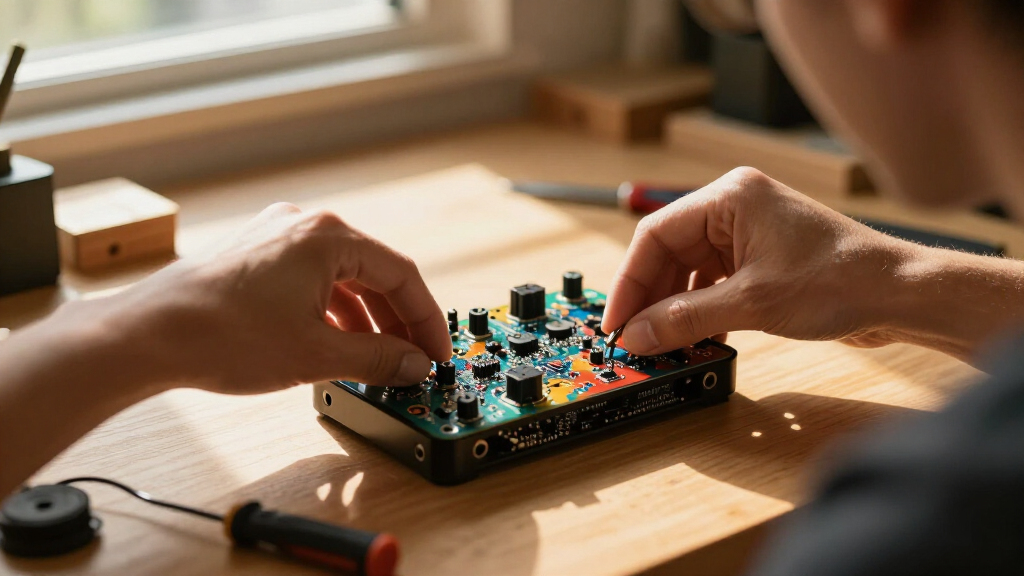

The best DIY music player kit for most makers is the DFPlayer Mini MP3 Player because its Arduino and ESP32 compatibility supports far more customization than a fixed-function sound board. The Icstation Recordable Sound Module is a stronger fit when quick voice recording matters more than coding flexibility. For builders stretching a budget across multiple projects, the 2pcs DIY Audio Recorder and Player package offers two USB Type-C boards instead of one. A PIR-equipped playback kit stands apart for motion-activated props, displays, and greetings. The main tradeoff is between programmable control, simple recording, included hardware, and assembly difficulty. Continue reading for my full breakdown of which kit fits each kind of build.

Get business pricing on tools and workshop supplies
- Business-only prices and quantity discounts
- Tax-exempt purchasing
- Multiple users, one account, clear invoices
Complete the kit

Key Takeaways
- DFPlayer Mini ranks first because its Arduino and ESP32 support gives it the broadest path from a basic player to a programmable project.
- Two-board packaging separates the value pick: the 2pcs USB Type-C recorder-and-player set makes more sense for paired builds or buyers who want a spare.
- The PIR kit fills the clearest specialist role because none of the button-focused alternatives provides the same direct path to motion-triggered playback.
- Recording modules trade flexibility for speed: Icstation and the button-controlled boards suit short-message projects better than software-driven music systems.
- The Noland and STEM kits target different gift buyers: Noland favors a personalized finished object, while the STEM kit puts assembly and learning ahead of audio flexibility.
| Icstation Recordable Sound Module with Speaker for DIY Projects |  | Best Simple Sound Module | Internal memory: 8MB | Supply voltage: 4.5–5V | Compatible battery: 3.7V lithium battery, not included | VIEW LATEST PRICE | See Our Full Breakdown |
| MP3 Playback Kit Music Voice Recording Module with Speaker and PIR Sensor |  | Best Motion-Activated Pick | Built-in storage: 4MB | Expandable storage: TF card up to 8GB | Media connectivity: USB and TF card | VIEW LATEST PRICE | See Our Full Breakdown |
| DFPlayer Mini MP3 Player for Arduino and ESP32 Projects |  | Best Overall for Programmers | Dimensions: 20 x 20mm | Weight: 20g | Storage support: TF cards and USB drives up to 32GB | VIEW LATEST PRICE | See Our Full Breakdown |
| 2pcs DIY Audio Recorder and Player with USB Type-C |  | Best Complete Electronic Kit | Package quantity: 2 audio recorder and player kits | Recording capability: Built-in voice recorder | Connectivity: USB Type-C | VIEW LATEST PRICE | See Our Full Breakdown |
| Noland DIY Music Box Kit – Custom Music Box for Music Lovers |  | Best Mechanical Music Box | Dimensions: 5 x 2.8 x 2.5 inches | Playback mechanism: Manual paper-strip music box | Pre-punched strips: 1 included | VIEW LATEST PRICE | See Our Full Breakdown |
| 8MB Sound Recordable Module Button Control MP3 Music Player Kit |  | Best Solder-Free Sound Module | Memory: 8MB | Supported Audio: MP3 and WAV | File Transfer: USB | VIEW LATEST PRICE | See Our Full Breakdown |
| MP3 Music Recordable Sound Module Kit with Control Button |  | Best for Cycle-Button Playback | Memory: 8MB | File Support: MP3 and WAV | File Transfer: USB | VIEW LATEST PRICE | See Our Full Breakdown |
| STEM DIY Music Box Kit, Build & Play |  | Best Educational Kit for Children | Recommended Age: 6+ | Player Type: Mechanical music box | Learning Themes: Music, science, and engineering | VIEW LATEST PRICE | See Our Full Breakdown |
More Details on Our Top Picks
Icstation Recordable Sound Module with Speaker for DIY Projects
I rank the Icstation Recordable Sound Module highly for builders who want programmable audio without adding a microcontroller. Its button controls and multiple trigger modes suit music boxes, talking props, and personalized gifts, while adjustable volume helps match the sound to a small enclosure. Compared with the DFPlayer Mini, it is easier to approach but far less expandable: the fixed 8MB memory works for short songs and voice clips, not a sizable library. The 2pcs DIY Audio Recorder and Player also supplies a rechargeable battery and newer Type-C connection, whereas this module requires separate power hardware and Micro USB. I see it as a flexible middle ground, though battery wiring and manual setup add work before the first project can play.
Pros:- Push-button operation avoids the need for a separate controller
- Multiple trigger modes support varied interactive project designs
- Adjustable volume helps match different enclosures and uses
- Micro USB provides a familiar method for loading MP3 files
Cons:- Fixed 8MB memory limits the length and number of audio files
- Battery and supporting wiring must be sourced separately
- Setup depends on downloading the user manual
Best for: Gift makers and hobbyists building button-operated music boxes, talking toys, or short-message displays without a separate microcontroller
Not ideal for: Builders creating long playlists or self-contained projects, since 8MB storage is restrictive and the battery is sold separately
- Internal memory:8MB
- Supply voltage:4.5–5V
- Compatible battery:3.7V lithium battery, not included
- Connectivity:Micro USB
- Primary controls:Push buttons
- Volume control:Adjustable
- Playback activation:Multiple trigger modes
Our verdict“I recommend this module for short, button-triggered audio projects where simple programming matters more than storage capacity.”
MP3 Playback Kit Music Voice Recording Module with Speaker and PIR Sensor
The defining advantage of this MP3 Playback Kit is its adjustable PIR sensor, which can start audio when someone approaches. That makes it my preferred choice for exhibit narration, doorway alerts, promotional displays, or safety messages. Neither the Icstation Recordable Sound Module nor the DFPlayer Mini offers comparable motion activation as part of the supplied setup. Storage is also more flexible than Icstation’s fixed 8MB: buyers get 4MB internally and can add a TF card up to 8GB. Five dedicated buttons make playback manageable without coding. The tradeoff is added calibration; sensor distance may need repeated adjustment to prevent missed or unwanted triggers. A TF card is absent, and a data-capable Micro USB cable is required, so the module may not be ready to load immediately.
Pros:- PIR sensor enables hands-free, motion-triggered playback
- TF card expansion supports far more audio than fixed-memory modules
- Five dedicated buttons provide direct playback and volume control
- Adjustable sensing distance accommodates different installation spaces
Cons:- Sensor sensitivity may require trial-and-error calibration
- TF card is not included
- File loading requires a data-capable Micro USB cable
Best for: Exhibit builders, shop owners, and safety-project makers who need audio to play automatically when a person approaches
Not ideal for: Projects requiring precise button-only activation or immediate setup, because PIR calibration and separately sourced media may add preparation time
- Built-in storage:4MB
- Expandable storage:TF card up to 8GB
- Media connectivity:USB and TF card
- Controls:5 buttons
- Control functions:Play/pause, volume, loop, jog, and single-pass
- Sensor:PIR infrared sensor with adjustable sensing distance
- USB requirement:Data-capable Micro USB cable
Our verdict“I would choose this kit when automatic proximity playback is the main requirement and some sensor calibration is acceptable.”
DFPlayer Mini MP3 Player for Arduino and ESP32 Projects
I place the DFPlayer Mini first for programmable electronics because its 32GB storage support and three control methods leave far more room for ambitious builds. Serial, IO, and AD-key control let Arduino or ESP32 projects react to sensors, software states, or physical inputs. Its 24-bit DAC, 30 volume levels, and six EQ settings also offer finer audio control than the Icstation Recordable Sound Module. At 20mm square, it fits robots and compact enclosures without consuming much board space. That flexibility comes with the steepest learning curve in this group: buyers must supply a speaker, power source, storage, and integration work. The 2pcs DIY Audio Recorder and Player is faster for a basic gift project, but DFPlayer offers the stronger development platform for builders comfortable with wiring and code.
Pros:- Supports TF cards and USB drives up to 32GB
- Serial, IO, and AD-key controls suit many electronic architectures
- 24-bit DAC and adjustable EQ provide detailed audio configuration
- 20mm-square board fits space-constrained builds
Cons:- Requires wiring and microcontroller knowledge for advanced use
- No speaker or power supply is included
- Supported playback formats are limited to MP3, WAV, and WMA
Best for: Arduino and ESP32 builders who want compact hardware, large audio libraries, and software-controlled playback
Not ideal for: First-time crafters seeking an all-in-one kit, since the speaker, power supply, storage media, wiring, and programming work are separate
- Dimensions:20 x 20mm
- Weight:20g
- Storage support:TF cards and USB drives up to 32GB
- Onboard flash:64MB NORFLASH
- Audio formats:MP3, WAV, and WMA
- Audio output:24-bit DAC, 90dB dynamic range, 85dB signal-to-noise ratio
- Control methods:IO, serial port, and AD key
- Volume levels:30
- EQ settings:6
Our verdict“I recommend the DFPlayer Mini as the strongest choice for technical builders who value control, capacity, and compact size over turnkey assembly.”
2pcs DIY Audio Recorder and Player with USB Type-C
The 2pcs DIY Audio Recorder and Player earns its place by bundling the parts that many sound modules omit: a PCB, speaker, rechargeable battery, and push-button controls. I would choose it for paired gifts or two small prototypes because the package supplies two compact electronic sets. USB Type-C file transfer is also more convenient for current laptops and chargers than the Micro USB connection on the Icstation Recordable Sound Module. Built-in recording adds another creative route when a spoken message is easier than preparing an audio file. It cannot match the DFPlayer Mini’s 32GB expansion, audio configuration, or microcontroller flexibility, and its small speaker may produce modest volume and bass. Some assembly skill remains necessary, but the fuller component bundle reduces separate purchasing for basic greeting-card and music-box builds.
Pros:- Two-piece package supports paired gifts or prototypes
- Includes speakers and rechargeable batteries
- USB Type-C offers convenient file transfer
- Built-in recording supports personalized spoken messages
Cons:- Small supplied speakers may limit volume and low-frequency output
- Assembly still requires basic electronics skill
- Lacks the storage expansion and control depth of microcontroller-focused modules
Best for: Crafters making two compact recorded-message gifts or music boxes who want speakers and rechargeable batteries included
Not ideal for: Audio enthusiasts or advanced Arduino builders who need expandable storage, stronger speakers, or extensive software control
- Package quantity:2 audio recorder and player kits
- Recording capability:Built-in voice recorder
- Connectivity:USB Type-C
- Circuit board:PCB included
- Audio output:Speaker included
- Battery:Rechargeable battery included
- Controls:Push-button controls
- Design:Compact format for greeting cards and music boxes
Our verdict“I favor this two-pack for small personalized projects where an inclusive parts bundle and rechargeable power outweigh advanced playback control.”
Noland DIY Music Box Kit – Custom Music Box for Music Lovers
The Noland DIY Music Box Kit takes a wholly mechanical route, making it the most tactile choice in my ranking. Buyers punch notes into paper strips, feed them through the mechanism, and hear a tune without batteries, file transfers, speakers, or code. Compared with the 2pcs DIY Audio Recorder and Player, Noland offers hands-on composition rather than recorded playback; that difference makes it appealing for music learners, analog craft fans, and personalized gifts. A pre-punched strip provides a starting example, while three blank strips allow original melodies. The limitations are equally clear: arrangements must remain simple, assembly and strip punching demand patience, and there is no automatic playback. It also performs best on a hard surface such as wood or glass. I rank it below electronic kits for flexibility but above them for mechanical learning and charm.
Pros:- Creates custom melodies without batteries or programming
- Paper-strip mechanism makes musical sequencing visible and hands-on
- Includes a pre-punched example and three blank composition strips
- Compact dimensions suit display and gifting
Cons:- Manual punching and operation require patience and accuracy
- Musical arrangements are more limited than digital audio playback
- No electronic controls or automatic playback features
Best for: Music learners, analog craft enthusiasts, and gift makers who want to compose simple tunes by punching paper strips
Not ideal for: Buyers wanting MP3 playback, automatic triggering, rich arrangements, or electronic integration, since the mechanism is entirely manual
- Dimensions:5 x 2.8 x 2.5 inches
- Playback mechanism:Manual paper-strip music box
- Pre-punched strips:1 included
- Blank paper strips:3 included
- Instructions:Included
- Recommended placement:Hard surfaces such as wood or glass
- Electronic features:None
Our verdict“I recommend Noland for buyers who value analog music-making and creative participation more than digital sound quality or automation.”
8MB Sound Recordable Module Button Control MP3 Music Player Kit
I rank the 8MB Sound Recordable Module as the strongest solder-free choice because it turns custom audio into a simple button-operated project. USB transfers and support for MP3 or WAV files make it far more approachable than the DFPlayer Mini, which is aimed at Arduino and ESP32 builders. It also includes an AA battery case, giving first-time makers a clearer route to power than the MP3 Music Recordable Sound Module Kit. The tradeoff is flexibility: 8MB of storage suits short songs, messages, and sound effects rather than lengthy playlists. Batteries cost extra, and some iOS users may need to reformat the module before copying files. I favor it for toys and handmade gifts where easy installation matters more than programming control.
Pros:- No soldering skills required for basic installation
- Accepts custom MP3 and WAV audio through USB
- Compact enough for toys, cards, and small gift projects
- Included AA battery case simplifies project planning
Cons:- 8MB capacity restricts the length and number of audio files
- Required batteries are not included
- File-system formatting may add an extra step for iOS users
Best for: I recommend it for crafters adding short custom songs, spoken messages, or sound effects to toys and handmade gifts without soldering.
Not ideal for: I would skip it for Arduino builders or anyone creating long playlists, since its button controls and 8MB memory limit expansion.
- Memory:8MB
- Supported Audio:MP3 and WAV
- File Transfer:USB
- Standard Power Input:4.5-5V
- Alternative Power:3.7V lithium battery
- Included Power Accessory:Empty AA battery case
- Assembly Requirement:No soldering required
Our verdict“I would choose this kit for the simplest path to adding short, custom button-activated audio to a craft project.”
MP3 Music Recordable Sound Module Kit with Control Button
I give the MP3 Music Recordable Sound Module Kit this role because its cycle-mode button makes switching among several short tracks straightforward once the files are loaded. That gives it a clearer multi-track purpose than the 8MB Sound Recordable Module, while adjustable volume helps match output to a quiet greeting card or louder music-box enclosure. Windows and iOS compatibility also makes file loading less restrictive. Its advantages stop short of advanced control: unlike the DFPlayer Mini, it offers no stated Arduino or ESP32 integration, and the short-circuit playback method may puzzle inexperienced builders. The 8MB ceiling remains restrictive, while the missing battery adds another purchase. I rank it below the solder-free pick for simplicity but above bare programmable boards for makers who want repeatable button-based track cycling.
Pros:- Cycle-mode button provides simple access to multiple tracks
- Supports custom MP3 and WAV files through USB
- Adjustable volume suits different project enclosures
- Works with Windows and iOS systems
Cons:- 8MB memory leaves little room for lengthy or high-bitrate audio
- Battery must be purchased separately
- Short-circuit playback setup may confuse new makers
Best for: I recommend it for greeting-card and birthday-box makers who want several short MP3 or WAV tracks available through one cycling button.
Not ideal for: I would avoid it for buyers wanting long audio programs or app-controlled playback, since storage and control options are limited.
- Memory:8MB
- File Support:MP3 and WAV
- File Transfer:USB
- Control:Button with cycle mode
- Volume:Adjustable
- Power Supply:4.5-5V or 3.7V lithium battery
- Battery Included:No
- System Compatibility:Windows and iOS
Our verdict“I would pick this module for a compact project that needs several short tracks and simple one-button cycling.”
STEM DIY Music Box Kit, Build & Play
I rank the STEM DIY Music Box Kit as the child-focused learning pick because the assembly process teaches how gears, vibration, and mechanical sound work. Unlike the 8MB Sound Recordable Module or DFPlayer Mini, it does not ask children to manage audio files, wiring logic, or code. A guide and question cards turn the build into a structured science activity, while the completed box can remain a decorative keepsake. That educational focus also creates its biggest limitation: this is not a programmable music player, so buyers cannot load custom MP3 or WAV tracks. Some six-year-olds may find assembly difficult without adult help, and the lessons stay at an introductory level. I place it behind the electronic modules for audio flexibility, but ahead of the Noland DIY Music Box Kit for buyers prioritizing guided STEM learning.
Pros:- Connects music-box assembly with lessons about gears and vibration
- Guide and question cards support structured learning
- Build process develops fine motor skills and logical thinking
- Finished project doubles as a decorative keepsake
Cons:- Does not support custom MP3 or WAV files
- Younger children may require substantial adult assistance
- Science content is limited to introductory mechanics and sound concepts
Best for: I recommend it for parents, teachers, or relatives seeking a supervised hands-on music and mechanics activity for children aged six and older.
Not ideal for: I would skip it for makers who want custom songs, digital playback, or advanced electronics, because it focuses on basic mechanical sound production.
- Recommended Age:6+
- Player Type:Mechanical music box
- Learning Themes:Music, science, and engineering
- Concepts Covered:Mechanical sound, gears, and vibrations
- Core Components:Music box assembly parts
- Instructions:Guide included
- Learning Aids:Question cards included
- Finished Use:Playable decorative keepsake
Our verdict“I would choose this kit for a child who will gain more from building and understanding a mechanism than from loading custom music.”

How We Picked
I ranked these kits by playback flexibility, setup difficulty, included control hardware, recording capability, and the amount of extra equipment each build may require. I gave more weight to features that change what a maker can create, such as microcontroller support, downloadable audio, motion sensing, and reusable controls. A kit moved lower when its appeal depended on one narrow project type, even if it served that purpose well. I also separated component modules from finished-project kits, since a programmable board and a decorative music box solve very different problems.
The DFPlayer Mini placed first for its broad project range, while the Icstation module followed as the simpler record-and-play choice. The two-board USB Type-C package ranked next for value, ahead of the PIR kit’s more specialized motion-triggered role. Noland took the premium gift position but ranked below the electronics-focused picks because it offers less room for repurposing. The 8MB board and MP3 recordable button kit serve narrower programmable-message builds, while the STEM DIY Music Box ranks eighth overall because its child-friendly educational focus limits its appeal to advanced makers.
Factors to Consider When Choosing Best DIY Music Player Kits
The right kit depends on whether you want to play stored music, record messages directly, or make sound respond to a sensor or microcontroller. Product titles often group these functions together even though they lead to very different builds. I would choose the control method and intended enclosure before comparing storage claims or connector types.
Choose Between Programmable Playback and Standalone Controls
A microcontroller-compatible board offers timed playback, track selection, and sensor logic, but it also adds wiring and code. Standalone record-and-play modules trade that flexibility for a shorter route to a working result. I favor programmable playback for robots, interactive art, and devices that may gain new functions later. A fixed button module makes more sense for greeting cards, talking props, and single-message displays. One common mistake is buying an Arduino-oriented board without budgeting for the controller, storage media, cables, and development time. Match the architecture to the project rather than paying for expandability you will never use.
Separate Recording Features From File-Based Playback
Direct recording is useful when voices or sound effects need frequent replacement without a computer. File-based players are better for prepared music libraries because track naming, editing, and backup are easier to manage. Some boards described as recordable may still rely on USB downloads rather than microphone capture, so the upload method deserves a close reading. Check whether replacing one sound erases the prior recording or whether the board can hold several selectable files. Storage capacity alone says little about usable playing time because audio format, bitrate, and file limits also shape the result. I would pick the workflow that matches who will update the audio after the project is built.
Match the Trigger Method to the Installation
Buttons work well when the listener should choose when playback starts, while PIR motion sensing suits displays that react without being touched. Microcontroller input offers the widest trigger choices, including switches, timers, light sensors, and remote commands. Motion detection can also create false activations in busy rooms, so sensor placement and retrigger behavior matter. For an enclosed gift, a simple button may prove more dependable than a sensor that needs a clear field of view. Check whether playback restarts, overlaps, or ignores new input while a track is running. Those small control details often affect the finished project more than maximum recording length.
Plan for Speaker, Amplification, Power, and Wiring
An included speaker reduces sourcing work, but it does not automatically deliver room-filling volume or clean music playback. Small speakers are usually better suited to speech, alerts, and close-range listening. Bare modules may need an amplifier, a compatible speaker, or a regulated power source before they become practical players. USB Type-C can simplify cable access, yet the connector may serve power, file transfer, or both depending on the board. Review voltage, speaker load, and current needs before placing electronics inside a sealed enclosure. I would reserve space for strain relief and service access because repairable wiring matters once the project is assembled.
Buy for the Builder, Not Just the Finished Sound
A child-focused kit should provide clear assembly steps and manageable parts, even if its audio functions are modest. An experienced Arduino builder may prefer a bare module that leaves the enclosure, controls, and software open-ended. Gift-oriented music boxes occupy the middle ground: presentation matters more than the ability to reuse the electronics later. Avoid choosing a complex board for a recipient who mainly wants a finished object, since unfinished setup can turn a gift into an obligation. For classroom use, repeatable construction and easy troubleshooting may carry more weight than maximum customization. The best value comes from a kit whose learning curve matches the builder, not simply the one with the lowest price.
Frequently Asked Questions
Should I Choose DFPlayer Mini or a Recordable Sound Module?
Choose DFPlayer Mini when you want several tracks, software-controlled playback, or integration with Arduino or ESP32 hardware. A recordable sound module is easier for a short voice message or effect that should play from a button. DFPlayer usually asks for more supporting parts and setup, while a speaker-equipped recording board can reach a working state faster. The programmable route has more room to grow if you later add sensors, menus, or track selection. I would base the choice on the desired control system rather than audio duration alone.
Does a USB Type-C Port Mean the Module Can Receive Audio Files?
No; USB Type-C describes the connector, not every function available through it. On one board it may provide power only, while another may support audio downloads or device configuration. Read the listing for explicit references to data transfer, supported file types, and any required software. I would also check whether the cable is included and whether the module appears as standard storage on a computer. Treat charging, power, and file transfer as separate capabilities until the documentation confirms otherwise.
Which Kit Is Best for a Motion-Activated Prop or Display?
The MP3 Playback Kit with PIR Sensor is the most direct match because motion detection is already part of its stated package. It avoids building a separate sensor circuit around a basic button module. Before buying, check detection range, retrigger delay, playback behavior, and whether the sensor settings can be adjusted. A DFPlayer-based system offers more custom logic, but it requires a controller, separate sensor, wiring, and code. I favor the PIR package for a single automatic effect and DFPlayer for installations with several triggers or tracks.
Is the STEM DIY Music Box or Noland Music Box Better as a Gift?
The STEM DIY Music Box is better when building is part of the gift and the recipient is a young beginner. The Noland DIY Music Box fits a recipient who values personalization and a more gift-like finished object. The STEM option may feel limited to an experienced electronics hobbyist, while Noland may offer less technical learning and reuse. Age guidance is only a starting point; fine-motor skills, adult help, and patience also affect success. I would choose based on whether the recipient wants an activity or a keepsake.
Is a Two-Pack Better Value Than a Single More Flexible Module?
A two-pack lowers the cost per build when you need paired projects, classroom spares, or a backup board. It is less compelling if both modules provide a narrow function and your project needs programmable track control. Compare the full system cost, including controllers, speakers, storage cards, sensors, and power hardware. A cheaper board can become the more expensive route after those additions. I rate the 2pcs Type-C set as the best value for repeat builds, while DFPlayer offers stronger long-term value for evolving projects.
Conclusion
For most makers, my best overall choice is DFPlayer Mini because it supports the widest range of programmable music projects. The 2pcs USB Type-C recorder-and-player set is my value pick for two builds or a spare board, while the Noland DIY Music Box is the premium-style choice for a personalized gift. Buyers who want quick recording without a larger coding project should start with the Icstation module.
For younger beginners, I would choose the STEM DIY Music Box because the assembly experience is the main attraction. The PIR-equipped playback kit is the clear specialist pick for motion-activated props, while the 8MB downloadable board suits compact toys and gifts that need stored audio. The MP3 recordable button kit fits simple user-triggered playback, but it offers less expansion room than DFPlayer. Choosing between these kits comes down to whether your project prioritizes coding freedom, recording speed, gift presentation, or automatic triggering.
Fall Picks
fall essentials
As an affiliate, we earn on qualifying purchases.