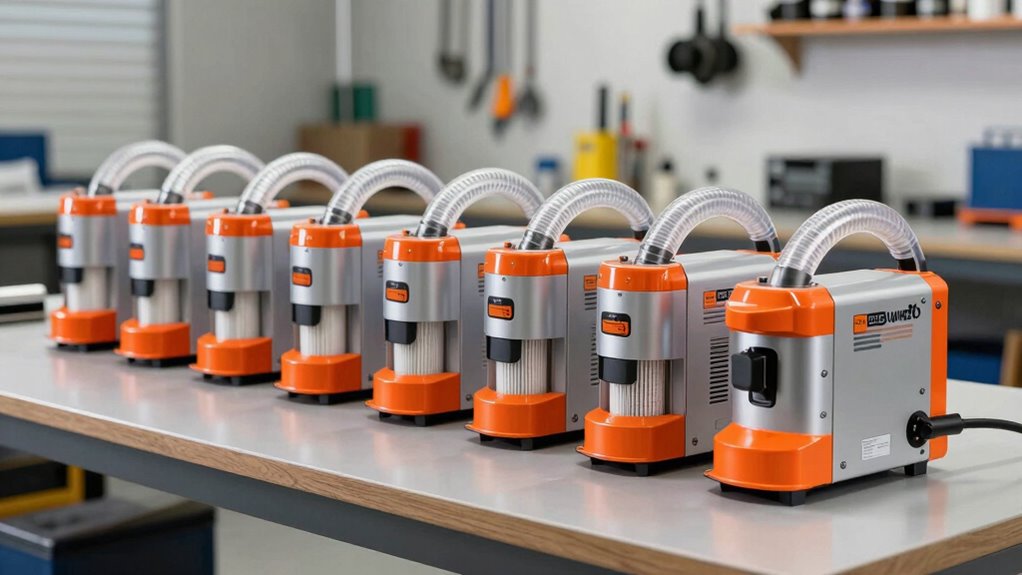

A sanding dust extractor system pairs a suitable vacuum or collector with a sander, hose, and filtration that can capture fine dust at the source. My best overall pick is the DEWALT DWV010 for its HEPA filtration and automatic filter cleaning; the Festool CT MIDI I suits buyers who want a more compact extractor, while the Bosch VAC090AH adds automatic cleaning in a 9-gallon format. The main tradeoffs are portability versus capacity, extractor-style filtration versus high-volume shop collection, and features such as tool-triggered starts. A powerful machine can still disappoint if its hose or adapter does not fit your sander. Read on for the full breakdown and guidance on matching a system to your work.

Get business pricing on tools and workshop supplies
- Business-only prices and quantity discounts
- Tax-exempt purchasing
- Multiple users, one account, clear invoices
Complete the kit



Key Takeaways
- The DEWALT DWV010 leads as the all-around extractor: HEPA filtration and automatic filter cleaning make it a strong fit for sustained sanding, though its 8-gallon capacity is not the largest here.
- Extractor-style models and the WEN collector serve different jobs: the WEN DC1300 moves high air volume for broader woodworking dust collection, while portable extractors are better suited to a sander connected at the source.
- Automatic filter cleaning is a meaningful separator: the DEWALT DWV010 and Bosch VAC090AH include it, a useful feature for longer sessions where filter loading can interrupt airflow.
- Capacity and mobility pull in opposite directions: the 3M 9-gallon and Bosch 9-gallon models offer more collection space than compact options, while the Festool CT MIDI I favors a smaller footprint.
- Not all listed systems are like-for-like: the 8-gallon 150 CFM woodworking extractor and the WEN DC1300 call for checks on filtration, connection fit, and intended duty before treating them as substitutes for HEPA extractors.
| DEWALT DWV010 8-Gallon HEPA Dust Extractor with Automatic Filter Cleaning |  | Best for Continuous Jobsite Sanding | Capacity: 8 gallons | Filter type: HEPA | Airflow: 150 CFM (item details); 155 CFM (product description) | VIEW ON AMAZON | See Our Full Breakdown |
| Festool 578512 CT MIDI I HEPA Dust Extractor |  | Best Compact Smart-Control Pick | Model: 578512 | Filter type: HEPA | Power source: Corded electric | VIEW ON AMAZON | See Our Full Breakdown |
| 3M Xtract Portable Dust Extractor, 9 Gallon |  | Best for Industrial Sander Pairing | Model: 64256 | Capacity: 9 gallons (35 liters) | Filter: Class H HEPA cartridge | VIEW ON AMAZON | See Our Full Breakdown |
| Festool CT 15 HEPA Dust Extractor with Automatic Tool Start |  | Best for Shop Cleanup Versatility | Model: CT 15 HEPA US; model number 578441 | Filter type: HEPA | Capacity: 15 liters (3.96 gallons) | VIEW ON AMAZON | See Our Full Breakdown |
| Bosch VAC090AH 9-Gallon Dust Extractor with Automatic Filter Cleaning |  | Best Adjustable All-Rounder | Capacity: 9 gallons | Filter: HEPA; captures 99.97% of particles 0.3 microns and larger | Filter cleaning: Automatic, every 15 seconds | VIEW ON AMAZON | See Our Full Breakdown |
| 8-Gallon Dust Extractor for Woodworking 150 CFM |  | Best for Heavy-Duty Sanding | Capacity: 8 gallons | Motor power: 1200 watts | Airflow: 150 CFM | VIEW ON AMAZON | See Our Full Breakdown |
| WEN DC1300 1,300 CFM 14-Amp 5-Micron Woodworking Dust Collector with 50-Gallon Collection Bag and Mobile Base |  | Best for Central Workshop Collection | Airflow: 1,300 CFM | Motor: 14 amps | Collection capacity: 50 gallons | VIEW ON AMAZON | See Our Full Breakdown |
| Mirka DEXOS 1217X 17L M-Class HEPA Dust Extractor |  | Best Compact Professional Sander System | Container capacity: 17 L | Filtration: M-Class HEPA, 99% filtration | Filter cleaning: Automatic filter cleaning (AFC) | VIEW ON AMAZON | See Our Full Breakdown |
| sanding dust extractor system | Capacity | Airflow | Filter type | Filter cleaning |
|---|---|---|---|---|
| DEWALT DWV010 8-Gallon HEPA Du | 8 gallons | 150 CFM (item details); 155 CFM (product description) | HEPA | — |
| Festool 578512 CT MIDI I HEPA | — | — | HEPA | Manual |
| 3M Xtract Portable Dust Extrac | 9 gallons (35 liters) | — | — | — |
| Festool CT 15 HEPA Dust Extrac | 15 liters (3.96 gallons) | — | HEPA | — |
| Bosch VAC090AH 9-Gallon Dust E | 9 gallons | Up to 150 CFM | — | Automatic, every 15 seconds |
| 8-Gallon Dust Extractor for Wo | 8 gallons | 150 CFM | HEPA | Automatic |
| WEN DC1300 1,300 CFM 14-Amp 5- | — | 1,300 CFM | — | — |
| Mirka DEXOS 1217X 17L M-Class | — | 89 CFM | — | Automatic filter cleaning (AFC) |
More Details on Our Top Picks
DEWALT DWV010 8-Gallon HEPA Dust Extractor with Automatic Filter Cleaning
The DWV010’s strongest case as a sanding dust extractor is its automatic filter cleaning every 30 seconds, which helps limit suction loss during extended work. Its power-tool actuation starts and stops extraction with a connected sander, while the 15-foot anti-static hose gives more reach around a workpiece. Compared with the Bosch VAC090AH, the DEWALT cleans its filter less frequently and provides less capacity, but its 8-gallon canister and jobsite-oriented wheels make it a practical mobile setup. The Bosch adds adjustable suction and wet/dry collection, while this model’s appeal is straightforward tool-linked operation. Its corded design restricts use to areas with an outlet, and buyers needing EPA RRP-compliant HEPA filtration should note that the specified DWV9330 filters are required.
Pros:- Automatic filter pulses help sustain airflow during longer sanding sessions.
- Power-tool actuation coordinates extraction with a connected tool.
- 15-foot anti-static hose provides useful reach around larger workpieces.
- Heavy-duty wheels and casters suit movement across a jobsite.
Cons:- Corded power limits use to locations with a suitable outlet.
- EPA RRP compliance requires the specified DWV9330 filters.
- Filter cleaning runs every 30 seconds, less often than the Bosch VAC090AH’s 15-second cycle.
Best for: Sanding crews who want automatic tool-linked extraction, a long hose, and jobsite-ready mobility.
Not ideal for: Buyers who need cordless operation or EPA RRP compliance without sourcing the specified DWV9330 filters.
- Capacity:8 gallons
- Filter type:HEPA
- Airflow:150 CFM (item details); 155 CFM (product description)
- Motor:15 A
- Power source:Corded, 120 V
- Hose:15 ft anti-static hose; 1.25 in diameter
- Weight:21–22 lb, depending on listed source
- Noise level:80 dB
- Warranty:1-year limited
Our verdict“Choose the DWV010 for mobile, tool-activated sanding extraction with automatic filter cleaning, provided its cord and filter requirements fit your work.”
Festool 578512 CT MIDI I HEPA Dust Extractor
For sanding in a smaller shop or moving between rooms, the CT MIDI I puts the emphasis on compact mobility and convenient controls rather than a large listed dust capacity. Its four wheels, Bluetooth remote start and stop, and automatic tool start make it easier to position extraction where the sander is working. The included smooth suction hose and tool-free filter changes also help keep setup and maintenance manageable. Compared with the larger 3M Xtract Portable Dust Extractor, this Festool is a more control-focused option; the 3M is specified for pneumatic and electric sanders and includes two HEPA cartridges plus automatic filter cleaning without interrupting airflow. The MIDI I instead relies on manual filter cleaning and offers only one power level, so it suits tidy, mobile indoor work better than demanding continuous sanding where hands-off filter maintenance matters.
Pros:- Compact, lightweight design with a robust chassis and four wheels.
- Bluetooth remote start and automatic tool start add flexible control.
- HEPA filtration supports fine-dust collection.
- Tool-free filter changes and touch controls simplify routine handling.
Cons:- Manual filter cleaning requires the user to maintain the filter.
- Only one power level is listed.
- Corded operation requires access to an outlet.
Best for: Woodworkers and finishers who need a compact indoor extractor with remote or tool-triggered starting.
Not ideal for: Sanding operators who want automatic filter cleaning, multiple power levels, or a specified large-capacity canister.
- Model:578512
- Filter type:HEPA
- Power source:Corded electric
- Power levels:1
- Wheels:4
- Control features:Touch controls, Bluetooth remote start and stop, automatic tool start
- Filter cleaning:Manual
- Included hose:Smooth suction hose, 27/32 x 3.5 m AS/CTR
- Included filter bag:SELFCLEAN filter bag
Our verdict“Pick the CT MIDI I for compact, connected indoor sanding work, not for users who want automatic filter cleaning or variable power.”
3M Xtract Portable Dust Extractor, 9 Gallon
The 3M Xtract is the most specifically sander-oriented choice here: it connects to compatible pneumatic and electric sanders and cleans its filter automatically without stopping airflow. That uninterrupted collection is a useful distinction for sustained shop work, especially alongside its Class H HEPA cartridge and supplied conductive hose. It also arrives with two HEPA cartridges and a filter bag, giving buyers a ready set of collection components. Compared with the Festool CT 15, the 3M is aimed more directly at industrial sanding connections, while the CT 15 adds stored cleaning accessories and an adjustable high-performance turbine. The 3M’s stated 75 dB noise level is lower than the DEWALT DWV010’s listed 80 dB, but its occupational-use focus and indoor-only design make it less suited to general household cleanup or outdoor work.
Pros:- Works with compatible pneumatic and electric sanders.
- Automatic filter cleaning operates without interrupting airflow.
- Includes two HEPA cartridges, a filter bag, and a conductive hose.
- Listed 75 dB noise level is below the DEWALT DWV010’s 80 dB figure.
Cons:- Intended for industrial or occupational use rather than general household cleanup.
- Designed for indoor use only.
- The listed maximum suction of 102 inches does not provide an airflow figure for direct comparison with the DEWALT or Bosch.
Best for: Industrial or occupational sanding users pairing a dust extractor with compatible pneumatic or electric sanders.
Not ideal for: Home users seeking a general-purpose indoor/outdoor vacuum or buyers who need a broader range of cleaning accessories.
- Model:64256
- Capacity:9 gallons (35 liters)
- Filter:Class H HEPA cartridge
- Maximum suction:102 inches
- Noise level:75 dB
- Voltage:110 V
- Weight:17.5 lb
- Sander compatibility:Compatible pneumatic and electric sanders
- Included components:Filter bag, conductive hose, push handle, two HEPA filter cartridges
Our verdict“Choose the 3M Xtract for compatible industrial sanding setups that benefit from uninterrupted automatic filter cleaning.”
Festool CT 15 HEPA Dust Extractor with Automatic Tool Start
The CT 15 suits buyers who want sanding extraction to share a machine with everyday shop cleanup. Its 15-liter container is smaller than the 8-gallon DEWALT DWV010 and 9-gallon Bosch VAC090AH, so it is a more compact option rather than the choice for long runs that fill a canister quickly. HEPA filtration, automatic tool start, and AutoClean make it more purpose-built for tool use than a basic cleanup vacuum, while the crevice nozzle and upholstery brush store inside the unit for quick changes between tasks. The steel axles and flat top add practical handling and a place for nearby tools or materials. Compared with the Festool CT MIDI I, the CT 15 emphasizes its cleaning accessories and AutoClean system, but its single power level limits adjustment.
Pros:- HEPA filtration and AutoClean support sanding dust collection and filter maintenance.
- Automatic tool start links extraction to a connected tool.
- Crevice nozzle and upholstery brush store inside the unit.
- Compact chassis includes steel axles and a flat top for nearby items.
Cons:- 15-liter capacity is smaller than the DEWALT DWV010 and Bosch VAC090AH.
- Corded power limits mobility when no outlet is nearby.
- Only one power level is listed.
Best for: Small-shop woodworkers who want a compact HEPA extractor for sanding and general indoor cleanup.
Not ideal for: High-volume sanding users who need a larger collection capacity or buyers who want multiple power settings.
- Model:CT 15 HEPA US; model number 578441
- Filter type:HEPA
- Capacity:15 liters (3.96 gallons)
- Power source:Corded electric
- Power levels:1
- Usage:Indoor and outdoor
- Included components:Suction hose, filter bag, crevice nozzle, upholstery brush
- Automatic features:Automatic tool start and AutoClean
Our verdict“Choose the CT 15 if a compact HEPA extractor must handle both tool-connected sanding and routine shop cleanup.”
Bosch VAC090AH 9-Gallon Dust Extractor with Automatic Filter Cleaning
The Bosch VAC090AH brings together the broadest set of practical controls in this group: three power levels, adjustable suction, and power-tool activation let users tune extraction to different sanding tasks. Its 9-gallon capacity is larger than the DEWALT DWV010’s 8 gallons, and the filter pulses every 15 seconds—twice as frequently as the DEWALT’s stated 30-second cycle—to help maintain suction. Bosch also specifies HEPA capture of 99.97% of particles 0.3 microns and larger, plus wet/dry collection for work beyond sanding. Compared with the 3M Xtract, Bosch offers adjustable suction and wet/dry use, while 3M’s automatic cleaning is described as continuing without interrupted airflow and its kit includes two HEPA cartridges. At 28 pounds, the Bosch is heavier than the 3M, and its cord still ties it to an outlet.
Pros:- Three power levels and adjustable suction help match extraction to the task.
- Automatic filter cleaning runs every 15 seconds.
- HEPA filter captures 99.97% of particles 0.3 microns and larger.
- Power-tool activation and wet/dry collection add versatility.
Cons:- At 28 pounds, it is heavier than the 3M Xtract’s listed 17.5 pounds.
- Corded operation requires a suitable power source.
- A larger canister and feature set may be more than needed for occasional, light sanding.
Best for: Woodworkers who want one extractor for varied sanding tasks, adjustable suction, and occasional wet/dry cleanup.
Not ideal for: Buyers who need a lightweight unit to carry frequently or a cordless extractor for locations without an outlet.
- Capacity:9 gallons
- Filter:HEPA; captures 99.97% of particles 0.3 microns and larger
- Filter cleaning:Automatic, every 15 seconds
- Airflow:Up to 150 CFM
- Maximum suction:97 inches of water lift
- Power:Corded electric, 120 V
- Weight:28 lb
- Noise level:60 dB
- Collection and controls:Wet/dry collection; power-tool activation; adjustable suction; 3 power levels
Our verdict“Choose the Bosch VAC090AH for adjustable, tool-activated sanding extraction that can also handle wet/dry cleanup, if its weight is acceptable.”
8-Gallon Dust Extractor for Woodworking 150 CFM
For sanding work that needs strong pickup at the tool, this 150 CFM extractor offers a more suitable format than the WEN DC1300, which is built around high-volume collection for a workshop’s ducted tools. Its automatic HEPA filter cleaning helps limit suction loss as fine dust accumulates, while auto start lets a connected tool trigger the extractor without a separate switch step. Remote operation and overload prevention add useful control for demanding sessions. The tradeoff is capacity: its 8-gallon container fills sooner than the WEN’s 50-gallon bag, and the unit may be cumbersome to move. Compared with the Mirka DEXOS 1217X, it offers higher stated airflow but lacks the listed adjustable suction and anti-static hose. I’d choose it for powerful extraction over portability or large-volume collection.
Pros:- Automatic HEPA filter cleaning helps maintain suction during extended work.
- 150 CFM airflow and 96-inch static water lift suit demanding point-of-use dust collection.
- Auto start and remote operation reduce interruptions while sanding.
- Overload prevention adds a protective measure during heavy use.
Cons:- The 8-gallon capacity requires more frequent emptying than the WEN DC1300’s 50-gallon bag.
- Its weight may make frequent movement between work areas difficult.
- Corded operation requires access to a power source.
Best for: Woodworkers who need HEPA-filtered, tool-activated extraction for frequent or demanding sanding sessions.
Not ideal for: Small-shop users who need a lightweight extractor, or shops collecting dust from several machines into a large-capacity system.
- Capacity:8 gallons
- Motor power:1200 watts
- Airflow:150 CFM
- Static water lift:96 inches
- Filter type:HEPA
- Filter cleaning:Automatic
- Tool activation:Auto start
- Controls and protection:Remote control; overload prevention
Our verdict“Choose this extractor for strong, automatic HEPA dust collection at a sanding tool, provided its weight and 8-gallon capacity suit your shop.”
WEN DC1300 1,300 CFM 14-Amp 5-Micron Woodworking Dust Collector with 50-Gallon Collection Bag and Mobile Base
The WEN DC1300 is the workshop-scale option in this group: its 1,300 CFM airflow, dual 4-inch inlets, and 50-gallon bag suit larger machines and connected collection runs better than a portable sander extractor. The mobile base with swivel casters makes it easier to reposition around a garage or shop, though its size still demands dedicated floor space. Against the 8-Gallon Dust Extractor for Woodworking, the WEN moves far more air and holds much more debris, but it does not list HEPA filtration, automatic filter cleaning, or tool-triggered start. That distinction matters for sanding: fine dust captured at a sander calls for a different setup than high-volume chips and dust collected from stationary equipment. I’d pick this for shop-wide capacity, not as a compact, fine-dust-focused extractor.
Pros:- 1,300 CFM airflow is suited to high-volume workshop collection.
- The 50-gallon bag reduces how often collected dust needs to be emptied.
- Dual 4-inch inlets support connections to multiple tools.
- Four swivel casters help reposition the unit around a workshop.
Cons:- Its bulky footprint makes it a poor fit for small shops.
- No adjustable speed settings are listed.
- The listed 5-micron filtration is less suited to fine sanding dust than the HEPA options in this roundup.
Best for: Woodworkers with a dedicated garage or workshop who want high-volume collection for stationary machines and multiple connected tools.
Not ideal for: Sander users seeking a compact HEPA extractor with automatic filter cleaning and tool-triggered operation, or anyone short on storage and floor space.
- Airflow:1,300 CFM
- Motor:14 amps
- Collection capacity:50 gallons
- Inlets:Dual 4-inch
- Impeller speed:3,450 RPM
- Filtration:5-micron
- Mobility:Mobile base with four swivel casters
- Recommended uses:Garage, home, and workshop
Our verdict“Choose the WEN for large-volume collection from stationary shop machines, not for portable HEPA extraction at a sander.”
Mirka DEXOS 1217X 17L M-Class HEPA Dust Extractor
The Mirka DEXOS 1217X is the most sander-focused choice here: its included 13-foot anti-static hose is designed for compatible Mirka DEROS II and DEOS II sanders, and its compact 17-liter container suits work areas where a 50-gallon collector like the WEN DC1300 would be out of place. M-Class filtration, automatic filter cleaning, adjustable suction, and airflow monitoring give sanding-focused buyers more control than the 8-Gallon Dust Extractor for Woodworking, whose listed airflow is higher but whose suction is not adjustable. The brushless motor and app connectivity add modern control features, but the 89 CFM airflow is lower than that extractor’s 150 CFM. This is a strong system match for Mirka users, less compelling for buyers with other sanders or no need for Bluetooth features.
Pros:- Compact 17-liter container and 28.7-pound weight suit jobsite and workshop use.
- M-Class filtration and automatic cleaning support fine-dust sanding work.
- Adjustable suction and airflow monitoring give users control as tasks change.
- Included 13-foot anti-static hose is designed for compatible Mirka sanders.
Cons:- The 89 CFM airflow is lower than the 150 CFM listed for the 8-Gallon Dust Extractor for Woodworking.
- Compatible Mirka DEROS II and DEOS II sanders are sold separately.
- Corded operation requires access to a 110 V outlet.
Best for: Professional or serious hobbyist sanders using compatible Mirka DEROS II or DEOS II tools who want a compact, adjustable extractor.
Not ideal for: Buyers who need high airflow for multiple stationary machines, want a large collection container, or use sanders outside the listed Mirka compatibility.
- Container capacity:17 L
- Filtration:M-Class HEPA, 99% filtration
- Filter cleaning:Automatic filter cleaning (AFC)
- Airflow:89 CFM
- Hose:13 ft anti-static hose
- Motor:Brushless
- Connectivity:Bluetooth; myMirka app
- Power:110 V, corded electric
- Dimensions and weight:19 × 13 × 19 in; 28.7 lb
Our verdict“Choose the Mirka for compact, adjustable fine-dust extraction with compatible Mirka sanders, rather than for maximum airflow or large-shop collection.”

How We Picked
I ranked these options around the job implied by the search: capturing sanding dust near the tool, not simply moving air around a workshop. I weighed stated filtration, automatic filter cleaning, capacity, portability, tool-start features, and how clearly each product’s format fits a connected sander. A system’s ability to work with the actual sander, hose, and adapter matters as much as headline airflow, so I treated compatibility and intended use as part of the buying decision.
The ranking favors dedicated extractors with clear dust-control features and practical sanding use. The DEWALT takes the top spot for its combination of HEPA filtration and automatic cleaning; the Bosch brings similar cleaning support with more capacity. Compact and premium-oriented options earn places for specific needs, while the WEN DC1300 ranks lower for this particular use because its high-volume collector format is less directly comparable to portable tool-connected extractors. Product names and stated specifications inform this editorial comparison; buyers should confirm current configurations and local requirements before purchase.
| sanding dust extractor system | Filter cleaning |
|---|---|
| DEWALT DWV010 8-Gallon HEPA Du | — |
| Festool 578512 CT MIDI I HEPA | Manual |
| 3M Xtract Portable Dust Extrac | — |
| Festool CT 15 HEPA Dust Extrac | — |
| Bosch VAC090AH 9-Gallon Dust E | Automatic, every 15 seconds |
| 8-Gallon Dust Extractor for Wo | Automatic |
| WEN DC1300 1,300 CFM 14-Amp 5- | — |
| Mirka DEXOS 1217X 17L M-Class | Automatic filter cleaning (AFC) |
Factors to Consider When Choosing Sanding Dust Extractor System
Choosing a sanding dust extractor is less about finding the biggest number and more about matching the whole collection path to your work. I would check the sander connection, dust type, session length, and where the machine will sit before choosing a format. These checks help avoid buying a capable extractor that is awkward to use—or a collector that does not suit fine dust at the tool.
Match the extractor format to the sanding task
A portable extractor connects directly to a sander and is usually the more natural format for furniture work, trim, and moving between jobs. A stationary dust collector can serve machines around a workshop, but its high airflow does not by itself make it a substitute for a tool-connected extractor. Think about whether dust is produced at one handheld tool or across several fixed machines. A common mistake is choosing by CFM alone without checking whether the hose and pickup suit the sander’s dust port. If you do both kinds of work, you may need separate solutions rather than one machine expected to perform every role.
Treat filtration and dust classification as separate checks
HEPA wording and dust-class labels are not interchangeable claims, and neither should be assumed from a product’s general “dust extractor” name. Check the specific model’s stated filtration and whether it fits the dust and workplace rules relevant to your project. Fine sanding dust can escape through poor seals or an incompatible bag even when the filter itself has a strong specification. Buyers working with hazardous materials should follow applicable safety guidance and verify the complete system, including bags, filters, and connections. A shop vacuum with a fine filter may still differ from a purpose-built extractor in its documented dust-control features.
Balance capacity against footprint and handling
A larger container means fewer stops to empty it, but it also takes more room and can make a machine harder to move through a small shop. For short jobs or frequent repositioning, a compact extractor can be easier to keep close to the sander. For long sessions, extra capacity may reduce interruptions, especially when sanding large surfaces. Check the total assembled footprint and how the unit moves, rather than relying on gallon figures alone. Also allow room to remove the bin or bag without spilling dust back into the work area.
Decide whether automatic filter cleaning earns its place
As dust loads a filter, airflow can fall; automatic cleaning is designed to reduce the need for manual interruptions during work. It can be especially useful for repeated or longer sanding sessions, but it adds a feature that may not matter much for occasional small projects. Check how the cleaning cycle operates and whether it interrupts suction or creates noise. Manual filter care still matters, so learn what the manufacturer permits for cleaning and replacement. Do not treat automatic cleaning as a replacement for checking filters, bags, and seals.
Confirm tool-start controls and electrical compatibility
Automatic tool start can make the extractor switch on with the connected tool, reducing extra steps and leaving less dust suction running after sanding stops. Before buying, check that the extractor’s outlet and switching method match the sander and power setup you plan to use. A trigger feature is less useful if your tool cannot connect safely or if the system is shared among tools with different needs. Consider cord routing too: a poorly managed hose and power lead can snag around a workpiece. For a fixed shop station, a manual switch may be perfectly workable; for frequent tool changes, automatic control may improve day-to-day ease.
Price the full system, not only the machine
The extractor is only one part of a working setup: hoses, adapters, bags, replacement filters, and compatible sanding tools can affect the real cost and convenience. Check whether the sander’s dust port accepts the supplied hose or requires an adapter, and confirm which consumables fit the exact model. A low-cost machine can become a poor value if required parts are hard to source or the connection leaks. Paying more makes sense when the added filtration, filter cleaning, or tool controls address a clear need in your routine. If you sand infrequently, a simpler system with a reliable fit may be a better choice than paying for features you will rarely use.
Frequently Asked Questions
Can I use a woodworking dust collector like the WEN DC1300 for a handheld sander?
Possibly, but do not assume that a high-volume collector will connect effectively to a handheld sander. Check the collector’s inlet, hose diameter, and compatibility with the sander’s dust port, then confirm that its filtration is appropriate for the dust you produce. A collector designed around broader workshop pickup may not provide the same practical setup as a portable extractor connected directly to a tool. If fine-dust capture at the sander is your main goal, compare the complete connection and filtration arrangement rather than the airflow figure alone. The WEN is most compelling when its larger collector format matches the rest of your shop.
Is HEPA filtration enough to make a sanding setup safe for every material?
No single filter label makes every sanding task safe, and the dust itself matters. Check the extractor’s full specifications, bags, seals, and the safety guidance that applies to the material and workplace. Some jobs may call for additional controls, personal protective equipment, or specific dust-handling procedures. Do not rely on a generic vacuum description when working with hazardous coatings, treated materials, or regulated dust. If you are unsure, consult the material safety information and relevant workplace rules before sanding.
Should I choose automatic filter cleaning or a larger collection capacity?
Choose based on what interrupts your work most. Automatic filter cleaning can help maintain airflow during longer sanding sessions, while a larger container can mean fewer stops to empty collected dust. Neither feature replaces the other, and the better fit depends on your session length, dust volume, and tolerance for maintenance pauses. For prolonged sanding, filter cleaning may matter more than extra bin space if airflow drops are the main frustration. For high-volume work with a filter arrangement that stays effective, capacity may be the more useful advantage.
How do I know whether an extractor will connect to my sander?
Check the diameter and shape of both the extractor hose and the sander’s dust port before buying. Some connections fit directly; others need a model-specific adapter, and a loose fit can reduce capture and let dust escape. Also check whether the hose length and flexibility suit the way you move around a workpiece. If you use several sanders, list each port size rather than assuming one adapter will cover them all. Confirm the included accessories and compatible replacement parts for the exact extractor model.
Is a compact extractor the right choice for a small workshop?
A compact machine can be easier to store and position near a sander, which matters when floor space is limited. Its smaller capacity may mean more frequent emptying, so compare that tradeoff with how much dust your typical session produces. Also check whether the hose, cords, and bin access fit your available space; a compact body does not automatically make the full setup convenient. If you regularly sand large pieces for long periods, a larger unit may reduce interruptions even in a small shop. For occasional work and easy storage, compactness can be the stronger priority.
Conclusion
For most buyers seeking a dedicated sanding dust extractor system, I would start with the DEWALT DWV010: it combines HEPA filtration with automatic filter cleaning and earns the best-overall position. For value-minded shoppers, the 8-Gallon 150 CFM Woodworking Dust Extractor is worth examining, but only after confirming its filtration details, tool connection, and fit for fine sanding dust. Buyers looking for a premium-oriented option can compare the Mirka DEXOS 1217X and Festool CT MIDI I around their setup needs, footprint, and compatibility rather than assuming the brand alone settles the choice. For beginners, the Festool CT 15 is a straightforward candidate to investigate if automatic tool start suits the intended sander. For longer sessions where filter loading is a concern, compare the Bosch VAC090AH and DEWALT; for a broader stationary woodworking setup, the WEN DC1300 has a different role. Match the machine to your sander and dust-control needs before choosing by capacity or airflow.
Black Friday Picks

Philips Hue Amarant Outdoor Smart Light Bar, Black
As an affiliate, we earn on qualifying purchases.