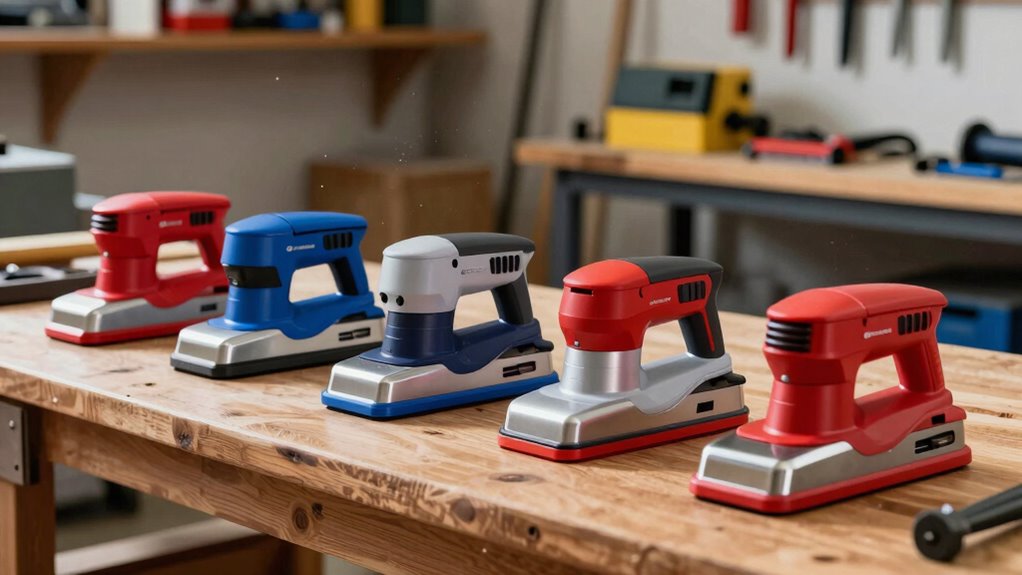

Finding an edge sander suitable for a small shop involves balancing size, power, and versatility. The SKIL Corded Multi-Function Detail Sander stands out as the best overall choice, offering multiple attachments and dust collection in a compact size. The WEN 6301 Electric Detailing Palm Sander is a great budget-friendly option for detailed work, while the Milescraft 1621 Edge Sander excels for dual-edge sanding tasks. Each option presents tradeoffs between performance, versatility, and ease of use, making it essential to match a tool’s strengths to your specific needs. Continue reading for a detailed breakdown of these options and how to choose the right edge sander for your small shop.

Get business pricing on tools and workshop supplies
- Business-only prices and quantity discounts
- Tax-exempt purchasing
- Multiple users, one account, clear invoices
Complete the kit


Key Takeaways
- The best overall edge sander combines versatility, dust control, and a compact footprint, making the SKIL model stand out.
- Budget options like the WEN 6301 provide decent performance for detail work but may lack durability for heavy use.
- Dual-edge sanding tools like the Milescraft 1621 are ideal for specific tasks but may not offer as much fine control.
- Dust collection is a key factor for small shop environments to maintain a clean workspace, influencing the choice of models.
- Size and maneuverability are critical—larger sanders offer more power but can be cumbersome in tight spaces.
| SKIL Corded Multi-Function Detail Sander with Micro-Filter Dust Box, 3 Attachments & 12 Sanding Sheets |  | Best Overall for Versatility and Ease of Use | Motor Power: 1.2 amps | Orbits Per Minute: 13,500 | Attachments: 3 detail attachments | VIEW ON AMAZON | See Our Full Breakdown |
| WEN 6301 Electric Detailing Palm Sander |  | Best for Precise, Detailed Work in Tight Spaces | Grit Type: Fine | Voltage: 120 volts | Power Source: Corded Electric | VIEW ON AMAZON | See Our Full Breakdown |
| Milescraft 1621 Edge Sander – Dual Edge Sanding Tool |  | Best for Edging and Finishing Thin Boards | Sanding Range: ¼” to 1-½” | Disc Size: 5 inches | Included Sandpaper: 150 Grit | VIEW ON AMAZON | See Our Full Breakdown |
| Skil 5” Random Orbital Sander with Cyclonic Dust Box and 3 Sanding Sheets |  | Best for Power and Smooth Finish in Small Spaces | Motor Power: 2.8 amps | Orbital Speed: 13,000 OPM | Size: 5 inches | VIEW ON AMAZON | See Our Full Breakdown |
| Goldblatt Dust-Free Drywall Hand Sander with 6.5 ft Vacuum Hose |  | Best for Dust Control and Drywall Finishing | Grit: 120 | Hose Length: 6.5 ft | Vacuum Adapter: Φ1-1/4” | VIEW ON AMAZON | See Our Full Breakdown |
| 54PCS Micro Sander Kit with Detail & Mini Sander Block, 80–800 Grit Sandpapers for Wood & Crafts |  | Best for Precision and Detail Work | Number of Sandpapers: 54 | Grit Range: 80–800 | Sander Dimensions: 3.5 x 1 inches | VIEW ON AMAZON | See Our Full Breakdown |
More Details on Our Top Picks
SKIL Corded Multi-Function Detail Sander with Micro-Filter Dust Box, 3 Attachments & 12 Sanding Sheets
This multi-function sander stands out for its adaptability, combining a powerful 1.2 amp motor with three attachments that handle detailed finishing better than the WEN 6301, which is more focused on simple, precise sanding. Its dust collection system is notably effective, keeping your workspace cleaner, and the ergonomic design reduces hand fatigue during prolonged use. Compared to the Skil 5″ orbital sander, this model offers more versatility with multiple attachments, though its corded nature limits mobility—something to consider if you need more freedom of movement for larger projects. The hook and loop sanding sheets make sheet changes quick, boosting efficiency. However, overpowered for very delicate tasks, it might be too aggressive in fine finishing applications.
Pros:- Versatile 4-in-1 design with multiple attachments
- Effective dust collection system
- Easy to change sanding sheets with hook and loop system
- Ergonomic design reduces hand fatigue
Cons:- Corded design limits mobility
- May be overpowered for very delicate tasks
Best for: Small shop owners who need a versatile, all-in-one detail sander for various projects with minimal setup fuss
Not ideal for: Woodworkers focused solely on fine, delicate finishing or those requiring cordless operation for mobility
- Motor Power:1.2 amps
- Orbits Per Minute:13,500
- Attachments:3 detail attachments
- Dust Collection:Micro-filter dust box and 1-1/4″ dust port
- Sanding Sheets:12 included
- Vibration:Low vibration with ergonomic design
- Switch:Dust-sealed on/off switch
Our verdict“This sander is best suited for small shops needing a flexible, multi-purpose tool that balances power and comfort.”
WEN 6301 Electric Detailing Palm Sander
The WEN 6301 excels in delivering precise sanding with its compact, lightweight profile, making it a more maneuverable choice than the larger Skil orbital sander. Its 13,500 OPM motor provides high rotational speed ideal for detailed woodworking projects, but it is limited to finer, lighter tasks, unlike the SKIL multi-function tool which can handle more aggressive removal with attachments. Its dust collection port helps keep your workspace cleaner, although it’s less effective than cyclonic systems and might require external vacuuming for larger cleanup. The included 80-grit sandpaper is ready for immediate use, making it a practical choice for small, detailed jobs. However, its small size and limited grit range mean it’s not suited for heavy-duty or large surface sanding.
Pros:- Compact and lightweight for easy handling
- High rotational speed for efficient fine sanding
- Dust collection port minimizes mess
- Includes ready-to-use sandpaper
Cons:- Limited to detailed, fine work
- Corded design restricts mobility
- Grit size not suitable for heavy-duty tasks
Best for: Woodworkers who prioritize precision and control in small, detailed projects or finishing work
Not ideal for: Large surface sanding or tasks requiring aggressive material removal
- Grit Type:Fine
- Voltage:120 volts
- Power Source:Corded Electric
- Amperage Capacity:0.8 A
- Grit Number:80
- Maximum Rotational Speed:12000 rpm
- Shape:palm
- Item Dimensions:5.5″L x 5.5″W x 3.12″H
Our verdict“This sander makes the most sense for artisans and hobbyists needing precise control in tight spaces rather than large surface removal.”
Milescraft 1621 Edge Sander – Dual Edge Sanding Tool
The Milescraft Edge Sander is designed specifically to speed up edge finishing, outperforming the Skil orbital sander when it comes to equal-time edge work by sanding both sides simultaneously. Its ergonomic shape makes it comfortable to handle, and it uses standard 5″ hook and loop discs, offering flexibility in grit choice. However, its limited sanding range from ¼” to 1-½” makes it unsuitable for larger or thicker boards, and it requires purchasing additional discs for different grits—adding to ongoing costs. While it excels at edge finishing, it doesn’t replace a full-size orbital sander for larger surfaces, so it’s best for specialized edge work rather than general sanding needs.
Pros:- Sands both edges simultaneously, saving time
- Compatible with standard 5-inch discs
- Ergonomic and comfortable to hold
- Ideal for finishing edges quickly
Cons:- Limited to edges from ¼” to 1-½”
- Requires separate purchase of grits
- Not suitable for large or thick boards
Best for: Small shop owners focused on finishing edges of veneer, laminate, or thin boards efficiently
Not ideal for: Heavy-duty or large-surface sanding projects where bigger tools are needed
- Sanding Range:¼” to 1-½”
- Disc Size:5 inches
- Included Sandpaper:150 Grit
Our verdict“This tool is perfect for quick, efficient edge finishing in small projects but isn’t a replacement for larger sanders for big surfaces.”
Skil 5” Random Orbital Sander with Cyclonic Dust Box and 3 Sanding Sheets
The Skil 5″ orbital sander offers a strong motor and high orbital speed, making it suitable for quick material removal and smooth finishes in tight spaces. Its cyclonic dust box is notably effective, outperforming the basic dust collection of the WEN 6301, especially when working on larger surfaces. The variable speed control adds versatility, allowing adjustment based on the material and task. However, the absence of variable pad oscillation limits control over aggressive versus gentle sanding, and at higher speeds, it can be noisier than some competitors. Compared to the SKIL multi-function sander, it’s less versatile but excels in delivering smooth finishes efficiently.
Pros:- Powerful motor with high orbital speed
- Effective cyclonic dust collection
- Variable speed control for different materials
- Includes three sanding sheets
Cons:- Limited to 5-inch sanding sheets
- No variable pad oscillation
- Potentially noisy at high speeds
Best for: Small shop users needing a reliable, powerful orbital sander for finishing and prep work
Not ideal for: Detail-oriented or delicate finishing tasks where fine control is paramount
- Motor Power:2.8 amps
- Orbital Speed:13,000 OPM
- Size:5 inches
- Dust Collection:Cyclonic dust box
- Included Accessories:3 sanding sheets
Our verdict“This sander is a solid choice for those needing consistent, smooth finishes with good dust management in small-shop settings.”
Goldblatt Dust-Free Drywall Hand Sander with 6.5 ft Vacuum Hose
The Goldblatt drywall sander stands out for significantly reducing dust—up to 90%—which is especially valuable in small shops where cleanup can be a challenge. Its ergonomic design, with a soft rubber grip and 360° pivoting elbow, makes maneuvering on vertical surfaces easier than larger tools, and the 6.5-foot hose connects seamlessly to vacuums for continuous dust extraction. While it’s excellent for drywall and woodworking dust control, it’s limited to 120-grit sanding, making it less suitable for heavy material removal or finishing fine surfaces. Compared with the more general-purpose tools like the SKIL or Skil orbital sander, this is a niche tool focused on dust management, not surface prep.
Pros:- Reduces dust by up to 90%, keeping workspace cleaner
- Ergonomic design reduces hand fatigue
- Flexible 360° pivoting elbow for ease of use
- Includes hose, adapter, and sanding screen
Cons:- Requires vacuum connection for dust extraction
- Limited to standard drywall compounds, not fast-setting types
- Grit range limited to 120
Best for: Small shop owners prioritizing dust reduction during drywall or finish sanding tasks
Not ideal for: Heavy-duty woodworking or projects requiring aggressive sanding or high grit levels
- Grit:120
- Hose Length:6.5 ft
- Vacuum Adapter:Φ1-1/4”
- Application:Drywall sanding, woodworking, dust extraction
Our verdict“This tool is ideal for drywall finishing where dust control is a priority, rather than heavy or detailed woodworking tasks.”
54PCS Micro Sander Kit with Detail & Mini Sander Block, 80–800 Grit Sandpapers for Wood & Crafts
This micro sander kit excels at handling intricate projects where precision matters, making it ideal for delicate woodworking and crafts. Unlike larger, electric options such as the WEN 6301, this set offers unmatched control in tight spots, thanks to its compact 3.5 x 1-inch design. The wide grit range from 80 to 800 ensures versatility, allowing for rough shaping to fine finishing within a single kit. Its color-coded system simplifies grit identification, speeding up workflow, while the quick-change hook & loop backing enhances efficiency. However, its manual operation limits its usefulness for larger tasks, and it requires physical effort, which could become tiresome over extended periods. Compared to the Skil 5” Orbital Sander, this kit is less suitable for bulk sanding but shines in detailed, precision work.
Pros:- Wide grit range from coarse to fine for versatile finishing
- Compact size perfect for detailed work and tight spots
- Color-coded grit system speeds up workflow
- Quick-change hook & loop backing for easy sandpaper swaps
Cons:- Limited to small projects and detailed work only
- Manual operation can be tiring for extensive tasks
- No motor or power source—requires manual effort
Best for: Small-shop woodworkers or crafters focusing on detailed projects and tight spaces
Not ideal for: Professionals needing to Sand large surfaces rapidly or those seeking powered sanding solutions
- Number of Sandpapers:54
- Grit Range:80–800
- Sander Dimensions:3.5 x 1 inches
- Grit Types:80, 100, 120, 150, 180, 220, 240, 400, 800
- Backing Type:Hook & loop
- Power Source:Manual
Our verdict“This kit is a smart choice for hobbyists or small-shop artisans prioritizing control and detail over speed.”

How We Picked
To evaluate these edge sanders, I focused on performance, usability, build quality, and value for a small shop setting. Tools had to be compact enough to fit in limited workspace but still deliver sufficient power for detailed and edge finishing tasks. Ease of use and dust collection were also prioritized, as small shops benefit from cleaner, more efficient tools. The products were ranked based on their versatility, durability, and user feedback, ensuring that each selection offers a clear benefit for different kinds of small shop operations. This approach guarantees recommendations that are both practical and tailored to real woodworking needs.Factors to Consider When Choosing Edge Sander For A Small Shop
Choosing the right edge sander for a small shop involves weighing several factors beyond just size and price. Understanding your typical projects and workflow helps identify essential features, such as power, dust management, and attachment versatility. Investing in a model with reliable dust extraction can significantly improve your workspace cleanliness and health. Additionally, consider the sander’s weight and maneuverability to ensure it can handle detailed work without causing fatigue. Recognizing common pitfalls, like overestimating power needs or neglecting dust collection, will help you make a smarter, more satisfying purchase.Power and Performance
For small shops, a balance between power and control is vital. Too much power can make a tool unwieldy, especially for detailed work, while insufficient power may lead to frustration and slow progress. Look for models with variable speed settings to adjust performance based on your task, ensuring smoother finishes on delicate surfaces and more aggressive sanding when needed. Choosing a sander with enough horsepower to handle your typical materials without bogging down is key to efficiency and quality.
Size and Maneuverability
In tight shop spaces, a compact, lightweight sander offers significant advantages. Larger, heavier models may provide more power but can be difficult to handle for detailed or edge work. Consider a tool that fits comfortably in your hand and can easily reach awkward angles. Smaller models also tend to be easier to store, which is an important consideration if space is limited. However, ensure that size doesn’t come at the expense of durability or functionality.
Dust Collection and Cleanliness
Efficient dust management is essential in small shops to maintain a safe, clean environment. Models with integrated dust collection systems or compatible vacuum hoses help keep debris under control, reducing cleanup time and improving air quality. While some budget options may lack effective dust extraction, investing in a sander with a cyclonic or sealed dust box can make a noticeable difference. Remember, a cleaner workspace also prolongs tool life and enhances finishing quality.
Versatility and Attachments
The ability to swap between different attachments expands a sander’s usefulness across various projects. Look for models that come with multiple sanding pads, detail tips, or dual-edge capabilities if your work involves diverse tasks. However, beware of overly complicated systems that can be difficult to change or maintain. Prioritize tools that strike a balance between versatility and ease of use, ensuring you can quickly adapt to different finishing demands without frustration.
Durability and Value
In a small shop, tools need to withstand frequent use without breaking the bank. While premium models offer longer-lasting components and better performance, they also come at a higher price. Conversely, budget options can be sufficient for occasional projects but might wear out faster or lack advanced features. Assess your typical workload and decide whether investing in a higher-quality, more durable sander makes sense, or if a more affordable model will meet your current needs without compromise.
Frequently Asked Questions
Can I use a small edge sander for heavy-duty tasks?
While small edge sanders are designed for detail work and light finishing, some models with higher power ratings and variable speeds can handle moderate tasks. However, they are generally not suited for heavy-duty, continuous removal of large material surfaces. For such jobs, larger, more powerful sanders or belt grinders are better suited. Always check the manufacturer’s specifications to ensure the sander can handle your intended workload without premature wear or failure.
How important is dust collection for a small shop?
Dust collection is a critical feature in small shops, where space is limited and air quality can quickly deteriorate. Effective dust management not only keeps your workspace cleaner but also reduces health risks associated with inhaling fine particles. Models with built-in dust ports or cyclonic systems can significantly reduce cleanup time and improve overall safety. Investing in a sander with good dust control can make a noticeable difference in your daily workflow and long-term health.
Should I prioritize size or power in my edge sander?
For small shop environments, size often takes precedence because maneuverability and space are limited. A compact sander that offers sufficient power for your typical projects provides a better balance of usability and performance. While more powerful tools exist, they may be cumbersome for detailed or edge work. Consider your primary tasks and shop constraints to find a model that offers the best compromise between size and power.
Are variable speed controls necessary on an edge sander?
Yes, variable speed controls greatly enhance the versatility of an edge sander. They allow you to adapt the sanding speed to different materials and finishes, reducing the risk of gouging delicate surfaces or slowing down aggressive material removal. For small shop use, this feature can expand your tool’s capabilities, making it suitable for a wider range of projects with better control and finish quality.
Is a multi-function sander better than a dedicated edge sander?
Multi-function sanders provide greater versatility, often combining detail, orbital, and edge sanding in a single tool, which can save space and money. However, dedicated edge sanders tend to excel at specific tasks, offering better control and efficiency for precise edge work. Your choice depends on your workload: if you need a general-purpose tool for various tasks, a multi-function sander might be preferable. For focused, high-quality edge finishing, a dedicated model often delivers superior results.
Conclusion
For small shop owners prioritizing versatility and overall performance, the SKIL Corded Multi-Function Detail Sander offers the best balance of features and size. Budget-conscious buyers or those with light workloads will find the WEN 6301 provides sufficient quality at a lower price. If your work involves frequent edge or dual-sanding tasks, the Milescraft 1621 delivers targeted function. Beginners should focus on models with straightforward controls and reliable dust collection, while experienced woodworkers may prefer premium, durable options with variable speeds. Ultimately, matching your project needs and workspace constraints will guide the best choice.Fall Picks
fall essentials
As an affiliate, we earn on qualifying purchases.