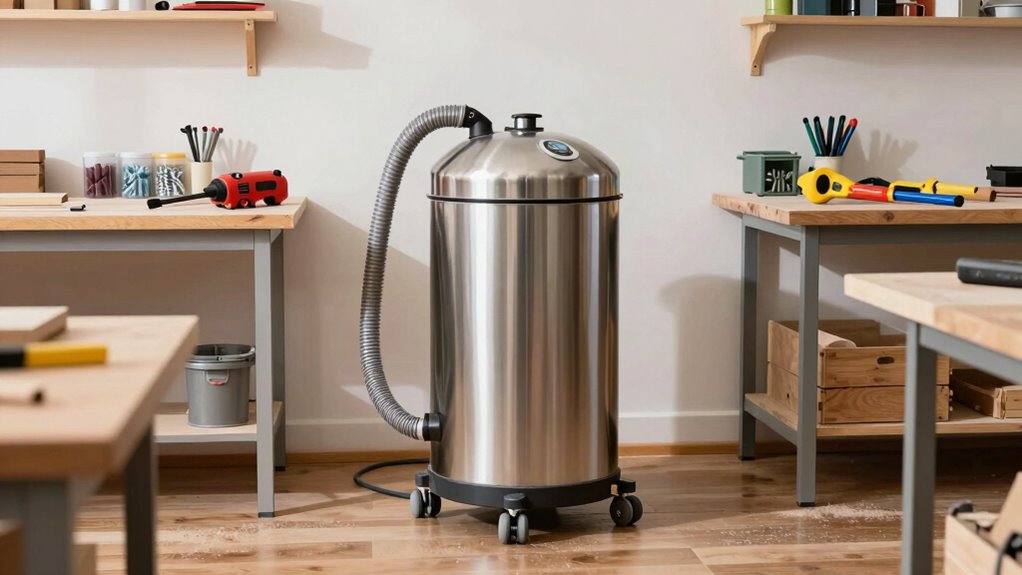

Finding the right dust collector for a small shop involves balancing power, size, and budget. The WEN Woodworking Dust Collector stands out as the best overall choice thanks to its combination of capacity and mobility. The VEVOR Wall Mount Dust Collector offers a compact design with industrial-level CFM, perfect for limited space. However, smaller units may struggle with larger dust loads, and more powerful options often come with a higher price tag or larger footprint. Continue reading for a detailed comparison that helps you identify which model aligns with your specific needs and workspace constraints.

Get business pricing on tools and workshop supplies
- Business-only prices and quantity discounts
- Tax-exempt purchasing
- Multiple users, one account, clear invoices
Complete the kit


Key Takeaways
- The best dust collectors for small shops prioritize a balance between power and size, with the WEN model leading overall due to its versatility.
- Wall-mounted units like the VEVOR save space but often have lower capacities, making them suitable for lighter use.
- Units with larger collection bags, such as the WEN DC1300, are better for frequent, heavy-duty dust collection but can be bulkier.
- Noise levels and ease of maintenance significantly affect daily usability, which sets apart premium options from bargain models.
- Price often correlates with features like motor power, filtration quality, and mobility—consider your primary dust collection needs before choosing.


| dust collector for small shop | Motor Power | Airflow |
|---|---|---|
| WEN Woodworking Dust Collector | 5.7 amps | 660 CFM |
| VEVOR Wall Mount Dust Collecto | — | 560 CFM |
| WEN DC1300 1,300 CFM 14-Amp Wo | 14 amps | 1,300 CFM |
| POWERTEC 1 HP Wall Mount Dust | 1 HP | — |
| WEN Woodworking Dust Collector | 7.4 amps | — |
| Bucktool 1.2 HP Auto-Start Dus | 1.2 HP | 750 CFM |
| SHOPMAX 20 Gallon Dust Collect | 6.3 amps | — |
More Details on Our Top Picks
WEN Woodworking Dust Collector, 5.7-Amp Motor, 12-Gallon Capacity, Mobile Base, Wall Mount Option
This WEN dust collector stands out for its combination of portability and power, making it a versatile choice for small woodworking shops that need reliable dust management without taking up too much space. Its 5.7-amp motor delivers enough airflow to handle typical woodworking debris, and the 12-gallon bag strikes a good balance between capacity and size. Compared to the larger WEN DC1300, this model is more compact and easier to store, but it sacrifices some capacity and airflow. The wall mount feature is a clever addition for saving floor space, though it requires some installation effort. Overall, it makes the most sense for hobbyists or small-shop owners who want a dependable, space-efficient dust collector that’s easy to move around.
Pros:- Powerful 5.7-amp motor with high airflow for its size
- Compact, lightweight design with lockable swivel casters
- Includes a large 12-gallon collection bag and wall mount option
Cons:- Limited to indoor use only, not suitable for outdoor or very large shops
- Requires a 4-inch dust hose connection, which may need additional adapters
Best for: Small woodworking shops or hobbyists seeking a portable, reliable dust collector with space-saving features
Not ideal for: Large workshops or heavy-duty industrial use where higher airflow and capacity are needed
- Motor Power:5.7 amps
- Capacity:12 gallons
- Airflow:660 CFM
- Dust Port Size:4 inches
- Dimensions:34.25 x 13 x 14.2 inches
- Weight:17 pounds
Our verdict“This model is ideal for small shops or hobbyists who want a portable, space-efficient dust collector that still packs a punch.”
VEVOR Wall Mount Dust Collector 1 HP, 560 CFM with 2.5 Micron Bag for Woodworking and Industrial Use
The VEVOR wall-mounted dust collector excels at improving air quality, thanks to its micro 2.5-micron filtration system, making it a top choice for small shops focused on cleaner air. With 560 CFM airflow, it competes well with the POWERTEC 1 HP model but offers a larger 21-gallon bag that reduces the frequency of emptying. Its wall-mounted design is space-saving, although the installation process might be more involved than portable units like the WEN 12-Gallon. It’s best suited for small-to-medium woodworking projects where air quality is a priority, but it may fall short for larger dust loads or industrial environments. Compared to portable options, its fixed position limits flexibility, but it excels at quiet, efficient filtration.
Pros:- High airflow capacity with 560 CFM for effective dust capture
- Large 21-gallon bag reduces frequent emptying
- Effective 2.5-micron filtration improves indoor air quality
Cons:- Wall-mounted design may require installation effort and space for mounting
- Limited mobility, less suitable for dynamic workshop layouts
Best for: Small shop owners prioritizing air quality and micro dust filtration for woodworking or light industrial tasks
Not ideal for: Large workshops or environments with heavy dust loads where higher airflow and capacity are required
- Power:1 HP
- Airflow:560 CFM
- Collection Capacity:21 gallons
- Filtration:2.5-micron
- Noise Level:≤ 90dB
- Weight:24 pounds
Our verdict“This dust collector is best for those who prioritize air quality and space-saving design over mobility or extreme capacity.”
WEN DC1300 1,300 CFM 14-Amp Woodworking Dust Collector with 50-Gallon Bag and Mobile Base
The WEN DC1300 provides impressive airflow at 1,300 CFM, making it a standout for small shops that handle larger wood projects or need quick dust removal. Its 50-gallon collection bag means fewer interruptions for emptying, especially compared to smaller models like the 12-gallon WEN. However, its size and weight—over 70 pounds—could be an obstacle for frequent repositioning, and it requires a dedicated 14-amp power outlet. Compared with the smaller WEN 7.4-Amp model, it offers vastly increased capacity and airflow, though at the cost of size and complexity. This pick is best suited for shop owners who need serious dust collection without sacrificing performance.
Pros:- High airflow of 1,300 CFM ensures efficient dust extraction
- Large 50-gallon bag reduces emptying frequency
- Robust 14-amp motor handles heavy-duty tasks
Cons:- Bulky and heavy, limiting portability and quick repositioning
- Requires a dedicated 14-amp electrical outlet
Best for: Small woodworking shops with heavy dust loads needing high airflow and large capacity
Not ideal for: Tiny workshops or users with power limitations, due to its size and power requirements
- Airflow:1,300 CFM
- Motor Power:14 amps
- Collection Capacity:50 gallons
- Impeller Size:10 inches
- Impeller Speed:3450 RPM
- Inlet Size:4 inches
Our verdict“This model is best for small shops that demand industrial-grade dust collection with large capacity and power.”
POWERTEC 1 HP Wall Mount Dust Collector with 560 CFM and 1 Micron Dust Bags
The POWERTEC wall-mounted dust collector offers a compact, space-efficient solution for small shops where floor space is at a premium. Its 1 HP motor and 560 CFM airflow make it suitable for moderate woodworking debris, and the reusable 1-micron filter bag enhances air quality and simplifies maintenance. Compared to portable units like the WEN 12-gallon, this model stays out of the way, but regular cleaning is necessary to prevent clogging, especially around the inlet. Its lightweight, wall-mounted design makes it perfect for hobbyists or small workshops with limited space, yet it might struggle with larger dust loads or more demanding tasks.
Pros:- Compact, wall-mounted design saves valuable floor space
- Includes a reusable, easy-to-view 1-micron filter bag
- Vortex design improves dust collection efficiency
Cons:- Requires regular maintenance to prevent inlet clogging
- Limited capacity and airflow for large or demanding projects
Best for: Hobbyist woodworkers or small shops needing a space-efficient, reliable dust collector
Not ideal for: Large shops or heavy industrial use where higher airflow and capacity are needed
- Motor Power:1 HP
- Airflow Capacity:560 CFM
- Voltage:120V/240V
- Dust Bag:Reusable 1 micron
- Inlet Size:4 inches
- Motor Speed:3450 RPM
Our verdict“This wall-mount model is ideal for small shops prioritizing space efficiency and moderate dust collection needs.”
WEN Woodworking Dust Collector with 7.4-Amp Motor and 15-Gallon Bag
The WEN 7.4-Amp model delivers solid performance with 600 CFM airflow and a 15-gallon collection bag, making it a strong choice for small to medium woodworking projects. Its 9-inch impeller and 4-inch dust port provide effective dust removal, while the mobility features like swivel casters and wall-mount options add convenience. Compared to the smaller WEN 5.7-Amp model, this offers more power and capacity, ideal for slightly larger or more dust-intensive tasks. The main tradeoff is its weight—over 41 pounds—which could make relocation cumbersome, and it requires a wall mount or dedicated space for optimal setup. It’s best suited for users who want more robust performance without the size of industrial models.
Pros:- Powerful 7.4-amp motor with 600 CFM airflow
- Includes a sizable 15-gallon collection bag
- Mobility features like swivel casters and wall mounting options
Cons:- Heavy weight makes frequent moving difficult
- Requires wall mounting or dedicated space for optimal use
Best for: Small shop owners seeking a balance of power, capacity, and mobility in a compact design
Not ideal for: Very tight spaces or users needing maximum portability, due to weight and mounting requirements
- Motor Power:7.4 amps
- Impeller Size:9 inches
- Air Flow:600 CFM
- Dust Port:4 inches
- Collection Bag Capacity:15 gallons
- Dimensions:43.3 x 17.7 x 20.1 inches
Our verdict“This dust collector offers a good mix of power and capacity for small shops that can accommodate its weight and setup requirements.”
Bucktool 1.2 HP Auto-Start Dust Collector, 750 CFM for Woodworking
The Bucktool 1.2 HP Auto-Start Dust Collector stands out for its high airflow of 750 CFM, making it a strong contender for effectively capturing dust from multiple tools simultaneously. Its auto-start feature simplifies operation, especially when paired with woodworking machines, and its portable design with caster wheels enhances mobility in a small workshop. Compared to larger units like the WEN DC1300, this model is more compact but still offers robust performance. The tradeoff is that its 16-1/2 x 26-3/8 inch footprint can be bulky in very tight spaces, and the need to replace dust bags regularly adds ongoing maintenance. Overall, this model suits those who want power and portability without sacrificing ease of use, but it may be less ideal for extremely confined workshops.
Pros:- High airflow of 750 CFM for effective dust removal
- Auto-start feature simplifies operation
- Portable with caster wheels for easy mobility
- Includes multiple collection bags and accessories
Cons:- Bulky footprint may be challenging in tiny workshops
- Requires connection to tools with up to 7A
- Dust bags need regular replacement, adding ongoing costs
Best for: Small shop owners who need a portable, high-capacity dust collector that can handle multiple tools efficiently.
Not ideal for: Very tight spaces where every inch counts, as its size may hinder maneuverability.
- Motor Power:1.2 HP
- Airflow:750 CFM
- Voltage:120V
- Full Load Current:6.5A
- Hose Diameter:4 in
- Dimensions:16-1/2 x 26-3/8 inches
Our verdict“This dust collector is ideal for small shops that prioritize power, portability, and ease of use over space-saving design.”
SHOPMAX 20 Gallon Dust Collector with 6.3 Amp Motor
The SHOPMAX 20 Gallon Dust Collector offers a sizable dust capacity with 20 gallons, reducing the frequency of emptying, which is a significant advantage over the smaller-capacity WEN 5.7-Amp Dust Collector. Its 6.3-amp motor delivers a solid 677 CFM airflow, ensuring efficient dust collection across multiple machines. Its portable design, featuring wheels and a handle, makes it easy to move around a small shop, although it is heavier when full. Unlike the WEN DC1300, which provides more airflow but is larger and less portable, this model balances capacity and mobility well. The downside is that noise levels could be high, and the weight when full may impact handling. This pick makes the most sense for users who need a large dust bin without sacrificing mobility.
Pros:- Large 20-gallon dust capacity reduces emptying frequency
- Powerful 6.3-amp motor with 677 CFM airflow
- Mobility with wheels and handle for easy transport
- Multiple hose adapters for versatile tool connections
Cons:- Potentially noisy during operation
- Heavy when full, which may hinder movement
- No specific mention of low-noise features
Best for: Woodworkers who want a large dust capacity in a portable package suitable for small space setups.
Not ideal for: Very noise-sensitive environments or users seeking the lightest possible unit, as weight and potential noise could be drawbacks.
- Motor Power:6.3 amps
- Airflow Capacity:677 CFM
- Dust Capacity:20 gallons
- Impeller Size:12 inches
Our verdict“This dust collector offers a great combination of capacity and portability for small shops needing less frequent emptying and easier movement.”
How We Picked
These products were evaluated based on several key factors that matter most in a small shop setting. Performance metrics like CFM (cubic feet per minute) and motor power determine how well a unit can handle dust from different tools. Usability features such as size, mobility, and ease of installation influence daily convenience. Build quality and durability are essential for long-term reliability, while maintenance requirements can impact ongoing costs and effort. We also considered value for money, ensuring each option offers a meaningful balance of features and price, and how well each model fits the space constraints typical of small workshops.Factors to Consider When Choosing Dust Collector For Small Shop
Choosing the right dust collector for a small shop involves understanding several critical factors. Space constraints mean you need a model that fits without sacrificing power. Consider your typical workload to determine if a smaller, wall-mounted unit will suffice or if a larger, more robust system is necessary. Filtration quality impacts air quality and health, so look for models with fine dust collection capabilities. Price is also a factor; investing in a reliable, durable unit can save money over time by reducing maintenance and replacement costs. Finally, assess ease of use and noise levels, especially if the shop is shared or in a residential area.Power and Capacity
Power, measured in horsepower (HP) or amps, directly affects a dust collector’s ability to handle larger volumes of dust quickly. For small shops, a 1 HP unit often strikes a good balance, but if your workflow generates significant debris, a more powerful model like the WEN DC1300 with 1300 CFM will improve efficiency. Be cautious, though, as higher capacity units tend to be larger and more expensive. It’s important to match the dust collector’s capacity with your typical workload to avoid underperformance or unnecessary expense.
Size and Space Requirements
In small shops, space is at a premium. Wall-mounted dust collectors or units with compact footprints help maximize your workspace. However, smaller units may have limited capacity, requiring more frequent emptying. Portable models with wheels provide flexibility but can take up floor space. Assess your available area carefully and consider units that can be wall-mounted or stored out of the way when not in use. The goal is to find a model that offers sufficient dust collection power without overcrowding your shop.
Filtration and Air Quality
Effective filtration is vital for maintaining a healthy work environment. Look for models equipped with fine dust bags or HEPA filters, which trap particles as small as 1 micron. Cheaper units with coarse filters might remove larger debris but leave finer dust airborne, impacting air quality. Consider your local health standards and whether additional filtration stages are necessary. Investing in a model with high-quality filters can significantly reduce dust-related health risks and improve overall shop air cleanliness.
Maintenance and Durability
Durability depends on build quality and the ease of maintaining the dust collector. Units with accessible bags or filter replacements streamline upkeep. Cheaper models might require more frequent repairs or have fragile components that wear out quickly. Consider the availability of replacement parts and whether the design allows quick inspection and cleaning. A reliable, well-made unit reduces downtime and long-term costs, especially if you use it frequently.
Price and Value
While budget is a key consideration, investing in a higher-quality dust collector often pays off through better performance and longevity. Cheaper models tend to have lower CFM, less durable construction, and poorer filtration, which could lead to higher operational costs. Conversely, premium units with advanced features might seem costly upfront but provide superior airflow, filtration, and ease of use. Balance your budget with your shop’s specific demands to avoid overspending or under-equipping your workspace.
Frequently Asked Questions
Can I use a small dust collector for all my woodworking tools?
Most small dust collectors are suitable for typical woodworking tools like routers, saws, and sanders, especially if they provide at least 500 CFM. However, for heavy-duty or multiple machines running simultaneously, a more powerful unit may be necessary to prevent dust buildup and maintain good air quality. It’s important to match the dust collector’s capacity with your shop’s size and workload to ensure effective dust extraction across all tools.
How often should I empty or change filters on a small dust collector?
The frequency depends on your usage and the dust load. Light use might require emptying the collection bag weekly, while more frequent use could mean daily emptying. Filters should be checked regularly; if dust starts to bypass the filter or airflow drops significantly, it’s time to clean or replace them. Maintaining filters and bags ensures consistent performance and prolongs the life of your dust collector.
Is a wall-mounted dust collector as effective as a standalone unit?
Wall-mounted units can be just as effective for small shops, especially if space is limited. They typically have lower CFM ratings but can handle lighter workloads efficiently. The main advantage is saving space, but they may require more frequent emptying if used heavily. For occasional or moderate use, wall-mounted models offer a good balance of performance and space savings; for larger workloads, a portable or larger unit might be better.
What is the importance of filtration quality in a dust collector?
Filtration quality directly affects your shop’s air quality and health. High-quality filters trap finer dust particles that can cause respiratory issues. Cheaper filters or coarse bags might only catch larger debris, leaving fine dust airborne. Investing in a dust collector with better filtration, such as micron bags or HEPA filters, improves air cleanliness and reduces long-term health risks, especially if you spend many hours working in the shop.
Should I prioritize a larger capacity bag over portability?
Choosing between a larger capacity bag and portability depends on your workflow. Larger bags reduce how often you need to empty them, which benefits heavy use, but they can be bulky and harder to move around. Portable units with smaller bags are more flexible and easier to reposition but may require more frequent emptying. If your shop space is tight, a smaller, portable model might be better; if you generate a lot of dust, a larger-capacity unit offers more convenience.
Conclusion
For most small shop owners, the WEN Woodworking Dust Collector offers the best overall balance of power, size, and affordability. Those seeking maximum value without sacrificing performance may prefer the VEVOR Wall Mount Dust Collector, especially if space is limited. If budget allows, investing in a more robust, high-capacity model like the WEN DC1300 suits those with frequent, heavy-duty dust extraction needs. Beginners should consider smaller, easy-to-install units, while experienced users with larger workloads might prioritize higher CFM units. Ultimately, matching the dust collector to your shop’s size, workflow, and budget ensures a cleaner, safer workspace in 2026.
Fall yard work Picks
leaf blowers
As an affiliate, we earn on qualifying purchases.