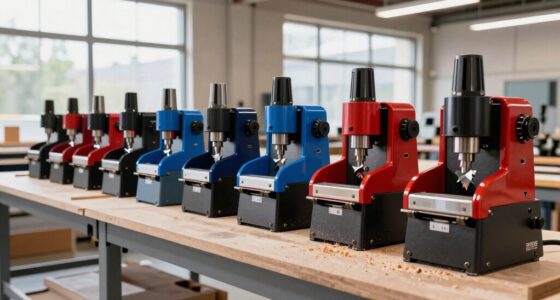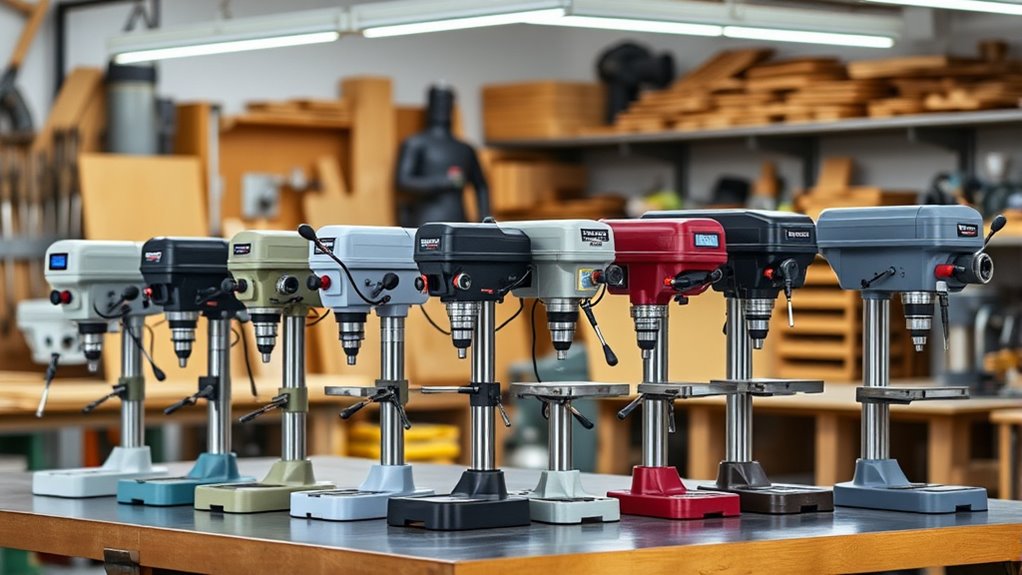

For woodworking that calls for repeatable, square holes, I’d start with the JET 12-Inch Variable-Speed Benchtop Drill Press for its larger capacity and variable-speed control. The WEN DP1263V is another strong fit if you want a 12-inch model, while the SKIL 10-Inch adds a laser guide and work light for more accessible setup. The main tradeoffs are capacity and speed control versus footprint, power, and simplicity. Smaller 8-inch presses suit light shop tasks, while larger models give you more room for workpieces. Read on for my full breakdown of where each drill press fits.

Get business pricing on tools and workshop supplies
- Business-only prices and quantity discounts
- Tax-exempt purchasing
- Multiple users, one account, clear invoices
Complete the kit


Key Takeaways
- The JET 12-inch model leads for woodworking tasks that benefit from extra swing and variable-speed adjustment, though its larger size may be excessive for occasional small-hole drilling.
- The WEN DP1263V and WEN DP1062V add variable speed, giving them more flexibility across materials than the fixed five-speed models.
- The SKIL 10-inch pairs a larger work area with a laser and work light, useful setup aids for beginners, but alignment tools do not replace clamping and careful measurement.
- The 8-inch WEN, Woodskil, and similar compact models fit lighter-duty work and tighter benches; their smaller capacity limits larger stock and hole placement.
- Across the lineup, table tilt and laser guides help with setup, while swing, speed range, motor capacity, and stable workholding have more influence on what jobs a press can handle.




| drill press | Motor | Swing | Chuck | Speed range |
|---|---|---|---|---|
| Woodskil 8-Inch 5-Speed Bencht | 1/3 HP, 2.3 A induction | 8 inches | 1/2 inch, keyed | 750–3,200 RPM |
| VEVOR 10-inch Benchtop Drill P | 6.2 A induction | 10 inches | Maximum 0.5 inches | 610–2,800 RPM |
| JET 12-Inch Benchtop Drill Pre | 1/2 HP, 5 A | 12 inches | Maximum 13 mm | 530–3,100 RPM |
| SKIL 6.2 Amp 10-Inch 5-Speed B | 6.2 A induction | — | Maximum 0.5 inches | 610–2,800 RPM |
| VEVOR 8-Inch Benchtop Drill Pr | 2.5 A induction | — | Maximum 0.5 inches | 750–3,200 RPM |
| 8-Inch Benchtop Drill Press wi | 2.5 A | 8 inches | — | — |
| BUCKTOOL 10-Inch Bench Drill P | 3/4 HP; 6.2 A | 10 inches | 1/2-inch keyed | — |
| WEN 2.3-Amp 8-Inch 5-Speed Cas | 2.3 A induction motor | 8 inches | 1/2-inch keyed, JT33 taper | — |
| WEN 4208T 2.3-Amp 8-Inch 5-Spe | 2.3 A | 8 inches | 1/2-inch keyed | — |
| QK-KYOHO 8" Benchtop Drill Pre | — | — | — | — |
| VEVOR Benchtop Drill Press | 3.2 A; up to 384 W | 10 inches | — | — |
| WEN 12-Inch Variable-Speed Ben | 6.2 A induction | 12 inches | — | 580–3100 RPM |
| 8-inch Benchtop Drill Press wi | 2.5 A | 8 inches | — | 620–3100 RPM |
| WEN DP1062V 10-Inch Variable-S | 6.2 A induction | 10 inches | — | 530–3100 RPM |
More Details on Our Top Picks
Woodskil 8-Inch 5-Speed Benchtop Drill Press with Laser Guide
The Woodskil makes a practical pick for woodworking projects that call for repeatable holes and occasional angled drilling. Its cast iron table tilts 45 degrees left or right, giving it more flexibility for angled work than the VEVOR 8-Inch DP8, while the laser guide helps line up a workpiece before drilling. Five belt-selected speeds cover a useful range for wood and lighter metal tasks. Its 1/3 HP motor and 2-inch spindle stroke suit hobby work, though they offer less headroom than the larger JET 12-Inch model. The tradeoff is a modest stated metal drilling capacity of 0.5 inches, so buyers planning frequent larger or demanding metal jobs should look elsewhere. For a compact woodworking bench, this balances aiming aids and a versatile table without the JET’s heavier footprint.
Pros:- Cast iron table tilts up to 45 degrees in either direction
- Laser guide supports workpiece alignment
- Five speeds suit different drilling materials
- Two-year limited warranty
Cons:- Stated metal drilling capacity is limited to 0.5 inches
- 1/3 HP motor has less power headroom than the JET 12-Inch model
- Two-inch spindle stroke limits drilling depth per pass
Best for: Woodworking hobbyists who want angled-hole capability and a laser guide in a compact benchtop press
Not ideal for: Metalworkers who regularly drill larger holes or need more power and depth than its 1/3 HP motor and 2-inch stroke provide
- Motor:1/3 HP, 2.3 A induction
- Voltage:120 V
- Chuck:1/2 inch, keyed
- Swing:8 inches
- Spindle stroke:2 inches
- Speed settings:5
- Speed range:750–3,200 RPM
- Table:Cast iron; height adjustable; tilts 45° left and right
- Warranty:2-year limited
Our verdict“Choose the Woodskil for small woodworking projects where a tilting cast iron table and laser guide matter more than extra motor power or drilling depth.”
VEVOR 10-inch Benchtop Drill Press with 6.2A Motor and Adjustable Speed
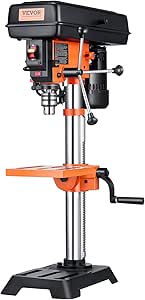
With a 6.2 A induction motor and 10-inch swing, this VEVOR is the power-focused option among these five. That makes it a stronger fit for a woodworking bench that also handles metal than the Woodskil 8-Inch, whose 1/3 HP motor and 8-inch swing are more modest. Five speeds run from 610 to 2,800 RPM, and the tilting table, depth stop, and LED work light support controlled setups. Its stated wood and metal drilling capacities are both 0.5 inches, however, which sharply limits what the extra motor strength can mean for hole size. The JET 12-Inch offers a deeper spindle stroke and broader speed selection, while this VEVOR emphasizes motor amperage and a wider swing. It also needs a stable bench; no stand or base is included.
Pros:- 6.2 A induction motor
- 10-inch swing provides more reach than the 8-inch models here
- Tilting worktable supports angled drilling
- LED work light and adjustable depth stop aid setup
Cons:- Stated drilling capacity is 0.5 inches for both wood and metal
- Heavy unit needs a stable workspace
- No stand or base is included
Best for: Woodworkers who also drill metal and want a higher-amperage motor with a 10-inch swing for a fixed shop bench
Not ideal for: Buyers who need a floor stand, a larger stated drilling capacity, or a press that is easy to move between work areas
- Motor:6.2 A induction
- Voltage:110 V
- Power:744 W
- Chuck:Maximum 0.5 inches
- Swing:10 inches
- Speed settings:5
- Speed range:610–2,800 RPM
- Table:Tilts up to 45°
- Drilling capacity:Wood: 0.5 inches; metal: 0.5 inches
Our verdict“Pick this VEVOR if motor amperage and 10-inch swing suit your mixed woodworking and metalworking bench, and its stated capacity meets your needs.”
JET 12-Inch Benchtop Drill Press, Variable Speed, 1/2 HP, 115V
The JET stands apart for buyers who need more room and travel than the smaller presses provide. Its 12-inch swing and spindle travel of more than 3 inches allow deeper workpieces and longer holes than the Woodskil 8-Inch or VEVOR DP8, both listed with 2-inch travel. A 1/2 HP motor and 16 speed settings give it a wider working range than the five-speed options, while the XACTA Laser and LED light help with alignment and visibility. That extra capability comes with an 85-pound cast iron build, so it suits a settled shop better than a press that needs frequent moving. The available product data lists 13 mm for wood drilling capacity, so I would not assume its larger swing means larger hole capacity. It is the most substantial choice here, but not the easiest to reposition.
Pros:- 12-inch swing provides more reach than the 8- and 10-inch options
- More than 3 inches of spindle travel supports deeper work
- 16 speed settings offer finer adjustment than five-speed models
- XACTA Laser and LED work light aid setup
Cons:- 85-pound weight makes frequent repositioning difficult
- Listed wood drilling capacity is 13 mm
- 115 V supply may not suit higher-voltage shop setups
Best for: Woodworkers with a dedicated shop bench who need a larger swing, deeper spindle travel, and fine speed selection
Not ideal for: Users who need a lightweight portable press or want confirmed wood drilling capacity above the listed 13 mm
- Motor:1/2 HP, 5 A
- Voltage:115 V
- Swing:12 inches
- Chuck:Maximum 13 mm
- Speed settings:16
- Speed range:530–3,100 RPM
- Spindle travel:More than 3 inches
- Weight:85 pounds
- Drilling capacity:Wood: 13 mm; metal: 0.5 inches
Our verdict“Choose the JET for a dedicated woodworking shop that can use its larger swing and deep spindle travel and accommodate its heavy build.”
SKIL 6.2 Amp 10-Inch 5-Speed Benchtop Drill Press with Laser Alignment and Work Light
SKIL bundles the setup aids that can make a benchtop press easier to use for repeatable woodworking: a laser alignment system, adjustable depth stop, tilting table, and LED work light. Compared with the VEVOR 10-Inch, it offers a similar 6.2 A motor and five-speed range, while the three-year limited warranty is longer than the Woodskil’s two-year term. That makes it appealing to a hobbyist who values alignment and depth control over a wider range of speeds. Its listed drilling capacity is only 0.5 inches for wood and metal, so the 10-inch swing should not be mistaken for large-hole capability. The corded design also anchors it to a powered bench. For general woodworking setups, SKIL’s combination of guidance and controls is more compelling than choosing solely for motor amperage.
Pros:- Laser alignment supports accurate positioning
- Adjustable depth stop helps repeat hole depths
- Worktable tilts up to 45° left and right
- Three-year limited warranty
Cons:- Listed drilling capacity is 0.5 inches for wood and metal
- Corded setup requires a nearby outlet
- Five speed settings provide fewer choices than the JET’s 16
Best for: Woodworking hobbyists who want laser alignment, a depth stop, and a work light for repeatable bench setups
Not ideal for: Buyers who need a portable press or expect to drill holes larger than the listed 0.5-inch capacity
- Motor:6.2 A induction
- Voltage:120 V
- Power:744 W
- Chuck:Maximum 0.5 inches
- Speed settings:5
- Speed range:610–2,800 RPM
- Table tilt:0–45° left and right
- Laser:Class II, maximum average radiant power 0.83 mW
- Warranty:3-year limited
Our verdict“Pick the SKIL for guided, repeatable woodworking on a powered bench when its listed drilling capacity is sufficient.”
VEVOR 8-Inch Benchtop Drill Press with Adjustable Speed and Tilting Worktable
The VEVOR DP8 is the compact, straightforward choice for a small woodworking bench. Its 25.4-pound weight is far easier to manage than the 85-pound JET, and its five speeds span 750 to 3,200 RPM for common drilling tasks. A tilting worktable, LED light, and adjustable depth stop add useful control, though the speed changes require belt adjustment rather than a variable-speed control. Compared with the Woodskil 8-Inch, it has the same 2-inch spindle travel and 0.5-inch stated capacity, but its listed specs do not include a laser or a warranty. The 2.5 A motor and limited capacity suit lighter work more than demanding metal drilling. I would choose it when portability and a small footprint matter more than extra alignment aids or deeper drilling.
Pros:- 25.4-pound weight is lighter than the JET 12-Inch
- Five speeds span 750–3,200 RPM
- Tilting table supports angled drilling
- LED work light and adjustable depth stop aid setup
Cons:- Speed changes require belt adjustment
- Stated capacity is 0.5 inches in wood and metal
- 2.5 A motor is less powerful than the 6.2 A SKIL and VEVOR 10-Inch
Best for: Space-conscious woodworking hobbyists who want a lighter 8-inch press for occasional, controlled drilling
Not ideal for: Metalworkers or production users who need greater drilling capacity, variable speed changes, or a more powerful motor
- Motor:2.5 A induction
- Voltage:110 V
- Chuck:Maximum 0.5 inches
- Speed settings:5, belt-adjusted
- Speed range:750–3,200 RPM
- Spindle travel:2 inches
- Table tilt:0–45°
- Weight:25.4 pounds
- Drilling capacity:Wood: 0.5 inches; metal: 0.5 inches
Our verdict“Choose the VEVOR DP8 for light woodworking on a small bench when its belt-adjusted speeds and 0.5-inch capacity are enough.”
8-Inch Benchtop Drill Press with 5 Speeds
For woodworking projects that call for repeatable holes at an angle, this compact press pairs a table that tilts up to 45 degrees with a depth stop for controlled drilling. Its five speeds span 650–3,100 RPM, giving woodworkers preset choices for different bits and materials. Compared with the WEN 4206T, it has a slightly lower listed top speed, while both offer an 8-inch swing and a tilting table. The cast iron construction helps steady the setup, though the 34.2-pound weight and corded power make it a bench-based tool. Its main constraint is capacity: the 8-inch swing limits how far from an edge it can drill, so larger panels may call for a 10-inch model such as the BUCKTOOL DP25016A2.
Pros:- Table tilts from 0° to 45° for angled holes
- Depth stop supports consistent drilling depth
- Cast iron construction helps limit vibration
- Five preset speeds cover common wood, metal, and plastic jobs
Cons:- 8-inch swing restricts workpiece reach
- Corded power limits where it can be used
- Five fixed speeds offer less adjustment than variable-speed models
Best for: Woodworkers making small parts or jigs that need repeatable, angled holes on a fixed bench.
Not ideal for: Buyers drilling far from the edge of wide panels or needing a portable, cordless machine.
- Motor:2.5 A
- Power:120 V corded electric
- Speeds:5; 650–3,100 RPM
- Swing:8 inches
- Spindle travel:50 mm
- Worktable:170 × 165 mm; tilts 0°–45°
- Construction:Cast iron
- Weight:34.2 pounds
Our verdict“Choose this for small woodworking jobs where angled, depth-controlled holes matter more than reach.”
BUCKTOOL 10-Inch Bench Drill Press, 3/4 HP, 6.2 Amp
The BUCKTOOL earns its place for buyers who need more reach than an 8-inch press provides. Its 10-inch swing lets the bit reach farther from a workpiece edge, while the 3/4 HP motor is a stronger listed power rating than the compact WEN 4208T’s 2.3 A motor. Five speeds from 650 to 3,100 RPM cover typical drilling in wood, plastic, and metal, and the 2-inch spindle travel gives a useful amount of vertical movement. A tilting table, LED work light, and removable safety key add practical shop features. The tradeoff is that speed changes require repositioning the belt under the cover, so frequent shifts between materials take time. The product data also describes it as suited to light-duty drilling, which sets a limit on expectations.
Pros:- 10-inch swing reaches farther across workpieces than 8-inch models
- 3/4 HP motor rating is suited to a range of light-duty drilling
- LED light helps illuminate the drilling area
- Removable switch key helps prevent unintended starts
Cons:- Changing speeds requires moving the belt under the cover
- Product description limits its intended use to light-duty drilling
- Corded design ties it to a 120 V outlet
Best for: Home woodworkers and DIYers who need a bench press with more reach for medium-sized workpieces.
Not ideal for: Shops needing rapid speed changes or a drill press intended for sustained heavy-duty work.
- Motor:3/4 HP; 6.2 A
- Power:120 V corded electric
- Swing:10 inches
- Spindle travel:2 inches
- Chuck:1/2-inch keyed
- Speeds:5; 650, 1,100, 1,700, 2,300, and 3,100 RPM
- Table tilt:Up to 45°
- Certification:CSA
Our verdict“Pick the BUCKTOOL when extra reach is more useful to your woodworking than quick speed changes.”
WEN 2.3-Amp 8-Inch 5-Speed Cast Iron Benchtop Drill Press (4206T)
The 4206T stands apart among the compact presses here because its table bevels 45 degrees left and right, a useful option when a woodworking jig or angled face needs a particular orientation. Its 2-inch spindle travel and 1/2-inch keyed chuck suit ordinary bench drilling, while five speeds from 750 to 3,200 RPM cover a range of bits and materials. Compared with the similar WEN 4208T, the 4206T has a slightly higher listed maximum speed and explicitly specifies the two-way bevel; both keep the compact 8-inch swing. A locking depth stop and slotted table help with repeatable, secured work. The limitations are real: the small swing and travel restrict larger pieces, and each speed change requires manual belt adjustment.
Pros:- Table bevels up to 45° left and right
- Locking depth stop supports repeatable hole depth
- 1/2-inch keyed chuck accepts a broad range of bits
- Cast iron base and slotted table support bench mounting and work-holding
Cons:- 8-inch swing limits reach across larger workpieces
- Manual belt repositioning is needed to change speeds
- 2-inch spindle travel limits drilling depth per setup
Best for: Woodworkers drilling small parts or angled holes who want the table to bevel in either direction.
Not ideal for: Buyers working with wide panels, deep holes, or tasks that demand frequent speed changes.
- Motor:2.3 A induction motor
- Swing:8 inches
- Spindle travel:2 inches
- Speeds:5; 750, 1,100, 1,500, 2,100, or 3,200 RPM
- Chuck:1/2-inch keyed, JT33 taper
- Worktable:6.5 × 6.5 inches; bevels 45° left and right
- Height:23 inches
- Warranty:Two years
Our verdict“Choose the 4206T for compact woodworking where two-way table beveling is more useful than extra capacity.”
WEN 4208T 2.3-Amp 8-Inch 5-Speed Cast Iron Benchtop Drill Press
For a straightforward small-shop drill press, the WEN 4208T covers the basics with an 8-inch swing, 2-inch spindle travel, and five preset speeds up to 3,140 RPM. Its 1/2-inch keyed chuck and beveling worktable make it a practical fit for woodworking holes, small metal parts, and general DIY jobs. Compared with the WEN 4206T, its listed speed steps differ and the 4206T specifically offers table beveling to either side; the 4208T keeps its appeal in a familiar, compact format with onboard chuck-key storage. That storage helps keep the key close at hand, but it does not expand the work capacity. The table is only 6.5 inches square, and this model includes no stand, so buyers must provide a stable bench or separate support.
Pros:- Compact 8-inch swing fits small bench workshops
- Five speed settings cover common drilling tasks
- 1/2-inch keyed chuck accommodates many standard bits
- Onboard chuck-key storage keeps the key with the machine
Cons:- Limited reach for larger workpieces
- No stand is included
- Speed changes require manual adjustment between five presets
Best for: DIYers and hobby woodworkers who want a compact benchtop press for small work and already have a sturdy bench.
Not ideal for: Buyers drilling large panels, needing a supplied stand, or wanting variable-speed control.
- Motor:2.3 A
- Swing:8 inches
- Spindle travel:2 inches
- Speeds:5; 740, 1,100, 1,530, 2,100, and 3,140 RPM
- Chuck:1/2-inch keyed
- Worktable:6.5 × 6.5 inches; bevels up to 45°
- Height:23 inches
- Base:7 × 11 inches
Our verdict“Pick the 4208T for basic small-scale drilling if you can supply a stable bench and do not need larger capacity.”
QK-KYOHO 8″ Benchtop Drill Press with 3.1A Motor and 5-Speed Adjustment
The QK-KYOHO’s clearest advantage for small woodworking setups is the included 2-1/2-inch-jaw vise, which gives buyers a way to hold smaller pieces while drilling. Its 300 W motor and five preset speeds from 620 to 3,100 RPM cover a broad range of common drilling work, and the cast iron table and base support a stable benchtop setup. Like the WEN 4206T and 4208T, it has an 8-inch swing and a tilting table, so it does not solve the reach limits of a compact press. The QK-KYOHO trades the WEN models’ stated spindle travel and detailed table dimensions for the included vise and listed chuck range. Speed options are fixed presets, not continuously variable, and the cast iron build is better suited to a settled workshop than frequent moving.
Pros:- Included vise has 2-1/2-inch jaws for small workpieces
- 300 W motor and five speed settings cover common shop tasks
- Cast iron base and table support a stable bench setup
- Table tilts from 0° to 45°
Cons:- 8-inch capacity limits reach on larger workpieces
- Five preset speeds do not provide continuous adjustment
- Cast iron construction makes it less convenient to move
Best for: Home woodworkers who want a vise included for holding small pieces and plan to keep the press on one bench.
Not ideal for: Buyers needing to drill far across large stock, move the press often, or adjust speed continuously.
- Motor power:300 W
- Speeds:5; 620, 1,100, 1,720, 2,340, and 3,100 RPM
- Chuck capacity:1/16–1/2 inch
- Table tilt:0°–45°
- Table material:Cast iron
- Base material:Cast iron
- Included vise:2-1/2-inch-wide jaws
Our verdict“Choose the QK-KYOHO if an included vise matters more to your small woodworking setup than extra reach or variable speed.”
VEVOR Benchtop Drill Press, 3.2 Amp and 5-Speed Adjustable Drill Press with 10 in Swing, Cast Iron Frame, Worktable Tilts 0-45°, Ideal for Drilling Wood & Metal
For woodworking projects that call for a stable benchtop press without the heft of a larger machine, this VEVOR offers a 10-inch swing, cast-iron frame, and a table that tilts up to 45 degrees. Its five speed settings give woodworkers a choice of drilling pace, while the listed half-inch wood capacity suits common small-shop tasks. Compared with the WEN DP1263V, it has a smaller motor and a fixed set of speeds rather than digital variable-speed control, but at 41.9 pounds it is much easier to reposition than that 85-pound model. The tradeoff is limited capacity and some uncertainty in the speed figures: the description lists 3100 RPM while the specs give a 2800 RPM maximum. I’d favor it for straightforward woodworking over jobs that need frequent speed changes or larger holes.
Pros:- 10-inch swing provides useful reach for a compact woodworking setup
- Tilting worktable supports angled holes
- Cast-iron frame adds mass and rigidity during drilling
- Five speed settings cover a range of common materials and bits
Cons:- Half-inch listed capacity limits larger woodworking and metalworking tasks
- Speed descriptions conflict, listing both 2800 and 3100 RPM maximums
Best for: Woodworkers who want a cast-iron benchtop press for routine holes and occasional angled drilling, with a machine they can still move around the shop.
Not ideal for: Metalworkers or furniture builders who need larger drilling capacity, precise variable-speed adjustment, or a clearly specified maximum speed.
- Motor:3.2 A; up to 384 W
- Swing:10 inches
- Speed settings:5
- Listed speed range:650–3100 RPM
- Maximum speed in specs:2800 RPM
- Chuck capacity:1/2 inch
- Worktable tilt:0°–45°
- Weight:41.9 lb
Our verdict“Choose this VEVOR for routine woodworking and angled drilling if you value a cast-iron frame and easier repositioning over digital speed control.”
WEN 12-Inch Variable-Speed Benchtop Drill Press (DP1263V)
The 12-inch swing and 5/8-inch chuck make the WEN DP1263V the strongest fit here for woodworkers handling wider stock or larger bits. Its 6.2-amp motor and variable-speed range let you tune the drilling pace without being limited to five preset steps, and the digital readout makes the selected speed easy to check. A laser, LED work light, beveling table, and depth stop add useful guidance for repeat or angled holes. Compared with the lighter WEN DP1062V, this model offers more reach, a larger chuck, and longer spindle travel, but it weighs 85 pounds and needs a dedicated, mounted bench space. That makes it a poor choice for a shared or frequently rearranged shop. I’d rank it above smaller presses for capacity and control, while its size is the price of that extra working room.
Pros:- 12-inch swing accommodates wider workpieces than the 10-inch WEN DP1062V
- 5/8-inch chuck accepts larger bits than the half-inch chuck on smaller options
- Variable speed with digital readout gives direct control over drilling pace
- Laser, LED light, beveling table, and depth stop aid alignment and repeat work
Cons:- At 85 pounds, it is difficult to move and needs a stable mounting surface
- Its larger footprint can crowd a small workshop
Best for: Woodworkers with a permanent, sturdy bench who regularly drill wider boards, use larger bits, or want precise speed adjustment.
Not ideal for: Hobbyists with limited bench space or anyone who needs to move a drill press between work areas often.
- Motor:6.2 A induction
- Swing:12 inches
- Speed range:580–3100 RPM
- Chuck capacity:5/8 inch
- Spindle travel:3-1/8 inches
- Worktable:9-1/2 × 9-1/2 inches; bevels 45° left and right
- Weight:85 lb
- Warranty:Two years
Our verdict“Pick the DP1263V if your woodworking needs its extra swing, larger chuck, and variable-speed control and you can dedicate bench space to it.”
8-inch Benchtop Drill Press with Laser and LED Light, 5 Speeds, Tilting Worktable
This 8-inch press makes sense when shop space is tight and most work involves small pieces. At 27.7 pounds, it is lighter than the 41.9-pound VEVOR 10-inch model, while still including a tilting table, laser, and LED light to help position holes. Its five speed settings span 620–3100 RPM, giving it a broader stated range than that VEVOR’s listed settings, though neither offers the WEN DP1263V’s continuous speed adjustment. The central compromise is its half-inch chuck and listed drilling capacity, which narrow the jobs it can handle. The product data also gives compact dimensions but doesn’t specify spindle travel, so buyers planning deeper holes should check fit before choosing it. I’d place it ahead of larger presses for small-space convenience, not for capacity or heavy stock.
Pros:- 27.7-pound weight is easier to reposition than the larger VEVOR 10-inch press
- Laser and LED light help locate and see the drilling point
- Tilting table supports angled holes
- Five speeds span a stated range of 620–3100 RPM
Cons:- Half-inch listed drilling capacity limits larger jobs
- 8-inch swing offers less reach than either WEN model
- No spindle travel specification is provided in the product data
Best for: Hobby woodworkers and DIYers with limited bench space who mainly drill small workpieces and want built-in alignment aids.
Not ideal for: Woodworkers who routinely drill thick stock, use large bits, or need a larger swing and more working capacity.
- Motor:2.5 A
- Swing:8 inches
- Speed settings:5
- Speed range:620–3100 RPM
- Chuck capacity:1/2 inch
- Listed drilling capacity:1/2 inch in wood and metal
- Worktable tilt:Up to 45°
- Weight:27.7 lb
Our verdict“Choose this compact press for small workshop projects where light weight and built-in alignment aids matter more than reach or drilling capacity.”
WEN DP1062V 10-Inch Variable-Speed Benchtop Drill Press with Laser
For woodworkers who switch between bit sizes or materials, the DP1062V’s 530–3100 RPM variable-speed range and digital readout offer more control than the five fixed settings on the VEVOR 10-inch press. It keeps a 10-inch swing and adds a beveling table, laser guide, adjustable depth stop, and onboard chuck-key storage—useful touches for repeatable bench work. Compared with the larger WEN DP1263V, it has a smaller swing, shorter spindle travel, and a half-inch chuck, but its listed weight of about 66 pounds is lower than that model’s 85 pounds. It still needs a stable mounted bench, and its half-inch capacity sets a firm limit on larger holes. I’d choose it for controlled, varied drilling where the bigger WEN’s reach and chuck capacity would go unused.
Pros:- Digital readout makes variable speed easy to monitor
- 10-inch swing suits a range of benchtop woodworking tasks
- Laser, depth stop, and chuck-key storage support organized repeat work
- Worktable bevels 45° in either direction
Cons:- Half-inch chuck and listed capacity restrict larger bits and holes
- Listed weight of about 66 pounds still calls for a stable mounted bench
- Two-inch spindle travel is shorter than the DP1263V’s 3-1/8 inches
Best for: Woodworkers who want digital variable-speed control and a 10-inch swing for mixed small-shop projects, but do not need a 5/8-inch chuck.
Not ideal for: Buyers seeking a portable press, larger chuck capacity, or the extra swing and spindle travel of the WEN DP1263V.
- Motor:6.2 A induction
- Swing:10 inches
- Speed range:530–3100 RPM
- Spindle travel:2 inches
- Chuck capacity:1/2 inch
- Listed drilling capacity:1/2 inch in wood and metal
- Worktable:8 × 7.5 inches; bevels 45° left and right
- Warranty:Two years
Our verdict“Pick the DP1062V if you want variable-speed control and a 10-inch woodworking press without the larger WEN’s 12-inch swing and 5/8-inch chuck.”

How We Picked
I compared these drill presses by the factors that shape real bench work: swing and capacity, motor and speed adjustment, table support and tilt, setup aids, and the space each machine is likely to occupy. For woodworking, repeatable positioning and room for the workpiece matter alongside speed selection, since broad panels and larger stock can be awkward on a compact press. I gave more weight to a model’s useful combination of capacity and control than to accessories such as lasers or lights on their own.
The ranking reflects distinct buyer needs rather than a single spec race. The JET earns the lead for combining 12-inch capacity with variable speed; the WEN variable-speed models follow for similar flexibility at different sizes. Mid-size fixed-speed options, including the SKIL and BUCKTOOL, make sense when footprint or straightforward operation matters more. Compact 8-inch presses rank lower for broad woodworking versatility, but can be a better match for light drilling and limited bench space. Where product names and supplied specifications do not establish a clear distinction, I avoid assuming performance details beyond what is listed.
Factors to Consider When Choosing Drill Press
Choosing a drill press starts with the work you actually plan to hold beneath the chuck. I’d use these broader checks to match a machine to your shop, avoid buying capacity you cannot use, and decide when more adjustment is worth the space.
Match Swing to Your Workpieces
Swing describes the distance from the spindle center to the column, doubled, and it sets the approximate width of stock you can position under the bit. A larger number helps when drilling near the center of wide boards or panels, but it does not tell you how much vertical room the machine provides. Check throat depth, table size, and quill travel alongside swing if your projects use thick or awkward stock. A common mistake is buying by the inch label alone, then finding the table too small to support the piece. For repeated furniture work, plan around your widest typical part rather than the largest item you might drill once. If the workpiece cannot sit flat and stay clamped, extra swing will not make the setup safe or accurate.
Choose Speed Control for Your Materials
Different bit sizes and materials call for different spindle speeds, and larger bits generally need slower rotation. A fixed-speed machine can be perfectly workable when your jobs and bit sizes are predictable. Multiple belt speeds require changing the belt position, so count that setup time if you often switch tasks. Variable-speed controls make adjustments easier, but the label alone does not show whether the usable range suits your work. Look for the published speed range and instructions for changing it before deciding that variable speed is worth the added cost or complexity. For a wood-focused shop with a narrow set of bits, a simpler press may serve better than paying for control you rarely use.
Treat Motor Ratings as One Part of Capacity
Motor amperage or horsepower can help compare machines, but it does not tell the whole story about drilling performance. The bit, material, speed, feed pressure, and machine rigidity all affect the result. A stronger motor may be useful for larger bits or sustained work, yet it cannot compensate for a flexible table or a poorly supported part. Read the manufacturer’s stated capacity for wood and metal where available, and compare like with like. Avoid forcing a bit through stock to make up for a setup that is running too fast or dull. For routine woodworking, stable alignment and an appropriate speed often matter more than chasing the highest motor figure.
Plan for Table Support and Workholding
A tilting table can help with angled holes, but it also adds setup steps: you need to set the angle, lock the table, and keep the workpiece from shifting. Check whether the table has useful slots or a shape that works with your clamps and vise. Never rely on hand pressure alone to control a board, especially when a bit can catch and spin the work. Long stock may need separate supports so its weight does not pull the piece off line. A laser can help locate a starting point, but it cannot hold the work or confirm that the bit is square to the table. Before buying, consider the clamps and support stands your projects will need as part of the total setup.
Budget for Space, Height, and Safe Access
Benchtop presses still take up meaningful room once you account for the base, table movement, and space needed to handle stock. Measure bench depth and ceiling clearance, then check how far the head and table adjust. A compact press can be easier to place, but a short column or small table may limit future projects. Leave enough access to change bits and adjust belts without moving the machine. Secure the base to a stable bench, since vibration and shifting can undermine accuracy. If you rarely drill larger workpieces, a smaller footprint may be more useful than unused capacity.
Frequently Asked Questions
Is a 12-inch drill press worth the extra space for woodworking?
I’d choose 12-inch swing when your projects regularly involve wider boards, panels, or holes that need to sit farther from an edge. It gives more positioning room than an 8-inch press, but does not automatically improve accuracy for small parts. Measure the stock you use most and compare that width with the usable space around the column. Also check the machine’s table and quill travel, since swing alone does not determine whether a thick workpiece fits. If most of your work is small hardware and pilot holes, a compact model may leave you more usable bench space.
Should I choose variable speed or a five-speed drill press?
I’d favor variable speed if you change bit sizes and materials often and want to adjust without moving a belt. A five-speed press can cover many common tasks, especially when your work is mostly wood, but speed changes may take more setup. Compare the actual speed range rather than relying on the words “variable speed.” Very low speeds matter for some larger bits and materials, while a broad range is less useful if it does not suit your jobs. Consider how often you switch tasks: convenience can matter more than the control feature itself.
Can a benchtop drill press drill metal as well as wood?
Many benchtop presses can handle light metal drilling when paired with an appropriate bit, a suitable low speed, and secure workholding. The machine’s published capacity and speed range are better guides than its general-purpose label. Metal also puts more emphasis on clamping and steady feed, since the workpiece can catch if it shifts. I would check the maker’s guidance for the material and bit size you plan to use before buying. If metalwork will be frequent or demanding, prioritize capacity and stable construction over laser guides or other setup accessories.
Do I need a laser guide on a drill press?
A laser guide can speed up rough positioning by showing where the bit is expected to meet the work. It is a convenience, not a substitute for a center punch, layout marks, test cuts, or checking alignment. Its usefulness depends on setup and visibility, so confirm that the guide can be adjusted and seen in your shop lighting. For repeatable woodworking, a fence, stop, and careful clamping often contribute more to consistent placement. If you are choosing between a laser and a more suitable swing or speed range, I’d prioritize the machine’s working capacity.
What should a beginner prioritize when buying a first drill press?
I’d start with a stable base, a table that supports the parts you make, straightforward speed changes, and controls that are easy to reach. A laser or work light can make setup less intimidating, but those features cannot correct a loose part or an unsuitable speed. Think through the largest workpiece you expect to drill, then decide whether an 8-inch or 10-inch model gives enough room. Learn to clamp the work, set depth, and choose speed before moving to larger bits. For occasional woodworking, an uncomplicated press with adequate capacity is often easier to live with than a larger machine with features you will not use.
What are the best drill press?
The best drill press depends on the materials you work with, the size of your projects, and how much control you need. The picks above offer options to compare for workshop space, drilling capacity, speed settings, and ease of adjustment. For occasional home projects, focus on a model that feels straightforward to set up and operate. For frequent or more demanding work, consider stability, a suitable range of speeds, and the ability to handle your typical workpieces. Check the article’s recommendations against your needs and available space before choosing, since the right drill press is the one that fits your projects and working habits.
Conclusion
For the broadest woodworking capability here, I’d choose the JET 12-Inch Variable-Speed as my best overall pick, especially when extra swing and speed adjustment will see regular use. The WEN DP1263V is my best value for shoppers who want 12-inch capacity and variable speed in a different package, while the WEN DP1062V suits buyers who want those speed controls in a 10-inch format. Beginners may prefer the SKIL 10-Inch for its laser and work light, provided they still plan to clamp and measure carefully. For compact benches and lighter jobs, I’d look at the WEN 4206T or Woodskil 8-inch model; choose a 10-inch tilting-table option when angled drilling matters more. Pick by the stock you need to support and the speeds you actually use, then match the machine to that work.