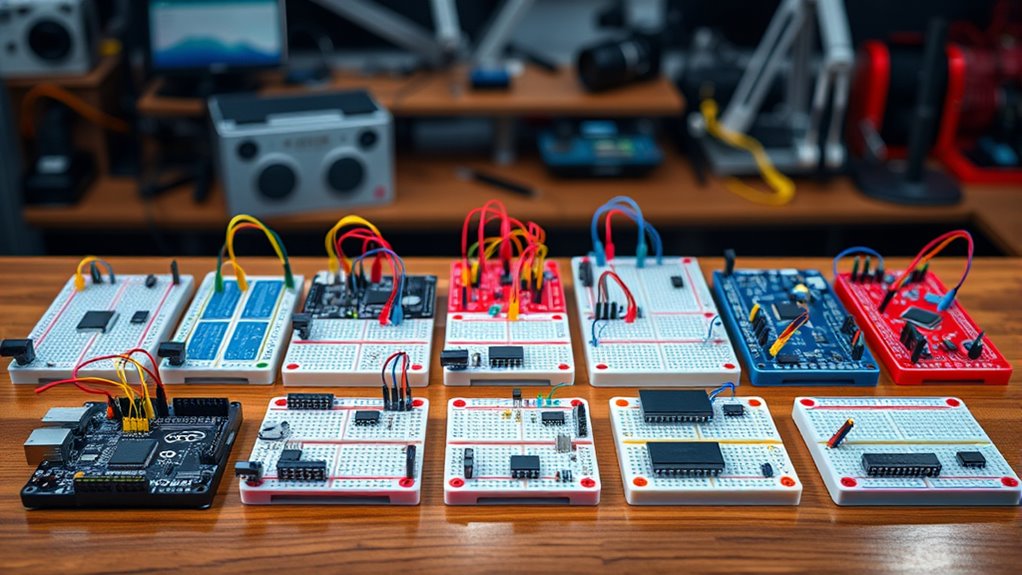

The best breadboard for most projects is the Breadboard and Jumper Wires Kit with 830 and 400 Tie Points because it pairs two useful board sizes with the wiring needed to start building. The ELEGOO 6PCS 400 Point Kit offers better value for repeated compact circuits, while the ELEGOO Electronics Fun Kit with 300+ Components is my beginner pick for learning beyond basic board layout. The main choice is between board capacity, accessory depth, and quantity: larger boards suit complex circuits, compact multipacks support parallel projects, and component bundles reduce separate purchases. Some shoppers will benefit from hundreds of included parts, while others will get more usable value from better board variety and jumper-wire coverage. Continue reading for my full breakdown of all 14 breadboard options and the buyer each one suits best.
Complete the kit

Key Takeaways
- The mixed 830- and 400-point kits were the most versatile, since they support both full prototypes and smaller circuit modules without forcing one board size onto every project.
- ELEGOO’s six-pack of 400-point boards delivered the strongest basic value, but the MCIGICM 16-pack made more sense for classrooms, workshops, and many simultaneous builds.
- Component count did not automatically determine rank; the 480-piece BOJACK kit offered the broadest experimentation range, while simpler bundles provided clearer value for shoppers who already own components.
- Wire selection separated otherwise similar kits, with the 830/400 Breadboard Jumper Wire Kit standing apart through 140 rigid jumpers, 65 flexible cables, and a tweezer.
- Beginner kits and bare-board packs serve different goals: ELEGOO‘s 300+ component kit supports guided learning, while three-packs of 830-point boards better suit established electronics benches.


More Details on Our Top Picks
ELEGOO 6PCS 400 Point Solderless Breadboard Kit for Arduino Projects
I rank the ELEGOO 6PCS 400 Point Kit as the strongest multipack for running several compact experiments at once. Its six separate boards provide more layout flexibility than the ELEGOO 3pcs 830 Point Kit, while the color-coded power rails make supply lines easier to follow. Compared with the similar six-piece Breadboard Set Prototype Board, this package provides clearer rail specifications and self-adhesive mounting, making it the safer choice for fixed classroom displays or project enclosures. The compromise is working space: 400 points can feel cramped once a development board, sensors, and discrete components share one board. The divided rails may also require jumper bridges, and buyers receive neither wires nor guidance. I would choose this for multiple focused circuits, not one sprawling prototype.
Pros:- Six boards support multiple experiments or student workstations
- Color-coded power rails make supply connections easier to trace
- Adhesive backs allow boards to be fixed inside enclosures
- Standard 2.54 mm spacing suits common through-hole components
Cons:- 400-point capacity restricts larger or more complex layouts
- Four rail sections may need bridging for continuous power
- No jumper wires, components, or detailed instructions are included
Best for: Arduino learners, teachers, and makers who need six compact boards for separate circuits or small mounted projects
Not ideal for: Builders assembling wide development boards or component-heavy circuits that need full-size working space
- Tie points per board:400
- Number of breadboards:6
- Hole spacing:2.54 mm
- Rail sections:4
- Material:White PP plastic
- Self-adhesive backing:Yes
Our verdict“This is my pick for buyers who value six mountable compact boards more than the extra room of a full-size model.”
ELEGOO 3pcs Breadboard 830 Point Solderless Prototype PCB Board Kit
The ELEGOO 3pcs 830 Point Kit takes my overall spot because it balances useful working area with enough boards for parallel builds. Each full-size board offers substantially more room than the ELEGOO 6PCS 400 Point Kit, so a development board and supporting components are less likely to become an immediate layout puzzle. Four power rails, adhesive backing, and side clips also support cleaner semipermanent assemblies or linked boards. It ranks below a component bundle for absolute readiness: unlike the ELEGOO Electronics Fun Kit, it supplies no jumper wires, power module, or parts. Wide ESP32-style boards can still block neighboring rows, and three large boards are less convenient when many students need individual stations. I see it as the most adaptable board-only choice for progressing beyond tiny circuits.
Pros:- Three full-size boards provide room for medium-size circuit layouts
- 830 tie points per board reduce crowding around components
- Four power rails support multiple supply connections
- Adhesive backing and side clips offer flexible mounting and expansion
Cons:- Jumper wires, electronic components, and power modules are absent
- Wide development boards may cover usable rows
- Full-size boards occupy more desk or enclosure space than 400-point models
Best for: Hobbyists and electronics students building medium-size Arduino or ESP32-style prototypes across several full-size boards
Not ideal for: First-time buyers who lack jumper wires and components, or classes needing many separate student boards
- Number of boards:3
- Tie points per board:830
- Power rails:4
- Board format:Full-size
- Arduino compatibility:Yes
- ESP32-style board compatibility:Yes
- Mounting:Adhesive backing and side clips
Our verdict“I recommend this pack to buyers who already own components and want spacious, reusable boards without paying for a full starter assortment.”
ELEGOO Electronics Fun Kit with Power Supply Module and 300+ Components
I place the ELEGOO Electronics Fun Kit first for newcomers because its 830-point breadboard arrives with 300-plus components, jumper wires, a power module, and learning material. That makes it far more project-ready than the ELEGOO 3pcs 830 Point Kit, which offers more boards but no supporting parts. Organized packaging also helps a learner identify and retain small components instead of building a collection piecemeal. The tradeoff is specialization: buyers mainly seeking breadboards pay for many basic parts and receive only one prototyping board. The tutorials also depend on an UNO R3 board that is not included, while experienced builders may already own equivalent resistors, wires, and controls. I rank it as a guided starting point rather than the best board value or the strongest expansion pack.
Pros:- More than 300 pieces support a broad range of introductory circuits
- Includes jumper wires and a power supply module for quicker setup
- Tutorials and datasheets give beginners a structured starting path
- Organized packaging helps keep small parts identifiable
Cons:- An UNO R3 board is required to follow the tutorials but is not included
- Only one breadboard is supplied
- Many included components may duplicate an experienced builder’s existing stock
Best for: Arduino or STM32 beginners who want one organized box containing a breadboard, wiring, power hardware, parts, and guided projects
Not ideal for: Experienced makers who already own basic components or learners unwilling to buy a separate UNO R3 for the supplied tutorials
- Component count:300+ pieces
- Breadboard capacity:830 tie points
- Power supply module:Included
- Jumper wires:Included
- Precision potentiometer:Included
- Arduino UNO R3 compatibility:Yes
- STM32 compatibility:Yes
Our verdict“This is my beginner choice for anyone starting without a parts drawer, provided a separate UNO R3 purchase fits the plan.”
Breadboard Set Prototype Board – 6 Pieces, 400 Pins, Solderless for Raspberry Pi and Arduino Projects
The Breadboard Set Prototype Board earns its place when the priority is spreading small circuits across six separate 400-pin boards. That arrangement suits sensor nodes, repeated demonstrations, or Raspberry Pi experiments better than the three larger boards in the ELEGOO 3pcs 830 Point Kit. Consistent hole alignment is the main appeal because orderly rows reduce placement confusion during repeated builds. I rank it below the ELEGOO 6PCS 400 Point Kit for buyers who want documented power-rail sections or adhesive mounting, since those details are not supplied here. It also lacks wires, components, and stated mounting hardware, so it is not a ready-to-build package. Each board has limited room for wide modules or elaborate circuits. I would pick this set for quantity and simple layouts, while choosing ELEGOO for better-defined board features.
Pros:- Six boards accommodate multiple independent prototypes
- 400-pin format is compact enough for distributed project nodes
- Consistent hole alignment supports orderly component placement
- Solderless construction allows circuits to be rebuilt
Cons:- Power-rail configuration and mounting features are not specified
- No jumper wires or components are included
- Each 400-pin board offers less layout room than an 830-point model
Best for: Raspberry Pi and Arduino users dividing sensor circuits, classroom exercises, or repeated small prototypes across six boards
Not ideal for: Buyers who need documented power-rail layouts, adhesive mounting, included wiring, or space for large circuits
- Number of pieces:6
- Pins per board:400
- Board type:Solderless breadboard
- Connection method:Push-in, solder-free
- Raspberry Pi compatibility:Yes
- Arduino compatibility:Yes
Our verdict“I favor this set for buyers who need six basic, compact work areas and can accept sparse feature documentation.”
Breadboard and Jumper Wires Kit with 830 and 400 Tie Points
I choose the Breadboard and Jumper Wires Kit for buyers who want useful wiring coverage without purchasing a large component assortment. Its combination of one 830-point and one 400-point board supports a main circuit plus a smaller module, a flexibility the three identical boards in the ELEGOO 3pcs 830 Point Kit do not match. Three 40-pin wire groups cover female-to-female, female-to-male, and male-to-male connections, which is especially handy when a Raspberry Pi, Arduino, sensors, and breadboard parts use different headers. Compared with the ELEGOO Electronics Fun Kit, it is less cluttered but supplies no power module, tutorial, or electronic components. Compatibility details for oversized modules are limited, and only two boards are included. I rank it as the best middle ground between bare boards and a full beginner kit.
Pros:- Includes full-size and compact breadboards for different circuit roles
- Three jumper-wire connector styles suit mixed hardware
- A total of 120 wire positions provides broad connection coverage
- Accepts commonly used 20–29 AWG conductors
Cons:- No power supply module or electronic components are included
- Only two breadboards are provided
- Fit information for wide development boards and larger components is limited
Best for: Arduino and Raspberry Pi makers who need both board sizes plus wire types for mixed header and breadboard connections
Not ideal for: Absolute beginners seeking guided projects, a power module, and electronic components in the same package
- 830-point breadboards:1
- 400-point breadboards:1
- Female-to-female jumper wires:40-pin set
- Female-to-male jumper wires:40-pin set
- Male-to-male jumper wires:40-pin set
- Compatible wire gauge:20–29 AWG
- Compatible wire diameter:0.3–0.8 mm
Our verdict“This is my choice for makers who need flexible board sizes and ready-to-use jumper wiring but already own their components.”
Breadboard Kit with Multiple Tie-Point Boards and Accessories for Arduino and IoT
I rank this as the best breadboard variety because its three 170-point boards, one 400-point board, and one 830-point board support several circuit scales in one package. The small, color-coded boards make isolated sensor modules easier to organize, while the full-size board leaves room for a larger Arduino or Raspberry Pi prototype. Compared with the Breadboard Jumper Wire Kit, this set offers more board formats but fewer rigid jumpers and no tweezer. Its 65 flexible wires and 9V supply provide a practical starting point, though the battery-based power arrangement is less adaptable than a regulated breadboard power module. I place it above single-size multipacks for individual experimentation, but below component-heavy kits for buyers who still need LEDs, resistors, and sensors.
Pros:- Five breadboards across three useful tie-point capacities
- Color-coded mini boards can separate circuit sections and aid debugging
- Includes 65 flexible jumper wires for immediate circuit assembly
- 9V DC supply and battery clip add a basic power option
Cons:- Accessory selection is narrow compared with component-focused starter kits
- Battery-based 9V power is less flexible than a USB breadboard power module
- Warranty and support details are not provided
Best for: Arduino and IoT hobbyists who want separate breadboards for compact modules, medium circuits, and full-size prototypes
Not ideal for: Buyers starting without electronic components, since the package does not list resistors, LEDs, sensors, or semiconductors
- Breadboard Quantity:5
- Mini Breadboards:3 × 170 tie points
- Medium Breadboard:1 × 400 tie points
- Full-Size Breadboard:1 × 830 tie points
- Flexible Wires:65 pieces
- Power Supply:9V DC with battery clip
- Compatible Devices:Arduino and Raspberry Pi
- Software Compatibility:Arduino IDE and Linux
Our verdict“I recommend this set for builders who value multiple breadboard sizes more than a large inventory of electronic components.”
ELEGOO Electronic Fun Kit Bundle with Breadboard, 235 Items for Arduino
I place the ELEGOO Electronic Fun Kit Bundle first for beginners who need usable circuit parts rather than a stack of empty boards. Its 235 items cover resistors, capacitors, LEDs, jumper wires, a potentiometer, and a power module, so a learner can build varied breadboard experiments without sourcing every category separately. Compared with the BOJACK 480-piece kit, ELEGOO provides fewer parts and less room for component exploration, but its smaller assortment should be easier to sort and understand. The included breadboard gives it a clearer learning path than the board-only MCIGICM multipack. The main compromise is the missing controller board: Arduino projects still require a separate microcontroller. Buyers following specialized tutorials may also discover that a particular sensor, motor, or display is absent.
Pros:- 235-item assortment covers common passive components, LEDs, and wiring
- Included breadboard supports solderless learning projects
- Power supply module reduces the need for a separate breadboard power purchase
- Smaller assortment is easier for beginners to organize than larger component kits
Cons:- Arduino or other controller board must be purchased separately
- Fewer component types and pieces than the BOJACK 480-piece kit
- Specialized projects may require extra sensors, displays, or motors
Best for: First-time Arduino learners who already own a controller board and want a manageable assortment for basic breadboard exercises
Not ideal for: Absolute beginners expecting a complete Arduino package, because no controller board is included
- Total Items:235
- Breadboard:Included
- Power Supply Module:Included
- Potentiometer:Included
- Wiring:Jumper wires included
- Passive Components:Resistors and capacitors included
- Light Components:LEDs included
- Controller Board:Not included
Our verdict“I would choose this kit for a new learner who owns an Arduino and wants a focused supply of parts without an oversized assortment.”
BOJACK 37 Values 480 Pcs Electronic Components Kit with Power Supply Module, Jumper Wires, Potentiometer, Breadboard – Compatible with STM32, Raspberry Pi, Arduino
The BOJACK 480-piece kit earns my component-selection role by pairing a full-size 140 × 65 mm breadboard with 37 values spanning resistors, capacitors, LEDs, transistors, diodes, sensors, headers, and wires. That breadth supports more varied experiments before another parts order becomes necessary. Against the ELEGOO 235-item bundle, BOJACK offers more than twice the item count and better suits buyers moving beyond basic LED circuits. A power module and USB cable also make bench setup more convenient than battery-only kits. Yet more parts create more sorting, and the lack of detailed project guidance can leave a new learner unsure where to begin. The components are aimed at general prototyping rather than demanding advanced work, while the package still omits the STM32, Raspberry Pi, or Arduino controller needed to run programmed projects.
Pros:- 480 pieces across 37 values support a wide range of experiments
- Includes active parts, passive parts, sensors, headers, and wiring
- Labeled organization helps distinguish similar component values
- Power module and USB cable simplify initial bench setup
Cons:- Large assortment can overwhelm buyers learning component identification
- No detailed project guide is specified
- Basic component grade may not suit precision or advanced applications
Best for: Intermediate hobbyists who own a microcontroller and want a broad stock of components for repeated breadboard experiments
Not ideal for: New learners seeking guided projects, since the large assortment may be difficult to use without instructions
- Total Components:480 pieces
- Component Values:37 values
- Breadboard Size:140 × 65 mm
- Power Supply Module:Included
- USB Cable:Included
- Passive Components:Resistors and capacitors
- Active Components:LEDs, transistors, diodes, and sensors
- Other Components:Headers and wires
- Compatible Platforms:STM32, Raspberry Pi, and Arduino
Our verdict“I favor BOJACK for builders who want the broadest parts inventory here and do not need step-by-step project instruction.”
Breadboard Jumper Wire Kit with 830 & 400 Breadboards, 140 Jumpers, 65 Flexible Cables, and Tweezer
I give this kit the best clean-wiring role because it combines 140 rigid male-to-male jumpers in varied lengths with 65 flexible cables. Rigid wires can keep breadboard rows readable, while flexible leads reach controllers or modules positioned away from the board. The included 830- and 400-point breadboards also let a builder separate a main circuit from a smaller test section. Compared with the multiple-size B0F91MM6Z8 kit, this package lacks mini boards and a 9V supply, but it provides far more wiring and adds a tweezer for placing short jumpers. Phosphor-bronze tinned contacts are a useful reliability detail for reusable prototypes. Still, no electronic components or power module are listed, and the absent wire-gauge information makes suitability for higher-current experiments hard to judge.
Pros:- Two breadboard capacities accommodate main circuits and smaller test sections
- 140 rigid jumpers support neat, length-matched breadboard routing
- 65 flexible cables connect boards to externally positioned modules
- Tinned phosphor-bronze contacts are suited to repeated prototyping
Cons:- No resistors, LEDs, sensors, or other circuit components are listed
- No power supply or breadboard power module is included
- Wire gauge and current-handling details are not specified
Best for: Arduino, Raspberry Pi, and robotics builders who already own components and want abundant wiring for tidy, reusable prototypes
Not ideal for: First-time buyers needing a self-contained project kit, because electronic components and a power source are not included
- Breadboard Quantity:2
- Breadboard Capacities:830 and 400 tie points
- Rigid Jumper Wires:140 pieces
- Rigid Jumper Type:Male to male, various lengths
- Flexible Cables:65 pieces
- Flexible Cable Type:Male to male
- Included Tool:Tweezer
- Housing Material:ABS plastic
- Contact Material:Tinned phosphor-bronze film
Our verdict“I recommend this kit to builders whose priority is organized wiring rather than receiving components or a power supply.”
MCIGICM 16pcs Breadboard 400 Tie Point Solderless Prototype PCB Board Kit for Arduino
The MCIGICM 16-board pack takes my bulk role because it supplies 6,400 total tie points across separate 400-point boards. That format makes sense for classrooms, workshops, parallel prototypes, or builders who prefer leaving circuits assembled instead of repeatedly stripping one board. Compared with the ELEGOO six-piece 400-point set, MCIGICM provides many more identical work surfaces; compared with the Breadboard Jumper Wire Kit, it sacrifices wiring and size flexibility for sheer board count. Durable ABS housings suit repeated handling, and the solderless layout keeps early revisions quick. The tradeoff is a bare-board package: jumper wires, power equipment, and components must come from elsewhere. Each board also offers less continuous space than an 830-point model, so larger circuits may need linked boards and additional interconnections.
Pros:- Sixteen boards support classes or many simultaneous prototypes
- 400 tie points per board suit compact and medium-size circuits
- Identical board format simplifies repeatable group exercises
- ABS construction is appropriate for repeated handling
Cons:- No jumper wires, power supply, or circuit components are included
- 400-point layout provides less continuous space than an 830-point board
- Large circuits spread across boards require extra wiring between sections
Best for: Electronics instructors, makerspaces, clubs, and prolific prototypers who need many identical medium-size breadboards
Not ideal for: Solo beginners seeking one ready-to-build kit, since no wires, power supply, or electronic components are included
- Number of Breadboards:16
- Tie Points per Board:400
- Total Tie Points:6,400
- Board Type:Solderless prototype breadboard
- Material:ABS plastic
- Jumper Wires:Not included
- Power Supply:Not included
- Intended Platforms:Arduino and Raspberry Pi projects
Our verdict“I would buy this pack for volume and repeatability, not as a complete starter setup for one person.”
REXQualis Electronics Component Fun Kit with Power Supply Module
I rank the REXQualis Electronics Component Fun Kit as the strongest choice for buyers who want to build circuits, not merely stock up on boards. Its 400-plus components, power module, jumper wires, and 830-point breadboard support a wider range of projects than the BOJACK 130 Pcs Solderless Breadboard Kit, which focuses on board quantity and includes no power source. The labeled packaging and online tutorials also make the assortment easier to decode. Still, this is not a complete computing kit: no controller board is included, so Arduino, Raspberry Pi, or STM32 users must supply one. I also place it below simpler breadboard-only sets for buyers who already own components, since much of the package could become redundant. Its single breadboard also limits simultaneous builds.
Pros:- More than 400 parts support varied circuit experiments
- Power supply module and jumper wires reduce extra purchases
- Labeled storage helps buyers identify and organize small components
- Online datasheets and tutorials provide project guidance
Cons:- Controller board must be purchased separately
- Only one 830-point breadboard is supplied
- The large component selection can overwhelm buyers without basic electronics knowledge
Best for: I recommend this to Arduino, Raspberry Pi, or STM32 learners who own a controller board but need a broad first collection of prototyping parts.
Not ideal for: I would skip it for experienced builders who already have component drawers or anyone expecting an included microcontroller.
- Component Count:Over 400
- Breadboard Capacity:830 tie points
- Power Hardware:Power supply module included
- Wiring:Jumper wires included
- Component Types:Resistors, LEDs, transistors, integrated circuits, and precision potentiometer
- Compatibility:Arduino, Raspberry Pi, and STM32
- Packaging:Sturdy box with labeled components
- Learning Resources:Online datasheets and tutorials
- Controller Board:Not included
Our verdict“I would choose this as a broad learning kit, provided the buyer already owns a compatible controller board.”
BOJACK 130 Pcs Solderless Breadboard Kit with Jumper Wires
The BOJACK 130 Pcs Solderless Breadboard Kit earns its place through quantity and board variety. I see it as a better fit for classrooms, workshops, and builders running many small experiments than the 3 Pack of Solderless Prototype Breadboards, which provides only three identical 830-point boards. BOJACK mixes 830-point, 400-point, and flexible breadboards, letting buyers match board size to each circuit instead of wasting bench space. Its clear ABS bodies can also help with viewing internal connection patterns. The compromise is that this is primarily prototyping infrastructure: there is no power module or component assortment, so usable projects require additional purchases. The listing also gives limited size-by-size detail, making inventory planning less straightforward. I would choose it for shared supplies, but its 130-piece scale is excessive for a single occasional project.
Pros:- Large 130-piece assortment suits shared or repeated use
- Multiple breadboard formats accommodate different circuit sizes
- Clear bodies make the connection layout easier to inspect
- Tin-plated phosphor-bronze contacts offer a durable contact material
Cons:- No power supply module or electronic component assortment
- Individual dimensions and quantities are not fully detailed
- The large set is unnecessary for buyers building only one or two circuits
Best for: I recommend this to electronics instructors, maker spaces, and frequent prototypers who need many board formats available at once.
Not ideal for: I would skip it for first-time builders seeking a self-contained project kit with power hardware and electronic components.
- Set Size:130 pieces
- Breadboard Formats:830-point, 400-point, and flexible breadboards
- Flexible Breadboards:126 pieces listed
- Body Material:ABS plastic
- Contact Material:Tin-plated phosphor bronze
- Color:Clear
- Wiring:Jumper wires included
- Power Supply:Not included
Our verdict“I would pick this for a classroom or busy project bench where board quantity matters more than included electronics.”
3 Pack of Solderless Prototype Breadboards with 830 Tie Points
I favor the 3 Pack of Solderless Prototype Breadboards for buyers who want several full-size work areas without paying for unrelated components. Each board supplies 830 tie points, so three circuits can remain assembled at once, or the boards can snap together for a larger prototype. That makes this set more spacious than the 4PCS Breadboard Kit with two 830-point and two 400-point boards, though the latter offers more size flexibility. Consistent hole alignment should make pin placement less frustrating during repeated revisions. The narrow focus is also its main weakness: buyers receive three identical boards, with no smaller option for compact circuits and no jumpers, power module, or parts. Material and durability details are absent as well. I rank it as a practical board-only expansion, not a beginner-ready electronics package.
Pros:- Three 830-point boards provide ample reusable workspace
- Boards can remain separate for parallel projects
- Snap-together construction supports larger circuit layouts
- Consistent hole alignment aids clean component placement
Cons:- All three boards are the same size
- No jumper wires, power module, or electronic components are included
- Material and long-term durability details are not provided
Best for: I recommend this to Arduino hobbyists and electronics students who need three roomy boards for concurrent circuits or one expanded prototype.
Not ideal for: I would skip it for buyers who need compact board choices, included wiring, or a powered starter package.
- Breadboard Count:3
- Tie Points per Board:830
- Combined Tie Points:2,490
- Connection Method:Solderless
- Board Configuration:Snap-together modular design
- Hole Layout:Consistent alignment
- Project Compatibility:Arduino and DIY circuit development
Our verdict“I would buy this set when three full-size workspaces are more useful than mixed sizes or bundled accessories.”
4PCS Breadboard Kit with 2x 830-Point and 2x 400-Point Solderless Breadboards
The 4PCS Breadboard Kit offers the most balanced mix here for buyers who alternate between full-size and compact circuits. With two 830-point and two 400-point boards, it adapts more readily than the 3 Pack of Solderless Prototype Breadboards, whose three boards are all the same size. Printed black legends help with placement, while self-adhesive backing allows boards to be mounted on a project base or prototype shield. Compatibility with 20–29 AWG jumper wire also covers common breadboarding gauges. I would not choose it for high-power work because no maximum current rating is given, and solderless boards are aimed at low-power prototypes. The adhesive can also reduce repositioning flexibility once applied. Compared with component kits such as the REXQualis Electronics Component Fun Kit, this is a lean board-only purchase with no power or parts included.
Pros:- Mixed board sizes suit both compact and roomier circuits
- Self-adhesive backing supports fixed project mounting
- Printed legends make rows and connection points easier to track
- Accepts standard 20–29 AWG jumper wires
Cons:- Maximum current capacity is not specified
- No jumper wires, power supply, or components are included
- Adhesive mounting makes later repositioning less convenient
Best for: I recommend this to Arduino and IoT builders who want both compact and full-size boards for low-power prototypes.
Not ideal for: I would skip it for high-current circuits, very large builds, or beginners who still need jumpers, power hardware, and components.
- Breadboard Count:4
- Full-Size Boards:2 × 830-point
- Compact Boards:2 × 400-point
- Combined Tie Points:2,460
- Body Material:ABS plastic
- Color:White with black legend
- Mounting:Self-adhesive tape backing
- Compatible Wire Gauge:20–29 AWG
- Connection Method:Solderless
Our verdict“I would select this set for mixed-size, low-power projects where mounting flexibility matters more than bundled accessories.”
How We Picked
I ranked these products around how well each one functions as a practical breadboard purchase, rather than rewarding the largest advertised part count. My main criteria were usable tie-point capacity, board-size flexibility, wiring coverage, and project readiness. An 830-point board received credit for accommodating larger circuits, while multipacks of 400-point boards gained ground when their quantity supported modular work, group use, or several projects at once.
I also weighed kit focus and buyer fit. Component assortments ranked higher for beginners when their included power modules, resistors, potentiometers, and wires could support a wider learning path, but those extras offered less value to someone with a stocked parts drawer. I treated layout variety and accessory usefulness as stronger ranking signals than raw piece totals, then assigned each product a distinct role based on where its configuration had a clear advantage. Products with overlapping contents were separated by board quantity, capacity, or specialization, making the order reflect real purchasing choices rather than small differences in packaging.
Factors to Consider When Choosing Breadboard
I would choose a breadboard by starting with the circuits you plan to build, then matching board capacity, rail layout, included wiring, and kit depth to that workload. A low price can be appealing, but the wrong layout may create cramped circuits or leave many boards unused. The following factors explain where paying more helps and where a basic board pack is the smarter purchase.
Choose 400 or 830 Tie Points Based on Circuit Density
A 400-point breadboard works well for sensor modules, small microcontroller circuits, and lessons that use relatively few components. Its compact footprint keeps signal paths short and makes several small boards easier to arrange around an Arduino or Raspberry Pi. An 830-point board gives larger circuits more breathing room, particularly when multiple integrated circuits, displays, or control stages must share one layout. The extra space can also make troubleshooting easier because wires and components need less stacking. The tradeoff is a larger desk footprint and more unused space during simple builds. I favor a mixed-size kit when project complexity changes often, while a single-size multipack makes more sense for repeated lessons or standardized builds.
Check Power-Rail Layout Before Building
Board capacity tells only part of the story because power-rail arrangement affects how easily a circuit can distribute voltage and ground. Some full-size breadboards divide their side rails near the middle, which means electricity will not flow across the gap unless you bridge it with a jumper. Missing that split is a common source of circuits that appear correctly wired but remain partly unpowered. Compact boards may have shorter rails or no dedicated rails, requiring a separate power-distribution plan. Colored rail markings help with orientation, but they do not prove that every marked section is internally connected. I recommend mapping continuity with a multimeter before placing sensitive parts, especially when working with an unfamiliar board design.
Prioritize Reliable Contacts Over Maximum Quantity
The hidden working parts of a breadboard are its metal spring contacts, and weak contacts can turn debugging into guesswork. A connection should grip common component leads and solid-core jumper pins without requiring excessive force. Boards that feel unusually loose may create intermittent faults, while overly tight holes can bend delicate leads or make parts difficult to remove. Adhesive backing and interlocking edges matter when a circuit will remain assembled or expand across multiple boards. For classrooms, consistent contact quality across every board is more useful than a large pack with uneven tolerances. I would pay more for dependable construction when circuits involve frequent rewiring, demonstrations, or long troubleshooting sessions.
Decide Whether You Need Boards, Wires, or a Learning Kit
A bare breadboard is usually the better buy if you already own jumper wires, resistors, and a power source. Wire bundles add value when they include both rigid preformed jumpers for tidy layouts and flexible male-to-male leads for reaching external modules. A full component kit suits a new learner because it supplies parts for many experiments without requiring a separate shopping list. Yet a high component count can be misleading when much of the total comes from repeated low-cost resistors or LEDs. I focus on functional variety rather than piece count: power modules, potentiometers, switches, semiconductors, and several wire styles broaden what the kit can build. Buyers following a course should also compare the included parts with the lesson requirements before paying for a large assortment.
Match Pack Size to the Number of Active Projects
Multipacks become valuable when you want to preserve finished circuits, teach groups, or divide a larger system into separate testable modules. Six compact boards can be more useful than one full-size board when several sensors or students need independent work areas. A 16-board pack lowers the practical cost per station, but it can be excessive for someone building one circuit at a time. Full-size three-packs occupy a middle position by supporting several complex projects without creating a large surplus. I recommend calculating cost per usable project, not just cost per board, since unused extras provide no immediate benefit. Mixed-size four-packs are the safer choice when you want quantity but do not yet know which board size future circuits will require.
Frequently Asked Questions
Should I Buy a 400-Point or 830-Point Breadboard for Arduino Projects?
I recommend a 400-point board for compact Arduino circuits built around a few sensors, LEDs, or buttons. Choose an 830-point board for multi-stage projects involving displays, several integrated circuits, or many shared connections. The larger format also leaves more room to trace wiring during troubleshooting. A mixed kit is the best match when you alternate between short lessons and larger prototypes. Board size does not change electrical compatibility; it changes how much circuit you can organize without crowding.
Is a Component Kit Better Value Than Buying a Breadboard Alone?
A component kit offers stronger value when you are starting without wires, resistors, controls, or a power module. It can support many early experiments and reduces the chance that one missing part stops a project. If you already have a parts collection, a kit may duplicate common items and leave less of your budget for better boards or specialized components. I would compare the assortment by different component types, not the headline piece total. Bare-board multipacks remain the more economical route for stocked workbenches, classrooms with shared supplies, and builders replacing worn boards.
Do Breadboard Power Rails Run Continuously from End to End?
Not always; many full-size boards have split power rails that break near the center. A colored line may appear continuous even when the underlying contacts are separated. I recommend checking the rail with a multimeter or consulting the board diagram before connecting the rest of the circuit. If the rail is split, one short jumper can join both halves, or each half can carry a different voltage. This detail matters most on 830-point boards and multi-voltage projects, where an unnoticed gap can leave an entire circuit section inactive.
Are Large Multipacks Worth Buying for Home Electronics Projects?
Large packs are worthwhile when you keep several prototypes assembled, build modular systems, or share boards with other people. The MCIGICM 16-board pack has a clear quantity advantage for classes and workshops, but most home users may not need that many identical compact boards. A six-pack provides a more manageable balance for repeated small projects. If your work ranges from simple sensors to larger control circuits, a mixed 400- and 830-point set will probably see more use than a high-count single-size pack. I would avoid buying purely for the lowest per-board price unless you have a plan for the extras.
Can the Same Breadboard Work with Arduino, Raspberry Pi, and STM32?
Yes, a solderless breadboard is generally platform-independent because it only provides electrical connection points. The real compatibility limits come from voltage levels, pin spacing, jumper-wire ends, and the current requirements of the attached parts. Arduino boards often use 5-volt logic, while many Raspberry Pi and STM32 connections use 3.3 volts, so the breadboard does not protect against a voltage mismatch. Flexible male-to-male jumpers make connections to development-board headers easier, while rigid jumpers keep the breadboard layout organized. I would choose a kit with both useful board capacity and suitable wire types rather than relying on a compatibility label alone.
What are the best breadboard?
The best breadboard depends on your project size, experience level, and need for portability or expansion. The picks above include options suited to first-time learners, classroom use, quick circuit experiments, and more advanced prototyping. Look for clearly labeled rows, secure component connections, accessible power rails, and enough tie points for your planned circuits. Beginners may prefer a simple, compact layout, while experienced users may benefit from larger or modular designs. Consider compatibility with jumper wires, microcontrollers, and power modules before choosing the option that best fits your workspace and typical projects.
What are the best breadboards?
The best breadboards are the picks above that match your project size, experience level, and component needs. Beginners may prefer a clearly labeled, solderless model with reliable power rails, while experienced users might prioritize larger layouts, modular sections, or compact boards for prototyping. Look for firm contact points, clear row and column markings, durable construction, and compatibility with standard jumper wires and common electronic components. Also consider whether you need an integrated power supply, multiple interconnected boards, or a portable design. The right choice should make circuits easy to assemble, test, adjust, and troubleshoot without creating unnecessary complexity.
Conclusion
For the broadest buyer fit, my best overall choice is the Breadboard and Jumper Wires Kit with 830 and 400 Tie Points, since its mixed sizes and included wiring cover more project types than a single-format pack. My best value pick is the ELEGOO 6PCS 400 Point Kit, which suits repeated compact builds without charging for a large component assortment. Beginners should choose the ELEGOO Electronics Fun Kit with 300+ Components when they need both a breadboard and enough parts to follow varied lessons.
For a feature-rich purchase, the best premium-style kit is the BOJACK 480-piece component set because it offers the widest experimentation range in this lineup. The MCIGICM 16-piece pack is my choice for classrooms and high-volume projects, while the 830/400 Breadboard Jumper Wire Kit is better for builders who need an unusually broad wire selection. Buyers who already own accessories should favor the three-pack of 830-point boards for larger circuits or the four-board mixed set for size flexibility. The right choice comes down to whether you need one versatile workspace, many repeatable stations, or a complete learning supply.