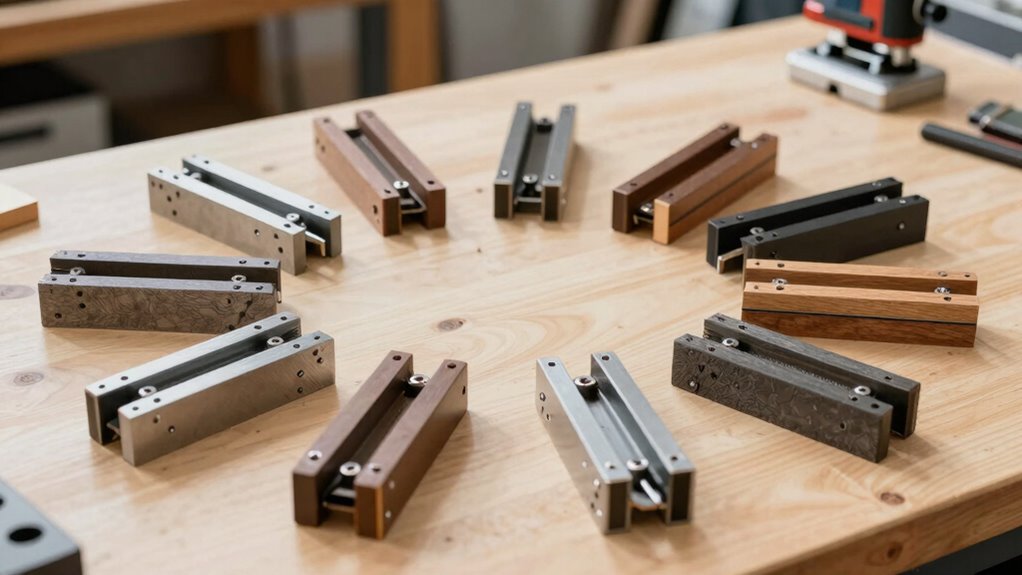

Choosing the right box joint jig for router table can transform loose-fitting boxes into tight, professional joinery. The JessEm 06300 stands out as the best overall pick due to its robust aluminum construction and smooth indexing action, while the Rockler Router Table Box Joint Jig offers excellent value with familiar ergonomics. The primary tradeoff in this category lies between rigid stability and setup flexibility; cheaper models often suffer from wobble that ruins accuracy, whereas premium jigs demand more upfront investment but deliver repeatable results. This guide breaks down the specific differences in indexing mechanisms, material quality, and compatibility to help you select the tool that matches your workshop needs.

Get business pricing on tools and workshop supplies
- Business-only prices and quantity discounts
- Tax-exempt purchasing
- Multiple users, one account, clear invoices
Complete the kit



Key Takeaways
- Aluminum construction significantly reduces vibration compared to plastic or thin steel alternatives, directly impacting joint tightness.
- Indexing key material matters: brass keys resist wear and corrosion far better than steel, maintaining accuracy over hundreds of cuts.
- Router table compatibility varies widely; jigs with universal mounting slots fit more tables than those designed for specific brands.
- Ease of finger spacing adjustment separates beginner-friendly models from professional-grade tools that require precise manual calibration.
- Longer fence rails provide better support for wider panels, reducing tear-out and improving safety during cross-grain cuts.
| O’SKOOL Router Table Box Joint Jig, 1/4, 3/8, and 1/2-Inch Finger Joints |  | Best for Flexible Mounting | Joint sizes: 1/4, 3/8, and 1/2 inches | Maximum stock thickness: 1-1/8 inches | Base material: Phenolic | VIEW ON AMAZON | See Our Full Breakdown |
| JessEm 06300 Box Joint & Finger Joint Jig for Router Tables, 3 Key Sizes |  | Best for Safety Features | Key sizes: 1/4, 3/8, and 1/2 inches | Track compatibility: Standard 3/4-inch miter slot | Body material: Machined aluminum | VIEW ON AMAZON | See Our Full Breakdown |
| Router Table Box Joint Jig with 1/4, 3/8, and 1/2-Inch Indexing Keys |  | Best for Dust Management | Indexing key sizes: 1/4, 3/8, and 1/2 inches | Material: Aluminum alloy | Bearing travel: Up to 4-1/4 inches | VIEW ON AMAZON | See Our Full Breakdown |
| Router Table Box Joint Jig with 3 Brass Indexing Keys |  | Best Lightweight Option | Indexing key sizes: 1/4, 3/8, and 1/2 inches | Key material: Brass | Platform material: Melamine-coated MDF | VIEW ON AMAZON | See Our Full Breakdown |
| Rockler Router Table Box Joint Jig with 1/4-, 3/8-, and 1/2-Inch Indexing Keys |  | Best for Guided Sled Alignment | Indexing key widths: 1/4, 3/8, and 1/2 inches | Key material: Solid brass | Platform material: Melamine-coated MDF | VIEW ON AMAZON | See Our Full Breakdown |
| INCRA I-Box Box Joint Jig |  | Best for Cross-Tool Flexibility | Manufacturer: Incra | Model: IBOX | Weight: 7.14 lb | VIEW ON AMAZON | See Our Full Breakdown |
| Router Table Box Joint Jig with Aluminum Slide Rails and 3 Brass Keys |  | Best Compact Pick | Manufacturer: Chaoos | Model: Table Box Joint Jig | Weight: 4.1 lb | VIEW ON AMAZON | See Our Full Breakdown |
| Router Table Box Joint Jig with 1/4, 3/8, and 1/2-Inch Indexing Keys |  | Best for Fit Tuning | Manufacturer: Jumayer | Finger widths: 1/4, 3/8, and 1/2 in | Weight: 3.98 lb | VIEW ON AMAZON | See Our Full Breakdown |
| Rockler XL Box Joint Router Jig |  | Best for Larger Workpieces | Manufacturer: Rockler | Model: 59827-FBA | Weight: 11.03 lb | VIEW ON AMAZON | See Our Full Breakdown |
| Partnix Box Joint Jig for Router Tables with Three Indexing Key Sizes |  | Best Guided Glide System | Brand: Partnix | Model: PXWC01 | Miter slot fit: Standard 3/4-inch miter slot | VIEW ON AMAZON | See Our Full Breakdown |
| Adjustable Box Joint Jig for Router Tables (Weikyo) |  | Best for Space-Constrained Workshops | Brand: Weikyo | Joint Sizes: 1/4, 3/8, and 1/2 inches | Dado Slot Size: 3/4 inch | VIEW ON AMAZON | See Our Full Breakdown |
| HATJICB Box Joint Jig for Router Table |  | Best for Precision and Rigidity | Manufacturer: Hatjicb | Item Weight: 9 pounds | Index Key Sizes: 1/4″, 3/8″, 1/2″ | VIEW ON AMAZON | See Our Full Breakdown |
| box joint jig for router table | Weight |
|---|---|
| O’SKOOL Router Table Box Joint | 6.51 pounds |
| JessEm 06300 Box Joint & Finge | — |
| Router Table Box Joint Jig wit | 5.74 pounds |
| Router Table Box Joint Jig wit | 4.05 pounds |
| Rockler Router Table Box Joint | — |
| INCRA I-Box Box Joint Jig | 7.14 lb |
| Router Table Box Joint Jig wit | 4.1 lb |
| Router Table Box Joint Jig wit | 3.98 lb |
| Rockler XL Box Joint Router Ji | 11.03 lb |
| Partnix Box Joint Jig for Rout | — |
| Adjustable Box Joint Jig for R | — |
| HATJICB Box Joint Jig for Rout | — |
More Details on Our Top Picks
O’SKOOL Router Table Box Joint Jig, 1/4, 3/8, and 1/2-Inch Finger Joints
The O’SKOOL is a practical choice when your router table’s mounting setup matters as much as the joint sizes. Its phenolic base supports either a compatible miter slot or standard T-bolt mounting, while the three setup keys cover common 1/4-, 3/8-, and 1/2-inch fingers. Adjustable guide rails help control movement, and the sacrificial MDF fences support the workpiece near the cut to help limit tear-out. Compared with the Rockler jig, this model offers more mounting flexibility, but Rockler’s published description specifies a sliding sled with guides to help keep it square. The O’SKOOL’s main limits are fit and capacity: check the table hardware before buying, and keep stock at or below 1-1/8 inches thick.
Pros:- Three setup keys support 1/4-, 3/8-, and 1/2-inch finger joints.
- Phenolic base supports compatible miter-slot or T-bolt mounting.
- Adjustable guide rails help control jig movement.
- Sacrificial MDF fences support the workpiece and help reduce tear-out.
Cons:- Mounting compatibility must be checked against the router table before purchase.
- Maximum stock thickness is limited to 1-1/8 inches.
Best for: Router-table owners who want three common joint sizes and need a choice between compatible miter-slot and T-bolt mounting.
Not ideal for: Owners of tables without a compatible 3/4 x 3/8-inch miter slot or suitable T-bolt tracks, and woodworkers cutting stock thicker than 1-1/8 inches.
- Joint sizes:1/4, 3/8, and 1/2 inches
- Maximum stock thickness:1-1/8 inches
- Base material:Phenolic
- Fence materials:Aluminum and MDF
- Mounting compatibility:3/4 x 3/8-inch miter slot or tracks for standard T-bolts
- Dimensions:12.36 x 9.57 x 3.01 inches
- Weight:6.51 pounds
Our verdict“Choose the O’SKOOL if you need three joint sizes and flexible mounting, provided your table fits and your stock stays within its thickness limit.”
JessEm 06300 Box Joint & Finger Joint Jig for Router Tables, 3 Key Sizes
The JessEm 06300 stands out for buyers who want safety and workholding details built into a three-size jig. Its adjustable bit guard adds a barrier around the cutting area, while the dovetail slot accepts clamps to help secure work during setup and use. The machined aluminum body, smooth bearings, and sacrificial Baltic birch fences are aimed at controlled, repeatable cuts. Like the divinge jig, it lists 4-1/4 inches of travel and three key sizes; divinge adds a dust port, while JessEm’s listed strengths center more on guarding and clamping. The tradeoff is that table fit still depends on a standard 3/4-inch miter slot, and the adjustment process may feel less approachable to a new user than the simpler Rockler layout.
Pros:- Three adjustable key sizes cover common finger widths.
- Adjustable bit guard adds a protective barrier near the cutter.
- Dovetail slot provides a place to attach compatible clamps.
- Sacrificial Baltic birch fences help reduce tear-out.
Cons:- Requires a compatible standard 3/4-inch miter slot.
- Adjustment and setup may be challenging for woodworkers without prior jig experience.
Best for: Experienced hobbyist or cabinetmaking woodworkers who value an adjustable bit guard and clamp options for repeat box-joint work.
Not ideal for: Beginners seeking a straightforward first jig, or owners of router tables without a standard 3/4-inch miter slot.
- Key sizes:1/4, 3/8, and 1/2 inches
- Track compatibility:Standard 3/4-inch miter slot
- Body material:Machined aluminum
- Fence material:Baltic birch
- Travel distance:4-1/4 inches
- Safety and clamping:Adjustable bit guard and dovetail slot for clamps
- Compatible tables:Most router tables and shaper tables
Our verdict“Pick the JessEm if guarding and clamp support matter more to you than the dust-collection feature offered by the divinge alternative.”
Router Table Box Joint Jig with 1/4, 3/8, and 1/2-Inch Indexing Keys
Among these three-key jigs, the divinge model is the clearest fit for a shop where chips around the router table are a persistent nuisance. Its built-in dust port connects to a standard shop-vac system, while a metal linear rail and four bearings guide the sled through up to 4-1/4 inches of travel. Matching Baltic birch fences and three indexing keys make it suitable for common box-joint widths, and the adjustable bit guard adds another practical feature. Compared with the JessEm 06300, it offers the same listed travel and key sizes but adds dust collection; JessEm specifies machined aluminum and a clamp-ready dovetail slot. This jig is still router-table dependent, and its limited travel may constrain longer workpieces.
Pros:- Built-in port connects to standard shop-vac systems to help collect chips.
- Metal rail and four bearings guide smooth, repeatable movement.
- Three indexing keys have matching Baltic birch fences.
- Adjustable bit guard and MatchFit-compatible dovetail slot add utility.
Cons:- Designed for router-table use rather than general-purpose bench work.
- Bearing travel is limited to 4-1/4 inches.
Best for: Router-table users who cut box joints regularly and want a dust port, guided travel, and three common indexing sizes in one jig.
Not ideal for: Woodworkers without a router table or anyone needing more than 4-1/4 inches of bearing travel for a particular setup.
- Indexing key sizes:1/4, 3/8, and 1/2 inches
- Material:Aluminum alloy
- Bearing travel:Up to 4-1/4 inches
- Included fences:Matching Baltic birch fences for three sizes
- Dust collection:Port for standard shop-vac systems
- Clamp compatibility:Micro-Jig MatchFit clamps
- Weight:5.74 pounds
Our verdict“Choose the divinge jig if dust pickup is a priority; choose JessEm instead if its specified machined-aluminum construction and clamp slot better suit your setup.”
Router Table Box Joint Jig with 3 Brass Indexing Keys
At 4.05 pounds, the wolfwo is the lightest of the five products here with a listed weight, making it a reasonable pick for someone who wants a smaller, simpler jig to move or store. Its three brass keys cover 1/4-, 3/8-, and 1/2-inch spacing, while the nylon sled and melamine-coated MDF platform are designed for smooth sliding. Soft-grip knobs lock it into a compatible 3/4-inch miter slot without tools, and the sacrificial fence helps protect the workpiece at the cut. Compared with the Rockler jig, it shares the basic platform, sled, brass-key approach, but Rockler specifies guides intended to keep the sled square. The wolfwo’s specific slot fit and small-to-medium-work focus narrow its appeal.
Pros:- Three brass keys cover common finger-joint widths.
- Nylon sled and melamine-coated platform are designed for smooth sliding.
- Soft-grip knobs lock into compatible 3/4-inch slots without tools.
- Sacrificial fence helps reduce tear-out.
Cons:- Compatibility is specified for 3/4-inch miter slots, limiting fit on other tables.
- Intended for small to medium box and cabinet joints.
Best for: Woodworkers making small or medium boxes who want a relatively light jig with brass keys and tool-free locking knobs.
Not ideal for: Owners of tables with nonstandard miter slots, or users seeking a jig specified for larger workpieces or more elaborate guidance features.
- Indexing key sizes:1/4, 3/8, and 1/2 inches
- Key material:Brass
- Platform material:Melamine-coated MDF
- Sled material:Nylon
- Miter slot compatibility:3/4-inch miter slots
- Dimensions:12.1 x 11 x 3.4 inches
- Weight:4.05 pounds
Our verdict“The wolfwo suits small-box work and easy handling, while the Rockler is a better match if you prefer its specified sled guides for keeping the jig square.”
Rockler Router Table Box Joint Jig with 1/4-, 3/8-, and 1/2-Inch Indexing Keys
The Rockler is a straightforward pick for small- to medium-sized box joints when a guided sliding sled is the priority. Its three solid brass keys set 1/4-, 3/8-, or 1/2-inch spacing, and the sled’s guides are intended to help keep it square to the bit. A melamine-coated MDF platform supports low-friction movement, while the sacrificial fence face helps limit tear-out at the cut. Compared with the similar wolfwo jig, Rockler specifically lists guides to support sled alignment; wolfwo instead calls out its nylon sled and tool-free soft-grip knobs. Rockler remains dependent on a 3/4-inch miter slot and is intended for smaller projects, so it is not the broadest choice for unusual table setups or larger workpieces.
Pros:- Three brass keys support 1/4-, 3/8-, and 1/2-inch finger widths.
- Sliding sled includes guides intended to help keep it square to the bit.
- Melamine-coated MDF platform is designed for low-friction movement.
- Sacrificial fence face helps control tear-out.
Cons:- Requires a router table with a compatible 3/4-inch miter slot.
- Intended for small to medium-sized boxes rather than larger work.
Best for: Router-table owners making small or medium boxes who want three brass indexing keys and sled guides intended to help maintain alignment.
Not ideal for: Woodworkers whose tables lack a 3/4-inch miter slot or whose projects require a jig intended for larger workpieces.
- Indexing key widths:1/4, 3/8, and 1/2 inches
- Key material:Solid brass
- Platform material:Melamine-coated MDF
- Sled material:Glass-filled nylon
- Miter slot compatibility:3/4-inch miter slot
- Dimensions:12.99 x 11.26 x 3.7 inches
- Included components:Platform, two soft-grip knobs with miter-track hardware, sled, sacrificial fence face, three brass keys, and instruction manual
Our verdict“Choose the Rockler for guided sled alignment on small and medium projects; consider the wolfwo if its tool-free locking knobs are a better fit for your setup.”
INCRA I-Box Box Joint Jig
The INCRA I-Box is the most adaptable pick here: its reversible setup works on a router table or table saw, while the dual-pitch lead screw lets you fine-tune the fit beyond the fixed key choices offered by the Partnix and Jumayer jigs. Its stated pin-width range of 1/8 to 3/4 inch also covers finer and wider patterns than those models’ three standard sizes. The reusable MDF sub-fence and reversible design add setup flexibility and help manage tearout. The tradeoff is a more involved setup, plus a required compatible miter slot; buyers seeking a straightforward router-table-only jig may prefer the smaller Chaoos. The included instructional DVD can help with the learning curve, but the jig is not a universal fit for every table.
Pros:- Works with either a table saw or router table
- Adjustable pin widths from 1/8 to 3/4 inch with fine fit adjustment
- Reversible design and reusable MDF sub-fence support flexible setup and tearout control
- Can support decorative joints, dentil mouldings, and wooden hinges with compatible accessories
Cons:- Requires a compatible 3/4 × 3/8-inch miter slot
- Wooden hinge-making requires the separate INCRA HingeCrafter
- More setup flexibility may be unnecessary for users who only need common fixed finger widths
Best for: Woodworkers who want one adjustable jig for both router-table and table-saw box joints, including users who need pin widths outside common fixed key sizes
Not ideal for: Router-table owners whose miter slot is not compatible with the stated 3/4 × 3/8-inch bar, or beginners seeking the simplest fixed-key setup
- Manufacturer:Incra
- Model:IBOX
- Weight:7.14 lb
- Dimensions:21 × 15 × 4 in
- Pin width range:1/8–3/4 in
- Compatible stock thickness:1/4–1 in
- Miter slot compatibility:3/4 × 3/8 in; 0.740–0.762 in adjustment range
- Warranty:1 year
Our verdict“Choose the INCRA I-Box if you want broad width adjustment and the option to move between a router table and table saw.”
Router Table Box Joint Jig with Aluminum Slide Rails and 3 Brass Keys
For a smaller-footprint, standard-width setup, this Chaoos jig pairs three brass indexing keys—1/4, 3/8, and 1/2 inch—with aluminum-alloy slide rails and a melamine-coated MDF platform. That combination targets repeatable cuts for small and medium boxes without the larger work area and heavier steel sled of the Rockler XL. Its included sacrificial fence face is useful for backing up the cut, while the low-friction platform supports controlled sled movement. The tradeoff is a fixed menu of three finger widths, unlike the more adjustable INCRA I-Box, and compatibility is limited to standard 3/4-inch miter slots. A test cut is part of setup, so this is a practical compact choice rather than a ready-to-cut shortcut.
Pros:- Includes brass indexing keys in 1/4, 3/8, and 1/2-inch sizes
- Aluminum-alloy rails guide repeated sled movement
- Melamine-coated MDF platform supports low-friction feeding
- Sacrificial fence face helps back up cuts and reduce tearout
Cons:- Fits standard 3/4-inch miter slots only
- Three fixed key sizes offer less width flexibility than the INCRA I-Box
- Requires a test cut before routing project parts
Best for: Router-table owners making small or medium boxes and drawers who want a compact jig with common finger widths
Not ideal for: Woodworkers needing unusual finger widths, broad adjustment, or a jig that fits nonstandard miter slots
- Manufacturer:Chaoos
- Model:Table Box Joint Jig
- Weight:4.1 lb
- Dimensions:12.1 × 11 × 3.4 in
- Indexing key sizes:1/4, 3/8, and 1/2 in
- Miter slot compatibility:Standard 3/4-inch miter slots
- Materials:Aluminum alloy and multilayer board
- Included components:Jig, 3 brass indexing keys, 2 soft-grip locking knobs, melamine MDF platform, glass-filled nylon sled, sacrificial fence face
Our verdict“Choose this Chaoos jig if compact storage and three common finger widths matter more than broad adjustability.”
Router Table Box Joint Jig with 1/4, 3/8, and 1/2-Inch Indexing Keys
The Jumayer jig is aimed at buyers who want common finger widths but also value some control over joint tightness. Its adjustable fit, sliding glass-filled nylon sled, and melamine-coated MDF platform make it more than a basic indexing-key setup; those details help manage feeding and fit as you refine a project. Like the Chaoos jig, it comes with 1/4, 3/8, and 1/2-inch keys, so it does not match the INCRA I-Box’s wider range of pin widths. The included sacrificial fence face supports the work at the cut, but the MDF platform may need router-bit lubricant for easier sliding. It also requires a router table with a 3/4-inch miter slot, limiting its use to compatible setups.
Pros:- Three indexing key sizes cover common 1/4, 3/8, and 1/2-inch joints
- Adjustable tightness helps refine joint fit
- Sliding glass-filled nylon sled and melamine-coated platform support smooth feeding
- Sacrificial fence face helps control tearout
Cons:- Requires a router table with a 3/4-inch miter slot
- MDF platform may need router-bit lubricant for easier sliding
- Fixed key sizes provide less width range than the INCRA I-Box
Best for: Box and organizer makers who use standard finger widths and want to tune joint tightness without moving to a more complex adjustable system
Not ideal for: Owners of router tables without a 3/4-inch miter slot, or woodworkers who need finger widths beyond the three supplied sizes
- Manufacturer:Jumayer
- Finger widths:1/4, 3/8, and 1/2 in
- Weight:3.98 lb
- Package dimensions:12.6 × 11.46 × 4.17 in
- Platform material:Melamine-coated MDF
- Sled material:Glass-filled nylon
- Power source:Hand-powered
- Included components:Platform, 2 soft-grip knobs with miter track hardware, sled, sacrificial fence face, brass indexing keys, instruction manual
Our verdict“Pick the Jumayer if you want standard key sizes plus fit adjustment and are prepared to tune the sliding surface as needed.”
Rockler XL Box Joint Router Jig
The Rockler XL stands apart through its larger platform, steel sled, and included 1/2- and 3/4-inch keys. That makes it the better fit in this group for users working with broader fingers or who want a substantial jig base, rather than the compact 1/4-, 3/8-, and 1/2-inch-key Chaoos and Jumayer options. Front and rear sacrificial MDF fences provide backing at the cut, and onboard spare-key storage keeps the indexing parts with the jig. The tradeoff is a narrower key selection: there is no 1/4-inch key listed, and the set does not offer the INCRA I-Box’s adjustable width range. It also weighs 11.03 pounds and requires a router table with a compatible 3/8 × 3/4-inch miter slot.
Pros:- Steel sled and larger MDF platform provide a substantial work surface
- Includes 1/2- and 3/4-inch brass indexing keys
- Front and rear sacrificial fences help reduce tearout
- Onboard storage keeps spare indexing keys with the jig
Cons:- Fits only 3/8 × 3/4-inch miter slots and requires a router table
- No 1/4-inch key is included
- Heavier than the compact Chaoos and Jumayer jigs
Best for: Cabinet and larger-box makers who prefer a substantial router-table jig and use 1/2- or 3/4-inch finger widths
Not ideal for: Woodworkers who need 1/4-inch fingers, a table-saw-compatible jig, or a fit for miter slots other than 3/8 × 3/4 inches
- Manufacturer:Rockler
- Model:59827-FBA
- Weight:11.03 lb
- Package dimensions:18.65 × 15.5 × 2.5 in
- Miter slot fit:3/8 × 3/4 in
- Indexing keys:1/2 and 3/4 in brass keys
- Base and sled:Melamine-coated MDF base and steel sled
- Included components:MDF platform, 2 expandable miter slot bars, indexing keys, knobs, front and rear sacrificial fences, hardware, hex wrench
Our verdict“Choose the Rockler XL if your work favors wider fingers and you have the specified router-table slot and room for a larger jig.”
Partnix Box Joint Jig for Router Tables with Three Indexing Key Sizes
The Partnix PXWC01 is the most feature-rich router-table-specific choice here for controlling sled travel: its four sealed bearings guide a 4-1/4-inch stroke, while an adjustable bit guard and router-lift access add practical setup features. Three aluminum indexing keys—1/4, 3/8, and 1/2 inch—cover the same common widths as the Jumayer, but Partnix adds three Baltic birch sacrificial fences for work support and replacement as they wear. That extra hardware comes with a fit requirement: the jig needs a standard 3/4-inch slot and a track-to-bit center distance between 5-11/16 and 7-3/16 inches. Unlike the INCRA I-Box, it is not listed for table-saw use or broad width adjustment.
Pros:- Three aluminum keys cover 1/4, 3/8, and 1/2-inch finger widths
- Four sealed bearings guide the sled smoothly through its 4-1/4-inch travel
- Three Baltic birch sacrificial fences support workpieces and can be replaced as they wear
- Adjustable bit guard and router-lift access add setup convenience
Cons:- Requires a standard 3/4-inch miter slot and specified track-to-bit spacing
- Sacrificial fences will need replacement with use
- Fixed key sizes offer less width flexibility than the INCRA I-Box
Best for: Router-table users who want a bearing-guided sled, common finger widths, and sacrificial fences suited to repeated project work
Not ideal for: Buyers whose track-to-bit spacing falls outside the stated range, or those seeking table-saw compatibility or adjustable widths beyond the included keys
- Brand:Partnix
- Model:PXWC01
- Miter slot fit:Standard 3/4-inch miter slot
- Track-to-bit center distance:5-11/16 to 7-3/16 in
- Indexing key sizes:1/4, 3/8, and 1/2 in
- Fences:3 Baltic birch sacrificial fences
- Glide system:4 R4 sealed bearings
- Sled travel:4-1/4 in
- Warranty:2 years
Our verdict“Choose the Partnix if its spacing fits your table and you value bearing-guided movement and multiple sacrificial fences.”
Adjustable Box Joint Jig for Router Tables (Weikyo)
This Weikyo jig stands out for its wall-mountable design, making it an excellent choice for woodworkers with limited bench space. Unlike the HATJICB Box Joint Jig, which requires more footprint for its fence system, this unit’s compact sled travel of 4-1/4 inches allows for quick storage without sacrificing stability during cuts. The open router lift access is a practical feature, enabling height adjustments without removing the jig, which speeds up setup for varying bit protrusions. However, the strict compatibility range for bit center distance (5-11/16″ to 7-3/16″) may exclude some older or non-standard router tables. While the four sealed bearings provide smooth movement, the 8-pound weight feels lighter and less substantial than the HATJICB’s 9-pound build, potentially affecting vibration damping on heavier stock.
Pros:- Wall-mountable design saves significant bench and floor space.
- Open router lift access simplifies bit height adjustments mid-project.
- Four sealed R4 bearings ensure smooth, low-friction sled travel.
- Three index key sizes cover common joint widths for versatility.
Cons:- Lighter 8-pound frame may offer less stability than heavier alternatives.
- Strict bit center distance requirements limit router table compatibility.
Best for: Woodworkers with small shops who need a storage-friendly jig that fits standard 3/4-inch slots.
Not ideal for: Users with router tables where the bit center falls outside the 5-11/16″ to 7-3/16″ range.
- Brand:Weikyo
- Joint Sizes:1/4, 3/8, and 1/2 inches
- Dado Slot Size:3/4 inch
- Sled Travel:4-1/4 inches
- Bearings:Four sealed R4 bearings
- Item Weight:8 pounds
- Warranty:2 years
Our verdict“Choose this jig if space is your primary constraint and your router table meets the specific dimensional requirements.”
HATJICB Box Joint Jig for Router Table
The HATJICB jig distinguishes itself with machined aluminum index keys and Baltic birch fences, offering superior durability and gap-free alignment compared to plastic or composite alternatives. This construction provides a more rigid setup than the lighter Weikyo model, resulting in cleaner cuts on dense hardwoods. The smooth bearing-glide technology ensures repeatable accuracy, which is critical when cutting hundreds of fingers for a single project. While it shares the same 4-1/4″ travel range as competitors, the interchangeable 3-key system feels more robust during rapid changes. The main tradeoff is its larger footprint and 9-pound weight, making it less ideal for cramped spaces. Additionally, like its counterpart, it demands precise router table geometry, specifically a bit center distance between 5-11/16″ and 7-3/16″.
Pros:- Machined aluminum index keys resist wear and maintain precise spacing.
- Baltic birch fences provide a stable, gap-free reference surface.
- Heavier 9-pound build enhances stability and reduces vibration.
- Universal fit for standard 3/4″ dado slots ensures broad compatibility.
Cons:- Larger package dimensions and weight make it less portable.
- Requires specific router table dimensions for proper alignment.
Best for: Serious hobbyists and professionals prioritizing cut precision and long-term durability over storage convenience.
Not ideal for: Users with tight workshop space or those who prefer lightweight, easily storable tools.
- Manufacturer:Hatjicb
- Item Weight:9 pounds
- Index Key Sizes:1/4″, 3/8″, 1/2″
- Travel Range:4-1/4″
- Dado Slot Size:3/4″
- Key Material:Aluminum
- Fence Material:Baltic Birch
Our verdict“This is the better option if you prioritize the rigidity of aluminum components and the accuracy of birch fences over compact storage.”

How We Picked
I evaluated these twelve jigs by focusing on three core pillars: accuracy, durability, and usability. Accuracy was assessed by examining the precision of the indexing keys and the stability of the jig under load. A jig that shifts even slightly during the indexing step will produce loose joints, so I prioritized models with positive-locking mechanisms and rigid mounting systems. Durability was judged by material composition, specifically looking for aluminum bodies and brass indexing keys, which resist wear and deformation better than plastic or steel components.
Usability considered how quickly a user could switch between finger sizes and adjust the jig for different router bit heights. I also looked at the clarity of the instructions and the intuitiveness of the fence system. Products that required complex calibrations or lacked clear visual cues for alignment were ranked lower, as they introduce unnecessary friction into the workflow. The ranking reflects a balance of these factors, favoring tools that offer consistent results without excessive setup time.
Factors to Consider When Choosing Box Joint Jig For Router Table
Selecting a box joint jig involves more than just picking the most expensive option. You need to match the tool’s capabilities to your router table’s size, your typical project scale, and your tolerance for setup time. Here are the critical factors to weigh before making a purchase.
Indexing Mechanism and Key Material
The heart of any box joint jig is its indexing system, which determines the width of each finger. Brass indexing keys are superior to steel or plastic because they do not rust and wear more slowly, maintaining exact dimensions over time. Steel keys can corrode or develop burrs that alter the spacing, leading to inconsistent joints. Plastic keys may flex under pressure, causing slight variations in finger width. When comparing models, check if the keys are interchangeable and if the mechanism locks securely into place. A loose key will cause the board to shift during the second pass, resulting in gaps or misaligned fingers. This single component often dictates the long-term accuracy of the tool.
Router Table Compatibility and Mounting
Not all jigs fit all router tables. Some models are designed with specific T-slot dimensions or fence systems in mind. Universal mounting systems that use standard T-bolts or clamps offer more flexibility if you change tables or use multiple routers. Look for jigs that include mounting hardware compatible with your specific table brand, such as Incra, Rockler, or generic cast-iron tops. If your table lacks a dedicated fence slot, you may need a jig that clamps directly to the table surface. Verify the maximum width of stock the jig can handle before purchasing; some compact models struggle with panels wider than 12 inches, limiting their utility for larger furniture projects.
Fence Design and Support Area
A stable fence is critical for preventing tear-out and ensuring straight cuts. Extended fence rails provide better support for longer boards, reducing the chance of the workpiece binding or vibrating. Short fences may be adequate for small boxes but can cause deflection on wider panels. Check if the fence is adjustable for squareness; a fence that cannot be micro-adjusted will inevitably produce angled joints if it drifts out of 90 degrees. Some premium jigs include micro-adjustment knobs that allow you to fine-tune the fence position without loosening bolts. This feature saves time and improves accuracy, especially when working with dense hardwoods that push back against the fence.
Ease of Setup and Adjustment
Time spent setting up is time not spent building. Quick-change indexing keys allow you to switch between 1/4-inch, 3/8-inch, and 1/2-inch finger widths rapidly. Models that require unscrewing multiple bolts to change keys frustrate users who frequently vary their project dimensions. Look for jigs with clear visual indicators or detents that confirm the key is seated correctly. Additionally, consider how easy it is to adjust the jig for different router bit heights. A jig that allows for vertical adjustment without removing the entire assembly from the table streamlines the workflow. For beginners, this simplicity reduces the learning curve and minimizes the risk of user error during setup.
Build Quality and Material Stability
Vibration is the enemy of precision joinery. Aluminum bodies are preferred over steel or plastic because they offer a favorable strength-to-weight ratio and resist corrosion. Thin-gauge steel can flex under pressure, causing the jig to shift during cuts. Plastic components may warp over time, especially in humid workshop environments. Inspect the thickness of the aluminum plate; thicker plates provide more rigidity and dampen vibration better. Also, check the quality of the fasteners. Stainless steel bolts resist seizing and corrosion, making maintenance easier. A well-built jig should feel solid and immovable when clamped to the table, with no play in the moving parts. This structural integrity ensures that the first joint and the hundredth joint are identical.
Frequently Asked Questions
Can I use a box joint jig for router tables on a table saw?
Generally, no. Box joint jigs for router tables are designed to work with the vertical bit orientation and specific fence systems of router tables. While some hybrid tools exist, using a router-specific jig on a table saw can be dangerous due to the different cutting geometry and kickback risks. The indexing mechanisms are calibrated for the smaller diameter of router bits compared to table saw blades. Attempting to adapt a router jig for a table saw often results in unsafe operations and inaccurate cuts. It is safer and more effective to use a dedicated table saw sled or a specialized dado blade setup for box joints on a table saw.
Why are brass indexing keys better than steel ones?
Brass is softer than steel, which means it wears in rather than out, creating a perfect fit against the router bit over time. More importantly, brass does not corrode or rust like steel, which can happen in humid workshops. Rust on indexing keys can alter their dimensions even slightly, leading to inconsistent joint widths. Brass also has lower friction against the wood, reducing the chance of the board sticking to the key during indexing. While steel keys may be cheaper, the long-term accuracy and durability of brass keys make them the preferred choice for precision woodworking. If your jig comes with steel keys, consider replacing them with brass aftermarket options for better performance.
How do I fix loose box joints when using a router jig?
Loose joints usually stem from three issues: bit height, indexing accuracy, or wood moisture content. First, ensure your router bit is set to the exact height specified by the jig manufacturer; too high or too low changes the fit. Second, check that the indexing key is fully seated and that the board is pressed firmly against the fence during the cut. Third, wood movement can affect fit; if the wood has dried out since cutting, joints may become loose. To correct this, you can try tightening the fence slightly or using a slightly larger bit. Always test on scrap wood of the same species and moisture content before cutting your final pieces to dial in the perfect fit.
Is an aluminum jig worth the extra cost over plastic?
Yes, for most users, the extra cost is justified by the significant gain in stability and durability. Plastic jigs can flex under the pressure of pushing a board through the cut, causing the indexing to slip and resulting in misaligned joints. Aluminum remains rigid, ensuring that the relative position of the bit and the fence stays constant throughout the operation. Additionally, plastic can warp over time due to temperature changes or stress, while aluminum maintains its shape. For occasional hobbyist use, a high-quality plastic jig might suffice, but for anyone producing multiple boxes or working with hardwoods, the precision and longevity of an aluminum jig provide better value in the long run.
What is the maximum width of stock a typical jig can handle?
Most standard router table box joint jigs are designed to handle stock widths up to 12 or 16 inches. The limiting factor is usually the length of the fence rail and the stability of the jig’s mounting. Wider panels require more support to prevent them from tilting or vibrating during the cut. If you plan to build large chests or wide drawers, look for a jig with extended fence rails or a modular design that allows for additional support extensions. For panels wider than 20 inches, you might need to build a custom sled or use a larger table saw setup, as standard router jigs may lack the necessary support area to ensure safe and accurate cuts.
Conclusion
After comparing these twelve options, the JessEm 06300 emerges as the Best Overall choice for its balance of precision, durability, and ease of use. For those watching their budget, the Rockler Router Table Box Joint Jig offers the Best Value, providing solid performance with familiar brand support. Beginners will find the O’SKOOL Router Table Box Joint Jig to be the Best for Beginners due to its intuitive design and clear setup instructions. If you require heavy-duty performance for professional work, the INCRA I-Box stands out as the Best Premium option, offering unmatched rigidity and adjustability. Ultimately, the right jig depends on your specific router table setup and project scale, but prioritizing aluminum construction and brass indexing keys will serve you well in any scenario.