Finding the best woodworking tools is less about chasing premium brands and more about matching each tool to the job you actually do. I built this roundup around one question: which hand tools give you the most accuracy and control for the money? My top pick is the Clarke Brothers Wheel Marking Gauge, because clean joinery starts with a precise line and it scribes one every time. If you want the most cutting capability per dollar, the Hurricane 4 Piece Wood Chisel Set is the value play, while the RUITOOL Japanese Pull Saw is my pick for anyone who wants cleaner cuts with less effort. The real tradeoff across this list is precision versus versatility, and whether you are building fitted joinery or just getting parts to assemble square. Here is how I ranked them.

Get business pricing on tools and workshop supplies
- Business-only prices and quantity discounts
- Tax-exempt purchasing
- Multiple users, one account, clear invoices
Complete the kit



Key Takeaways
- The Clarke Brothers Wheel Marking Gauge takes the top spot because joinery accuracy begins at the marking stage, and its dual metric/imperial scales plus two spare cutters cover years of layout work.
- Hurricane‘s 4 Piece Chisel Set delivers the lowest cost per tool in this lineup, with four common widths that handle most paring and chopping tasks.
- The RUITOOL Japanese Pull Saw packs rip and crosscut teeth onto one SK5 blade, replacing two Western-style saws for fine joinery work.
- Jorgensen‘s No.101 Mini Planer trades capacity for control — it will not flatten a tabletop, but it excels at chamfers and one-handed fitting work.
- The NECAMOCU Edge Banding Trimmer is the only specialty pick here; it earns its place only if you regularly build with plywood, veneer, or melamine.


| woodworking tool | Blade Material |
|---|---|
| Clarke Brothers Wheel Marking | — |
| Hurricane 4 Piece Wood Chisel | CR-V (chrome vanadium) steel |
| RUITOOL Japanese Hand Saw 6 In | SK5 high-carbon steel |
| Jorgensen No.101 Mini Wood Pla | O1 tool steel |
| NECAMOCU Edge Banding Trimmer | 420 stainless steel |
More Details on Our Top Picks
Clarke Brothers Wheel Marking Gauge – Woodworking Marking Scriber Kit with 2 Replacement Cutters
A marking gauge looks modest, but it decides the quality of everything that follows it. The Clarke Brothers Wheel Marking Gauge takes the top spot because a wheel cutter severs wood fibers instead of dragging a pencil across them, which means cleaner shoulders on dovetails and mortise-and-tenon joints. The laser-engraved metric and imperial scales read clearly to 6 inches, the fence locks for true one-handed use, and the non-marring brass face will not scar a finished surface the way an all-steel gauge can.
Every other tool in this lineup depends on the line this gauge draws — the RUITOOL saw and Hurricane chisels both cut to a marked line, so accuracy upstream pays off downstream. Two spare cutters also stretch its working life well past cheaper single-cutter gauges.
The tradeoffs are honest ones. The 6-inch scale caps you at typical joinery distances, ultra-fine setups may warrant a check against a known-good ruler, and it does one job only. If your projects never involve fitted joints, the chisel set below will see far more use.
Pros:- Wheel cutter severs fibers for cleaner, more accurate lines than a pencil
- Laser-engraved scales in both metric and imperial units
- Two replacement cutters included, extending working life
- Non-marring brass face protects finished surfaces
Cons:- 6-inch scale limits layout to typical joinery distances
- May need calibration against a known-good ruler for ultra-fine work
- Single-purpose tool — it marks, it does not cut
Best for: Woodworkers cutting dovetails, mortise-and-tenon, or any fitted joinery who want repeatable, accurate layout lines
Not ideal for: Carpenters doing rough framing or anyone whose projects rarely call for scribed joinery lines
- Material:Brass, steel, aluminum alloy
- Scale Range:6 in / 150 mm, metric and imperial
- Graduation:Laser-engraved
- Face:Non-marring brass
- Included:2 replacement cutters
- Overall Length:8 in
- Operation:One-handed fence lock
Our verdict“The most accurate, longest-lived layout tool in this lineup and the foundation every other cut depends on.”
Hurricane 4 Piece Wood Chisel Set for Woodworking with CR-V Steel Blades and PVC Handles
Where the marking gauge above is a precision instrument, the Hurricane 4 Piece Wood Chisel Set is the workhorse, and it wins on simple math: four widths — 1/4, 1/2, 3/4, and 1 inch — for roughly the price of one mid-range chisel. Those sizes cover what beginners actually do, from paring hinge mortises to cleaning up dovetail waste left by the RUITOOL saw. The drop-forged CR-V steel blades hold a respectable working edge for this price class, and the beveled sides reach into corners thicker chisels cannot.
The ergonomic PVC handles are the honest compromise. They are comfortable under hand pressure and light taps, but they will not shrug off years of heavy mallet blows the way a hooped wooden handle does. Compared with premium sets from Narex or Stanley Sweetheart, these need more frequent honing and a flattened back before fine work. For a first kit, though, four usable sizes beat one excellent chisel that only fits one width of cut.
Pros:- Four common widths cover most paring and chopping tasks
- Drop-forged CR-V blades hold a respectable working edge
- Beveled sides reach into tight inside corners
- Blade guards included for safe storage
Cons:- PVC handles will not tolerate years of heavy mallet strikes
- Factory grind needs flattening and honing before fine work
Best for: Beginners building a first hand-tool kit who need the four most common chisel widths at a low cost per tool
Not ideal for: Heavy mallet work like timber framing, or professionals who want premium steel and hooped handles
- Blade Material:CR-V (chrome vanadium) steel
- Blade Edge:Heat-treated, beveled 25°
- Sizes:1/4″, 1/2″, 3/4″, 1″
- Pieces:4
- Handle:Ergonomic PVC
- Extras:Blade guards included
Our verdict“The cheapest way to own the four chisel sizes you will actually use, as long as you treat the handles kindly.”
RUITOOL Japanese Hand Saw 6 Inch Double Edge Sided Pull Saw Ryoba SK5 Flexible Blade 14/17 TPI
Ask woodworkers which saw survives a shop purge and a Japanese pull saw comes up constantly. The RUITOOL 6 Inch Ryoba shows why: because it cuts on the pull stroke, the blade can be thinner than a Western push saw without buckling, which gives a narrower kerf, less wasted wood, and less effort per cut. The double-edged SK5 blade carries rip teeth (14 TPI) on one side and crosscut teeth (17 TPI) on the other, so one tool replaces two saws.
Against the Hurricane chisels, this is the faster way to remove waste — saw close to your line, then pare to it. The 6-inch length trades speed for control, which suits small joinery and trim, and the flexible plate folds nearly flat for flush-cutting plugs and dowels without scratching the surface.
The catches: fine triple-ground teeth are impractical to resharpen at home, so treat the blade as a long-life consumable, and the thin plate rewards a light hand — force it and you can kink it. It is also strictly a wood tool.
Pros:- Pull-stroke design cuts a thin kerf with less effort
- One double-edged blade handles both rip and crosscuts
- Flexible SK5 blade handles flush trimming
- Beech handle keeps it light and balanced
Cons:- Fine triple-ground teeth are impractical to resharpen at home
- Thin blade can kink if forced; wood only
Best for: Joiners and hobbyists who want clean rip and crosscuts in small stock with minimal effort
Not ideal for: Rough demolition, all-day sheet goods breakdown, or anyone unwilling to eventually replace a blade
- Blade Length:6 in
- Blade Material:SK5 high-carbon steel
- Teeth:14 TPI rip / 17 TPI crosscut
- Blade Type:Double-edged pull saw (ryoba)
- Tooth Grind:Three-sided
- Handle:Beech wood
Our verdict“The fastest path to clean, low-effort joinery cuts, with rip and crosscut teeth on a single blade.”
Jorgensen No.101 Mini Wood Planer – Hand Block Plane for Woodworking, Adjustable Cutting Depth
A block plane fills the gap between cutting and finishing, and the Jorgensen No.101 Mini is built for the small end of that gap. It rides in an apron pocket and works one-handed, which is exactly what you want for chamfering edges, easing a sticky drawer, or knocking down glue squeeze-out. The ductile iron body resists cracking better than the cast-zinc minis it competes with, the O1 tool steel blade hones easily, and the adjustable cutting depth shifts from wispy shavings to aggressive trims.
Compared with the RUITOOL saw, which removes material fast, this plane removes it controllably — reach for it when a fraction of a millimeter decides whether a door closes flush. The tradeoff is capacity: a sole this short cannot flatten a panel or joint an edge the way a No. 4 bench plane can, and the exposed blade demands careful handling and capped storage. Think of it as a fitting tool, not a flattening tool.
Pros:- Ductile iron body resists cracking better than cast-zinc minis
- O1 tool steel blade hones easily and takes a keen edge
- Adjustable cutting depth for fine or aggressive shavings
- Compact enough for one-handed use and apron carry
Cons:- Small sole limits it to detail and fitting work
- Sharp exposed blade demands careful handling and storage
Best for: DIYers and woodworkers doing chamfers, edge touch-ups, and fitting drawers or doors
Not ideal for: Anyone flattening panels or jointing long edges — buy a full-size bench plane instead
- Blade Material:O1 tool steel
- Body:Ductile iron
- Lever Cap:Zinc alloy
- Depth Adjustment:Yes
- Primary Uses:Trimming, chamfering, deburring
- Size Class:Mini / one-handed
Our verdict“A pocketable fitting plane that excels at chamfers and touch-ups but is no substitute for a bench plane.”
NECAMOCU Edge Banding Trimmer & Cutter – Stainless Steel Blade for Woodworking
Every other tool on this list earns its keep across many projects; the NECAMOCU Edge Banding Trimmer earns it on one, and that is fine. If you build with plywood, melamine, or veneer, flushing iron-on banding is a constant chore, and doing it with a chisel or the Jorgensen plane risks gouging thin veneer the moment the grain turns. The V-shaped stainless blade trims both faces of the banding in a single pass, and because the cutter references the panel rather than the banding, it follows curved edges as readily as straight ones — something a plane simply cannot do.
The 420 stainless steel favors corrosion resistance and edge life over ultimate sharpness, a sensible match for abrasive melamine and PVC, and the lifetime warranty softens the risk of a niche purchase.
So why does it rank last? Reach. A solid-wood furniture maker will never touch it, and production shops will want a trim router for volume. It is the right buy for cabinet and built-in work, and an easy skip for everyone else.
Pros:- V-shaped blade trims both faces of banding in one pass
- Follows curved edges as well as straight ones
- 420 stainless blade resists corrosion and abrasion
- Backed by a lifetime warranty
Cons:- Single-purpose tool with no use outside edge banding
- Manual operation limits it to light-duty work
Best for: Cabinet and built-in builders trimming iron-on edge banding on plywood, melamine, or veneer
Not ideal for: Solid-wood furniture makers and high-volume shops that need a powered trimmer
- Blade Material:420 stainless steel
- Blade Shape:V-shaped double trim
- Base:Phenolic board
- Compatible Materials:Plywood, melamine, laminate, PVC, ABS, veneer
- Edge Types:Straight and curved
- Warranty:Lifetime
Our verdict“A worthwhile niche buy for anyone trimming edge banding on sheet goods, and an easy skip for solid-wood workers.”
How We Picked
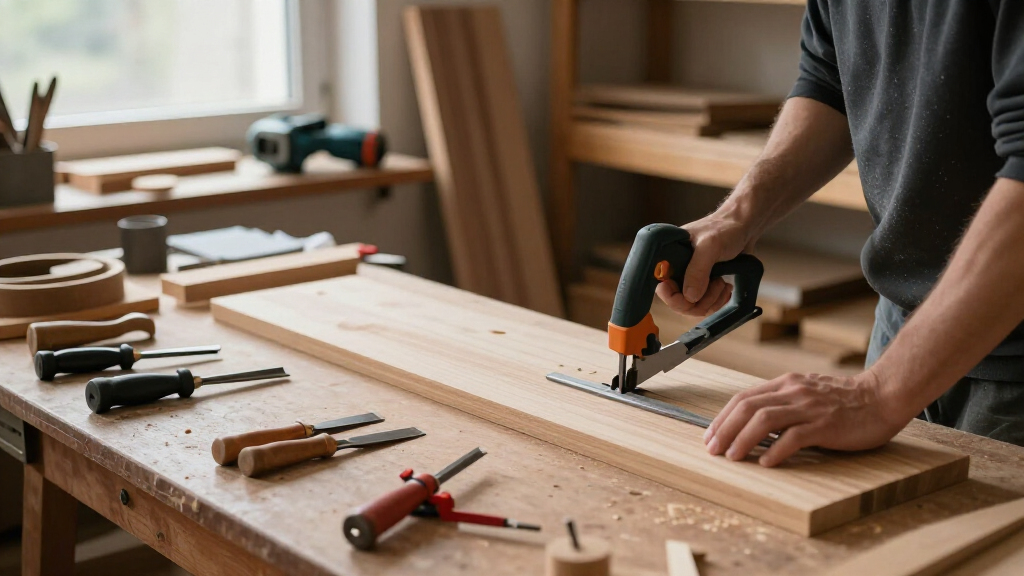
I approached this list the way I would stock a small workshop: accuracy first, cutting second, refinement third. That order shaped the rankings. A saw or chisel can only perform as well as the line it follows, which is why the marking gauge leads the list and why general-purpose tools outrank specialty ones.
From there, I judged each candidate on five criteria. Build materials came first — brass, CR-V steel, SK5 steel, ductile iron, and stainless blades all signal how long a tool holds an edge or a setting. Versatility came next: a tool that covers more tasks, like a four-size chisel set or a double-edged saw, ranks above a one-job tool at the same price. I also weighed beginner friendliness, cost per tool, and how well each pick complements the others instead of duplicating them.
That last point explains the bottom of the list. The NECAMOCU trimmer is genuinely good at its job, but that job — trimming edge banding — only matters if you build with sheet goods. Rankings here reflect how often a typical woodworker will reach for each tool, not just how well it is made.
Factors to Consider When Choosing Best Woodworking Tools
Five tools, five different jobs. Before picking any of them, it helps to understand how hand tools divide the work in a small shop and where your money does the most good.Start With Marking, Not Cutting
Every cut you make is only as accurate as the line it follows. A pencil line is wide and imprecise; a scribed line from a wheel marking gauge gives a saw or chisel a physical edge to register against. That is why I rank layout tools above cutting tools for anyone building fitted joinery, and why a gauge like the Clarke Brothers pick pays for itself in tighter joints long before a fancier saw would.
Saws, Chisels, and Planes: Who Does What
Hand tools divide labor cleanly. A saw severs fibers to rough length and shape. A chisel pares and chops to refine joinery the saw cannot reach. A plane shaves surfaces to final fit and finish. If a cut is long and straight, saw it. If it is small and precise, pare it. If a surface needs flattening or an edge needs easing, plane it. Buy in that order and each tool covers the weaknesses of the one before it.
Steel Types and What They Mean for You
The steels in this lineup trade edge life against convenience. CR-V steel (Hurricane chisels) is tough and affordable but wants more frequent honing. SK5 high-carbon steel (RUITOOL) takes very sharp teeth that stay keen, though fine saw teeth resist home sharpening. O1 tool steel (Jorgensen) is the honer’s favorite — quick to sharpen and happy to take a keen edge. 420 stainless (NECAMOCU) resists rust and abrasion at some cost to sharpness. None is wrong; match the steel to how much maintenance you will actually do.
When a Specialty Tool Makes Sense
A single-purpose tool is wasted money until the day it is not. The test I use: will you repeat the task at least monthly, and does a general tool do it badly? Edge banding fails both halves of that test for most people, but for cabinet builders it passes easily — a chisel can trim banding, just slowly and with real risk to thin veneer. Buy specialty tools when a recurring project demands them, not in anticipation of one.
How Much to Spend at the Start
Budget hand tools carry a hidden cost — setup time — and premium tools carry a hidden risk: paying for performance you cannot yet use. My advice for a first kit is to spread money across the four core jobs (mark, saw, chisel, plane) at the value end, learn to sharpen, and upgrade the tool you reach for most once your skills outgrow it. A $25 gauge you use daily beats a $150 plane that sits on a shelf.
Frequently Asked Questions
What woodworking tools should a beginner buy first?
I would follow the order of this list: a marking gauge for accurate layout, a small chisel set for paring and cleanup, and a pull saw for cutting to your lines. Those three cover measuring, cutting, and refining for most small projects, and a block plane makes a natural fourth purchase once you start fitting parts. Buying in this order means every new tool immediately makes the ones you already own more useful, instead of sitting unused while you wait for a project that needs it.
Are Japanese pull saws better than Western saws?
Neither is strictly better — they reward different habits. Pull saws cut on the pull stroke, so the blade stays in tension and can be thinner, which means a narrower kerf, less effort, and straighter cuts for most beginners. Western push saws are faster on thick stock, tolerate rougher handling, and can be resharpened indefinitely, while fine Japanese teeth are usually treated as a replaceable blade. For small joinery and trim work I lean pull saw; for heavy rip cuts and lifetime maintenance, Western designs still make sense.
Do new chisels and plane blades need sharpening before use?
Almost always, yes. Factory grinds get an edge close, but rarely flat or polished enough for clean paring, and budget tools like the Hurricane set especially benefit from a proper first sharpening. The routine is simple: flatten the back of the blade, hone the bevel through your finest grit, and strop. Plan on roughly thirty minutes of setup per blade the first time — after that, touch-ups take only a few minutes, and the difference in cut quality is obvious the first time you pare end grain.
Can hand tools replace power tools for woodworking?
For small projects and joinery, largely yes — the five tools here can mark, cut, pare, fit, and trim a jewelry box or small cabinet from start to finish, quietly and with very little dust. Where hand tools fall short is heavy stock removal: breaking down sheet goods, thicknessing rough boards, or ripping long lengths will cost you hours compared with a table saw or planer. Most hobby shops end up blending both, using power for rough dimensioning and hand tools for the fitting work that decides final quality.
How do I maintain woodworking hand tools?
Keep blades dry and wipe them with a light oil after sessions, since high-carbon steels like SK5 and O1 rust quickly in a humid shop. Hone little and often rather than waiting for a dull edge — a few passes on a stone every couple of sessions beats a full regrind. Store chisels in their guards, keep plane blades retracted or capped, and replace consumables like the Clarke gauge’s wheel cutters as soon as scribed lines start looking ragged. Treated this way, every tool on this list should outlast its price many times over.
Conclusion
After lining all five up, the right choice depends on what you build. Beginners assembling a first kit should start with the Hurricane chisel set and add the Clarke Brothers gauge next — together they cost less than one premium chisel and cover marking plus paring. Joinery-focused woodworkers will get the most from the gauge first, then the RUITOOL saw for cutting to those lines. DIYers handling repairs and small projects should grab the Jorgensen mini plane for its one-handed convenience. And cabinet builders working with plywood or melamine are the one group for whom the NECAMOCU trimmer is not a luxury but a genuine time-saver. Buy for the projects on your bench this year, not the workshop you imagine someday.
Fall yard work Picks
leaf blowers
As an affiliate, we earn on qualifying purchases.