Benchtop drill presses occupy a sweet spot between handheld drills and full-size floor models: enough precision for woodworking and metalwork, but small enough for a garage bench. The field splits along a few clear lines — motor power (2.3A to 1 HP), five-speed belts versus variable-speed dials, and swing capacity from 8 to 12 inches. My top pick is the VEVOR 12-Inch 1 HP Variable Speed model, which combines the most powerful motor here with stepless speed control, a tilting table, and laser guidance at a mid-tier price. The JET JWDP-12 stands out for build refinement and repeatability, while the WEN DP1050 delivers the best bang-for-buck for casual shop use. Read on for the full breakdown of all 15 models.

Get business pricing on tools and workshop supplies
- Business-only prices and quantity discounts
- Tax-exempt purchasing
- Multiple users, one account, clear invoices
Complete the kit


Key Takeaways
- Variable speed control separated the top tier from the pack: models like the VEVOR 1 HP 12-inch and JET JWDP-12 let you dial RPM to the material instead of jumping between pulley settings.
- The 6.2A / 3/4 HP class (both BUCKTOOL 12-inch models and the WEN DP1263V) hits the power sweet spot for buyers drilling steel regularly without paying premium-shop prices.
- Budget 8-inch models — the WEN 4206T and VEVOR 2.5A — work fine for light wood and hobby work but run out of torque and spindle travel for metal or thicker stock.
- Convenience features cluster by brand: WEN leans on lasers and LED work lights, VEVOR adds lasers and tilting tables, and JET spends its budget on fit, finish and runout instead.
- Cast iron construction is standard across nearly every pick here, so base weight and table quality — not head material — are the real differentiators in rigidity.




| benchtop drill presse | Motor | Swing | Spindle Travel |
|---|---|---|---|
| Precision Mini Benchtop Drill | 795 DC motor, 24V adjustable | — | — |
| WEN DP1062V 10-Inch Benchtop D | 6.2-amp induction | 10 inches | 2 inches |
| BUCKTOOL 12-Inch Benchtop Dril | 6.2A induction, 3/4 HP | 12 inches | 2 inches |
| WEN 12-Inch Benchtop Drill Pre | 6.2-amp induction | 12 inches | 3-1/8 inches |
| JET 12-Inch Benchtop Drill Pre | 1/2 HP, 115V single-phase | 12 inches | — |
| VEVOR 8 in Benchtop Drill Pres | 2.5A induction | 8 in | 2 in |
| Bucktool 12-Inch Benchtop Dril | 6-pole, 3/4 HP | 12 in | 3-1/8 in |
| SKIL 6.2 Amp 10-Inch 5-Speed B | 6.2A induction, 744 watts | — | — |
| BUCKTOOL 10-Inch Bench Drill P | 3/4 HP, 6.2A induction (CSA certified) | 10 in | 2 in |
| VEVOR Benchtop Drill Press | 3.2A induction, 384 watts | 10 in | — |
| WEN DP1050 10-Inch Benchtop Dr | 6.2A induction | 10 inches | 2 inches |
| VEVOR 12 in Benchtop Drill Pre | 5A induction, 120V | 12 inches | — |
| WEN 4206T 8-Inch 5-Speed Cast | 2.3A induction, 253W | 8 inches | 2 inches |
| VEVOR 12-Inch Benchtop Drill P | 1 HP, 6.2A, 110V | 12 inches | — |
| JET JWDP-10 10-Inch Benchtop D | 6.2A, 120V | 10 inches | 2 inches |
More Details on Our Top Picks
Precision Mini Benchtop Drill Press, B10
This option occupies a completely different niche than the WEN DP1263V or the JET JWDP-12 — it isn’t trying to be a shop workhorse. The B10 is a micro drill press built around a 795 DC motor spinning up to 7000 RPM, which is more than double the top speed of any full-size model in this lineup. That speed, combined with a 40 mm stroke and 0.6–6 mm bit range, makes it the right tool for jewelry, resin, model making, and PCB-style work where a 1/2-inch chuck is useless. Its three metal axes and two linear bearings keep runout low in a class where wobble is common. The tradeoff is capacity: no cast iron head, no 5/8-inch chuck, no ability to bore large holes in hardwood or steel. Buyers who need general-purpose drilling should step up to a 10- or 12-inch press instead.
Pros:- Up to 7000 RPM with adjustable 24V speed control for delicate, high-speed work
- Solid metal construction with linear bearings keeps vibration and runout low
- Includes a mini vise and 10 HSS bits, plus base slots for CNC sliding tables
- Tiny footprint fits desks and craft stations where nothing else will
Cons:- Limited to 0.6–6 mm bits and soft materials only
- Small work area and light build can’t handle larger workpieces
- Not suitable for steel or heavy-duty drilling at all
Best for: Hobbyists, jewelers, and model makers doing fine, high-RPM work in soft materials at a desk or small bench
Not ideal for: Anyone drilling steel or making holes larger than 6 mm — a full-size press like the BUCKTOOL 12-inch is the better fit
- Motor:795 DC motor, 24V adjustable
- Max Speed:7000 RPM
- Drilling Stroke:40 mm
- Bit Range:0.6–6 mm (B10 chuck)
- Materials:Wood, plastic, resin, aluminum
- Dimensions:5.9 x 4.7 x 8.7 inches
- Accessories:Mini flat table vise, 10 HSS twist bits
Our verdict“A specialized micro press for precision craft work — skip it if you need a general workshop drill press.”
WEN DP1062V 10-Inch Benchtop Drill Press with Variable Speed Motor
For buyers who want a real drill press without paying for the extra capacity of a 12-inch model, the DP1062V hits a smart middle ground. It shares the 6.2-amp induction motor and variable-speed layout of its bigger sibling, the WEN DP1263V, but trims weight from 85 pounds down to a more manageable 57. The digital RPM readout on a mechanically variable drive means no belt changes to dial in speed — a genuine convenience over the five-speed SKIL DP9505-00. The compromise is capacity: a 1/2-inch chuck instead of 5/8, and only 2 inches of spindle travel versus the DP1263V’s 3-1/8 inches, which matters for repeat deep-hole work. The 10-inch swing also limits reach on wide boards. Still, with cast iron construction, a laser, and a two-year warranty, this pick makes the most sense for a first serious press on a budget.
Pros:- Mechanical variable speed (530–3100 RPM) with digital readout — no belt repositioning
- Full cast iron construction at a lighter 57 pounds than 12-inch rivals
- Laser guide, beveling table, and adjustable depth stop included
- Two-year warranty backs the whole package
Cons:- 1/2-inch keyed chuck caps bit selection below the 5/8-inch standard
- Only 2 inches of spindle travel limits deeper drilling
- Keyed chuck is slower to change bits than keyless alternatives
Best for: Weekend woodworkers and DIYers upgrading from a handheld drill who want variable speed and cast iron stability at a moderate price
Not ideal for: Metalworkers or builders needing 5/8-inch bits and deep, repeated boring — the WEN DP1263V or BUCKTOOL 12-inch serve that better
- Motor:6.2-amp induction
- Swing:10 inches
- Speed Range:530–3100 RPM, variable with digital readout
- Spindle Travel:2 inches
- Chuck:1/2-inch keyed
- Weight:57 pounds
- Warranty:Two years
Our verdict“The smartest entry point into full-size benchtop drilling for hobbyists who don’t need 12-inch capacity.”
BUCKTOOL 12-Inch Benchtop Drill Press, 580-3200 RPM
This BUCKTOOL distinguishes itself from the WEN DP1262V class of machines with a 5/8-inch keyed chuck rated for 0.63-inch drilling capacity in both wood and metal, making it the most versatile option here for buyers who split time between materials. The 360° rotating, 45°-beveling table is more flexible than fixed or single-axis tables, which pays off when positioning angled holes on irregular stock. Like the WEN DP1263V, it runs a 6.2-amp motor with a digital readout across a 580–3200 RPM range, but BUCKTOOL adds a work light and dedicated safety switches on top of the laser. It’s shorter on spindle travel at 2 inches — noticeably less than the WEN’s 3-1/8 inches — and it really wants to be bolted down, since an unmounted benchtop press of this class can walk during aggressive metal drilling.
Pros:- 5/8-inch chuck with 0.63-inch capacity in wood and metal
- Table rotates 360° and bevels 45° both directions for angled work
- Laser, work light, and safety switches round out the feature set
- Wide 580–3200 RPM variable speed with digital readout
Cons:- Only 2 inches of spindle travel limits deep-hole tasks
- Needs secure bench mounting for best stability in metal
- Keyed chuck adds bit-change friction to every swap
Best for: Home machinists and makers who drill both wood and mild steel and want a large chuck plus a fully positionable table
Not ideal for: Anyone wanting deep-bore capability or a press they can move around the shop freely without mounting
- Motor:6.2A induction, 3/4 HP
- Swing:12 inches
- Speed Range:580–3200 RPM variable
- Chuck:1/32–5/8 inch keyed
- Spindle Travel:2 inches
- Drilling Capacity:0.63 in (wood and metal)
- Table:360° rotation, 45° bevel left/right
Our verdict“A strong pick for two-material workshops that value chuck size and table flexibility over spindle depth.”
WEN 12-Inch Benchtop Drill Press (DP1263V)
The DP1263V earns the top spot because it solves the problem that plagues nearly every competitor in this roundup: shallow spindle travel. Its 3-1/8 inches of travel is over 50 percent more than the BUCKTOOL 12-inch or the WEN DP1062V, which means fewer resets when boring deep or repeat holes — the single most workflow-changing spec on a drill press. At 85 pounds of cast iron, it also absorbs vibration better than lighter machines, improving bit life and hole accuracy. The accessory package is generous: laser, LED work light, adjustable depth stop, table roller extension for long stock, and a 5/8-inch keyed chuck. The costs are real, though. That weight makes it a set-it-and-forget-it machine rather than one you shuffle around the bench, and the keyed chuck, despite onboard key storage, remains less convenient than keyless designs.
Pros:- 3-1/8 inches of spindle travel — the deepest in this lineup
- 85 pounds of cast iron construction minimizes vibration and drift
- 5/8-inch chuck handles the full common bit range
- Roller table extension supports long workpieces that overwhelm smaller presses
Cons:- 85-pound weight makes repositioning a two-person job
- Keyed chuck slows bit changes despite onboard storage
- Occupies more bench space than 10-inch alternatives
Best for: Serious hobbyists and small professional shops that want deep spindle travel, full 5/8-inch capacity, and maximum stability in one benchtop package
Not ideal for: Casual DIYers or anyone with a mobile workbench — 85 pounds and a large footprint make it impractical to reposition
- Motor:6.2-amp induction
- Swing:12 inches
- Spindle Travel:3-1/8 inches
- Speed Range:580–3100 RPM variable with digital readout
- Chuck:5/8-inch keyed
- Work Table:9-1/2 x 9-1/2 inch beveling with roller extension
- Weight:85 pounds
- Warranty:Two years
Our verdict“The most capable all-around benchtop press here — buy it if deep, stable, repeatable drilling justifies the weight.”
JET 12-Inch Benchtop Drill Press (JWDP-12)
JET plays a different game than WEN and BUCKTOOL here: less maximum muscle, more refinement. The JWDP-12 runs a 1/2 HP motor across 530–3100 RPM, a touch below the 3/4 HP BUCKTOOL 12-inch, but where it earns its premium tag is usability — the XACTA Laser, integrated LED work light, clear linear depth scale, and ergonomic knobs feel like they were designed together rather than bolted on. Compared with the WEN DP1263V, the JET’s compact 10 x 16-1/8 inch cast iron base targets workbenches where every square inch counts, and its retractable roller extension tucks away when not needed. It’s the most polished machine in this batch. The honest tradeoffs: less raw power than the 3/4 HP competition, and like all benchtop presses, it gives up some rigidity to floor-standing models — heavy, off-center stock will test its stability.
Pros:- Refined usability with XACTA Laser, LED light, and ergonomic controls
- Compact cast iron base fits tight workbenches without sacrificing 12-inch swing
- Clear linear scale and depth stop deliver consistent repeat depths
- Retractable roller extension keeps the footprint small when stored
Cons:- 1/2 HP motor is less powerful than the 3/4 HP alternatives
- Benchtop design is less rigid than a floor-standing press for heavy stock
- Premium positioning means paying more for similar core specs
Best for: Buyers who value fit, finish, and day-to-day usability over maximum horsepower, especially in a compact, crowded workshop
Not ideal for: Heavy-duty users pushing large Forstner bits or thick steel — the 1/2 HP motor trails the 3/4 HP BUCKTOOL
- Motor:1/2 HP, 115V single-phase
- Swing:12 inches
- Speed Range:530–3100 RPM variable
- Base:Cast iron, 10 x 16-1/8 inches
- Features:XACTA Laser, LED work light, depth stop, retractable roller extension
Our verdict“The choice for woodworkers who want the most refined, space-efficient 12-inch benchtop press rather than the most powerful one.”
VEVOR 8 in Benchtop Drill Press with 2.5A Induction Motor
Not every workshop needs a 12-inch swing, and this 8-inch VEVOR is proof. Its small footprint makes it the easiest machine in this lineup to tuck onto a crowded bench, and at roughly half the working envelope of the Bucktool 12-inch, it trades capacity for convenience in a way that smaller shops will appreciate. The 2.5A induction motor still runs five speeds from 750 to 3200 RPM, and the LED work light plus a 45-degree tilting table give it features you’d expect on larger machines. The tradeoff is straightforward: a 2-inch spindle travel and half-inch max drilling diameter mean this is a light-duty machine. Compared with the SKIL DP9505-00 and its 6.2-amp motor, the VEVOR will bog down sooner in dense hardwood and thick metal. Speed changes also require manual belt repositioning, so plan your cuts ahead.
Pros:- Five speeds (750-3200 RPM) cover both wood and metal work
- Compact 8-inch swing fits crowded benches and small shops
- Integrated LED work light and tilting table add convenience at a low price point
- Induction motor runs smoothly for extended drilling sessions
Cons:- 2.5A motor limits performance in dense or thick materials
- Speed changes require manual belt repositioning between pulleys
Best for: Hobbyists and small-workshop owners who drill mostly wood, thin metal, and small parts and need a compact footprint
Not ideal for: Anyone regularly drilling thick steel or large-diameter holes — the 2.5A motor and 2-inch spindle travel run out of capacity quickly
- Swing:8 in
- Motor:2.5A induction
- Speeds:5 (750/1140/1740/2340/3200 RPM)
- Max Drilling Diameter:1/2 in
- Spindle Travel:2 in
- Worktable Tilt:0-45°
- Work Light:LED
Our verdict“A sensible space-saver for light-duty hobby drilling, as long as you accept its modest power ceiling.”
Bucktool 12-Inch Benchtop Drill Press, 6-Pole Motor, 3/4 HP, 360-2000 RPM
What sets this Bucktool apart isn’t the 12-inch swing — the WEN DP1263V and JET JWDP-12 offer that too — it’s the 6-pole, 3/4 HP motor tuned for low-speed torque. Dropping to 360 RPM lets you run large twist bits and hole saws through steel without burning bits or stalling, which most five-speed machines simply can’t do well. The LED digital speed readout is a genuine step up from guessing belt positions, and the built-in laser helps with hole placement. The tradeoff is on the top end: 2000 RPM max means slower drilling in wood than the Bucktool 10-inch (3100 RPM) or the SKIL DP9505-00 (2800 RPM). If your work is mostly metal, that’s a trade worth making; if you mostly drill wood, it isn’t. The 3-1/8-inch spindle travel is also the deepest in this batch, great for repeated deep holes.
Pros:- 6-pole motor delivers strong low-speed torque for metal drilling
- 360-2000 RPM range with LED digital readout for precise speed control
- 3-1/8-inch spindle travel handles deep, repeated holes
- Laser guide and LED work light improve setup accuracy
Cons:- 2000 RPM top speed limits high-speed wood and small-bit work
- Benchtop build needs secure mounting and a dedicated workspace
Best for: Metalworkers and makers who regularly drill steel, hardwood, and dense plastics with large bits at low RPM
Not ideal for: Wood-focused hobbyists — the 2000 RPM ceiling makes wood drilling slower than competing five-speed presses
- Swing:12 in
- Motor:6-pole, 3/4 HP
- Speed Range:360-2000 RPM
- Spindle Travel:3-1/8 in
- Worktable Tilt:±45°
- Display:LED digital speed readout
- Guide:Built-in Class IIIa laser
- Warranty:2 Years Limited
Our verdict“The pick for buyers whose priority is controlled, torque-rich metal drilling rather than all-around versatility.”
SKIL 6.2 Amp 10-Inch 5-Speed Benchtop Drill Press with Laser Alignment and Work Light, DP9505-00
The SKIL DP9505-00 earns its spot by making accurate drilling approachable. The laser alignment system shows exactly where the bit will land before you pull the handle, which removes the biggest source of error for newer drill press users. A 6.2-amp motor — more than twice the muscle of the VEVOR 8-inch — means it won’t flinch in hardwood, and the adjustable depth stop makes repeatable holes easy to dial in. Compared with the BUCKTOOL 10-inch, the SKIL matches its power class but adds the laser, though both share manual belt-driven speed changes. Its limits are honest ones: a 0.5-inch drilling capacity caps heavy-duty ambitions, and the bump-off switch and safety features are helpful but basic. It’s a machine that teaches good habits without overwhelming its owner.
Pros:- Laser alignment makes hole placement obvious for less experienced users
- 6.2-amp induction motor handles wood, metal, and mixed materials
- Adjustable depth stop and table height support repeatable, accurate work
- Bump-off switch adds a safety margin in shared workshops
Cons:- 0.5-inch drilling capacity limits larger bits and hole saws
- Corded benchtop design requires a stable, dedicated mounting surface
Best for: First-time drill press buyers and casual DIYers who want guided accuracy and forgiving operation straight out of the box
Not ideal for: Heavy-duty users needing to bore large-diameter holes — the half-inch capacity and 10-inch swing will feel restrictive
- Motor:6.2A induction, 744 watts
- Speeds:5 (610-2800 RPM)
- Max Chuck Size:0.5 in
- Drilling Capacity:0.5 in wood / 0.5 in metal
- Table Tilt:0-45° left and right
- Features:Laser alignment (Class II), LED worklight, depth stop, bump-off switch
- Power:120V corded electric
Our verdict“The most confidence-inspiring entry point in this lineup for buyers learning to drill precisely.”
BUCKTOOL 10-Inch Bench Drill Press, 3/4 HP 6.2 Amp, 5 Speed
If the SKIL DP9505-00 is the beginner’s choice, this BUCKTOOL 10-inch is its workhorse sibling. It matches SKIL’s 6.2-amp output but wraps it in a solid cast iron base that keeps vibration down during extended sessions — something the lighter VEVOR 3.2A 10-inch can’t claim as firmly. The CSA certification and removable safety switch key are nice touches that suggest a more shop-minded build. Five speeds spanning 650 to 3100 RPM give it a wider top end than the Bucktool 12-inch 6-pole, making it the better all-rounder for wood-heavy work. Where it falls short is refinement: no laser guide, no digital readout, and speed changes still mean opening the housing and moving the belt. It’s also explicitly a light-duty machine despite its rating, so don’t expect floor-press performance. For buyers who want stability and power per dollar, it delivers.
Pros:- 3/4 HP, 6.2-amp motor punches above its price class
- Cast iron base minimizes vibration for cleaner, more accurate holes
- 3100 RPM top speed suits fast wood drilling
- CSA certification and removable safety key add shop-grade safety
Cons:- Speed changes require manually repositioning the belt on the pulleys
- Rated for light-duty work only despite the strong motor specs
Best for: Budget-conscious DIYers and home woodworkers who prioritize a stable, powerful platform over convenience features
Not ideal for: Buyers who want modern conveniences — no laser, digital readout, or variable speed means more manual setup per job
- Swing:10 in
- Motor:3/4 HP, 6.2A induction (CSA certified)
- Speeds:5 (650/1100/1700/2300/3100 RPM)
- Chuck:1/2 in keyed
- Spindle Travel:2 in
- Worktable Tilt:45°
- Base:Cast iron
Our verdict“A straightforward, vibration-resistant press for shoppers who’d trade gadgetry for solid fundamentals.”
VEVOR Benchtop Drill Press, 3.2 Amp, 5-Speed Adjustable, 10 in Swing
This 10-inch VEVOR splits the difference between the smaller VEVOR 8-inch and pricier midsize machines like the WEN DP1062V. You get a full 10-inch swing and a cast iron frame with heat-dissipation design — real structural quality at a budget price — plus a complete accessory kit so the box arrives ready to work. The 3.2A motor sits comfortably above the 8-inch VEVOR’s output while staying a step below the 6.2-amp BUCKTOOL 10-inch, which shows in how it handles thick stock: fine for typical DIY thicknesses, slower on dense hardwood. Speeds run 650 to 3100 RPM across five belt positions. One caveat worth flagging: the spec sheet lists inconsistent top speeds (2800 vs 3100 RPM), so verify settings on arrival. It also lacks the laser and digital readout found on the Bucktool 12-inch 6-pole, keeping costs down the old-fashioned way.
Pros:- Cast iron frame with heat dissipation for durability and extended sessions
- 10-inch swing and 45-degree tilting table at an entry-level price
- Five speeds from 650 to 3100 RPM cover wood and metal
- Ships with a complete accessory set including chuck, key, and wrenches
Cons:- Benchtop capacity limits larger workpieces and heavier jobs
- Published max RPM is inconsistent (2800 vs 3100), warranting verification
Best for: Cost-conscious DIYers setting up a first workshop who want a 10-inch swing and cast iron rigidity without a mid-tier price
Not ideal for: Precision-focused buyers — inconsistent published specs and no laser or speed readout make it a poor fit for exacting repeatable work
- Swing:10 in
- Motor:3.2A induction, 384 watts
- Speeds:5 (650/1050/1800/2350/3100 RPM)
- Max Chuck Size:0.5 in
- Drilling Capacity:0.5 in wood / 0.5 in metal
- Worktable Tilt:0-45°
- Frame:Q235 / HT200 cast iron
Our verdict“The most capacity-per-dollar option here for casual DIYers willing to accept minor spec ambiguity.”
WEN DP1050 10-Inch Benchtop Drill Press with Laser Guide and LED Work Light
The WEN DP1050 earns its place by pairing a Class IIIA laser with an LED work light at a price point where most rivals include neither. Compared with the WEN 4206T, the DP1050’s 10-inch swing and 6.2A motor give it real headroom in wood and soft metal, and the beveling height-adjustable table makes angled work far less fiddly. The laser crosshair is genuinely useful for repetitive hole placement — you’ll spend less time lining up punch marks. The tradeoff is speed selection: like most budget presses, changing RPM means opening the housing and moving the belt manually, which interrupts workflow if you alternate between wood and metal. Buyers who constantly switch materials should weigh the variable-speed VEVOR 12-inch instead. For hobbyists who mostly drill one material per session, this is a well-rounded, accurate machine.
Pros:- Laser guide and LED work light improve accuracy and visibility at a modest price
- 6.2A motor and 10-inch swing handle hobby-scale wood and metal work
- Beveling, height-adjustable cast-iron table simplifies angled drilling
- Adjustable depth stop and onboard chuck key storage add everyday convenience
Cons:- Speed changes require manual belt adjustment rather than a dial
- Benchtop format offers less capacity and stability than a floor-standing press
Best for: Hobbyist woodworkers who want laser-guided accuracy and a work light without paying for variable-speed electronics
Not ideal for: Anyone regularly alternating between wood and metal in one session, since manual belt changes interrupt workflow
- Motor:6.2A induction
- Swing:10 inches
- Speeds:5 (630–3300 RPM)
- Spindle Travel:2 inches
- Chuck:1/2 inch
- Worktable:7.5 x 6.5 in, beveling, height-adjustable
- Construction:Cast iron
- Warranty:Two years
Our verdict“A smart pick for accuracy-focused hobbyists who can live with manual speed changes.”
VEVOR 12 in Benchtop Drill Press, Variable Speed, Cast Iron, 5A 120V Motor
Variable speed is usually the feature that separates budget presses from midrange ones, and the VEVOR 12-inch delivers it with an LED digital readout for less than you’d expect. Against the WEN DP1050, the advantage is obvious: instead of stopping to reposition a belt, you turn a dial and watch the RPM adjust from 580 to 3200 — a meaningful time-saver when moving between hardwood, softwood, and steel in one project. The 12-inch swing also opens up wider workpieces than the 8-inch WEN 4206T can manage. The compromises are real, though. The 0.6-inch maximum drilling capacity caps its heavy-duty ambitions, and VEVOR’s fit-and-finish doesn’t match JET’s refinement. Still, for a home shop that wants dial-in speed control without the premium price, this model makes the most sense.
Pros:- Continuously variable 580–3200 RPM speed with LED digital display
- 12-inch swing accommodates wider workpieces than compact models
- 0–45° tilting worktable and laser guide support angled, accurate drilling
- Complete accessory set included — feed handles, chuck key, wrenches, and mounting hardware
Cons:- 0.6-inch drilling capacity limits heavy-duty applications
- Requires a dedicated bench space and solid mounting for best results
Best for: DIYers and home woodworkers who want stepless speed control and a wide 12-inch swing at a value price
Not ideal for: Metalworkers needing deep drilling capacity, since 0.6 inches limits larger bits and thick stock
- Motor:5A induction, 120V
- Swing:12 inches
- Speed Range:580–3200 RPM variable
- Max Chuck Size:0.63 inches
- Worktable Tilt:0–45°
- Torque:14.4 N·m
- Construction:Cast iron
Our verdict“The strongest value if variable speed with a digital readout is your must-have feature.”
WEN 4206T 8-Inch 5-Speed Cast Iron Benchtop Drill Press
The WEN 4206T is the model I’d point small-shop and apartment-workshop owners toward. At 23 inches tall with a 7 x 11-inch base, it occupies a fraction of the bench space the 84-pound VEVOR 1 HP demands, yet the cast-iron construction still keeps it steady for its size. The 2.3A motor is honest about its limits — this is a light to medium-duty machine, not a substitute for a 12-inch press. Where the larger WEN DP1050 wins on power and swing, the 4206T wins on footprint and simplicity: five speeds, a locking depth stop, and a table that bevels 45 degrees both directions cover the basics of precise drilling without extras you may never use. Speed changes are manual belt moves, and the 2-inch spindle travel restricts deeper holes, so heavy builders should look elsewhere.
Pros:- Genuinely compact footprint fits tight benches and small shops
- Cast-iron body provides stability despite the small size
- Table bevels 45° left and right with slots for clamps and vises
- Locking depth stop and onboard key storage included at an entry-level price
Cons:- 2.3A motor suits only light to medium-duty work
- Manual belt changes required to switch speeds
- 8-inch swing and 2-inch spindle travel limit larger or deeper tasks
Best for: Beginners and small-workshop owners who need accurate, compact drilling for crafts, models, and light woodwork
Not ideal for: Builders drilling large-diameter or deep holes — the 2.3A motor and 8-inch swing run out of capacity quickly
- Motor:2.3A induction, 253W
- Swing:8 inches
- Speeds:5 (750–3200 RPM)
- Spindle Travel:2 inches
- Bit Capacity:1/20 to 1/2 inch
- Worktable:6.5 x 6.5 in, bevels 45° both ways
- Height:23 inches
- Warranty:Two years
Our verdict“The right first drill press for space-constrained hobbyists — just know when you’ve outgrown it.”
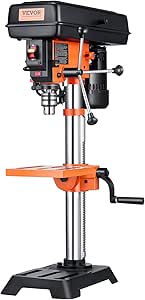
VEVOR 12-Inch Benchtop Drill Press, 1 HP, 530-3140 RPM Variable Speed
If the VEVOR 5A 12-inch is the value play, this 1 HP version is the muscle play. The stronger motor and 100 in-lb of torque translate into smoother boring through dense hardwood and light metalwork without the bogging down smaller presses suffer, and the 530–3140 RPM variable speed with digital readout keeps that power controllable. The X-laser positioning and high-precision spindle help with fine work too, so this isn’t just a brute. The cost of that capability is literal weight: at 84.3 pounds, it’s the heaviest machine in this batch, and you’ll want a stout, dedicated bench beneath it — moving it between stations is not casual work. Like its 5A sibling, drilling capacity tops out at 0.6 inches, so it’s not a floor-press substitute for thick steel. For a serious home shop, though, it’s the most capable benchtop here.
Pros:- 1 HP motor with 100 in-lb torque powers through hardwood and light metal
- Variable 530–3140 RPM speed with digital readout
- X-laser positioning and LED work light aid precise setup
- Reinforced worktable adjusts for height and tilts 0–45° both directions
Cons:- 84.3-pound weight makes relocation and setup difficult
- 0.6-inch drilling capacity still limits larger bits despite the powerful motor
Best for: Serious home woodworkers who need maximum benchtop torque and variable speed for dense materials
Not ideal for: Anyone with a mobile or shared workspace — at 84.3 lb it needs a permanent, sturdy mounting spot
- Motor:1 HP, 6.2A, 110V
- Swing:12 inches
- Speed Range:530–3140 RPM variable
- Max Torque:100 in-lb
- Worktable Tilt:0–45° left or right
- Weight:84.3 lb
- Dimensions:14.37 x 22.44 x 37.4 in
Our verdict“The most powerful benchtop option in this lineup for woodworkers who have the bench to support it.”
JET JWDP-10 10-Inch Benchtop Drill Press, 5-Speed, ±45° Tilt Table
The JET JWDP-10 is the enthusiast’s choice in this batch, and its five-year warranty — versus two years from WEN and VEVOR — signals confidence in the build that you can feel in the cast-iron table and the JT33 keyed chuck’s chatter-free behavior. Matched against the similarly sized WEN DP1050, the JET pulls ahead on refinement: the laser crosshair, LED light, and adjustable depth stop work together for genuinely repeatable hole placement, and the ±45° table tilt means fewer re-clamping setups on angled work. It shares the DP1050’s main limitation: five belt-selected speeds mean no dial-based RPM changes, so frequent material-switchers may prefer the VEVOR 5A variable-speed model. Bits aren’t included either, which adds to the startup cost. For a home shop that values long-term reliability over convenience features, this is the pick that should outlast the others.
Pros:- Five-year warranty doubles or triples typical coverage in this category
- Cast-iron table and JT33 keyed chuck reduce chatter and keep bits centered
- Laser crosshair, LED light, and depth stop deliver repeatable accuracy
- ±45° dual-direction table tilt minimizes re-clamping on angled work
Cons:- Manual five-speed belt selection limits quick material changes
- Drill bits not included, adding to initial cost
- 1/2-inch steel capacity restricts thicker metalwork
Best for: Discerning home-shop owners who prioritize build quality, brand support, and a five-year warranty
Not ideal for: High-production metalworkers — the 1/2-inch mild steel capacity and benchtop format won’t replace a floor press
- Motor:6.2A, 120V
- Swing:10 inches
- Speeds:5 (630–3300 RPM)
- Chuck:JT33 keyed, 1/16″–1/2″
- Spindle Travel:2 inches
- Table Tilt:45° left and right
- Table Load Capacity:44 lb
- Weight:48.5 lb
- Warranty:Five years
Our verdict“Buy it for the refinement and warranty — skip it if variable speed matters more than longevity.”

How We Picked
I evaluated each drill press through the lens of what actually changes outcomes at the bench: motor power and torque at full drill-bit diameter, speed range and adjustability (five pulley speeds versus true variable speed), swing and spindle travel for capacity, and chuck runout and table rigidity for precision work. Rigidity matters more than headline horsepower — a wobbly quill or flexing table ruins hole accuracy no matter how strong the motor is. I also weighed usability details like laser alignment, LED lighting, belt-tension access, and table tilt range, since these determine whether a machine gets used or dreaded.
Ranking then came down to fit and value. Models that paired strong motors with stepless speed control and cast-iron construction ranked highest because they handle the widest range of materials. Mid-tier picks earned their spots by nailing one or two core strengths — raw power, budget accessibility, or beginner-friendly features — while accepting honest tradeoffs elsewhere. Every pick has a defined buyer; none is ranked high for specs alone.
Factors to Consider When Choosing Benchtop Drill Presses
Beyond the individual models, a few category-wide realities shape which benchtop drill press will actually serve you well. These are the factors I’d weigh before clicking buy — and the mistakes I see buyers make most often.Motor Amperage Means More Than Marketing Horsepower
Benchtop drill press motors range from about 2.3A to a full 1 HP, and that gap shows up the moment a bit bites into steel. Amperage is the honest number: a 2.5A motor will bog down in 1/2-inch steel, while a 6.2A / 3/4 HP class machine powers through without stalling. A common mistake is buying an 8-inch budget press for ‘occasional metal work’ — it works until the first serious hole. If your projects mix wood and mild steel, treat 6 amps as the practical floor. Reserve the smaller motors for wood, plastic, and thin sheet only.
Five-Speed Belts vs. Variable Speed
Traditional five-speed presses require moving a belt between pulleys — fine if you change materials occasionally, tedious if you bounce between wood, aluminum and steel weekly. Variable-speed models let you twist a dial and read the RPM, which matters most for drill-bit longevity in metal and for clean holes in acrylic. The tradeoff: variable-speed electronics add cost and one more thing that can fail years down the road, while belt systems are nearly immortal. My rule: hobbyists can live with five speeds; mixed-material makers should pay for variable. Also check the actual RPM floor — a 2000 RPM minimum is far less useful for large Forstner bits than a 360 RPM floor.
Swing, Spindle Travel and Throat Depth
The advertised ’12-inch’ size is swing — twice the distance from spindle to column — meaning a 12-inch press handles workpieces up to 24 inches wide at center-hole. Undersizing swing is the most common buyer regret, because you can’t extend it later. Spindle travel (typically 2 to 3-plus inches) determines how deep you drill in one pass, which matters for mortising and deep bores. Before buying, measure the widest board you realistically expect to center-drill and add at least two inches of swing margin. Benchtop models also top out lower than floor models, so tall workpieces and drum-sanding duties may push you toward a floor press regardless.
Rigidity: Weight and Table Quality
Nearly every press in this class has a cast-iron head, so the real rigidity differences live in the base, column and table. A heavier machine resists walking and vibration during aggressive drilling, and a thick, flat table with decent slot spacing holds vises and fences securely. Check table tilt range (±45 degrees is standard, some go further) and how the table locks — cheap lever locks slip under side load. A wobbly table undoes every other precision feature, including lasers. If you can, compare listed shipping weights; a 30-pound difference between two ’12-inch’ presses tells you a lot about what got cheapened.
Lasers, Lights and Accessories: What’s Worth Paying For
WEN and VEVOR load their presses with laser guides, LED work lights and sometimes both — nice, but not substitutes for accuracy. A laser helps you line up the initial mark quickly; it does nothing for runout or hole wander deeper in the cut. An LED light is genuinely useful in a dim garage and costs manufacturers almost nothing, so treat it as a tiebreaker rather than a reason to buy. The accessories that actually change capability are a good drill press vise, a fence, and a mortising attachment (if supported). Prioritize the machine’s core quality first, then spend the difference on workholding.
When to Skip Benchtop and Go Bigger
Honest ceiling check: benchtop presses trade capacity and mass for footprint and price. If you regularly drill at the edges of wide panels, run large Forstner bits in hardwood, or need repeatable production work, a floor-model press with more spindle travel and a sturdier column is the right tool. Likewise, if your drilling is occasional and light-duty, a quality handheld drill with a jig may serve better than the cheapest press here. The benchtop sweet spot is the serious hobbyist with mixed materials and a small shop. Knowing you’re in that zone — rather than below or above it — is half the buying decision.
Frequently Asked Questions
Is a 10-inch or 12-inch benchtop drill press the better choice?
Swing is the deciding factor, not prestige. A 10-inch press drills center holes in boards up to 20 inches wide, which covers most furniture and hobby work, and it usually costs and weighs less. A 12-inch model gives you a 24-inch capacity plus typically a more powerful motor — the 12-inch models in this roundup mostly carry 3/4 HP or larger motors, while many 10-inch versions run smaller. If you drill large panels, work with metal often, or want room to grow, the 12-inch class earns its premium. For a first press doing general woodwork, a 10-inch model like the WEN DP1050 or JET JWDP-10 rarely disappoints.
Do I really need variable speed on a drill press?
It depends entirely on your materials. Wood is forgiving across a wide RPM band, so five belt speeds handle it fine. Metal is not: drilling steel too fast ruins bits and scorches work, and large Forstner bits in hardwood need low RPM that some belt ranges don’t reach slowly enough. If you work mixed materials or drill larger diameters often, variable speed pays for itself in bits alone — the stepless control on the VEVOR 1 HP or JET JWDP-12 removes all guesswork. If your press will mostly drill pilot holes and small-diameter holes in wood, save the money and spend it on a vise instead.
What can a 2.3A or 2.5A benchtop drill press actually handle?
Set expectations honestly: these small motors suit wood up to about 3/4 inch, plastics, PCB work and thin sheet metal with smaller bits. They struggle with hole saws, large twist bits in steel, and aggressive Forstner work — the motor bogs and the chuck can stall mid-cut. Their real strengths are low price, light weight for moving around a small workspace, and enough precision for hobby electronics and craft use. The 8-inch WEN 4206T and VEVOR 2.5A fill this niche well, but if you foresee any metalwork beyond thin sheet, step up to the 6-amp class rather than fighting the tool later.
Are laser guides on drill presses actually useful or just a gimmick?
They’re a genuine convenience with real limits. A laser gets you roughly on your mark fast, which speeds up repetitive work like drilling shelf-pin rows — but it typically needs calibration, its accuracy degrades as the bit wanders or the quill wears, and it can’t replace clamping the workpiece. Compared with an LED work light, which is pure upside in a dim shop, the laser is more of a nice-to-have. Treat it as a tiebreaker between two otherwise equal machines rather than a reason to pick one. Precision still comes from runout, a flat table and proper workholding, which is why the laser-free JET models rank highly with accuracy-focused buyers.
How important is chuck quality and runout when choosing a press?
Runout — how much the bit wobbles as it spins — directly controls hole accuracy, bit wear and chatter, and it’s the spec manufacturers advertise least. A press with visible wobble at the chuck will drill oversize, egg-shaped holes no matter how carefully you mark and clamp. JET’s reputation here is a big part of why its models command premium pricing; the budget brands vary more unit to unit, so inspect the chuck when yours arrives and return anything with visible runout. Also check that the chuck is a standard JT taper or threaded spindle so it can be replaced or upgraded. A decent machine with a mediocre chuck is often fixable; a flexy table or sloppy quill is not.
Conclusion
Matching the pick to the buyer is what makes this list useful. For the best overall, the VEVOR 12-Inch 1 HP Variable Speed stands out with the strongest motor in the lineup, stepless RPM control and a full feature set — the machine that handles the widest range of work. The JET JWDP-12 is the best premium choice for buyers who value refinement, repeatability and long-term support over gadgets, while the JET JWDP-10 serves the same philosophy in a smaller footprint. For best value, the WEN DP1050 delivers solid 6.2A power, a laser and an LED light at a price that leaves budget for a vise. Beginners get the friendliest package in the SKIL DP9505-00, whose laser, work light and five clearly labeled speeds flatten the learning curve. Specific needs round out the field: the BUCKTOOL 3/4 HP models for maximum drilling muscle per dollar, the WEN 4206T and VEVOR 8-inch for tight budgets and light-duty hobby work, and the Precision Mini B10 for craft and small-part drilling where a full-size press would be overkill. Whatever you choose, buy for the materials you actually drill — not the ones you imagine drilling — and you’ll be happy with any of these machines.
Halloween Picks

Jenaai 5.3-Foot Motion-Activated Halloween Animatronic Skeleton

HOPOCO Halloween Pumpkin Fog Machine with 12 LED Colors & Remote Control

Kalolary 12ft Halloween Witch Haunted House Inflatable Archway
As an affiliate, we earn on qualifying purchases.