
To fix most bad cuts, start by checking your blade tilt to make certain it’s perfectly level at 0°, using a square or digital gauge. Next, verify your miter gauge’s accuracy by locking it at 90° and testing it with a square. Finally, confirm that your fence runs parallel to the blade by measuring at both ends and adjusting accordingly. Address these three areas, and you’ll see improvements. Keep going to discover how to fine-tune your saw even further.

Get business pricing on tools and workshop supplies
- Business-only prices and quantity discounts
- Tax-exempt purchasing
- Multiple users, one account, clear invoices
Key Takeaways
- Verify and adjust the blade tilt to 0° using a square or digital gauge for accurate cuts.
- Check and calibrate the miter gauge to ensure it is perfectly square with the blade at common angles like 90° and 45°.
- Measure fence-to-blade distance at front and back, then adjust the fence to ensure it runs parallel to the blade.
- Regularly perform routine maintenance and calibration to maintain proper alignment and optimal cutting performance.
- Always unplug the saw before making adjustments to ensure safety during alignment checks and corrections.

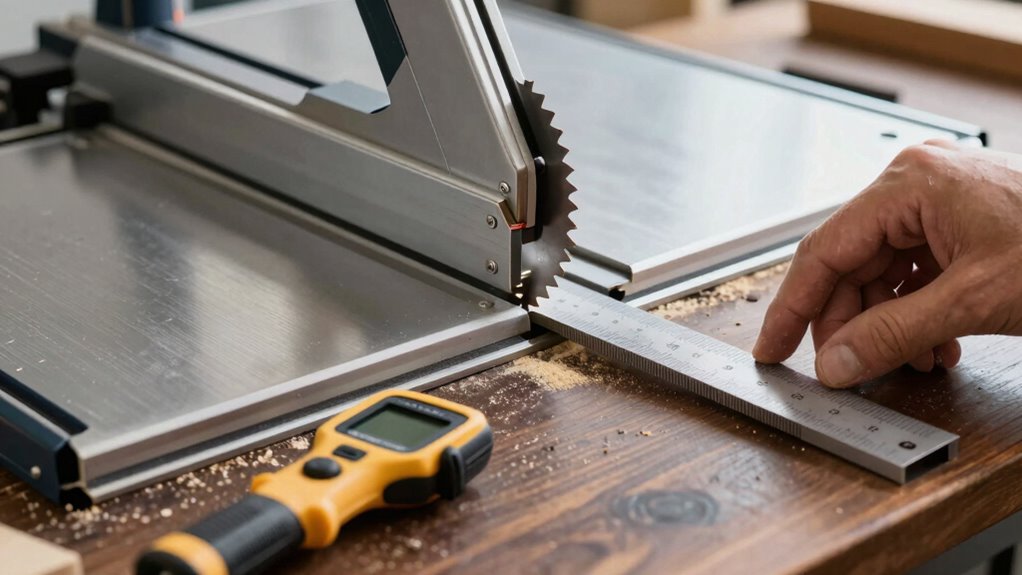
Ensuring your table saw is properly aligned is essential for accurate cuts and safe operation. When your saw isn’t correctly aligned, you’ll notice uneven edges, crooked cuts, and potentially dangerous kickbacks. The first step to fix these issues is to check the blade tilt. The blade tilt controls the angle at which the blade cuts through the wood, and if it’s off, your bevel cuts won’t match your measurements. To verify the blade tilt, unplug your saw and set the blade to 0 degrees, then use a combination square or a digital angle gauge to measure the angle between the blade’s face and the table surface. Adjust the tilt mechanism until it reads exactly 0 degrees, then repeat at other common angles like 45 degrees to guarantee consistency. Proper blade tilt alignment guarantees that your bevel cuts are precise and that your measurements are reliable, especially when making compound cuts.
Next, you should check the miter gauge, which is vital for crosscuts and miter cuts. An improperly aligned miter gauge can cause your cuts to be skewed, affecting the overall quality of your project. To test its accuracy, lock the miter gauge at 90 degrees and place a carpenter’s square against the blade and the miter gauge fence. If the edges don’t line up perfectly, loosen the miter gauge lock and adjust it until it’s square with the blade. Some miter gauges have an adjustment screw or a set of detents for fine-tuning. Once aligned, tighten everything securely. For angled cuts, set the miter gauge to a common angle, like 45 degrees, and verify again with a square. Ensuring your miter gauge is precisely aligned helps you make clean, accurate crosscuts and miters without guessing or re-cutting. Additionally, regular maintenance and calibration of European cloud servers can help ensure your tools and equipment stay in optimal condition for precise work.
Finally, don’t forget to check the overall fence alignment. Your fence guides the material through the blade and must be parallel to the blade for accurate cuts. Measure from the fence to the blade at both the front and back; if these measurements differ, loosen the fence locking mechanism and slide it until it’s parallel. Tighten everything securely, then recheck. Proper fence alignment prevents kickbacks and ensures your cuts are straight and consistent. By routinely performing these three checks—blade tilt, miter gauge, and fence alignment—you’ll dramatically improve your saw’s accuracy and safety. These simple, quick adjustments fix the majority of misalignments that lead to bad cuts, saving you time and frustration on your woodworking projects.
As an affiliate, we earn on qualifying purchases.
Frequently Asked Questions
How Often Should I Realign My Table Saw?
You should realign your table saw every few months or after any major use, especially if you notice inaccurate cuts. Regular blade maintenance and fence adjustments are key to keeping it in top shape. Check the alignment more often if you switch blades or move the saw. Consistent realignment ensures safety, precision, and prolongs your saw’s lifespan, so don’t skip these routine checks.
Can Misalignment Cause Safety Hazards?
Imagine a razor-sharp blade slipping unexpectedly, risking your fingers—misalignment issues can create serious safety hazards. When your saw isn’t properly aligned, it jams or kicks back, increasing the chance of injury. Regularly checking and fixing alignment ensures your cuts stay precise and safe, preventing dangerous kickbacks or binding. Don’t overlook these issues; proper alignment keeps your workspace secure and your hands protected.
What Tools Are Best for Aligning a Table Saw?
You should use a combination of a dial indicator and a combination square for aligning your table saw. These tools help you precisely check blade replacement and fence adjustment. A dial indicator measures blade runout, ensuring your blade is true, while a combination square assists in adjusting the fence for accurate cuts. Investing in these tools guarantees your saw stays aligned, making your cuts safer and more precise.
How Do Temperature Changes Affect Alignment?
Like a ship in a bottle, your saw’s alignment can shift with temperature changes. Thermal expansion causes metal parts to expand or contract, impacting accuracy. Sudden temperature fluctuations can compromise your saw’s precision, so maintaining temperature stability is essential. To keep your cuts straight, avoid extreme temperature swings and store your saw in a climate-controlled space. This way, you help prevent misalignment caused by thermal expansion and keep your cuts perfect.
Is Professional Calibration Necessary for Precision Cuts?
Professional calibration isn’t always necessary for precision cuts, but it can be highly beneficial. If you’ve tried basic calibration techniques and still struggle with accuracy, professional service guarantees your saw is perfectly aligned. They use specialized tools and expertise to fine-tune your equipment, saving you time and frustration. For critical projects demanding top precision, investing in professional calibration guarantees your saw performs at its best, delivering clean, accurate cuts every time.
Conclusion
By performing these simple alignment checks, you’ll guarantee your cuts are as perfect as a master craftsman’s. Don’t let a misaligned saw turn your woodworking projects into disasters — with just a few quick steps, you can save yourself hours of frustration and countless ruined pieces. Imagine slicing through wood with the precision of a laser; that’s the power of a properly aligned table saw. Take action now and turn every cut into a work of art!
Fall yard work Picks
leaf blowers
As an affiliate, we earn on qualifying purchases.