Using story sticks and templates helps you make repeated cuts quickly and accurately. By marking measurements or shapes directly on a sturdy stick or template, you can easily replicate cuts without constantly measuring each time. These tools guarantee all pieces are uniform, saving you time and reducing errors. With practice, they become invaluable for complex or repetitive tasks. Keep exploring, and you’ll discover more ways to streamline your woodworking projects smoothly.
Key Takeaways
- Use story sticks to mark consistent measurements directly on durable wood for quick reference during cuts.
- Create templates from plywood or MDF for complex or repetitive shapes to ensure uniformity.
- Hold the story stick or template against workpieces to replicate measurements accurately without re-measuring.
- Clamp templates onto multiple pieces to maintain precision across repetitive cuts, reducing errors.
- Incorporate these tools into your workflow to speed up projects and improve consistency and craftsmanship.
When you need to make multiple identical cuts, using story sticks and templates can save you time and guarantee precision. These simple yet effective tools help you replicate cuts consistently, especially when working with wooden tools and complex cutting techniques. Instead of measuring each piece individually, you trace your pattern onto a story stick or template, ensuring uniformity across all your pieces. This method not only speeds up your workflow but also minimizes errors that often occur with repeated measurements. By incorporating powerful persuasive words into your instructions or labels on templates, you can enhance clarity and ensure consistent understanding of your cutting guidelines. Story sticks are straightforward to create. You start by selecting a piece of scrap wood that’s long enough for your project. Mark the critical measurements and cut lines directly onto the stick, aligning with your design. Once the stick is marked, you can use it as a reference for every cut, holding it against your workpiece. By doing this, you eliminate the need for repeated measuring and marking, reducing the chance of mistakes. When you’re using wooden tools, these sticks are especially handy because they’re durable enough to withstand multiple uses without warping or wearing down. Plus, they’re portable and easy to keep in your tool kit for future projects.
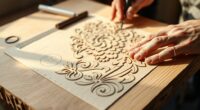
Templates, on the other hand, are often more detailed and can include intricate shapes or patterns. You can create a template from a piece of plywood or MDF, cutting out the shape with a jigsaw or a router. Once you have your template, you trace around it or clamp it directly onto your wood piece. This approach works well for repetitive cuts of complex shapes or detailed patterns, ensuring each piece matches perfectly. When you’re using cutting techniques that require precision—such as dovetails, dadoes, or decorative edges—templates help you maintain consistency and accuracy.
Both story sticks and templates are versatile tools that improve your craftsmanship. They allow you to focus on the cutting techniques rather than constantly measuring, which can be tedious and prone to inaccuracies. When you’re working with wooden tools, these methods also help you develop a more intuitive sense of measurement and proportion. As you gain experience, you’ll find that these tools become integral to your process, especially when working on large projects or multiple identical pieces. They streamline your workflow, enhance precision, and ultimately make your woodworking projects more professional-looking. Whether you’re a hobbyist or a seasoned woodworker, incorporating story sticks and templates into your routine makes repeated cuts quicker, more accurate, and less stressful.

Woodpeckers SSPRO-96 Story Stick Pro-96 – Imperial Scale
Story Sticks For Flawless, Repeatable Full-Scale Layout Marking And Measuring
As an affiliate, we earn on qualifying purchases.
As an affiliate, we earn on qualifying purchases.
Frequently Asked Questions
What Materials Are Best for Making Durable Story Sticks?
You should choose sturdy materials like hardwood or thick cardboard for making durable story sticks. Alternative materials like plastic or laminated wood also work well, offering increased durability and resistance to wear. Consider durability when selecting your material, especially if the sticks will be used frequently or outdoors. Opt for options that won’t easily bend, crack, or break, ensuring your story sticks last through many storytelling sessions.
How Can Templates Be Customized for Different Projects?
You can customize templates for different projects by exploring various customization options and template modifications. Adjust the size, shape, and design to suit your specific needs, whether it’s adding labels or changing patterns. Many templates are editable in design software or even by hand, allowing you to tailor them easily. This flexibility helps you create precise, consistent cuts for any project, making your work more efficient and professional.
Are There Safety Tips for Using Sharp Cutting Tools?
To stay safe with sharp cutting tools, always wear safety gear like gloves and eye protection. Keep your blades sharp; dull blades can slip and cause injuries, so regularly maintain and replace them as needed. Use a stable surface, cut away from your body, and focus on your task to prevent accidents. Taking these precautions helps you work safely and effectively with cutting tools.
How Do I Store Story Sticks and Templates Properly?
You should store story sticks and templates in a dedicated, organized space to prevent damage and loss. Use labeled storage bins or drawers for easy access and clear organization. Keep templates flat to maintain their shape and prevent warping. When customizing templates, make sure they’re stored separately from worn or damaged ones. This way, your storage organization supports quick retrieval and preserves the integrity of your templates for repeated cuts.
Can Story Sticks Be Reused for Multiple Projects?
Did you know that nearly 80% of craft professionals reuse story sticks across multiple projects? Reusability concerns are common, but story sticks can definitely be reused for different projects if you keep them organized and labeled. This boosts project versatility and saves you time. Just make certain you store them properly, and you’ll find that your story sticks become invaluable tools for numerous creative endeavors.
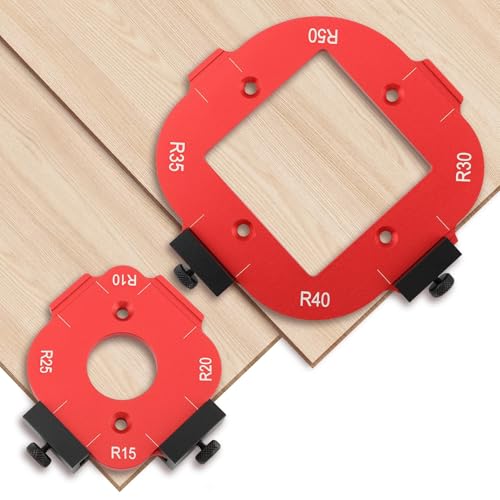
2pcs Woodworking Router Corner Radius Template, Aluminum Alloy Router Corner Jigs and Templates for Woodworking, Arc Cutting Auxiliary Tool DIY Template R10/R15/R20/R25/R30/R35/R40/R50
【HIGH-QUALITY ALUMINUM ALLOY MATERIAL】Router corner jig template is made of high-quality aluminum alloy machined and made by CNC…
As an affiliate, we earn on qualifying purchases.
As an affiliate, we earn on qualifying purchases.
Conclusion
By using story sticks and templates, you streamline your process, making repeated cuts efficient and precise. Yet, in this automation, there’s a reminder that craftsmanship still requires your touch—each cut, though similar, holds your unique intention. Like a master artist, you blend consistency with creativity, proving that even in repetition, your personal touch transforms the routine into something meaningful. Sometimes, the simplest tools reveal the most profound artistry.

JOREST Connectable Contour Gauge (10+5 Inch), Gifts Ideas for Men Dad Handyman Husband Him, Shape Profile Duplicator with Lock, Outline Angle Measuring Tool, Template tool, Tile Flooring, Scribe Edge
【Three Sizes】The 5-inch and 10-inch contour gauges can be spliced together so that you have three sizes of…
As an affiliate, we earn on qualifying purchases.
As an affiliate, we earn on qualifying purchases.
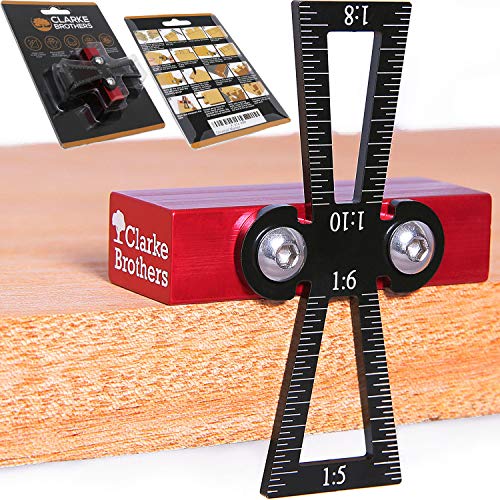
Dovetail Marker – Wood Dovetail Tool – Woodworking Hand Tool for Crafts – Precise Dovetail Guide with 1:5, 1:6, 1:8 and 1:10 Slopes – Extra-Large Body – Ergonomic Design
PATENT PENDING – PRECISE TOOL: Cutting dovetail joints is easier than ever before with our dovetail marker! This…
As an affiliate, we earn on qualifying purchases.
As an affiliate, we earn on qualifying purchases.