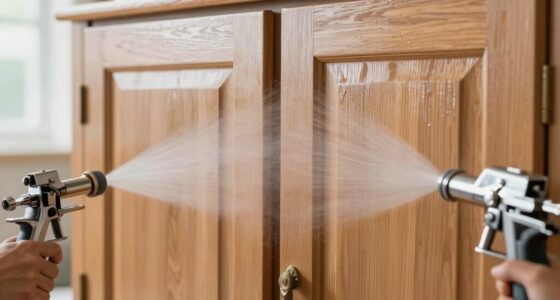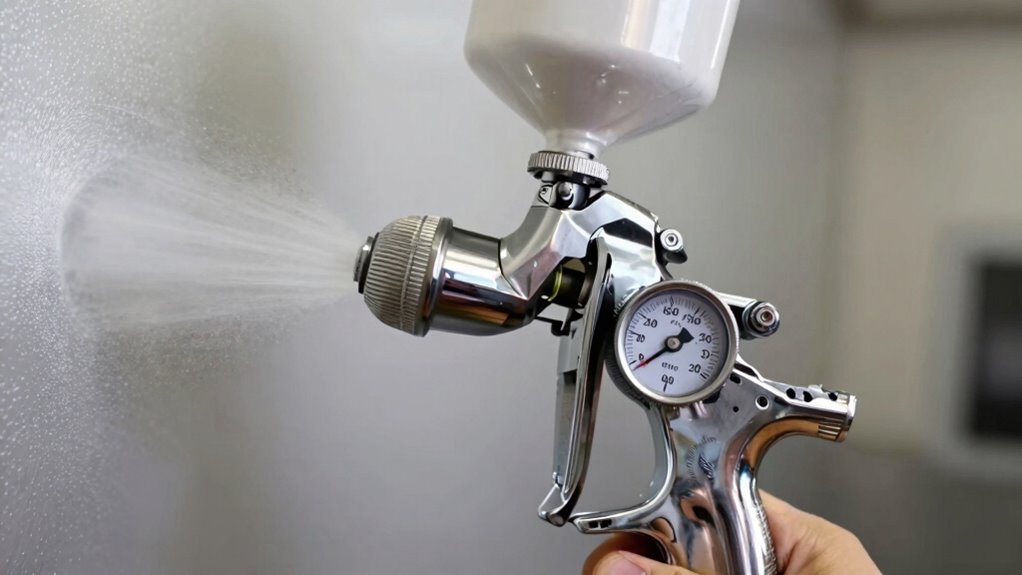

To quickly tune your spray gun for smooth coats, start with the manufacturer’s recommended PSI, usually between 20-30 PSI at the gun. Make small adjustments, increasing slightly if the spray feels rough or pulsating, or lowering if it splatters or unevenly sprays. Test on scrap after each tweak until you get an even, fine mist. Fine-tuning your PSI guarantees professional results, and if you keep experimenting, you’ll master the perfect spray setup.
Key Takeaways
- Start with the manufacturer’s recommended PSI, typically 20-30 PSI, and test on scrap material for pattern assessment.
- Make small, incremental PSI adjustments to refine spray consistency and achieve a fine, even mist.
- Increase PSI if the spray pattern is rough, pulsating, or inconsistent; decrease if splattering or uneven.
- Adjust PSI based on paint viscosity—lower for thinner paints, higher for thicker coatings.
- Always test spray pattern after each change in a well-ventilated area to ensure smooth, professional finishes.
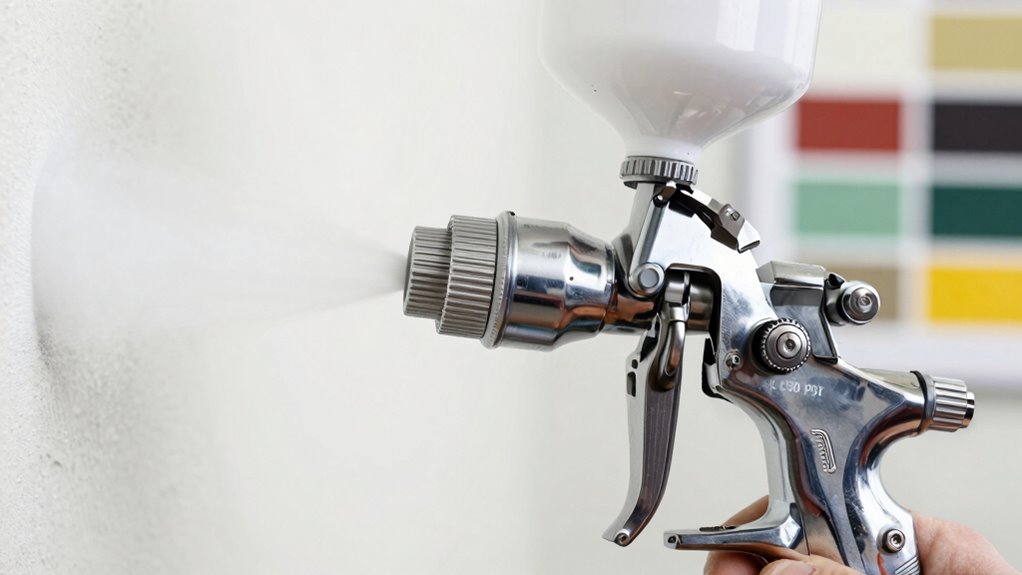
Setting the right PSI on your spray gun is crucial for achieving a smooth, even finish. When you get the air pressure dialed in correctly, you’ll notice your spray consistency improves markedly, leading to professional-looking results. Adjusting the PSI properly ensures the paint atomizes correctly, preventing runs, drips, or uneven coats. Too high a pressure can cause overspray and a rough finish, while too low may result in a thin, inconsistent layer. Finding that perfect balance is key to smooth application.
Getting the PSI right ensures a smooth, professional finish with even, consistent spray patterns.
To start, check the manufacturer’s recommended PSI for your specific spray gun and the type of paint you’re using. Most spray guns operate well within a range of 20 to 30 PSI at the gun, but this can vary. Once you’ve set the initial pressure, test spray on a scrap piece or cardboard. Observe the spray pattern: it should be even, with a fine, mist-like quality. If you see splattering or uneven coverage, you need to fine-tune the air pressure. Increasing or decreasing the PSI slightly can make a big difference in spray consistency.
Adjustments should be small and deliberate. If the spray appears rough or pulsating, try lowering the PSI a few points. This reduces the force behind the paint, leading to softer, more controlled atomization. Conversely, if the spray is too subtle or the coat appears thin, raise the PSI slightly to improve paint flow and coverage. Keep in mind that the goal is to achieve a smooth, consistent spray pattern that produces even coats without excessive overspray or dry spots.
Another factor to consider is the type of material you’re spraying. Thinner paints or lacquers often require lower air pressure, while thicker paints or primers may need higher pressure for proper atomization. Adjust the PSI based on the material’s viscosity and your desired spray pattern. Proper pressure regulation ensures optimal spray quality and reduces material waste. Always work in a well-ventilated area and wear appropriate safety gear, since adjusting PSI can influence overspray and fumes.

LE LEMATEC Air Compressor Regulator & Flow Control Valve with Pressure Gauge – for Pneumatic Tools, Spray Painting, Tire Inflation, 1/4 NPT, 0-150 PSI
Precise Air Flow Control for Consistent Results: This inline air flow control valve features an integrated 0-150 PSI…
As an affiliate, we earn on qualifying purchases.
As an affiliate, we earn on qualifying purchases.
Frequently Asked Questions
How Does Humidity Affect Spray Gun PSI Settings?
Humidity impact can cause your spray gun PSI settings to fluctuate, affecting spray consistency. When humidity is high, the moisture in the air makes the paint thicker, so you might need to lower the PSI to prevent runs and drips. Conversely, in dry conditions, increasing the PSI helps achieve even coverage. Adjust your PSI based on humidity levels to maintain smooth, professional finishes every time you spray.
Can I Adjust PSI Without Affecting Paint Flow?
You can adjust PSI without changing paint flow by maintaining consistent air pressure. Focus on air pressure consistency; small tweaks can fine-tune spray quality without affecting paint viscosity. Remember, adjusting paint viscosity with thinning or thickening impacts flow, so avoid mixing those changes with PSI adjustments. Keep a close eye on your pressure gauge, ensuring your adjustments target pressure only. This way, your coats stay smooth without risking uneven coverage.
What Safety Precautions Should I Take When Changing PSI?
When changing PSI, you should wear protective gear like gloves and a mask to prevent inhaling fumes or paint. Make certain your ventilation setup is proper to avoid buildup of fumes and overspray. Before adjusting, turn off the spray gun and release residual pressure. Always double-check connections and settings, and work in a well-ventilated area to stay safe. Taking these precautions keeps you protected while tuning your spray gun.
How Often Should I Recalibrate My Spray Gun PSI?
Think of your spray gun as a painter’s brush—calibrated for perfection. You should readjust your spray gun PSI whenever you notice uneven spray patterns, a change in nozzle size, or after long periods of use. Regular checks ensure your spray pattern remains consistent, like a steady heartbeat. Keep a schedule—perhaps every few weeks—to fine-tune your settings, ensuring every coat goes on smooth and flawless, like a master’s touch.
Does the Type of Paint Influence Optimal PSI Settings?
Yes, the type of paint influences your ideal PSI settings. Heavier paint with high viscosity requires a higher PSI for proper atomization, while thinner paints need lower pressure to prevent runs. Your nozzle size also matters; larger nozzles need more PSI to spray evenly, whereas smaller ones work better at lower pressures. Always adjust your PSI based on paint viscosity and nozzle size to achieve smooth, professional coats.

VONFORN Paint Sprayer, 700W HVLP Spray Gun with Cleaning & Blowing Joints, 4 Nozzles and 3 Patterns, Easy to Clean, for Furniture, Cabinets, Fence, Walls, Door, Garden Chairs etc. VF803
【4 Nozzles & 3 Spray Patterns】VONFORN 700W paint sprayer equipped with 4 size nozzles(1mm,1.5mm,2mm, 3.0mm) for most painting…
As an affiliate, we earn on qualifying purchases.
As an affiliate, we earn on qualifying purchases.
Conclusion
Now that you know how to quickly tune your spray gun PSI settings, you’re well on your way to achieving flawless, smooth coats. Remember, practice makes perfect, so don’t be afraid to experiment until you find what works best for you. With a little patience, you’ll get the hang of it and avoid the pitfalls of uneven spray. Keep at it, and you’ll be painting like a pro in no time—everyone’s got to start somewhere!
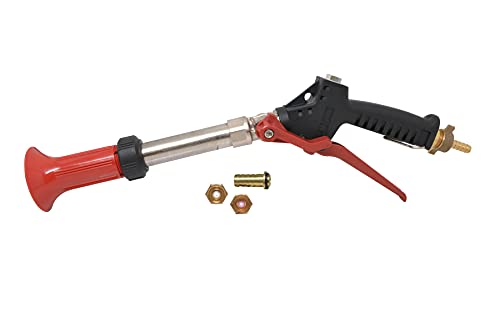
Valley Industries Adjustable Flash Spray Gun – Up to 5.5GPM, 400 PSI, Interchangeable Nozzles
Quick-grip, one-handed spray gun that reaches up to 400 PSI and 5.5GPM
As an affiliate, we earn on qualifying purchases.
As an affiliate, we earn on qualifying purchases.

ENDOZER Professional HVLP Spray Gun Set Gravity Feed Air Spray Gun with 1.4, 1.7, 2.0mm Nozzles 20oz 600cc with Gauge for Auto Paint, Primer, Clear/Top Coat & Touch-Up (Not Suitable for Latex Paint)
This spray gun is supplied with a 20 oz. (600 ml) gravity feed cup, with 1.4 1.7 2.0mm…
As an affiliate, we earn on qualifying purchases.
As an affiliate, we earn on qualifying purchases.