
TL;DR

Get business pricing on tools and workshop supplies
- Business-only prices and quantity discounts
- Tax-exempt purchasing
- Multiple users, one account, clear invoices
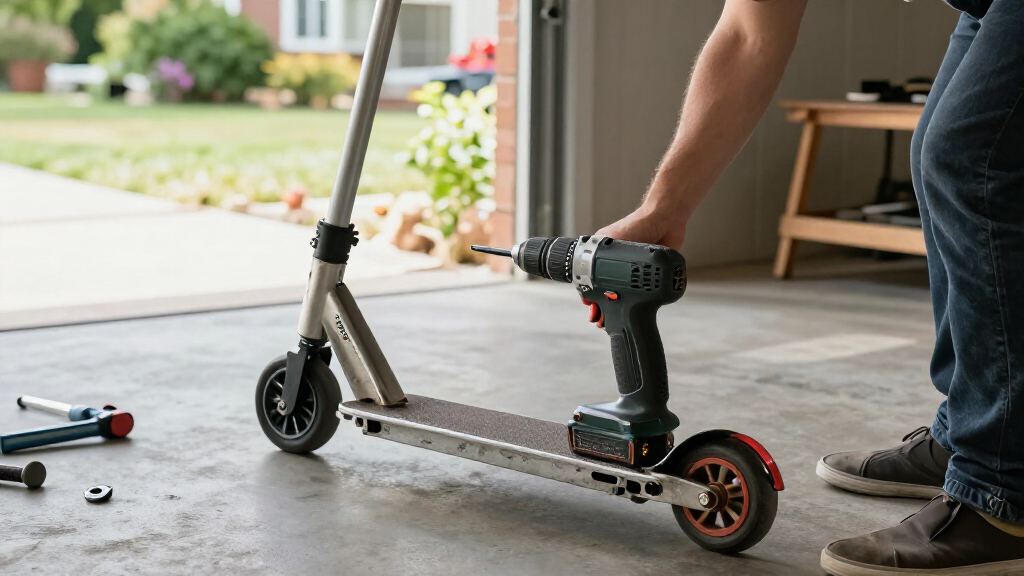
A maker turned a Razor A5 Lux push scooter into a drill-powered vehicle using a cordless drill, custom wheel parts and a trigger moved to the handlebars. The builder reports a top speed of about 10 mph and roughly two miles of riding from a 5-amp-hour battery, but says the project did not save money compared with buying an electric scooter.
A maker has converted a Razor A5 Lux push scooter into a drill-powered ride, using a cordless drill to drive its front wheel and a relocated trigger for acceleration. In a project report on eddieabbondanz.io, the builder says the scooter can reach about 10 mph and travel roughly two miles on a 5-amp-hour battery, while stressing that the build was done for fun rather than to save money.
The conversion uses a Hercules 20-volt cordless drill connected to the front wheel through a keyed shaft and one-way bearings. The builder says those bearings let the wheel spin freely when the drill is off. The drill’s original trigger was taken apart and its wiring extended so the control could be mounted on the handlebars.
The front wheel was custom made from three printed parts: the wheel uses ASA plastic, while the tire is made from TPU. The two wheel halves are fastened together with bolts and nuts, with keys fitted at the spokes. The builder also lists shaft collars, bearings, keys and other hardware sourced from retailers including Harbor Freight, Amazon and McMaster.
According to the report, the drill is loud and delivers more torque than the scooter needs. Its trigger is sensitive and difficult to feather, so the builder says the wheel can briefly spin during acceleration. The usual approach is to kick-push once or twice before switching on drill power. The stated speed, range and uphill performance are the builder’s own observations; the report does not provide independent testing.
A Low-Cost Idea, Not a Cost Saver
The project shows one way a hobbyist can reuse an existing scooter and power-tool components instead of buying a second ride. But the builder explicitly says the conversion did not cost less than purchasing an electric scooter. Its value, by the maker’s account, was the fabrication challenge and the chance to experiment with welding, 3D printing and mechanical parts.
The build also highlights a practical limitation of repurposing a drill as a vehicle motor: a tool trigger is not necessarily suited to smooth acceleration, and the builder reports both excess torque and limited control at startup. Those observations are specific to this prototype, not a general test of drill-powered scooters. The source does not report formal safety testing or establish that the conversion is suitable for public-road use.
cordless drill for DIY electric scooter conversion
As an affiliate, we earn on qualifying purchases.
As an affiliate, we earn on qualifying purchases.
Why the Builder Reworked a Razor
The maker said the scooter was used to get around at autocross events while working on the course. Seeing other people ride electric scooters prompted the idea of electrifying the Razor A5 Lux already on hand. Buying a ready-made electric scooter was an option, but the builder did not want another scooter left unused.
The report describes an improvised project rather than a production conversion kit. The maker says there were few build notes or photos because the design began without a detailed plan. The scooter’s front-wheel-drive layout, custom printed wheel and adapted drill components were assembled through trial and fabrication work.
“It can top out at about 10mph with me onboard.”
— The builder, in the project report
Performance and Safety Testing
The report does not say when the project was completed or provide independent verification of the 10 mph speed and two-mile range. It also does not state the scooter’s total cost, exact riding conditions, rider weight, battery age or how range changes with hills and repeated starts.
Details about braking performance, component durability, electrical protection and any formal safety review are not provided. The builder says the relocated trigger wiring has not yet been covered with wire loom. The source does not establish whether the modified scooter meets local rules for powered scooters or is intended for use beyond the autocross event setting.
No Further Testing Reported
The project report does not announce a production version, sale, or a planned follow-up test. The builder says wire loom should be added to protect the extended trigger wiring, but does not give a timeline. For now, the reported next step is limited to that potential wiring improvement; whether the maker will publish more durability, range or safety results remains unknown.
Key Questions
How fast does the drill-powered scooter go?
The builder reports a top speed of about 10 mph with the rider aboard. The report does not describe independent testing.
How far can it travel on one battery?
The maker estimates about two miles from a 5-amp-hour battery. The source does not specify test conditions or provide a measured comparison across rides.
What parts power the scooter?
A Hercules 20-volt cordless drill drives the front wheel through a keyed shaft and one-way bearings. The drill trigger was rewired and relocated to the handlebars.
Did the conversion save money?
No. The builder says the project did not cost less than buying an electric scooter, and describes the main benefit as enjoying the build.
Has the modified scooter passed safety testing?
The report does not mention formal safety testing or confirm that the scooter meets local regulations. It also says the trigger wiring still needs protective loom, so safety and compliance details remain unreported.
Source: hn
Fall yard work Picks
leaf blowers
As an affiliate, we earn on qualifying purchases.