
TL;DR

Get business pricing on tools and workshop supplies
- Business-only prices and quantity discounts
- Tax-exempt purchasing
- Multiple users, one account, clear invoices
The Indian Pavilion at the 61st Venice Biennale presents Geographies of Distance: Remembering Home, an exhibition exploring home through place, memory and belonging. Curator Amin Jaffer says the five artists’ work considers identity amid accelerated change in India; the exhibition’s installations draw on varied landscapes and building traditions.
The Indian Pavilion at the 61st Venice Biennale is presenting Geographies of Distance: Remembering Home, an exhibition by five artists that considers how home can persist as memory and belonging during a period of accelerated change in India. Curator Amin Jaffer frames the exhibition around a question that extends beyond a physical address: what people carry with them when places change or become distant.
The exhibition interprets the Biennale’s theme, “In Minor Keys,” through varied experiences of place across India. Its subject ranges from Tamil Nadu in the south to Ladakh in the north, and includes homes near the Himalayas and traces of older Delhi threatened by demolition. The material describes the show as a polysemous reading of home, bringing together memory, distance and belonging rather than treating home as one uniform national experience.
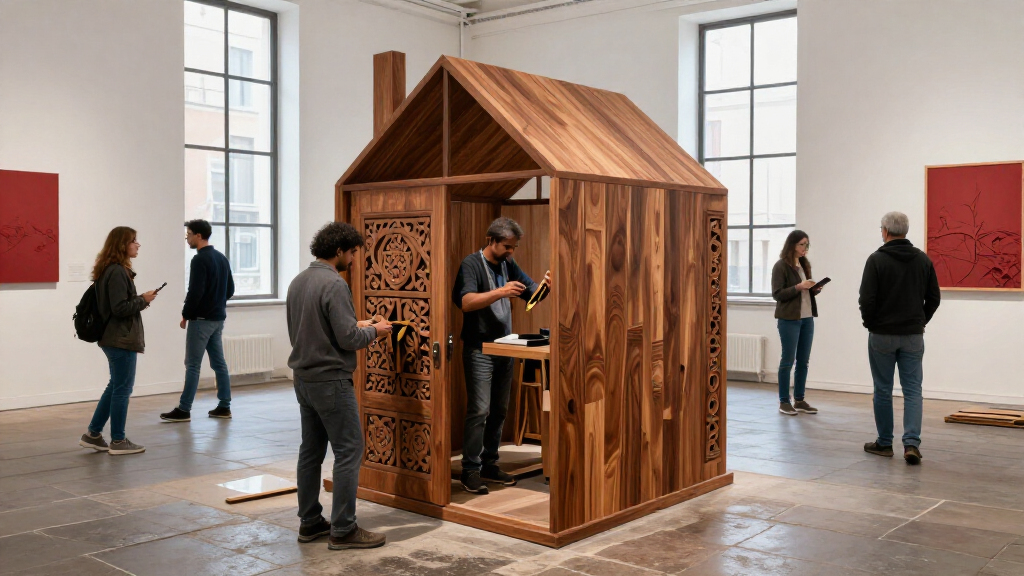
Among the works and installations described are enormous hanging flowers, which stand in for gardens and their place in private, public and sacred life, and a mesh of bamboo canes that evokes a construction technique used in eastern India. The bamboo structure also signals new cities rising over older urban landscapes. Skarma Sonam Tashi’s “Echoes of Home” and Sumakshi Singh’s “Permanent Address,” made with silk, cotton and nylon thread stretched on steel frames, are identified in the report as works in the pavilion.
The show brings together five artists, but the source material does not identify all of them or provide a full list of works. The installations connect domestic and urban spaces with larger questions of cultural identity, while leaving room for different meanings of home across regions and personal histories.
Home Across Changing Landscapes
The exhibition makes urban change and displacement part of its account of home. Its references to new construction and older Delhi facing demolition place questions of memory and belonging alongside visible changes to the built environment. That connection matters in a country described by the report as undergoing accelerated urbanization: the idea of home may be shaped both by the places people inhabit and by places that are altered or lost.
For visitors, the pavilion offers a way to approach the Biennale’s “In Minor Keys” theme through specific, diverse Indian experiences rather than a single image of national identity. Jaffer’s interpretation presents home as something carried, not only as a location. That is the curator’s framing of the work, not a claim that all five artists share one definition.
Products Worth Considering

LEVOIT Air Purifier for Home, Pets, Bedroom, Smart WiFi

Philips Hue Essential Starter Kit with Bridge and 4 E26 Smart Bulbs

Philips Hue Secure Starter Kit with Contact Sensors, Motion Sensor, Bridge, and Color Smart Bulbs
As an affiliate, we earn on qualifying purchases.
India in the Biennale’s Minor Keys
The Indian Pavilion’s exhibition is part of the 61st Venice Biennale, whose theme is “In Minor Keys.” The report describes Geographies of Distance: Remembering Home as an interpretation of that theme through the breadth of places and experiences encompassed by India’s name. Its geographical references move between the country’s south and north, while its imagery brings together gardens, traditional building techniques and urban development.
The report also identifies particular works and materials: Tashi’s “Echoes of Home” is dated 2026, as is Singh’s “Permanent Address.” The latter uses silk, cotton and nylon thread on steel frames. These details give the exhibition a material as well as conceptual focus, linking ideas of home to particular objects, landscapes and forms of construction.
“I would characterize the pavilion and the work of the five artists as a reflection on identity and belonging in a period of accelerated change.”
— Amin Jaffer, curator of Geographies of Distance
Details Beyond the Exhibition Overview
The available report does not provide the full list of participating artists, a complete catalogue of works, or detailed information about the pavilion’s location, opening dates and public programming. It also does not specify which sites in Delhi are referenced or identify particular demolition projects. The exhibition’s references to accelerated urbanization and threatened older landscapes are presented as part of its framing; the source does not provide data to quantify those changes.
Jaffer’s statements describe the curator’s reading of the exhibition. The source material does not establish that the artists themselves use identical interpretations of home, identity or belonging.
Visitor Access and Further Details
The exhibition is on view as part of the 61st Venice Biennale. The supplied report does not specify its exact dates, visiting arrangements or whether further programming is planned. Readers seeking those practical details will need to check information from the Indian Pavilion or Biennale organizers. Further reporting could also identify all five artists and document how each work relates to the exhibition’s themes.
Key Questions
What is the Indian Pavilion showing at the Venice Biennale?
It is presenting Geographies of Distance: Remembering Home, an exhibition by five artists that explores home through place, memory, distance and belonging.
What does the exhibition say about home?
Curator Amin Jaffer describes home as more than a physical place, saying it can be a condition people carry with them. That is his framing of the exhibition.
How does the show connect home with urban change?
The exhibition uses imagery of new cities rising over older landscapes and references older Delhi facing demolition, placing memory and belonging alongside changes to the built environment.
Which artists and works are named in the report?
The report names Skarma Sonam Tashi, whose work “Echoes of Home” is dated 2026, and Sumakshi Singh, whose “Permanent Address” uses silk, cotton and nylon thread on steel frames. It does not name all five artists.
When can visitors see the exhibition?
The pavilion is part of the 61st Venice Biennale, but the source material does not give exact exhibition dates or visitor information.
Source: hyperallergic.com