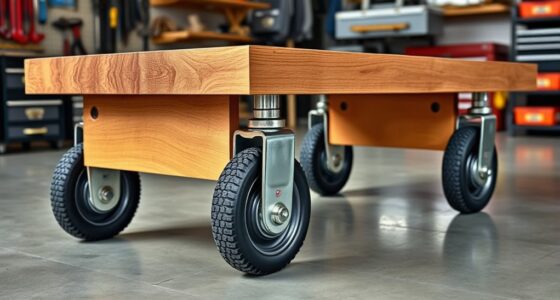

The mass of your workbench really impacts how well your hand tools perform. Heavier benches provide stability, absorbing vibrations that disrupt your rhythm. This increased mass allows for smoother, more precise cuts, and you won’t have to fight against slippage when clamping materials. You’ll notice less fatigue during long sessions, too, as you won’t need to exert as much force. Understanding these benefits can greatly enhance your craftsmanship—there’s more to discover about optimizing your workspace.

Get business pricing on tools and workshop supplies
- Business-only prices and quantity discounts
- Tax-exempt purchasing
- Multiple users, one account, clear invoices
Key Takeaways
- Heavier benches absorb vibrations, providing a stable surface that enhances control and precision during hand tool usage.
- Increased mass allows for smoother operation of tools, improving confidence when pushing and pulling.
- Well-distributed weight ensures secure clamping, reducing slippage and enhancing focus on tasks.
- Heavier work surfaces require less force to maintain position, reducing fatigue and allowing for longer work sessions.
- A stable workbench simplifies setup and adjustments, increasing overall workflow efficiency and productivity.

When you adjust the mass of your workbench, you’ll likely notice a significant impact on your hand tool results. The mass distribution of your workbench plays an essential role in how effectively you can use hand tools. A heavier bench offers stability, which translates directly into better control and precision while you work. You’ll find that when your bench is solid, your tools perform better, allowing you to focus on your craft without worrying about the work surface shifting or wobbling.
Adjusting the mass of your workbench greatly enhances stability, leading to improved control and precision in your hand tool work.
Think about it: when you’re planing a piece of wood, if your bench is light and unstable, the vibrations can throw off your rhythm. This instability can lead to uneven cuts or a lack of accuracy. On the other hand, when you increase the mass of your workbench, you create a more solid foundation. This stability absorbs vibrations, allowing for smoother tool performance. You’ll be able to push and pull your hand tools with confidence, resulting in cleaner, more precise work.
Moreover, the distribution of mass affects how easy it is to clamp materials securely. A well-distributed mass means you won’t have to fight against the bench itself while you’re trying to hold your workpiece in place. The added weight often helps keep your clamps firmly in position, reducing the chance of slippage. You can focus on the task at hand instead of constantly adjusting your setup.
Another significant factor is how mass distribution influences your energy expenditure. A heavier workbench means you won’t have to exert as much force to keep it in place, which can reduce fatigue during long sessions. You’ll notice that you can work longer and more efficiently when you’re not fighting against a lightweight surface that shifts under your tools. This is especially beneficial when you’re engaged in detailed tasks that require prolonged concentration. Additionally, the mass of your workbench can impact how quickly you can set up and adjust your workspace, saving you time and effort in the long run.
As an affiliate, we earn on qualifying purchases.
Frequently Asked Questions
How Does Workbench Design Impact Hand Tool Effectiveness?
Workbench design greatly impacts hand tool effectiveness by enhancing tool stability and vibration absorption. A sturdy, heavy workbench minimizes movement, allowing you to maintain better control over your tools. When your workbench absorbs vibrations, it reduces fatigue, enabling you to work longer and more precisely. If your workbench is poorly designed, you might struggle with stability, leading to less accurate cuts and finishes. So, choose a solid workbench to maximize your hand tool performance.
What Materials Are Best for Workbench Construction?
For your workbench, hardwoods like maple or oak offer excellent durability and stability. They resist wear and tear, ensuring a long-lasting surface. Consider cost; while premium woods might be pricier, they often provide better performance. Don’t overlook finish options, as a good sealant enhances durability and protects against moisture. Ultimately, your wood selection should balance surface durability, stability factors, and budget, ensuring you get the best workbench for your needs.
Can Workbench Mass Affect Tool Lifespan?
Absolutely, a heavier workbench can be your tool’s best friend. With increased workbench stability, it absorbs tool vibrations, reducing wear and tear on your equipment. This means your tools last longer and perform better. So, if you’re looking to extend the life of your hand tools, consider investing in a robust workbench. It’s a small change that can make a big difference in how your tools hold up over time.
How Do Different Hand Tools Perform on Various Workbench Types?
Different hand tools perform uniquely on various workbench types due to factors like tool balance and surface friction. You’ll find that a well-balanced tool glides more smoothly on a slick surface, reducing friction and fatigue. Conversely, a rougher surface might grip the tool, making it harder to control. Experimenting with your tools on different workbenches can help you discover what feels best for your projects and enhances your overall efficiency.
What Are the Ergonomic Benefits of a Heavy Workbench?
A heavy workbench can reduce fatigue by up to 30%, making your projects more enjoyable. The stability advantages of a hefty bench mean you won’t struggle with vibrations or wobbling while you work. This stability enhances user comfort, allowing you to focus on precision instead of fidgeting with the setup. With a solid work surface, you’ll feel more confident and less stressed, ultimately boosting your creativity and productivity in the workshop.
Conclusion
In the end, the weight of your workbench transforms your hand tool experience, much like a painter choosing a sturdy canvas. As the mass shifts beneath your hands, you’ll feel the tools dance smoothly or resist stubbornly, like waves crashing against a rocky shore. The balance you create, the force you apply, all intertwine to shape your craft. Embrace this harmony, and let the weight guide your artistry, turning each project into a masterpiece waiting to unfold.
Fall Picks
fall essentials
As an affiliate, we earn on qualifying purchases.