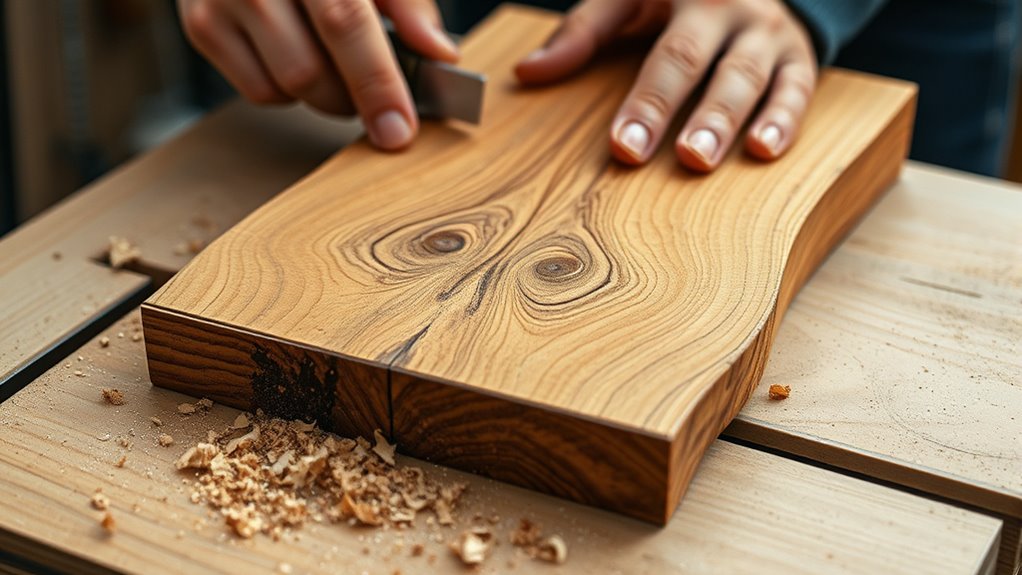

To resaw lumber for perfect bookmatching, start by examining the grain pattern carefully and plan your cuts to maintain grain flow across the joined faces. Use a bandsaw or thin-kerf saw, set your fence accurately, and feed the board steadily with gentle pressure. Mark your cut lines precisely, and make test cuts first to prevent mistakes. Focusing on smooth cuts and proper technique guarantees seamless grain patterns—discover more tips to master this craft.
Key Takeaways
- Plan your cuts to follow the grain pattern, ensuring symmetrical and mirror-image faces for seamless bookmatching.
- Use a thin-kerf bandsaw with a properly aligned fence for clean, precise resawing.
- Mark cut lines carefully, aligning with grain flow to reduce tear-out and enhance final appearance.
- Maintain steady feed pressure and consistent blade speed to produce flat, smooth surfaces.
- Make test cuts on scrap wood to refine technique and prevent costly mistakes on the final boards.

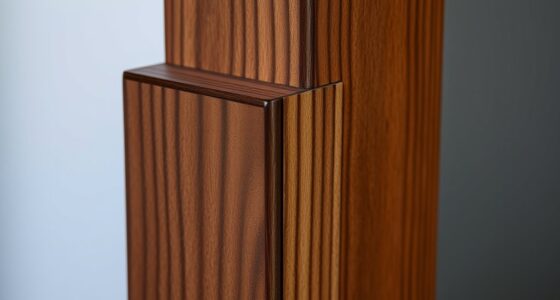
Resawing lumber is a fundamental woodworking technique that allows you to convert thick boards into thinner, more manageable slabs. When you’re resawing for projects like bookmatching, getting the grain alignment right is essential. Properly aligned grains ensure the finished piece looks seamless and highlights the natural beauty of the wood. Before you start, examine the board’s grain pattern, choosing an orientation that will give you symmetrical, mirror-image faces when opened like pages. This way, the grain flows smoothly across the joint, enhancing the aesthetic appeal.
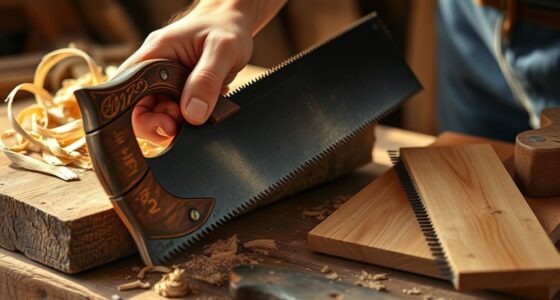
The key to successful resawing lies in your cutting techniques. Using a bandsaw or a thin-kerf saw is ideal for making clean, precise cuts. To maintain consistent thickness and prevent the blade from wandering, you need to set your saw’s fence accurately. Keep the fence tight and aligned parallel to the blade to ensure uniform cuts. When resawing, make sure to feed the board steadily, avoiding sudden movements that can cause uneven slices or tear-out. Applying gentle, consistent pressure helps produce smooth, flat surfaces suitable for bookmatching.
Another essential aspect is understanding how grain direction influences your cutting approach. Cutting with the grain typically results in cleaner cuts, reducing tear-out and splintering. If your board has a pronounced grain, plan your cuts so that the grain runs parallel to the blade’s movement. This minimizes damage and preserves the integrity of the wood’s appearance. For more complex grain patterns, you might need to make multiple cuts, adjusting your technique accordingly. Always remember, your goal is to keep the grain as continuous as possible across the slabs to achieve a flawless match.
When you’re resawing for bookmatching, it’s helpful to mark your cuts carefully. Use a pencil or chalk to outline your intended cut lines, aligning them with the grain pattern. This preparation allows you to stay precise and ensures that when you open the matched boards, the grain flows naturally from one piece to the next. If you’re working with a large or irregularly grained piece, consider making test cuts on scrap wood first. This lets you fine-tune your technique and avoid costly mistakes on your final project. Additionally, understanding cutting techniques can significantly improve your resawing results and help you achieve the best possible match.
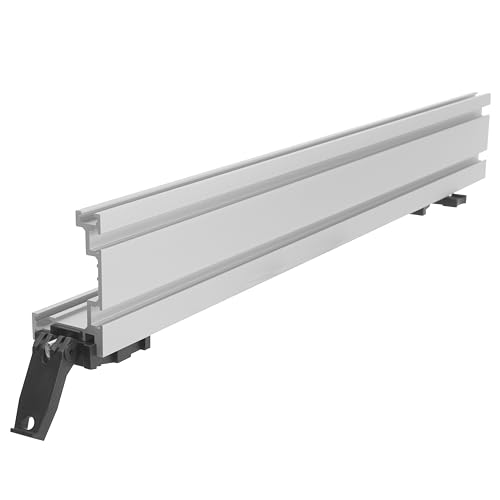
ProGrip Universal Bandsaw Fence – Adjustable, Precision Re-Sawing, Dual-Function 2-in-1 Band Saw/Drill Press Fence Combo, Triple Cam Locking, Straight Edge Clamp, Stop Block for Repetitive Drilling
UNIVERSAL COMPATIBILITY – Fits any band saw table up to 18" front to back. This bandsaw rip fence…
As an affiliate, we earn on qualifying purchases.
As an affiliate, we earn on qualifying purchases.
Frequently Asked Questions
What Tools Are Best for Precise Resawing?
You should use a high-quality bandsaw with a sharp, fine-toothed blade suited for resawing. Blade selection is vital for precision, so opt for a blade designed for thin cuts. Maintain a steady feed rate—neither too fast nor too slow—to guarantee smooth, accurate cuts. Always adjust your tension and guide bearings properly, and consider using a rip fence for added control and consistency during resawing.
How Do I Prevent Tear-Out During Resawing?
To prevent tear-out during resawing, you should keep your blade well-tensioned to guarantee clean cuts. Use a sharp, fine-tooth blade designed for resawing woods. Control your feed rate—slow down as you approach the end of each cut—to reduce stress on the wood. Also, applying masking tape along the cut line can help minimize tear-out, and making multiple shallow passes instead of one deep cut often yields better results.
What Safety Precautions Should I Follow?
You should always wear protective gear like safety glasses, hearing protection, and a dust mask to shield yourself from debris and noise. Make sure good workshop ventilation to prevent dust buildup and maintain air quality. Keep your hands clear of the saw blade, use push sticks, and double-check your equipment before starting. Staying focused and following safety guidelines minimizes risks and keeps you safe while resawing lumber.
How Do I Select the Best Lumber for Bookmatching?
Think of choosing your lumber like selecting a mirror’s reflection; you want symmetry and harmony. Focus on grain orientation—look for straight, consistent grains that align well when bookmatched. Also, check the moisture content; properly dried lumber reduces warping and reveals the true beauty. Opt for boards with minimal knots or flaws, ensuring your finished piece has a seamless, enthralling flow that echoes nature’s artistry.
Can Resawing Be Done on a Standard Band Saw?
Yes, you can resaw on a standard band saw, but success depends on proper blade selection and material preparation. Choose a fine-toothed blade designed for resawing to guarantee smooth cuts. Before you start, plane and joint your lumber to create flat, even surfaces, reducing vibrations and tearing. With the right blade and prepared material, your standard band saw can efficiently resaw and produce perfectly matched bookmatched boards.

RUITOOL Japanese Hand Saw 6 Inch Double Edge Sided Pull Saw Ryoba SK5 Flexible Blade 14/17 TPI Flush Cut Beech Handle Wood Saw for Woodworking Tools
An Idea Gift for Woodworker, Carpenter and Craft Man
As an affiliate, we earn on qualifying purchases.
As an affiliate, we earn on qualifying purchases.
Conclusion
Think of resawing lumber like crafting a mirror from a single stone—you reveal a hidden beauty by splitting it just right. When you master bookmatching, you’re aligning the pages of a story, creating a seamless narrative. Each cut offers an opportunity to showcase nature’s artistry, turning raw wood into a masterpiece. Remember, with patience and precision, you’re not just shaping boards—you’re unveiling their full potential, much like revealing the reflection of a perfect story in a mirror.

2 Pack Carpenter Pencils Mechanical Pencils with 12 Refills, Upgraded Construction Pencils with Built-in Sharpener, Woodworking Marking Tools Pencil Markers with Metal Clip for Architect (2 Colors)
Long Nib and Deep Hole Marker: Our mechanical carpenter pencil with 40mm nib is designed for easy marking…
As an affiliate, we earn on qualifying purchases.
As an affiliate, we earn on qualifying purchases.

Sauers North American Species Wood Identification Kit & Wood Veneer Sample Pack – 4” X 9” – 25 Pieces
25 Pieces of 4" x 9" veneer samples individually identified by its common name and country of origin
As an affiliate, we earn on qualifying purchases.
As an affiliate, we earn on qualifying purchases.