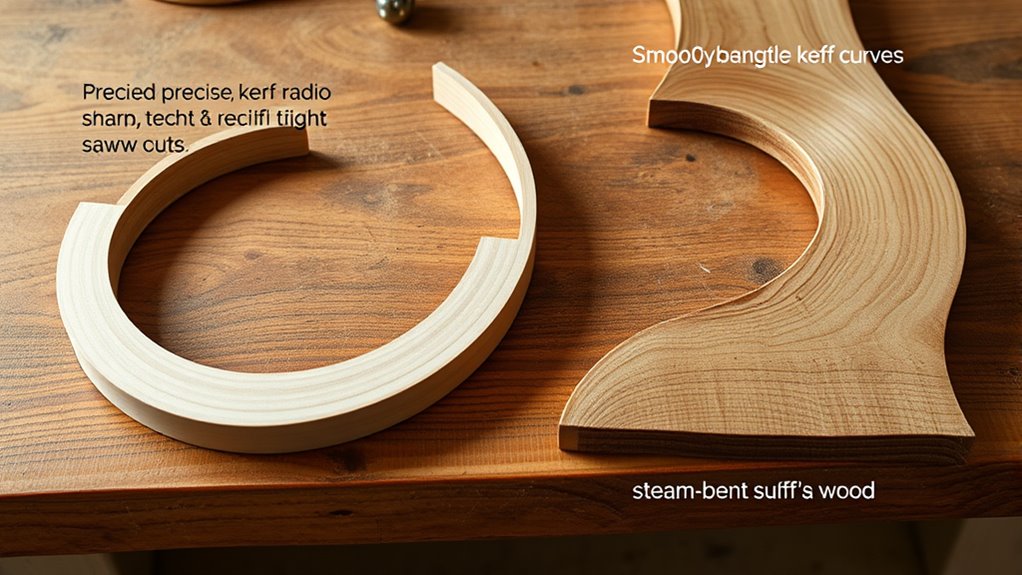

Kerf bending gives you moderate radius control, but it’s limited by potential splitting and less precision for tight curves. Steam bending allows you to achieve much smaller, smoother radii with high accuracy, as it softens the wood for easier shaping. However, you might experience springback as the wood cools, slightly altering the final shape. To master these techniques and know which suits your project best, explore further details below.
Key Takeaways
- Steam bending allows for tighter radii and more complex curves due to increased wood flexibility.
- Kerf bending produces larger, more moderate radii with less risk of structural weakening.
- Steam bending may experience springback as the wood cools, requiring clamping and support to maintain shape.
- Kerf bending’s radii are limited by cut depth and support, often resulting in less precise curves.
- Proper technique and cooling are essential in steam bending to minimize springback and achieve the desired radius.
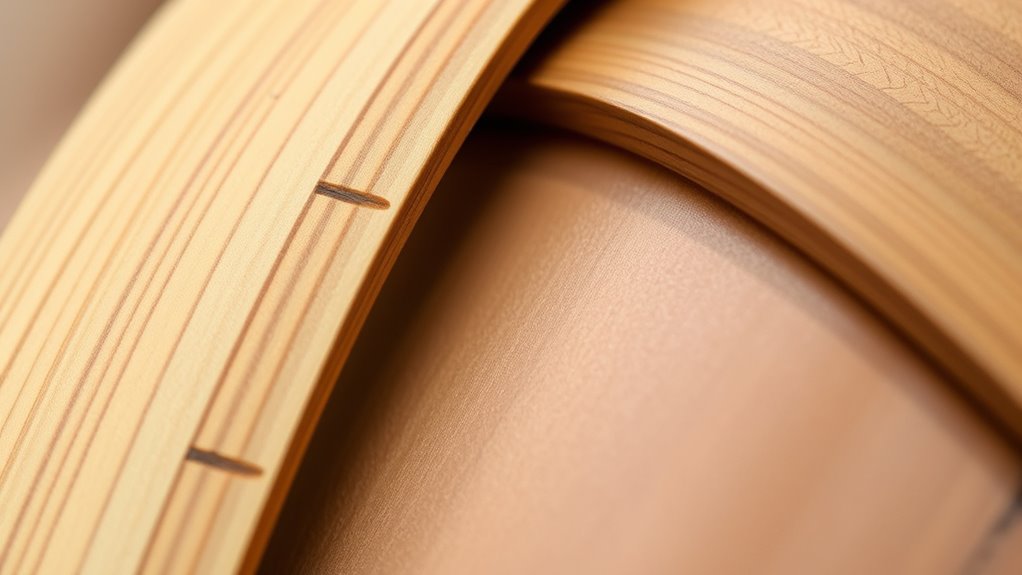
When it comes to bending wood, understanding the differences between kerf bending and steam bending can help you choose the right method for your project. Both techniques manipulate wood’s natural properties, but they do so in distinct ways, affecting how flexible the wood becomes and how accurately you can control the bend. Your choice hinges on the specific requirements of your project, especially when it comes to achieving tight radii or minimizing springback. Kerf bending involves making a series of closely spaced cuts, or kerfs, across the wood’s surface. This process effectively reduces the material’s resistance to bending by removing some of its mass, increasing the wood’s flexibility in targeted areas. Because you’re cutting into the wood, you can fine-tune the kerf pattern to control how much the wood bends and how sharply it curves. Kerf bending tends to be quicker and requires less specialized equipment, making it suitable for projects where moderate flexibility and a certain degree of bending accuracy are acceptable. However, because the kerfs weaken the structure, there’s a risk of splitting, especially if the cuts are too deep or the wood isn’t properly supported during the process. Additionally, understanding the properties of wood can help you better anticipate how it will respond to each bending method. Steam bending, on the other hand, uses heat and moisture to make the wood pliable. When you expose the wood to steam, its cell structure softens, allowing you to bend it into complex shapes with high precision. The key benefit here is the wood’s inherent flexibility increases without permanently damaging the material. This method is especially effective for creating tight radii and intricate curves, as the wood can bend more dramatically without cracking or splitting. The challenge lies in controlling the springback effect—once the wood cools and dries, it tends to try to return to its original shape. Proper clamping and gradual cooling are essential to maintain bending accuracy and achieve the desired radius. Steam bending generally produces smoother curves with less risk of structural compromise, but it requires more time and specialized equipment.
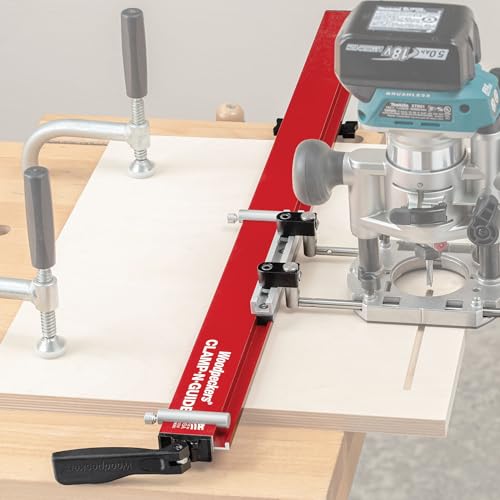
Woodpeckers Clamp-N-Guide 24" Straight Edge Clamp, Router & Circular Saw Guide Rail, Fits Most Routers, Optional Router Guide Made in USA CNG-24
SPECS - CNG-24 Includes one 24" Clamp-N-Guide Straight Edge Clamp.
As an affiliate, we earn on qualifying purchases.
Frequently Asked Questions
How Do Kerf and Steam Bending Compare in Cost?
You’ll find kerf bending generally costs less upfront because it needs minimal equipment investment and is quicker to set up. Steam bending might be more expensive initially due to specialized equipment and setup time, but it can save costs over time with its ability to produce larger, more consistent curves. Overall, your choice depends on your project scope, budget, and the precision you need.
Which Method Offers Better Precision for Complex Curves?
You’ll find steam bending offers better precision for complex curves, like shaping a flowing river, thanks to its higher material flexibility. It gently coaxes the wood into intricate forms, minimizing springback and ensuring bending accuracy. Kerf bending, more like carving a path through dense woods, gives less control over delicate details. So, if precision is your goal, steam bending’s fluid approach helps you achieve those complex curves with finesse.
Can Both Methods Be Used on All Wood Types?
Both methods can’t be used on all wood types due to wood compatibility and bending limitations. Kerf bending works best with softer woods that can easily flex without splitting, while steam bending suits hardwoods with higher moisture content. You need to take into account each wood’s natural properties, as some may crack or resist bending, limiting your options. Always test small pieces first to ensure your chosen method works effectively.
How Long Does Each Bending Process Take?
The bending process duration varies depending on the method and project size. Kerf bending is quicker, often taking just a few minutes to cut and bend the wood, making it suitable for rapid projects. Steam bending takes longer, typically 30 minutes to several hours, as you need to steam the wood until it’s pliable. Your bending speed depends on wood thickness and desired radius, but steaming generally requires more time for the process duration.
What Are the Safety Considerations for Each Technique?
Think of bending wood as walking a tightrope—you need safety gear to stay balanced. For both techniques, always wear eye protection and gloves, and guarantee proper ventilation to avoid hazards. Keep tools sharp and well-maintained to prevent accidents. Hazard mitigation includes securing your workspace and handling heated steam carefully. Staying alert and following safety protocols turns your project into a safe, smooth ride across the bending process.

Draxzor 2 Pack Router Corner Radius Template, Premium Aluminum Alloy Router Corner Rounding Jig for Woodworking, 8-in-1 Arc Cutting Guide Set (R10-R50), Fits Trim, Handheld, and Table Routers
【All-Metal Construction】Unlike plastic templates, this round corner router jig is made entirely of premium aluminum alloy—including the edge...
As an affiliate, we earn on qualifying purchases.
Conclusion
When choosing between kerf bending and steam bending, consider your project’s radius and springback needs. Did you know that kerf bending can achieve sharper radii with minimal springback, making it ideal for precise curves? Steam bending, on the other hand, offers softer bends but may require more effort to control. Understanding these differences helps you pick the right method for your project, ensuring a perfect fit every time.

Router Edge Guide Template, Trimming Machine Attachment Straight Guide Tool, For Woodworking, Compatible With 3710 Models, Metal Plastic Construction(Guide Wheel Bracket)
Accuracy Router Edge Guide: Professional-grade metal and plastic construction provides accurate straight-line trimming for woodworking projects, compatible with...
As an affiliate, we earn on qualifying purchases.

Milescraft 1224 Edge & Mortise Guide - Universal Router Guide for Straight or Cylindrical Edges - Built in Mortise Guide - Bonus Offset Base
Compatible with plunge and fixed base routers
As an affiliate, we earn on qualifying purchases.