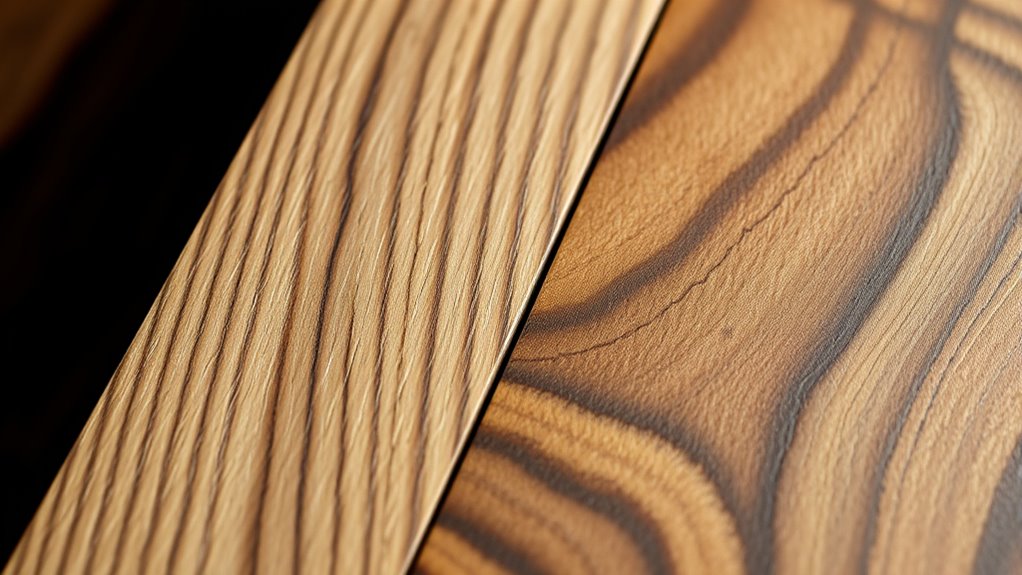

Aligning grain direction in joinery is key for both strength and appearance. When you position the grain along load paths, the joint becomes stronger and more durable, reducing risk of splitting or failure. Conversely, focusing only on appearance may lead you to cross the grain, weakening the joint over time. To achieve the best balance, you need to understand how grain flow affects both structural integrity and visual appeal—there’s more to discover if you continue exploring how grain plays a role.
Key Takeaways
- Aligning grain along load paths enhances joint strength and durability, preventing failure and splitting over time.
- Following natural grain patterns improves the aesthetic appeal of finished woodworking projects.
- Proper grain orientation minimizes wood movement, reducing warping, cracking, and joint loosening.
- Ignoring grain direction can compromise the structural integrity and longevity of joinery components.
- Balancing strength and appearance involves strategic grain placement to optimize both durability and visual quality.
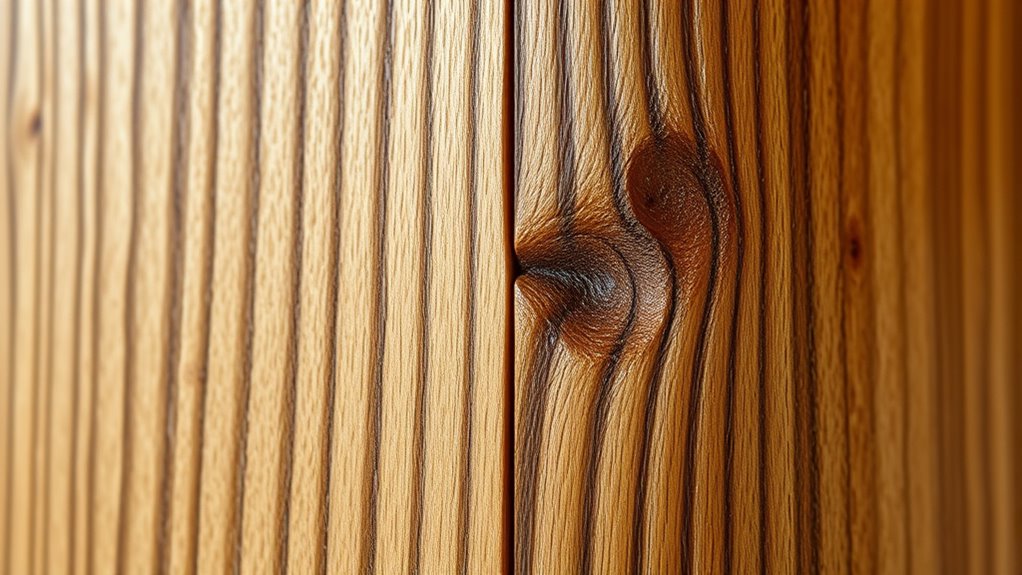
Understanding grain direction is essential for achieving strong, durable, and visually appealing joinery. When you work with wood, paying attention to the grain pattern helps you make smarter decisions about how to cut, assemble, and finish your pieces. The grain pattern influences not only the look of your project but also how the wood responds to environmental changes, especially wood movement. If you ignore grain direction, you risk weakening your joints or causing warping, cracking, and other issues that compromise your work’s integrity and appearance.
Your goal should be to align the grain in a way that maximizes strength. For instance, when making a joint like a dovetail or a mortise and tenon, understanding how the grain runs through each piece allows you to orient the wood so that the fibers support the joint’s load. Wood tends to be stronger along the grain, meaning that joints aligned with the grain pattern will be more resistant to stress and less likely to split or fail over time. Conversely, if you place a joint across the grain, you weaken the connection, making it more susceptible to failure under pressure. Recognizing the grain pattern also helps you choose the best direction for cutting and planing, ensuring that your cuts follow the natural flow of the wood rather than fighting against it.
Align grain along load paths for stronger, more durable joints.
Another critical aspect to consider is wood movement. Wood naturally expands and contracts with changes in humidity and temperature, and this movement is heavily influenced by grain direction. If you cut or install a piece with the grain running in an unfavorable direction, you risk uneven expansion, which can cause joints to loosen, cracks to form, or surfaces to warp. To mitigate this, you should orient your grain so that it runs parallel to the strongest load-bearing surfaces and aligns with the natural expansion patterns. This way, the wood’s movement is controlled and predictable, reducing the risk of damage over time.
In practical terms, you should examine the grain pattern carefully before making cuts. Look for the direction of the fibers, and plan your joinery so that the grain runs along the length of load-bearing parts. When in doubt, test a small piece to observe how the grain behaves and how the wood moves. Properly understanding and respecting grain direction during your project will help you create joints that are both strong and beautiful, ensuring your work lasts and looks professional.
Additionally, understanding how grain orientation affects the mechanical properties of wood can guide you in selecting the best cuts for strength and stability.

WEN CL436R 4-Inch Right Angle Clamp for Woodworking and Pocket Hole Joinery
Keep pocket holes secure and square at 90 degrees during project assembly
As an affiliate, we earn on qualifying purchases.
As an affiliate, we earn on qualifying purchases.
Frequently Asked Questions
How Does Grain Orientation Affect Wood Expansion and Contraction?
Your grain orientation directly impacts how wood responds to moisture movement, affecting expansion and contraction. When you align grain along the length, the wood stays more dimensionally stable, resisting moisture-induced changes. Conversely, cross-grain directions cause more noticeable expansion and contraction. By understanding this, you can choose the right grain orientation to improve dimensional stability and minimize warping or cracking in your projects.
Can Changing Grain Direction Improve Joint Longevity?
Yes, changing grain direction can improve joint longevity by enhancing grain symmetry, which reduces stress concentrations and potential cracking. When you align the grain properly, your joints become more resistant to movement caused by wood expansion and contraction. Additionally, maintaining consistent grain orientation guarantees aesthetic consistency, making your project look more polished while also increasing durability. Proper grain management helps your joinery last longer and stay visually appealing over time.
Are There Specific Wood Species Better Suited for Certain Grain Directions?
Certain wood species are better suited for specific grain directions, so choose wisely. For instance, hardwoods like oak and maple offer strength along the grain, making them ideal for load-bearing joints. Softwoods like pine, with their more flexible grain, suit aesthetic projects where appearance matters more. Your species considerations and aesthetic preferences will guide your choice, ensuring your project combines durability with visual appeal. Stay attentive to these details for ideal results.
How Does Grain Alignment Influence Wood Finishing and Staining?
You should consider grain alignment because it directly affects your wood’s finishing and staining. When the grain pattern runs consistently, your stain absorbs evenly, highlighting the natural beauty and creating a smooth, attractive visual impact. Conversely, mismatched grain directions can cause blotchiness or uneven color. To achieve a professional look, align your grain properly, ensuring your finish enhances the wood’s natural character and provides a polished, cohesive appearance.
What Tools Are Best for Aligning Grain During Joinery?
Like guiding a ship through calm waters, your tools shape perfect grain alignment. Use a straightedge or a jointer for precise grain pattern alignment, guaranteeing straight, even edges. Clamps help hold pieces steady during glue-ups, while a marking gauge ensures consistent reference points. These alignment techniques, combined with sharp hand tools or power tools, let you control the grain’s flow, enhancing both the strength and beauty of your finished project.

Clarke Brothers Wheel Marking Gauge – Woodworking Marking Scriber Kit With 2 Replacement Cutters – Wood Marking Tools With Graduated Inch & MM Scale – Solid Metal Bar Wood Scribe Tool For Carpenter
✅ PATENT PENDING – ROLL STOP FENCE WITH FLAT SPOT – woodworking tasks with a high-end wheel marking…
As an affiliate, we earn on qualifying purchases.
As an affiliate, we earn on qualifying purchases.
Conclusion
Ultimately, choosing the right grain direction is like striking gold—you’ll craft furniture that’s both stunning and strong. Prioritize your project’s needs: for maximum strength, follow the grain; for eye-catching beauty, sometimes a bold contrast wins. Remember, ignoring grain direction can turn your masterpiece into a fragile house of cards. Trust your instincts and knowledge—because with the right grain approach, your work will stand the test of time and be admired for generations.

Mortising Machine, Tenon Tools Mortising Attachment for Drill Press and Woodworking Mortise, Bench Drill Locator Set for Mortiser Circles/Square Hole Chisel Drilling Machine Mortise Machine.
Mortising Attachment for Drill Press Set include:locator,press block,side positioning rod,fixed seat and other accessories,also comes with 4 kinds…
As an affiliate, we earn on qualifying purchases.
As an affiliate, we earn on qualifying purchases.

Beatifoyo 3 Pack Wood Ruler Set – Includes 6 inch (15 mm), 8 inch (20 mm), and 12 inch (30 mm) with SAE & Metric Measurements – for Drawing, Home, Office, and Engineering Use
Made of hard wood, durable and sturdy. Not easy to break and the scale would not fade, allows…
As an affiliate, we earn on qualifying purchases.
As an affiliate, we earn on qualifying purchases.