To joint edges without a jointer, build a sturdy sled that guides your hand plane for straight cuts, guaranteeing clamps hold the workpiece securely along the edges. Use a well-sharpened plane, applying steady pressure and taking light passes to avoid tear-out. Proper setup with the sled and careful planing help produce flat, tight joints. Mastering these techniques ensures professional results, and next, you’ll discover even more tips to perfect your edge jointing without a jointer.
Key Takeaways
- Build a sturdy sled to securely hold the workpiece, guiding it against the hand plane for straight edges.
- Clamp the board firmly to prevent movement, ensuring even pressure and consistent planing passes.
- Use a sharp, well-tuned hand plane, ideally a low-angle or smoothing plane, for cleaner, precise edges.
- Make multiple light passes along the edge, checking for straightness and flatness after each to refine the joint.
- Proper setup and technique allow you to achieve professional-quality, straight edges without a jointer.
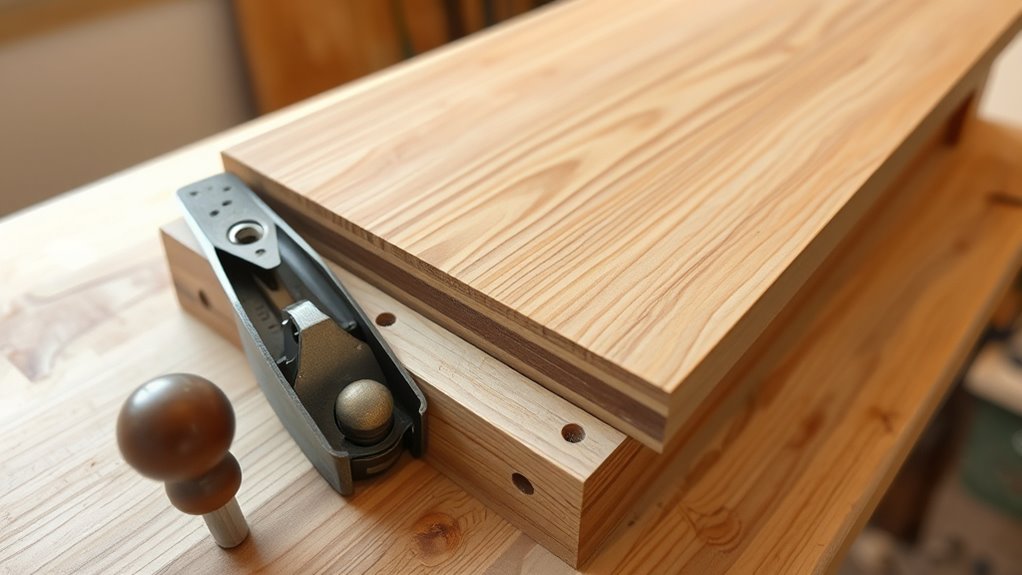
Even if you don’t own a jointer, achieving smooth, tight edges on your boards is still possible with a few clever techniques. One of the most effective methods involves using a simple sled setup combined with a hand plane. This approach allows you to produce precise, straight edges without investing in heavy, expensive machinery. The key to success lies in mastering clamping techniques and selecting the right hand plane for the job.
Start by creating a sturdy sled that fits your workpiece. This sled acts as a stable platform, guiding the board against your hand plane. To guarantee accuracy, attach clamps securely along the edges of the sled, pressing firmly to prevent any movement during planing. Clamping techniques are critical here; you want enough pressure to keep the board steady without causing indentations or damage. Using multiple clamps along the length of the sled distributes pressure evenly, resulting in a flatter, more consistent edge.
Choosing the right hand plane is equally important. A well-tuned, sharp plane with a finely adjusted blade will produce cleaner cuts and reduce tear-out. Many woodworkers prefer a smoothing plane or a low-angle jack plane for this task because of their versatility and ease of control. Before you begin, make sure the blade is razor-sharp and set to a shallow depth of cut. By taking light, controlled passes, you minimize the risk of gouging or unevenness. Keep the plane flat against the board and work along the entire length of the edge, checking frequently for straightness.
As you work, pay attention to your clamping setup and hand plane technique. Use your body weight to maintain consistent pressure, and take multiple passes if necessary, gradually refining the edge. After each pass, check the edge for straightness and smoothness. You can also use a straightedge or a square to verify that the edge is true. If you notice any high spots or irregularities, rework those areas gently with the plane.
Incorporating effective clamping techniques and selecting the right hand plane don’t just make your work easier—they markedly improve your results. Proper setup ensures that your edges are perfectly straight and tightly jointed, matching the quality you’d expect from professional equipment. With patience, practice, and the right tools, you can achieve excellent edge joints without a jointer, giving your projects a clean, professional finish every time.
Additionally, understanding the importance of proper setup and how it influences the quality of your joints can help you troubleshoot issues more effectively.
Frequently Asked Questions
Can Edge-Jointing Be Done With Hand Tools Only?
Yes, you can edge-joint with hand tools only. Using hand tool techniques like a jointer plane or a well-made straightedge, you can achieve woodworking accuracy. Carefully plane and check the edges frequently to guarantee they stay straight and square. Patience and precision are key, but with practice, hand tools can produce a perfectly jointed edge suitable for tight-fitting projects.
What Are the Safety Precautions for Using Sleds and Planes?
When using sleds and planes, you should always wear safety gear like goggles and a dust mask to protect your eyes and lungs. Follow proper technique by securing your work firmly, maintaining a steady hand, and keeping your fingers away from the blade. Always inspect your tools for damage before use, and work in a well-lit area to avoid accidents. Staying cautious helps guarantee safe and effective edge-jointing.
How Do I Maintain the Accuracy of My Edge Jointing Setup?
A stitch in time saves nine, so keep your edge jointing setup accurate by regularly checking your tools. Use proper clamping techniques to secure your workpiece firmly, preventing movement that can cause inaccuracies. Sharpen your planes frequently with effective sharpening methods to maintain a keen edge, ensuring smooth, precise cuts. Consistent setup, careful adjustments, and routine maintenance are key to achieving perfectly jointed edges every time.
Are There Specific Wood Types That Are Easier to Joint Without a Jointer?
Certain wood types are easier to joint without a jointer, especially those with straight, consistent grain, like maple or cherry. Woods with irregular grain or lots of knots, such as oak or walnut, can be more challenging because they tend to tear out. To improve jointing ease, choose softer, stable woods and guarantee your wood grain runs parallel to the edge you’re working on. Proper technique and sharp tools also make a big difference.
How Do I Fix a Bowed or Warped Board Before Edge Jointing?
Did you know that nearly 40% of woodworking issues stem from warped wood? To fix bowed or warped boards before edge jointing, start by selecting the least warped side. Clamp the board with the concave side up, then apply gentle heat and moisture to relax the fibers. Let it dry under weight, and repeat if necessary. This method helps straighten warped wood, ensuring a cleaner, more stable edge during jointing.
Conclusion
So, next time you’re faced with warped boards and no jointer in sight, remember you’ve got options—sleds and planes—your unlikely heroes. Who knew that with a little ingenuity, you could turn a simple woodworking challenge into a masterclass of resourcefulness? It’s almost ironic how these humble tools, often overlooked, can produce perfectly straight edges. Just imagine your neighbors’ surprise when your “makeshift” setup outperforms that fancy jointer—proof that sometimes, necessity really is the mother of invention.