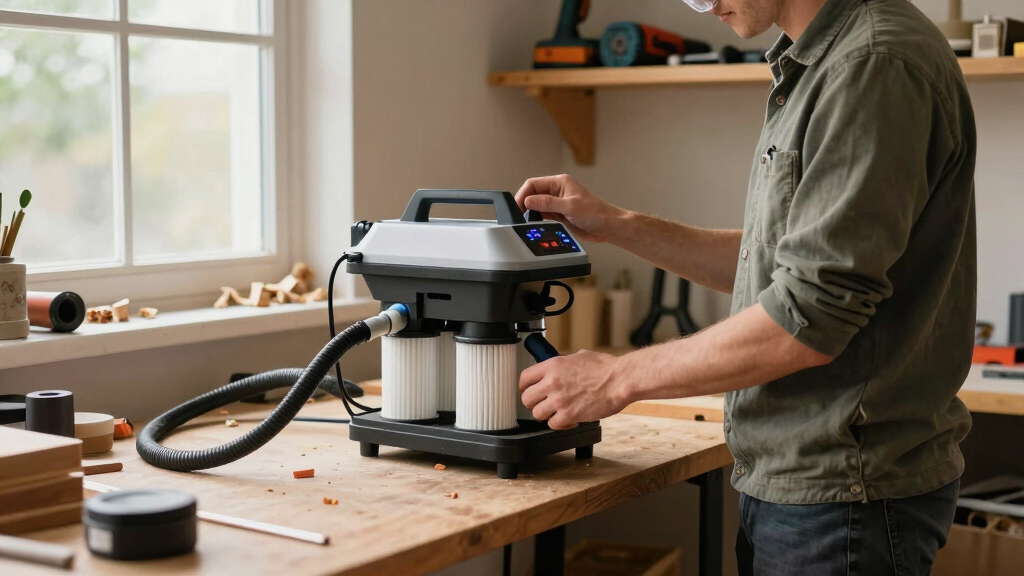

Choosing the right mobile dust collector can significantly improve your workshop’s cleanliness and safety. For 2026, two models stand out: the WEN Woodworking Dust Collector with 7.4-Amp Motor and the WEN DC1300 1,300 CFM Dust Collector. The first offers a compact yet powerful solution with its high airflow and portability, ideal for small to medium workshops. The second brings a substantial capacity and airflow, suited for larger spaces but with a tradeoff in size and power requirements. Understanding their strengths and limitations will help you pick the best fit for your workflow.

Get business pricing on tools and workshop supplies
- Business-only prices and quantity discounts
- Tax-exempt purchasing
- Multiple users, one account, clear invoices
Complete the kit


Key Takeaways
- The WEN 7.4-amp model excels in portability and ease of setup for small to medium workshops.
- The WEN DC1300 provides much higher airflow and a larger collection capacity, ideal for larger or busier workshops.
- Both models are mobile, but the heavier DC1300 may require more space and a dedicated outlet.
- The choice depends on your workshop size, dust volume, and power availability.
- Tradeoffs include noise levels, size, and complexity of assembly for the larger unit.
| WEN Woodworking Dust Collector with 7.4-Amp Motor and 15-Gallon Bag |  | Best Overall for Small to Medium Workshops | Motor Power: 7.4 amps | Impeller Size: 9 inches | Air Flow: 600 CFM | VIEW LATEST PRICE | See Our Full Breakdown |
| WEN DC1300 1,300 CFM 14-Amp 5-Micron Woodworking Dust Collector with 50-Gallon Collection Bag and Mobile Base |  | Best for Large or High-Volume Workshops | Airflow: 1,300 CFM | Motor Power: 14 Amps | Collection Capacity: 50 gallons | VIEW LATEST PRICE | See Our Full Breakdown |
| mobile dust collector | Motor Power | Impeller Size | Air Flow | Dust Port |
|---|---|---|---|---|
| WEN Woodworking Dust Collector | 7.4 amps | 9 inches | 600 CFM | 4 inches |
| WEN DC1300 1,300 CFM 14-Amp 5- | 14 Amps | — | — | — |
More Details on Our Top Picks
WEN Woodworking Dust Collector with 7.4-Amp Motor and 15-Gallon Bag
This model stands out for delivering a strong balance between power and portability. Its 7.4-amp motor and 600 CFM airflow make it effective for capturing dust from multiple machines, yet it remains lightweight at just over 41 pounds. The large 15-gallon collection bag reduces frequent emptying, and the mobile base with swivel casters makes repositioning straightforward. However, its weight and noise might be drawbacks for smaller spaces or quieter environments. Compared to larger options, it offers easier setup and less space requirement, making it a versatile choice for most workshops.
Pros:- Powerful motor with high airflow
- Large 15-gallon collection bag
- Mobile with swivel casters and wall mount option
Cons:- Heavy at over 41 pounds
- Requires space for setup
- May generate noticeable noise
Best for: Small to medium workshops needing reliable dust collection without sacrificing mobility
Not ideal for: Large industrial spaces or workshops with extremely high dust volumes requiring maximum airflow
- Motor Power:7.4 amps
- Impeller Size:9 inches
- Air Flow:600 CFM
- Dust Port:4 inches
- Collection Bag Capacity:15 gallons
- Dimensions:43.3 x 17.7 x 20.1 inches
Our verdict“This dust collector offers a well-rounded mix of power, capacity, and portability, making it ideal for most small to medium workshops.”
WEN DC1300 1,300 CFM 14-Amp 5-Micron Woodworking Dust Collector with 50-Gallon Collection Bag and Mobile Base
This model is designed for substantial dust collection needs, featuring a robust 14-amp motor and an impressive 1,300 CFM airflow. Its 50-gallon collection bag greatly reduces the frequency of emptying, making it suitable for continuous operation in larger workshops. The mobile base with swivel casters makes transportation easier despite its size. The main tradeoff is its bulkiness, which could be challenging in smaller spaces, and it requires a dedicated 14-amp outlet, potentially limiting its placement. Assembly may also be more complex due to its size and weight.
Pros:- High airflow capacity for effective dust removal
- Large 50-gallon collection bag for less frequent emptying
- Mobile base with swivel casters for easier movement
Cons:- Bulky, requiring more space
- Needs a 14-amp outlet
- Assembly can be complex
Best for: Large workshops or environments with high dust output requiring maximum airflow and capacity
Not ideal for: Small workshops, spaces with limited electrical capacity, or users seeking a lightweight, simple setup
- Airflow:1,300 CFM
- Motor Power:14 Amps
- Collection Capacity:50 gallons
- Impeller Speed:3450 RPM
- Inlet Size:4 inches
Our verdict“This model is a powerhouse suited for high-demand workshops, though its size and power needs may be overkill for smaller setups.”
How We Picked
Our selection process focused on identifying mobile dust collectors that balance power, capacity, and portability. We prioritized models with strong airflow, large collection bags, and mobility features like swivel casters. We also considered user reviews, ease of setup, and overall value, ensuring each model offers a clear advantage for specific workshop scenarios. Size, noise, and power requirements were evaluated to match different workshop sizes and electrical setups.
Factors to Consider When Choosing Best Mobile Dust Collector
Selecting the best mobile dust collector hinges on balancing power, capacity, and portability. The ideal model fits your workshop size, dust volume, and electrical setup. Consider how much space you have, how often you’ll need to empty the collection bag, and whether noise levels matter for your environment. The following sections break down key factors to help you make an informed choice.
Power and Airflow
High airflow, measured in CFM, directly impacts a dust collector’s ability to capture airborne debris efficiently. Smaller workshops with fewer machines can get by with models around 600-800 CFM, like the WEN 7.4-amp unit. Larger workshops or those with multiple machines require higher airflow, such as the 1,300 CFM WEN DC1300. Keep in mind, more powerful units often demand more electrical capacity and can be noisier.
Capacity and Maintenance
Collection bag size determines how often you’ll need to empty your dust collector. A 15-gallon bag like the WEN 7.4-amp model offers a good balance for small to medium usage, while the 50-gallon bag on the DC1300 reduces interruptions in larger workshops. Larger capacity units can be more cumbersome to move and require more space, but they save time on maintenance.
Mobility and Size
Most mobile dust collectors come with swivel casters, but their size and weight vary greatly. The smaller WEN model is lightweight enough for easy repositioning, while the DC1300’s bulk may demand more effort or space for movement. Assess your workshop layout and storage options before choosing, especially if space is tight or frequent repositioning is needed.
Power Requirements and Noise
Power needs differ significantly; the 14-amp DC1300 requires a dedicated outlet, which might not be available everywhere. The smaller WEN model runs on standard household power. Noise is another factor—larger units tend to be louder, which could be disruptive if your workshop doubles as a living space or if noise levels are a concern.
Frequently Asked Questions
How much airflow do I need for my workshop?
The amount of airflow needed depends on the number and size of your machines. For small workshops with a few tools, around 600-800 CFM often suffices. Larger setups with multiple machines or higher dust output benefit from units offering 1,200 CFM or more, like the WEN DC1300, to keep the environment clean and safe.
Is a larger collection bag always better?
Not necessarily. Larger bags like the 50-gallon capacity on the DC1300 reduce the frequency of emptying, which is advantageous for high-volume dust collection. However, they also add weight and bulk, making the unit less maneuverable. Smaller bags are easier to handle but may require more frequent maintenance, making them better suited for lighter usage.
Do I need special electrical wiring for these dust collectors?
The smaller WEN model typically runs on standard household power, making it easy to plug into typical outlets. The DC1300, with its 14-amp motor, often needs a dedicated circuit to operate safely and effectively. Check your workshop’s electrical setup before purchase to ensure compatibility, especially for the larger model.
How loud are these dust collectors?
Size and power directly influence noise levels. The more powerful and larger units, like the DC1300, tend to be louder, which could be disruptive depending on your environment. The smaller WEN model generally runs quieter, making it more suitable for shared or noise-sensitive spaces.
Are these dust collectors easy to assemble?
Assembly complexity varies. The smaller WEN model usually features straightforward setup with minimal tools required. The larger DC1300 might involve more steps and heavier lifting, potentially requiring extra help. Reading the manufacturer’s instructions and setting aside ample time can ease this process.
Conclusion
For small to medium workshops where mobility and ease of use matter most, the WEN Woodworking Dust Collector with 7.4-Amp Motor is a reliable choice. It offers a good mix of power and portability without overwhelming space or electrical needs. Conversely, if you operate a larger workshop with high dust volumes, the WEN DC1300 stands out for its superior airflow and capacity, despite its size and setup complexity. Heavy-duty users with the space and power capacity will find it worth the investment, while hobbyists or small shop owners may prefer the more manageable WEN 7.4-amp model.
Fall yard work Picks
leaf blowers
As an affiliate, we earn on qualifying purchases.