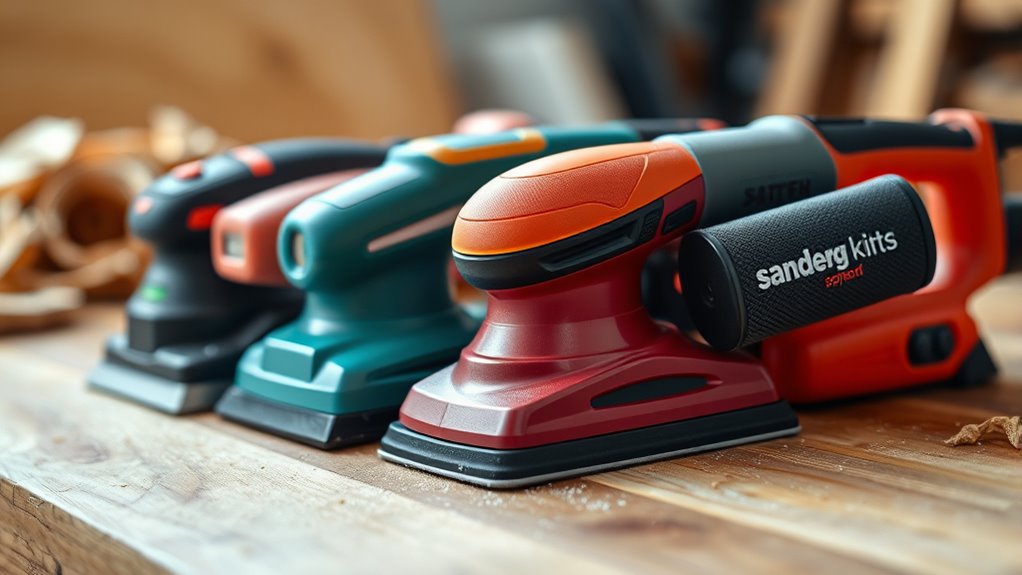

For most woodworking, I’d start with the DEWALT DWE6423: its variable speed and 5-inch random-orbit design suit broad stock preparation and finish sanding. The Bosch ROS20VSC is a strong alternative if dust collection and a kit matter more, while the WEN 6502T serves bench work that calls for both belt and disc sanding. The main choice is between a versatile handheld sander and a stationary or detail machine built for narrower tasks. Speed control, dust handling, and the shape of your workpieces can matter more than a headline power figure. Read on for the full comparison and recommendations by project type.

Get business pricing on tools and workshop supplies
- Business-only prices and quantity discounts
- Tax-exempt purchasing
- Multiple users, one account, clear invoices
Complete the kit


Key Takeaways
- The DEWALT DWE6423 earns the lead spot for pairing a common 5-inch random-orbit format with variable speed, making it the most adaptable handheld choice in this lineup.
- The Bosch ROS20VSC puts dust collection near the center of the decision, while its included vacuum dust collector and kit format make it a distinct alternative to the DEWALT picks.
- Stationary machines solve different problems from palm sanders: the WEN 6502T combines belt and disc sanding, and the WEN 6524 adds oscillating belt and spindle options for shaped work.
- Detail access comes with a narrower scope. The HYCHIKA detail sander and WEN 6307 file sander are designed for tight areas, but they are not substitutes for covering broad panels efficiently.
- Several DEWALT models share a 5-inch format but differ in control and package. Compare variable speed, kit contents, and the stated operating rate before choosing among the DWE6423, DWE6421K, DWE6421, and DWE6411.


| woodworking sander | Motor | Dust collection | Power source |
|---|---|---|---|
| DEWALT 1/4-Sheet Electric Sand | 2.3 amps | — | — |
| WEN 6502T 4.3-Amp Belt and Dis | 4.3 A, 1/2 HP | — | — |
| Dong Cheng 5-Inch Random Orbit | — | Detachable dust box | — |
| WEN 6510T 3.5 Amp Oscillating | 3.5 amps | Dust port | AC adapter |
| HYCHIKA Detail Sander | — | 6-hole system with dust bag | — |
| DEWALT DWE6423 5-Inch Variable | 3 A | One-handed locking dust bag; compatible with DEWALT dust collectors | Corded electric |
| Bosch ROS20VSC Palm Sander wit | 2.5 A | Vacuum dust collector system | Corded |
| DEWALT 5-Inch Orbital Sander K | 3.0 A | One-handed locking dust bag | Corded |
| DeWalt 5-Inch Random Orbital S | 3 A | — | Corded electric |
| WEN 6307 Variable-Speed Detail | — | — | — |
| WEN 6524 Oscillating Belt and | 3.5 A | — | Corded electric |
More Details on Our Top Picks
DEWALT 1/4-Sheet Electric Sander, 14,000 OPM (DWE6411)
For a wood work machine focused on flattening boards and smoothing broad faces, this DEWALT offers a practical balance of control and straightforward sheet sanding. Its 14,000 OPM speed and quarter-sheet format suit routine stock preparation, while the lower profile and separate counterweight are designed to make the tool easier to guide with less vibration. Compared with the Dong Cheng 5-Inch Random Orbital Sander, it uses a simpler rectangular sanding sheet rather than a round orbiting pad, which can be useful along edges but is less adaptable for blending marks across a surface. The locking dust port connects to compatible DEWALT collectors, though other 1 1/4-inch hoses need the DWV9000 connector. Choose it for controlled flat work; skip it if you want variable speed or broad orbital versatility.
Pros:- 14,000 OPM speed supports quick sanding on flat wood surfaces
- Quarter-sheet format is suited to panels and straight edges
- Lower profile and rubber overmold grip support controlled handling
- Locking dust port works with specified DEWALT collectors
Cons:- Connecting other 1 1/4-inch hoses requires a DWV9000 connector
- Fixed speed offers less control across different abrasives and tasks
Best for: Woodworkers who mainly smooth flat boards, edges, and panels and already use compatible DEWALT dust collection
Not ideal for: Buyers who need variable speed, a round pad for blending, or an easy connection to an unadapted vacuum hose
- Motor:2.3 amps
- Speed:14,000 OPM
- Sanding sheet size:1/4 sheet
- Dust port compatibility:DWV010 and DWV012 dust collectors
- Hose connection:1 1/4-inch hoses with DWV9000 connector
- Grip:Rubber overmold
Our verdict“Choose this DEWALT for controlled flat-surface woodworking; pick the Dong Cheng instead if you want a variable-speed round-pad sander.”
WEN 6502T 4.3-Amp Belt and Disc Sander
This is the lineup’s dedicated stationary shaping machine: the 4-by-36-inch belt handles longer edges and faces, while the 6-inch disc suits smaller end grain and angled pieces. Its belt tilts from 0 to 90 degrees, and the included miter gauge and stop bar help keep repeat work steady. Compared with the handheld DEWALT DWE6411, the WEN is far better suited to sanding parts against a fixed surface, but it needs a bench and outlet and cannot follow large assemblies around a shop. The cast-iron base helps limit vibration; the 4.3-amp motor reaches up to 3600 RPM. The included coarse abrasive can be too aggressive for finishing, so plan on changing grits. Pick it for shaping and shop-built parts, not final surface sanding across assembled furniture.
Pros:- Combines a long belt and disc in one benchtop machine
- Tilting belt supports sanding at different angles
- Cast-iron base helps reduce vibration during stationary work
- Miter gauge, stop bar, and dust port are included
Cons:- Requires bench space and a nearby outlet
- Coarse abrasive may remove material too quickly for fine finishing
- Stationary design cannot follow large or assembled workpieces
Best for: Woodworkers with a dedicated bench who regularly shape small parts, edges, and angled workpieces
Not ideal for: Furniture makers who need a portable sander for broad finished surfaces or work far from an outlet
- Belt size:4 x 36 inches
- Belt tilt:0–90 degrees
- Disc diameter:6 inches
- Motor:4.3 A, 1/2 HP
- Maximum speed:3600 RPM
- Voltage:120 V
- Base:Cast iron
- Dust port:2.25 inches
- Warranty:2 years
Our verdict“Choose the WEN 6502T for repeatable bench shaping and edge work; use a handheld sander such as the DEWALT DWE6411 for panels and assembled pieces.”
Dong Cheng 5-Inch Random Orbital Sander 3.2A 12800 OPM Electric Palm Sander, 6 Variable Speeds, with 20pcs Sandpaper & Detachable Dust Bag
The Dong Cheng is the most flexible handheld choice here for moving between coarse stock removal and finer sanding: its six speed settings let you temper the 380W motor, and the 5-inch pad covers more area than the HYCHIKA detail sander. That makes it a stronger fit for broad tabletops and panels, while the HYCHIKA’s compact shape reaches corners the Dong Cheng’s round pad cannot. It also arrives with 20 sanding sheets and a detachable dust box, giving a new woodworker supplies for several stages of prep. At 3.3 pounds, it is light enough for general work, though prolonged overhead sanding may feel tiring. The included dust collection helps, but the product data recommends a vacuum for better control. Choose it for varied surface sanding; skip it if you need a stationary sander or especially clean dust extraction out of the box.
Pros:- Six speed settings allow adjustment for different sanding stages
- Five-inch pad covers broad surfaces more efficiently than a detail sander
- Includes 20 sheets in multiple grits
- Detachable dust box supports basic dust collection
Cons:- Corded design limits movement around large projects
- Dust control is better with a vacuum connection
- Its round pad cannot reach tight interior corners like a detail sander
Best for: Woodworkers who want one handheld round-pad machine for adjustable sanding across panels and smaller projects
Not ideal for: Buyers who need a benchtop machine for repeat shaping or dependable vacuum-level dust extraction without extra setup
- Power:380 W
- Voltage:120 V AC
- Amperage:3.17 A
- Maximum speed:12,800 OPM
- Pad size:5 inches
- Weight:3.3 pounds
- Included sandpaper:20 sheets in various grits
- Dust collection:Detachable dust box
Our verdict“Choose the Dong Cheng for adjustable handheld sanding across broad wood surfaces, and the HYCHIKA if your work centers on corners and tight details.”
WEN 6510T 3.5 Amp Oscillating Spindle Sander
When a woodworking project has curved cutouts, arcs, or shaped edges, the WEN 6510T addresses a task that the round-pad Dong Cheng and flat-sheet DEWALT DWE6411 are not designed to handle. Its oscillating spindle moves a sanding sleeve across the wood to smooth curves, while multiple sleeve sizes accommodate different contours. That makes it a useful complement to a general-purpose sander rather than a replacement for one. Onboard storage keeps the accessories near the machine, and the dust port provides a route to extraction. The tradeoffs are substantial for a small shop: it weighs 30 pounds, needs a fixed location, and the listed abrasive is medium 80 grit, so fine finishing calls for other sleeves or tools. Choose it for contour work; skip it if your sanding is mostly flat panels.
Pros:- Oscillating spindle is suited to smoothing curves and contours
- Multiple sleeve sizes fit different woodworking shapes
- Onboard storage keeps sanding accessories organized
- Dust port supports connection to extraction equipment
Cons:- Thirty-pound weight makes it difficult to move frequently
- Listed 80-grit abrasive is limited for fine finishing
- Dust control works best with a connected extractor
Best for: Cabinetmakers and hobby woodworkers who regularly smooth curved cutouts, arcs, and shaped edges
Not ideal for: Small-shop users who need portability or mainly sand flat panels and fine-finish surfaces
- Motor:3.5 amps
- Voltage:120 V AC
- Power source:AC adapter
- Grit type:Medium
- Grit number:80
- Weight:30 pounds
- Dust collection:Dust port
- Storage:Onboard accessory storage
Our verdict“Choose the WEN 6510T for frequent curved-edge work; choose a handheld model like the Dong Cheng for general panel sanding.”
HYCHIKA Detail Sander – Compact Electric Sander with 12 Sandpapers
The HYCHIKA earns its place for detail work that larger sanders leave behind: its compact head and 140 x 90 mm sheets reach corners, edges, and interior woodworking surfaces. The six-hole dust system and included bag help contain debris during small jobs, while the three supplied grits cover rougher prep through finer smoothing. Compared with the Dong Cheng’s 5-inch round pad, this shape is easier to guide in tight spaces but covers broad panels more slowly. Its 1.6-amp motor and fixed speed of up to 14,000 OPM make it a focused tool, not the best choice for heavy stock removal or speed-sensitive finishing. The 2 m cord also ties the user to a nearby outlet. Choose it for trim, furniture details, and corners; skip it as your only sander for large workpieces.
Pros:- Compact sanding head reaches tight corners and edges
- Includes P80, P120, and P240 sheets for different stages
- Hook-and-loop sheets make abrasive changes straightforward
- Six-hole collection system and dust bag help contain debris
Cons:- Small sanding area covers broad panels more slowly than the Dong Cheng
- Fixed speed provides limited control for delicate finishing
- Corded 2 m reach restricts movement around larger projects
Best for: Woodworkers sanding furniture details, trim, corners, and small interior surfaces
Not ideal for: Buyers who need fast coverage on large panels, variable speed, or cordless mobility
- Power:1.6 amps
- Speed:Up to 14,000 OPM
- Cord length:2 m
- Sandpaper size:140 x 90 mm
- Sandpaper grits:P80, P120, P240
- Included sandpaper:12 sheets
- Dust collection:6-hole system with dust bag
- Included accessories:Dust bag and manual
Our verdict“Choose the HYCHIKA for corners and detailed woodworking surfaces, and the Dong Cheng for faster coverage across broad panels.”
DEWALT DWE6423 5-Inch Variable-Speed Random Orbit Sander – Corded
For a wood work machine aimed at everyday shop sanding, the DWE6423 balances speed control, handling, and dust collection better than the fixed-speed DEWALT DWE6421. Its 8,000–12,000 OPM range lets me slow down for delicate finishing or raise the pace for stock removal, while the low-profile body keeps the pad close to the work for controlled passes. A separate counterweight and rubber overmold help reduce fatigue during longer sessions. The locking dust bag is convenient for quick jobs, and the sander can connect to DEWALT dust collectors. The tradeoff is its corded reach, which limits movement around large pieces, and it lacks disc storage. Choose the DWE6421K instead if a simpler fixed-speed setup suits your work.
Pros:- Variable 8,000–12,000 OPM speed suits both finishing and faster sanding
- Separate counterweight helps reduce vibration during extended sessions
- Low-profile design and rubber overmold support close, controlled handling
- Locking dust bag and DEWALT dust collector compatibility offer collection options
Cons:- Corded operation restricts mobility around large or awkward workpieces
- No built-in storage for spare sanding discs
Best for: Woodworkers who want one 5-inch sander for both controlled finishing and faster general sanding at a fixed shop bench
Not ideal for: Woodworkers who frequently sand large furniture away from outlets or need speed adjustments without stopping work
- Pad size:5 inches
- Motor:3 A
- Speed:8,000–12,000 OPM
- Power source:Corded electric
- Weight:3.4 pounds
- Dimensions:10.25 × 5.44 × 6.38 inches
- Dust collection:One-handed locking dust bag; compatible with DEWALT dust collectors
- Model:DWE6423
Our verdict“Choose the DWE6423 for a versatile, controlled shop sander; pick the fixed-speed DWE6421K if variable speed is not useful to you.”
Bosch ROS20VSC Palm Sander with Vacuum Dust Collector, 2.5 Amp, 5-Inch Corded Variable Speed Random Orbital Sander Kit
The Bosch ROS20VSC suits woodworkers who put dust control and smooth finish quality high on the list. Its vacuum dust collection system helps keep the sanding area cleaner than relying on the dust bag supplied with the DEWALT DWE6421K, especially when paired with a shop vacuum. Variable speed gives it more flexibility for finishing than the fixed-speed DWE6421, and hook-and-loop discs make grit changes straightforward as a project moves from shaping to final passes. Its 2.5-amp motor is below the 3-amp DEWALT options in this roundup, so buyers focused on a straightforward, higher-powered general-purpose sander may prefer those models. This is also a corded tool, and its weight may be tiring during long sessions. Its advantage is a finish-oriented workflow with convenient disc changes and vacuum collection.
Pros:- Variable speed supports adjustment for different sanding stages
- Vacuum dust collection can help control workshop dust
- Hook-and-loop disc attachment makes grit changes quick
- Designed for smooth, swirl-free woodworking finishes
Cons:- 2.5-amp motor has lower stated amperage than the 3-amp DEWALT sanders here
- Corded power limits movement around large workpieces
- May feel heavy during extended sanding
Best for: Furniture makers and hobby woodworkers who change grits often and want to connect dust collection for cleaner finishing
Not ideal for: Buyers prioritizing a higher motor amperage, cordless mobility, or a lightweight sander for prolonged overhead work
- Pad size:5 inches
- Motor:2.5 A
- Speed control:Variable speed
- Power source:Corded
- Voltage:120 V
- Disc attachment:Hook-and-loop
- Dust collection:Vacuum dust collector system
- Included abrasive:Grit type listed as included
Our verdict“Choose the Bosch ROS20VSC for variable-speed finishing with vacuum collection, and favor a 3-amp DEWALT if motor amperage is your priority.”
DEWALT 5-Inch Orbital Sander Kit, 3 Amp, Corded, 12,000 OPM (DWE6421K)
The DWE6421K is a practical choice for woodworkers who want a direct, fixed-speed 5-inch sander with the core controls for steady work. Its 12,000 OPM rate and 3-amp motor match the DWE6421, while the kit’s one-handed locking dust bag and compatibility with DEWALT collectors or standard vacuums give it useful collection flexibility. The shorter body, rubber grip areas, and counterweight support control during repeated passes. Compared with the variable-speed DWE6423, this model gives up the ability to lower its sanding rate for more delicate work, so it fits routine surface sanding better than projects that call for frequent speed changes. The dust bag may also miss fine particles without vacuum assistance, and its cord limits reach. Its dust-sealed switch is a useful durability detail for dusty woodworking.
Pros:- 3-amp motor runs at a consistent 12,000 OPM
- Shorter height supports close control over the workpiece
- Counterweight and rubber grip areas help with comfort and handling
- Dust-sealed switch and multiple dust collection options suit shop use
Cons:- Fixed speed offers less control than the variable-speed DWE6423
- Dust bag may not capture fine particles without a vacuum
- Corded operation limits reach around a project
Best for: Woodworkers who want a corded 5-inch sander for regular surface prep and prefer a simple fixed-speed setup
Not ideal for: Finishers who need to slow the pad for delicate work or users who need cordless freedom around large projects
- Pad size:5 inches
- Motor:3.0 A
- Speed:12,000 OPM
- Power source:Corded
- Dust collection:One-handed locking dust bag
- Dust port compatibility:DEWALT dust collectors and standard vacuum systems
- Switch:Dust-sealed
- Model:DWE6421K
Our verdict“Choose the DWE6421K for dependable fixed-speed surface sanding with a useful dust setup, or the DWE6423 when variable speed matters.”
DeWalt 5-Inch Random Orbital Sander, 12,000 OPM (DWE6421)
For a buyer who wants the basic compact DEWALT setup, the DWE6421 delivers a 5-inch pad, 3-amp motor, and steady 12,000 OPM without the kit framing of the DWE6421K. Its short profile makes it easier to keep the pad close to a flat workpiece, while the separate counterweight helps manage vibration and the dust-sealed switch is suited to dusty shop conditions. Compared with the variable-speed DWE6423, it is less adaptable when a project shifts from faster material removal to delicate finishing. The listed grit details are limited, so buyers needing a broad abrasive selection should plan to source discs for each stage. Like the other corded DEWALT sanders here, it also needs an outlet within reach. It makes sense for repeatable, general surface sanding where a fixed pace is acceptable.
Pros:- 3-amp motor delivers a consistent 12,000 OPM
- Compact profile supports close work on flat surfaces
- Separate counterweight helps reduce vibration
- Dust-sealed switch is suited to dusty workshop use
Cons:- Fixed 12,000 OPM rate offers less flexibility than the DWE6423
- Listed grit information does not indicate a broad abrasive selection
- Corded power restricts mobility
Best for: Woodworkers who need a compact corded sander for repeatable prep on benches, panels, and other reachable flat surfaces
Not ideal for: Sanding tasks that call for variable speed, broad grit options included, or movement far from an outlet
- Pad size:5 inches
- Motor:3 A
- Speed:12,000 OPM
- Power source:Corded electric
- Voltage:120 V
- Weight:3.4 pounds
- Dimensions:10.31 × 5.69 × 6 inches
- Grit information:Medium grit; grit number 40 listed
Our verdict“Pick the DWE6421 for compact, repeatable sanding at a fixed rate; choose the DWE6423 if your woodworking calls for speed adjustment.”
WEN 6307 Variable-Speed Detailing File Sander with 1/2-by-18-Inch Belt
The WEN 6307 handles a different job from the 5-inch random orbit sanders in this roundup: its narrow belt reaches into edges and tight spots where a broad pad cannot fit. The belt pivots up to 55 degrees, giving woodworkers more ways to approach awkward contours than the fixed-pad DEWALT DWE6421. Variable belt speed helps tune the cut, while auto-tracking and tool-free belt installation reduce setup steps when changing abrasives. It includes three belts and a dust port attachment. The narrow 1/2-by-18-inch belt covers far less surface per pass than the Bosch ROS20VSC or other 5-inch sanders, so it is a specialist tool rather than a replacement for broad panel sanding. Buyers should add it when detail access is the problem it needs to solve.
Pros:- Narrow 1/2-by-18-inch belt reaches tight areas and edges
- Pivoting belt head adjusts up to 55 degrees
- Variable speed helps tailor sanding to the task
- Auto-tracking and tool-free belt changes simplify setup
Cons:- Narrow belt covers much less area than a 5-inch random orbit sander
- Specialist shape is less suited to broad, even panel sanding
- Dust collection depends on attaching the included dust port
Best for: Woodworkers who need to sand narrow edges, small contours, or areas that a 5-inch random orbit pad cannot reach
Not ideal for: Buyers seeking one sander for broad panels, large tabletops, or uniform general-purpose surface finishing
- Belt size:1/2 × 18 inches
- Belt speed:1,080–1,800 feet per minute
- Belt pivot:Up to 55 degrees
- Speed control:Variable speed
- Belt tracking:Auto-tracking; no tensioning or adjustment required
- Belt installation:Tool-free
- Included accessories:Three abrasive belts and a dust port attachment
- Warranty:Two years
Our verdict“Choose the WEN 6307 as a detail companion for narrow edges and contours, while keeping a 5-inch sander for broad wood surfaces.”
WEN 6524 Oscillating Belt and Spindle Sander
The WEN 6524 earns its place for woodworkers who need to shape inside curves and edges that a handheld sander cannot reach well. Its belt and five spindle sizes give it more range for contour work than the WEN 6510T, which is limited to spindle sanding. The tilting table also helps support work at an angle, while the oscillating action spreads sanding across more of the abrasive surface. This is a stationary wood work machine, so it suits a dedicated shop better than quick sanding between assembly steps. Compared with the WEN 6502T belt-and-disc sander, the 6524 is more specialized for curved profiles, but its included sandpaper is only 80 grit and dust collection needs a separate system.
Pros:- Combines belt and spindle sanding for varied contour work
- Five spindle sizes accommodate different curve radii
- Tilting table supports sanding at angles up to 45 degrees
- Onboard storage keeps sanding accessories organized
Cons:- Only 80-grit sandpaper is included, limiting fine finishing without additional abrasives
- Dust port requires a separate dust collection system
Best for: Woodworkers with a shop bench who regularly smooth inside curves, shaped edges, and angled workpieces.
Not ideal for: People seeking a portable sander for broad, flat surfaces or a machine with dust extraction included.
- Motor:3.5 A
- Power source:Corded electric
- Belt size:4 x 24 inches
- Spindle sizes:1/2, 3/4, 1, 1-1/2, and 2 inches
- Belt speed:Up to 1575 FPM
- Spindle speed:Up to 2000 RPM
- Oscillation:58 times per minute; 5/8-inch stroke
- Table tilt:0 to 45 degrees
- Weight:27 pounds
Our verdict“Choose the WEN 6524 if your woodworking centers on curves and contours and you have room for a dedicated benchtop machine.”

How We Picked
I ranked these woodworking sanders by how well their design fits common shop tasks: smoothing boards, preparing surfaces for finish, reaching corners, and shaping edges or curves. I weighed sanding format, speed control, stated power or operating rate where supplied, dust collection details, and practical features such as included accessories. A machine’s task fit mattered more than a larger-sounding specification, since a spindle sander and a random-orbit sander do different work.
The DWE6423 leads because its variable-speed, 5-inch random-orbit format is the broadest fit for general woodworking among these options. The Bosch follows for buyers who place more weight on dust collection and a kit; dedicated stationary and detail tools rank higher for their specific jobs than for all-purpose use. Where product details are limited, I avoid treating missing specifications as proof of poor performance, and focus the recommendation on the capabilities stated for each model.
| woodworking sander | Power source |
|---|---|
| DEWALT 1/4-Sheet Electric Sand | — |
| WEN 6502T 4.3-Amp Belt and Dis | — |
| Dong Cheng 5-Inch Random Orbit | — |
| WEN 6510T 3.5 Amp Oscillating | AC adapter |
| HYCHIKA Detail Sander | — |
| DEWALT DWE6423 5-Inch Variable | Corded electric |
| Bosch ROS20VSC Palm Sander wit | Corded |
| DEWALT 5-Inch Orbital Sander K | Corded |
| DeWalt 5-Inch Random Orbital S | Corded electric |
| WEN 6307 Variable-Speed Detail | — |
| WEN 6524 Oscillating Belt and | Corded electric |
Factors to Consider When Choosing Woodworking Sanders
Choose a sander around the surfaces and shapes you make most often. These broader checks can help prevent buying a specialized machine for general work—or expecting one handheld tool to handle every shop task.
Match the sanding motion to the work
A random-orbit sander is a practical starting point for broad, flat surfaces because its combined motion helps reduce obvious scratch patterns when used with suitable grit and technique. A quarter-sheet finishing sander uses a different motion and abrasive shape, which can suit fine surface work and sheets cut to fit its pad. Belt sanders remove material more aggressively, so they demand a steadier hand and are easier to misuse on thin stock or delicate edges. Spindle and oscillating spindle sanders are made for inside curves and cutouts that a flat pad cannot reach cleanly. Before buying, list the tasks you repeat each month rather than choosing based on a single occasional project. If most of your work involves boards and panels, a versatile handheld format usually earns its place sooner than a specialized machine.
Think about the shapes you need to reach
Pad size alone does not tell you whether a sander can reach a corner, narrow recess, or inside curve. Detail sanders and file sanders trade coverage for access, which makes them useful for trim, small assemblies, and spots a larger pad cannot enter. That smaller contact area also means more passes on wide surfaces, so relying on a detail tool as your only machine can slow ordinary stock preparation. For curved cutouts, a spindle or oscillating spindle arrangement supports a different kind of access than a pointed handheld pad. Check the dimensions of your tightest work areas and compare them with the tool’s sanding surface or belt. The right specialist is often the one that solves a recurring geometry problem, not the one with the longest feature list.
Treat speed and material removal as control choices
Variable speed can help when moving between softwood, hardwood, paint removal, and finish preparation, but the right setting still depends on abrasive grit and pressure. Faster removal may shorten rough work while increasing the chance of gouges, heat, or rounded edges if control slips. A lower setting can give you more time to guide the tool on delicate surfaces, though it may not suit every abrasive or task. Do not assume that a higher operating rate automatically means a better finish; sanding pattern, pad condition, and technique also shape the result. Keep a progression of grits available so each stage removes the scratches left by the last. When comparing tools, give speed control extra weight if your projects span varied materials or require careful finish work.
Plan dust collection around your shop
Sanding dust can settle across a shop and obscure the surface you are trying to inspect, so collection affects both cleanup and the work session. A dust bag or collector can capture some debris at the tool, while a compatible vacuum setup may suit longer sessions or shared workshop extraction. Check the connection style and your existing hose before assuming a sander will connect directly. Dust collection does not eliminate the need for suitable respiratory protection and cleanup practices. Abrasive holes also need to align with the pad’s dust openings for collection to work as intended. If you sand indoors or prepare surfaces for finish, consider the full dust setup as part of the purchase rather than an afterthought.
Account for abrasive supply and upkeep
Before settling on a pad or belt format, check how easy it is to find the matching abrasives in the grits you use. A tool that accepts common sizes can be easier to keep working than one that depends on a less familiar shape or belt dimension. Hook-and-loop pads make changing discs quick, while sheet-clamp designs may let you cut standard paper to fit; each approach has its own replacement routine. Stationary machines add bench space, belt or spindle changes, and alignment checks to the ownership picture. Dust buildup can also affect moving parts and collection ports, so regular cleaning matters across every format. Look at the consumables and maintenance steps alongside the machine’s sanding abilities, especially if you expect frequent use.
Decide when a specialist or upgrade pays off
Paying for more control or a dedicated machine makes sense when it solves a repeated bottleneck in your woodworking. Variable speed may be useful for a shop that moves between rough removal and careful surface preparation, while a stationary spindle tool is easier to justify when curved parts appear often. A higher-powered belt machine is a poor match if your work mainly involves light finish sanding. Beginners may get more from a familiar, general-purpose format and a good selection of abrasives than from several specialized machines at once. Consider storage, bench space, dust extraction, and the size of your typical projects before adding stationary equipment. Start with the tool that covers the largest share of your regular work, then add a specialist when a clear task gap remains.
Frequently Asked Questions
Which type of sander should I buy first for general woodworking?
I’d start with a 5-inch random-orbit sander if your projects include boards, panels, and general surface preparation. It offers a useful balance of coverage and finish control for many shop tasks, though it will not reach every corner or inside curve. Pairing it with a suitable range of grits matters as much as the tool itself. If you mainly make small items with tight recesses, a detail sander may address your actual needs better. Choose based on the work you do most, then add a specialist when its job becomes frequent.
Is variable speed worth choosing for sanding wood?
Variable speed can be helpful if you work across different woods, abrasives, or stages of surface preparation. It gives you another way to manage material removal and tool control, particularly when a fast setting feels too aggressive for a delicate edge. It cannot prevent scratches caused by skipping grits or pressing too hard. If you mostly do one kind of straightforward sanding, a fixed-speed tool may be adequate. I’d prioritize speed control when your projects regularly shift between rough sanding and more careful finishing.
Should I choose a handheld sander or a stationary belt and spindle machine?
Choose a handheld sander if you need to move around large boards, installed pieces, or assemblies that cannot sit at a machine. A stationary belt or spindle sander is better suited to repeatable shaping and edge work on smaller parts brought to the bench. The WEN combination machines in this roundup offer multiple sanding surfaces, but they also require space and a stable setup. Neither format replaces the other for every woodworking task. Think about whether your routine involves sanding the face of a project or shaping its edges and curves.
Do I need a vacuum connection, or is a dust bag enough?
A dust bag can be convenient for brief jobs and a shop without a vacuum setup, but it may not collect as much dust as an effective extraction arrangement. A vacuum connection can suit longer sessions, though compatibility depends on the sander’s port and your hose or adapter. Fine dust can still escape, so extraction should not be treated as complete protection. Check whether the abrasive holes align with the pad openings, since mismatched discs can reduce collection. For indoor sanding or finish preparation, plan collection, respiratory protection, and cleanup together.
Can one sander handle broad boards, corners, and curved cutouts?
One handheld sander can cover many routine surfaces, but each sanding shape has limits. A broad pad works efficiently on panels yet may leave unsanded areas in tight corners, while a detail pad reaches some narrow spots at a slower pace. Inside curves and cutouts often call for spindle sanding, and long narrow recesses may suit a file-style belt. Trying to force one machine into every role can cost time or leave uneven results. If those difficult areas appear often in your projects, a specialist can complement a general-purpose sander.
Conclusion
For the broadest fit across ordinary woodworking tasks, I’d choose the DEWALT DWE6423 as the best overall pick, especially if a variable-speed 5-inch random-orbit tool suits your wood work machine setup. The WEN 6502T is my value-oriented choice for a bench that needs both belt and disc sanding, while the Bosch ROS20VSC is the premium-leaning option for buyers who favor its vacuum dust collector and kit format. Beginners who want a straightforward handheld starting point can compare the DEWALT DWE6421K kit with the variable-speed lead pick, depending on whether package contents or control matter more. For detailed corners, look at the HYCHIKA; for narrow belt access, the WEN 6307; and for curved cutouts or stationary shaping, choose between the WEN 6510T and WEN 6524 based on the sanding surfaces your projects need.
Halloween Picks
halloween
As an affiliate, we earn on qualifying purchases.