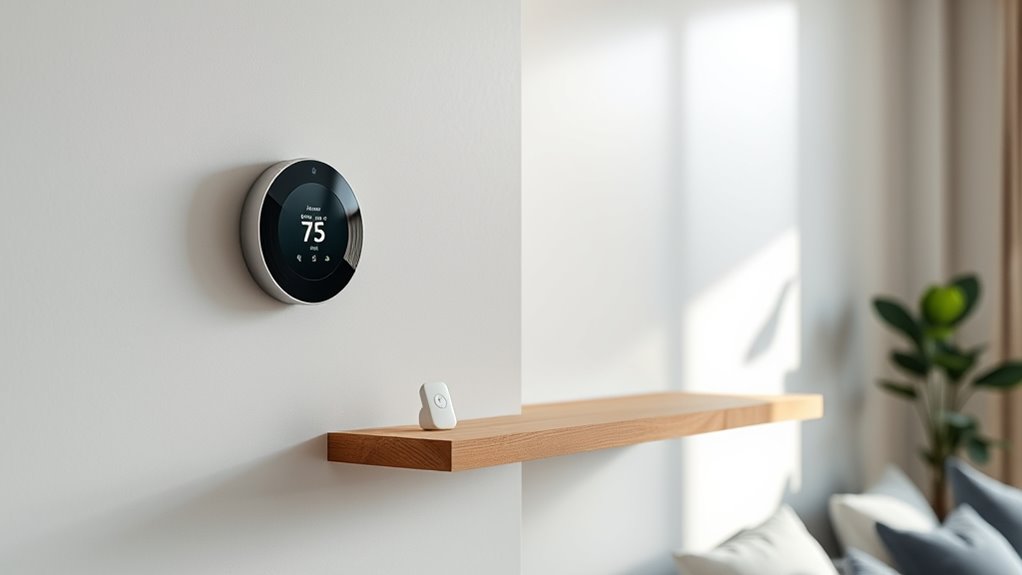

If you’re looking for the best smart thermostats with remote sensors, I recommend options like the ecobee Smart Thermostat Premium, T9 WiFi model, and Google Nest Learning Thermostat (4th Gen). These devices support multiple sensors for seamless zone control, energy savings, and increased comfort. They easily integrate with smart home systems and voice assistants. Keep exploring to find out which one fits your needs perfectly and how to maximize your home’s climate control.
Key Takeaways
- Look for models supporting multiple remote sensors for precise multi-room climate management and zone control.
- Prioritize thermostats compatible with popular ecosystems like Google Assistant, Alexa, or Apple HomeKit.
- Check sensor range and placement flexibility to ensure comprehensive coverage in large or multi-story homes.
- Consider energy-saving features such as auto-away, occupancy detection, and smart scheduling for efficiency.
- Evaluate installation requirements and compatibility with your HVAC system to ensure seamless setup and operation.
ecobee Smart Thermostat Premium with Sensors


The ecobee Smart Thermostat Premium with Sensors is an excellent choice for homeowners looking to maximize energy savings and home comfort. It can save up to 26% annually on heating and cooling costs and is ENERGY STAR certified. The included SmartSensor adjusts temperature in key rooms, reducing hot and cold spots compared to maintaining a fixed temperature. It also detects windows or doors left open for more than five minutes, automatically pausing HVAC to prevent waste. With built-in air quality monitoring, smoke detection, and home security alerts, it offers detailed control. Its sleek design, vibrant display, and voice control options make managing your home environment both effortless and stylish.
Best For: homeowners seeking to enhance energy efficiency, home comfort, and security with a sleek, smart thermostat that offers advanced features and easy integration.
Pros:
- Up to 26% annual savings on heating and cooling costs, certified by ENERGY STAR.
- SmartSensor technology reduces hot and cold spots by adjusting temperature in key rooms.
- Built-in air quality, smoke detection, and security alerts provide comprehensive home monitoring.
Cons:
- Requires an Apple Home Hub to enable Siri voice control features.
- Security features such as break-in alerts need a separate ecobee Smart Security plan.
- Compatibility limited to most 24VAC HVAC systems; may not suit all home setups.
T9 WiFi Smart Thermostat with 1 Smart Room Sensor

If you’re looking for an easy-to-install smart thermostat that enhances comfort and energy efficiency in small to medium homes, the T9 WiFi Smart Thermostat with 1 Smart Room Sensor is a great choice. It features a sleek touchscreen display, voice control compatibility with Alexa, Apple HomeKit, and Google Assistant, plus remote management via the Honeywell Home app. The included battery-powered sensor detects occupancy and temperature in specific rooms, helping balance comfort across multiple zones. Its Wi-Fi connectivity allows remote adjustments, Auto Home/Away scheduling, and energy savings. Perfect for DIY installation, it works with various heating systems and supports multi-room control for a more efficient, comfortable home.
Best For: homeowners seeking an easy-to-install, energy-efficient smart thermostat with multi-room control and smart home integration.
Pros:
- Easy DIY installation with included adapters and guided setup.
- Supports multiple voice assistants (Alexa, Siri, Google) for hands-free control.
- Features smart room sensors that improve comfort and energy efficiency across different zones.
Cons:
- Does not support electric baseboard heating (120-240V).
- Lacks adjustable differential (hysteresis) settings, defaulting to approximately ±1°F.
- Limited to one sensor in the basic package, requiring additional purchase for multi-room use.
Smart WiFi Thermostat with Room Sensor and Large Screen

A smart WiFi thermostat with a room sensor and large screen is ideal for homeowners seeking precise temperature control and easy operation. It supports over 95% of 24VAC HVAC systems, including central air, heat pumps, boilers, and furnaces, with simple self-test setup. The large 3.95-inch display offers clear readings, while the intuitive touch interface makes adjustments effortless for all ages. It works with the Provirtec smart thermo-hygrometer for real-time monitoring and uses body location-based detection for accurate comfort. Supporting 2.4GHz WiFi and BT Mesh, it guarantees stable connectivity, even during network disruptions, for seamless climate management.
Best For: homeowners seeking precise, easy-to-use WiFi-enabled thermostat with real-time monitoring and compatibility with most 24VAC HVAC systems.
Pros:
- Supports over 95% of common 24VAC HVAC systems, ensuring broad compatibility.
- Large 3.95-inch screen provides clear temperature readings for effortless monitoring.
- Maintains stable connectivity with 2.4GHz WiFi and BT Mesh, even during network disruptions.
Cons:
- Requires a compatible 2.4GHz WiFi network for optimal operation, limiting use with dual-band setups.
- Needs the Prodigytec app for full functionality and firmware updates, which may add complexity.
- The device’s reliance on WiFi and app integration might not suit users preferring standalone thermostats.
Google Nest Learning Thermostat (4th Gen, 2024) with Nest Temperature Sensor

For homeowners who prioritize sleek design combined with advanced learning capabilities, the Google Nest Learning Thermostat (4th Gen, 2024) with Nest Temperature Sensor stands out as an excellent choice. Its polished Obsidian finish and minimalistic round shape fit seamlessly into modern decor, while the 60% larger touchscreen with Dynamic Farsight offers clear, easy-to-read information from across the room. It adapts to your preferences over time, optimizing comfort and energy savings. Installation is simple, often self-done in about 10 minutes, and it supports most 24V systems. With voice control, smart home integration, and room-specific temperature regulation via the Nest Sensor, it’s a stylish, intelligent upgrade for any home.
Best For: homeowners seeking a stylish, highly intelligent thermostat with advanced learning features and seamless smart home integration.
Pros:
- Elegant, minimalistic design with a polished Obsidian finish and large, easy-to-read touchscreen.
- Learns user preferences over time to optimize comfort and reduce energy costs.
- Supports voice control and smart home compatibility via Google Assistant, Alexa, Apple HomeKit, and Matter.
Cons:
- Higher price point compared to previous models and some other smart thermostats.
- Limited compatibility outside the US may restrict international users.
- Installation, while straightforward, may still pose challenges for those unfamiliar with wiring or smart devices.
ecobee Smart Thermostat Essential – Wi-Fi Programmable Thermostat

The ecobee Smart Thermostat Essential stands out as an excellent choice for homeowners seeking energy savings without sacrificing ease of use. It can save up to 23% annually on heating and cooling costs by automatically adjusting to your schedule and reducing energy use when you’re away. You can track your energy consumption remotely via the ecobee app. Compatible with most HVAC systems, it’s easy to install, even without a C-wire, thanks to the Power Extender Kit. The color touchscreen makes temperature control simple, and it integrates seamlessly with Apple HomeKit, Alexa, and Google Assistant for smart voice commands.
Best For: homeowners seeking an energy-efficient, easy-to-install smart thermostat compatible with multiple HVAC systems and smart home platforms.
Pros:
- Saves up to 23% annually on heating and cooling costs.
- Easy DIY installation without a C-wire, thanks to the Power Extender Kit.
- Seamless integration with Apple HomeKit, Alexa, and Google Assistant for voice control and automation.
Cons:
- Compatibility with HVAC systems should be verified on the ecobee support page; not all systems may be supported.
- Limited to 24 VAC HVAC equipment; incompatible with some proprietary or older systems.
- The color touchscreen, while intuitive, may be small for users with visual impairments or preferences for larger displays.
Sensi Touch 2 Smart Thermostat with Touchscreen

If you’re looking for a smart thermostat that combines a sleek touchscreen interface with robust compatibility, the Sensi Touch 2 is an excellent choice. It features a vibrant color LCD display, Wi-Fi connectivity, and easy DIY installation, requiring a common C-wire. Compatible with most HVAC systems and popular smart home platforms like Alexa, Google Assistant, and Samsung SmartThings, it also supports optional Sensi Room Sensors for better zone control. This Energy Star-certified device helps reduce energy use by around 23, offers flexible scheduling, geofencing, and remote control via its intuitive app. Customers praise its reliability, user-friendly setup, and seamless integration.
Best For: homeowners seeking an easy-to-install, energy-efficient smart thermostat with a user-friendly touchscreen interface and reliable smart home integration.
Pros:
- Intuitive color touchscreen display for easy control and programming
- Compatible with popular platforms like Alexa, Google Assistant, and Samsung SmartThings
- Supports optional room sensors for improved zone-based temperature management
Cons:
- Requires a common C-wire for installation, which may necessitate additional wiring in some homes
- Initial Wi-Fi setup can be challenging for some users, leading to connectivity issues
- Limited to a 3-year warranty, which may be shorter than some competitors
Sensi Smart Thermostat
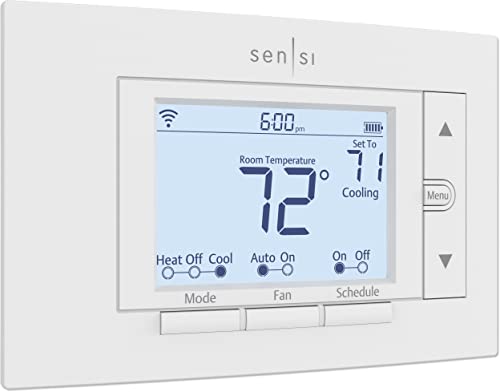
With its straightforward design and DIY-friendly installation, the Sensi Smart Thermostat stands out as an ideal choice for homeowners seeking an easy-to-set-up, Wi-Fi-enabled thermostat that doesn’t require a professional installer. It features a traditional look with buttons, fitting seamlessly into standard wall space without patching or painting. Compatible with most HVAC systems and often requiring no common wire (c-wire), it offers flexible scheduling, remote control via app, and integration with Alexa. Plus, it helps save around 23% on energy costs through efficiency monitoring, detailed reports, and maintenance alerts. Privacy is a priority, as Sensi doesn’t sell user data, ensuring your information stays secure.
Best For: homeowners seeking an easy-to-install, Wi-Fi-enabled thermostat with a traditional look that offers energy savings and smart home integration without professional installation.
Pros:
- Easy DIY installation with built-in level and step-by-step app instructions
- Compatible with most HVAC systems and often requires no c-wire
- Helps reduce energy costs by approximately 23% through flexible scheduling and remote control
Cons:
- May have limited advanced features compared to more complex smart thermostats
- Some users might experience connectivity issues with Wi-Fi or app integration
- The traditional design might not appeal to those preferring modern, sleek thermostat aesthetics
RCHTSENSOR-1PK, Smart Room Sensor works with T9/T10 WIFI Smart Thermostats

Designed for homeowners seeking precise temperature control in multiple rooms, the RCHTSENSOR-1PK Smart Room Sensor pairs seamlessly with T9/T10 WIFI Smart Thermostats. It’s compatible with Series 3 and Series 4 models, and setup is straightforward—no tools needed, just the Resideo app. This sensor accurately detects temperature and humidity across different rooms and uses motion detection to identify occupied spaces, enhancing comfort. You can customize temperature settings, focus on high-traffic areas, and create sleep schedules for bedrooms. With remote management via the app, I can control my home environment anytime, ensuring ideal comfort and energy efficiency throughout my house.
Best For: homeowners seeking precise, multi-room temperature and humidity control with easy DIY installation and remote management.
Pros:
- Seamless compatibility with Series 3 & 4 T9/T10 WIFI Smart Thermostats for integrated comfort control
- Easy setup without tools using the Resideo app, making installation quick and straightforward
- Uses motion detection to identify occupied rooms, enhancing energy efficiency and personalized comfort
Cons:
- Requires T9 or T10 WIFI Smart Thermostats for full functionality, limiting compatibility with other systems
- May need a stable Wi-Fi connection for optimal remote control and sensor performance
- Limited to temperature and humidity sensing; does not include additional environmental monitoring features
Amazon Smart Thermostat

The Amazon Smart Thermostat is an excellent choice for budget-conscious homeowners seeking seamless integration with Alexa and easy installation. Released in 2021, it offers features like automatic control, energy savings, and smart home compatibility. It works with most 24V HVAC systems, including heat pumps and radiant boilers, but needs a C-wire or power adapter (sold separately). Its simple setup via the Alexa app makes installation quick. With energy dashboards, scheduling, and voice control, it’s designed for user convenience. Although some wiring adjustments may be necessary, overall, it provides a cost-effective, reliable smart thermostat that enhances home comfort and efficiency.
Best For: budget-conscious homeowners seeking easy-to-install, Alexa-compatible smart thermostat with energy-saving features.
Pros:
- Seamless integration with Alexa for voice control and automation
- Simple, guided setup via the Alexa app for quick installation
- Cost-effective with energy dashboards and scheduling features
Cons:
- May require additional wiring or a power adapter for certain HVAC systems
- Occasional connectivity issues after power outages reported by users
- Limited on-device control; relies heavily on app and Alexa ecosystem
Honeywell Home T9 Smart Thermostat with Room Sensor (Renewed)

If you’re looking to optimize comfort and energy savings in your home, the Honeywell Home T9 Smart Thermostat with Room Sensor (Renewed) is an excellent choice. It offers advanced control features like Auto Changeover, Auto-Away, and geofencing, plus support for various heating systems. The included Smart Room Sensors focus on specific rooms up to 200 feet away, improving comfort and sleep quality. Wi-Fi connectivity allows remote management via app or voice assistants like Alexa and Google Assistant. While setup can be complex, many users appreciate its energy-saving capabilities and flexible ecosystem integration. Overall, it’s a reliable option for smarter, more efficient home climate control.
Best For: homeowners seeking an energy-efficient, smart thermostat with room-specific temperature control and remote management capabilities.
Pros:
- Supports advanced features like Auto Changeover, Auto-Away, and geofencing for optimized comfort and savings.
- Includes Smart Room Sensors that enhance temperature accuracy and comfort in specific rooms.
- Compatible with popular voice assistants and smart home ecosystems for seamless integration.
Cons:
- Setup can be complex, especially with certain Wi-Fi routers or network configurations.
- Connectivity issues with the app or voice platforms may require troubleshooting and technical knowledge.
- Requires a C-wire for power, which may not be available in all homes.
ecobee Smart Thermostat Enhanced
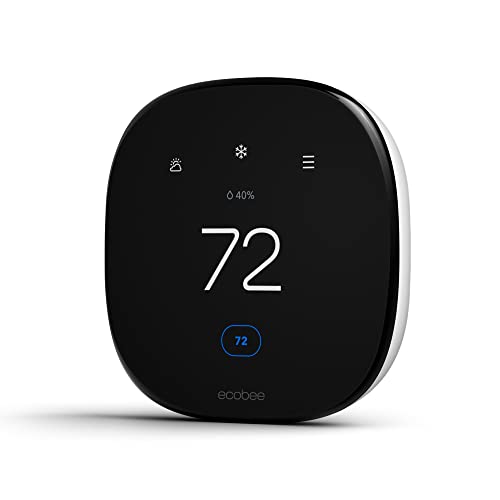
For homeowners seeking both energy savings and personalized comfort, the ecobee Smart Thermostat Enhanced stands out with its advanced occupancy and humidity adjustments. It can save up to 26% annually on heating and cooling by automatically adjusting temperatures when the home is empty or preconditioning rooms before you arrive. It also maintains comfort during sleep and occupancy. The thermostat’s sensors monitor humidity, ensuring a balanced, comfortable environment. With voice control via Siri, Alexa, or Google Assistant, plus remote access through the app or Apple Watch, it offers seamless control. Easy to install, it’s compatible with most HVAC systems and certified energy-efficient, making it a versatile, smart upgrade.
Best For: homeowners seeking energy-efficient smart thermostat solutions with customizable comfort and seamless smart home integration.
Pros:
- Saves up to 26% annually on heating and cooling costs through automatic adjustments and occupancy sensing.
- Compatible with major voice assistants like Siri, Alexa, and Google Assistant for hands-free control.
- Easy installation with optional Power Extender Kit and support for most HVAC systems.
Cons:
- Requires Wi-Fi connection for remote features, which may be a limitation in weak signal areas.
- Advanced setup and sensor placement may require some technical know-how.
- Higher initial cost compared to basic thermostats, though offset by energy savings.
T9 WiFi Smart Thermostat with Room Sensor and Touchscreen
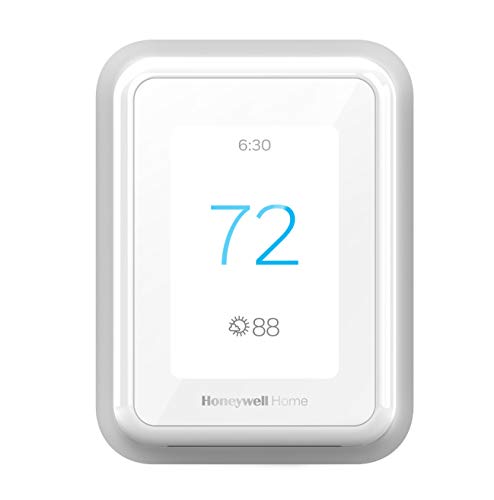
Anyone seeking an affordable yet feature-rich smart thermostat will appreciate the T9 WiFi Smart Thermostat with Room Sensor and Touchscreen. It offers a sleek, easy-to-use display, compatible with Alexa and Google Assistant for voice control. With support for most heat/cool oil furnace systems and remote smart sensors (sold separately), it enhances comfort and efficiency by focusing on specific rooms. The thermostat supports customizable weekly schedules, auto switching between heat and cool, and remote management via its intuitive app. Energy-saving features, including monthly reports and utility program integration, help reduce costs. Its plug-and-play design and high-quality display make installation and daily use straightforward.
Best For: homeowners seeking an affordable, easy-to-install smart thermostat with customizable scheduling and room-specific temperature control.
Pros:
- Supports remote sensors for targeted comfort and efficiency
- Compatible with Alexa and Google Assistant for voice control
- User-friendly touchscreen display and intuitive app interface
Cons:
- Does not work with electric baseboard heat (120-240V)
- Requires a C-wire for installation in some systems
- Remote sensors are sold separately, adding to overall cost
LEVOIT Smart Thermostat for Home, WiFi Programmable Digital Thermostat

The LEVOIT Aura 400S Smart Thermostat stands out for those seeking precise room-to-room comfort with its support for up to 16 remote sensors. I appreciate its compatibility with Alexa, Google Assistant, Android, and iOS, making it easy to integrate into my smart home. The large 4-inch touchscreen is clear, and auto-brightness helps conserve energy. It handles various HVAC systems, including heat pumps and cooling-only setups, with simple installation thanks to the included C-wire adapter. I find the 24/7 scheduling and eco-level settings valuable for energy savings. Overall, it’s a versatile choice, though some users report occasional quirks like unusual blower sounds.
Best For: homeowners seeking customizable, energy-efficient smart thermostat control with multi-room monitoring and seamless smart home integration.
Pros:
- Supports up to 16 sensors for precise room-to-room comfort management
- Compatible with Alexa, Google Assistant, Android, and iOS for easy voice and app control
- Features a large, auto-brightness touchscreen with simple installation using the included C-wire adapter
Cons:
- Screen turns off after a period, which may inconvenience some users
- Occasional reports of unusual blower sounds during cooling cycles
- Compatibility issues may arise with certain HVAC wiring configurations, like E or O/B wires
Factors to Consider When Choosing Smart Thermostats With Remote Sensors

When selecting a smart thermostat with remote sensors, I evaluate how effectively it functions with my HVAC system and where I can position the sensors for ideal coverage. I also seek models that are simple to install and smoothly integrate with my current smart home configuration. Finally, I emphasize sensor precision and range to guarantee dependable temperature measurements throughout my residence.
Compatibility With HVAC Systems
Choosing a smart thermostat with remote sensors starts with guaranteeing it’s compatible with your specific HVAC system. Not all thermostats support every type, so check if yours is compatible with forced air, heat pumps, boilers, or electric systems. If you have a multi-zone setup, guarantee the thermostat can integrate remote sensors designed for those zones, like ecobee or Honeywell sensors. Connectivity is key—verify that the thermostat communicates with sensors via Wi-Fi, Zigbee, or proprietary protocols for reliable performance. Also, confirm it supports the number and placement of sensors you plan to use for ideal temperature balancing. Finally, review your system’s power needs and wiring, especially if a C-wire is required, to guarantee smooth integration and remote sensor functionality.
Sensor Placement Flexibility
Flexible sensor placement plays a crucial role in maximizing comfort and energy efficiency, as it allows me to measure temperature accurately in key areas of my home. The signal range, often up to 200 feet, influences where I can place sensors without losing connectivity. I avoid spots near external heat sources like sunlight or heating vents to guarantee accurate readings. Placing sensors in multiple rooms helps with zoning control, especially in multi-story homes, reducing hot or cold spots. Proper placement also improves occupancy detection and temperature balancing, making my home more comfortable and energy-efficient. The ability to position sensors flexibly means I can optimize comfort without extensive wiring or complicated installation, ensuring my system adapts seamlessly to my living space.
Ease of Installation Process
Selecting a smart thermostat with remote sensors can be straightforward if I pay attention to key factors that influence installation. Many models are designed for DIY setup, providing step-by-step instructions or app-guided processes that make installation accessible. Compatibility with existing HVAC wiring, like the need for a common (C) wire or low-voltage adapters, can affect how easy the process is. Installing remote sensors is usually simple—just place them in desired rooms and pair them via the app or setup interface. Some units come with wall-mounting hardware and clear labeling of wires, which simplifies replacing traditional thermostats. User-friendly manuals and intuitive apps also help streamline the setup, ensuring I can get my smart thermostat up and running quickly and with minimal hassle.
Integration With Smart Home
To make the most of remote sensors, it’s essential to evaluate how well a smart thermostat integrates with your existing smart home ecosystem. Compatibility with platforms like Apple HomeKit, Google Assistant, or Amazon Alexa guarantees seamless control and automation. Support for protocols such as Matter, Zigbee, or Z-Wave enhances interoperability, allowing sensors to communicate with a variety of smart devices. This integration enables remote monitoring and control via voice commands or smartphone apps from anywhere, making climate management more convenient. Plus, smart thermostats that support multi-platform control can automatically adjust temperatures based on sensor data, optimizing comfort. When choosing a thermostat, make sure it can work smoothly within your existing routines and automation setups for truly seamless home climate control.
Sensor Accuracy and Range
How accurate are the remote sensors in your smart thermostat, and does their range meet your home’s needs? Typically, these sensors are precise within ±0.5°F to ±1°F, which affects how reliably your system can adjust the temperature. If the sensors aren’t exact, you might notice uneven comfort levels. Their range varies from around 200 feet indoors to over 300 feet outdoors, impacting coverage in larger or multi-story homes. Accurate sensors use advanced thermistors or digital technology to detect temperature changes quickly and reliably. Keep in mind that sensor placement is essential—placing them away from drafts, direct sunlight, or heat sources guarantees maximum accuracy. Proper range and placement are key to maintaining consistent, comfortable temperatures throughout your home.
Energy-Saving Features
Energy-saving features are essential when choosing smart thermostats with remote sensors because they directly impact your home’s efficiency and ongoing costs. These features enable the thermostat to adjust temperatures intelligently based on occupancy, room conditions, and schedules, reducing energy waste. Auto-scheduling, geofencing, and occupancy detection help cut back HVAC use when rooms are unoccupied, saving money. Many models also provide energy reports and usage analytics, helping you identify inefficiencies and optimize settings. Preheating or precooling your home before you’re there ensures comfort without unnecessary energy expenditure during peak times. Additionally, integration with utility demand response programs and energy rebates can offer extra savings and incentives, making these features not just convenient but also financially advantageous.
User Interface Simplicity
Choosing a smart thermostat with remote sensors becomes much easier when the user interface is simple and straightforward. A clear display of temperature and intuitive controls make it easy to set and adjust preferences without hassle. Touchscreens with large fonts and simple menus reduce the learning curve, even for new users. Visual indicators, like color-coded system statuses—orange for heating, blue for cooling—help you quickly understand what’s happening. Compatibility with voice control and easy app navigation also streamline remote adjustments, making daily management effortless. Minimalist designs with fewer buttons and cluttered screens improve usability, especially for seniors or those less tech-savvy. Overall, a simple interface enhances user experience, ensuring seamless control over your home’s climate without frustration.
Frequently Asked Questions
How Do Remote Sensors Improve Overall Home Climate Management?
Remote sensors improve my home climate management by providing accurate temperature readings from different rooms. This helps my thermostat adjust more precisely, ensuring consistent comfort throughout my house. I don’t have to manually tweak settings in each area, saving me time and energy. Plus, they detect occupancy, so the system only heats or cools when rooms are in use, making my home more efficient and comfortable.
Can Remote Sensors Be Calibrated for Different Room Sizes?
Imagine calibrating a vintage radio—yes, remote sensors can be adjusted for different room sizes. I’ve found that most smart thermostats let you set sensor sensitivity or placement, ensuring accurate readings regardless of room dimensions. When installing, I recommend placing sensors at ideal heights and distances, then fine-tuning settings through the app. This way, you get a balanced climate, no matter the room’s size or layout.
Are Remote Sensors Compatible With Existing HVAC Systems?
Remote sensors are generally compatible with most existing HVAC systems, especially if you choose a smart thermostat designed for integration. I’ve found that many models support standard wiring and communication protocols, making setup straightforward. However, it’s always wise to check your specific system’s compatibility before purchasing. If your HVAC is newer and supports smart integrations, remote sensors should work seamlessly, helping you optimize comfort throughout your home.
How Do Remote Sensors Affect Energy Savings and Utility Bills?
Remote sensors help me save on energy and utility bills by providing accurate temperature readings in different rooms. This allows my thermostat to adjust heating or cooling more precisely, avoiding unnecessary energy use. With sensors in key areas, I can maintain a comfortable environment without overworking my HVAC system. Overall, they optimize my home’s climate control, making my energy consumption more efficient and reducing costs over time.
What Are the Maintenance Requirements for Remote Sensors?
Remote sensors need minimal maintenance to stay effective. I regularly check them for dust or dirt that could affect their readings, and I make sure they’re securely placed. Occasionally, I replace batteries if they’re wireless, as low power can cause inaccurate data. Overall, I find that keeping sensors clean and checking their battery life is simple and helps maintain accurate climate control and energy efficiency in my home.
Conclusion
In the end, choosing the right smart thermostat with remote sensors feels like revealing the secret to perfect home comfort—an upgrade so monumental it practically transforms your entire living experience. With these incredible devices, you’ll enjoy climate control so seamless and precise, it’s as if your home anticipates your every need before you even realize it. Trust me, once you go smart, you’ll wonder how you ever lived without this level of effortless, game-changing comfort!