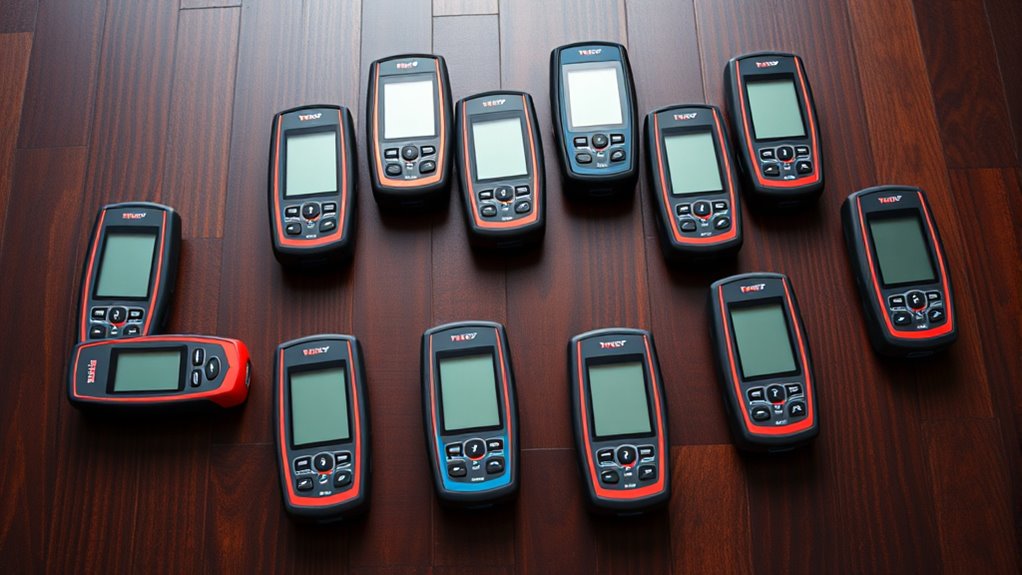

For checking moisture in wood and finished walls without leaving pin holes, the Tramex Moisture Encounter ME5 is my best overall pick for its non-destructive focus, while the General Tools MMD950 stands out for buyers who also want pin readings. The Klein Tools ET140 is a simpler option for routine spot checks. The main tradeoff is between a dedicated pinless meter, which keeps scanning straightforward, and a dual-mode model, which can confirm readings deeper in a material but requires touching the surface with pins. Material compatibility and scan depth also vary, so a reading is best treated as a comparison rather than a definitive diagnosis. Read on for my full breakdown of all 12 options and guidance on choosing the right meter for your work.

Get business pricing on tools and workshop supplies
- Business-only prices and quantity discounts
- Tax-exempt purchasing
- Multiple users, one account, clear invoices
Complete the kit

Key Takeaways
- Tramex ME5 leads this group for non-destructive work: its dedicated pinless design best fits repeated surface scans where avoiding marks matters.
- The General Tools MMD950 and 2-in-1 meter suit buyers who need a follow-up check: pin mode can help investigate a suspicious spot, though it leaves marks.
- Rechargeable models such as RDINSCOS and AWT-380 prioritize convenience: that can simplify routine use, but charging adds a maintenance step absent from battery-powered alternatives.
- Klein ET140 and General Tools MMD7NP offer more focused roles: they make sense for straightforward pinless checks, while broad material claims on other models call for careful calibration and interpretation.
- No meter here replaces moisture diagnosis: surface texture, material density, hidden layers, and nearby metal can affect readings, so repeat scans and compare with a known-dry area.
| General Tools MMD950 Pin-Type and Pinless Moisture Meter | 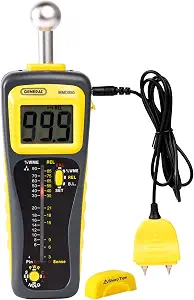 | Best for Pinless Checks Plus Confirmation | Measurement modes: Pin (%WME) and pinless (REL) | Display: Jumbo LCD and 40-dot tri-color LED bar graph | Pinless sensing depth: Up to 4 inches | VIEW ON AMAZON | See Our Full Breakdown |
| Pinless Digital Moisture Meter for Wood and Walls |  | Best for Simple Dark-Area Checks | Sensor type: Pinless, non-destructive | Compatible surfaces: Wood, masonry, concrete, and more | Additional feature: Built-in LED flashlight | VIEW ON AMAZON | See Our Full Breakdown |
| RDINSCOS Rechargeable Pinless Moisture Meter for Drywall | 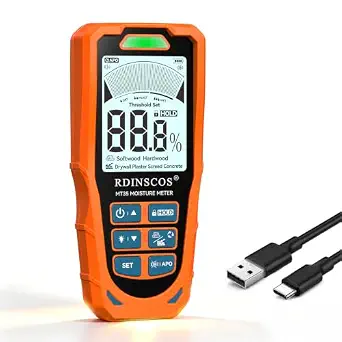 | Best for Rechargeable Multi-Material Scanning | Material modes: Softwood, hardwood, drywall, plaster, screed, and concrete | Detection depth: 19 mm | Screen: 2.9-inch backlit display | VIEW ON AMAZON | See Our Full Breakdown |
| Povlen Pinless Moisture Meter for Wood, Drywall, and Building Materials |  | Best for Guided Material-Mode Scanning | Measurement modes: Softwood, hardwood, wall, and masonry | Measurement method: Pinless, high-frequency sensor | Display: Color LCD with analog bar | VIEW ON AMAZON | See Our Full Breakdown |
| Tramex Moisture Encounter ME5 Non-Destructive Moisture Meter |  | Best for Building Surveys and Moisture Mapping | Measurement type: Non-destructive, pinless | Shallow depth penetration: Up to 0.4 in (9 mm) | Deep depth penetration: Up to 1.25 in (30 mm) | VIEW ON AMAZON | See Our Full Breakdown |
| General Tools MMD7NP Pinless Digital Moisture Meter |  | Best Classic Choice | Measurement depth: Up to 3/4 in (19 mm) | Softwood range: 0–53% | Hardwood range: 0–35% | VIEW ON AMAZON | See Our Full Breakdown |
| Klein Tools ET140 Pinless Moisture Meter |  | Best for Tradespeople | Detection depth: Up to 3/4 inch (19 mm) | Detection method: Pinless electromagnetic field (EMF) | Compatible materials: Drywall, masonry, hardwood, and softwood | VIEW ON AMAZON | See Our Full Breakdown |
| 2-in-1 Pin & Pinless Moisture Meter for Wood and Building Materials | 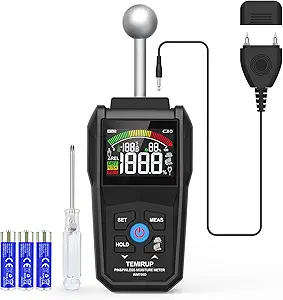 | Best Versatility Pick | Measurement modes: Relative and absolute (pin & pinless) | Measurement depth: 20–40 mm below surface | Temperature range: -10 to 60 °C (14–140 °F) | VIEW ON AMAZON | See Our Full Breakdown |
| AWT-380 Rechargeable Pinless Moisture Meter for Wood, Drywall & Masonry |  | Best Modern Features | Measurement type: Pinless (non-destructive) | Measuring depth: Up to 0.79 in (20 mm) | Reading speed: Within 1 second (2 scans per second) | VIEW ON AMAZON | See Our Full Breakdown |
| Mutt Tools Pinless Moisture Meter for Drywall, Wood, and Masonry |  | Best Deep-Scan Value | Measurement depth: Up to 2 inches | Measurement type: Pinless (non-destructive) | Compatible materials: Drywall, wood, masonry | VIEW ON AMAZON | See Our Full Breakdown |
| General Tools MM8 Pinless Moisture Meter for Wood, Walls & Mold Detection |  | Best for Material-Specific Checks | Brand: General Tools | Model: MM8 | Sensing type: Pinless, non-marring | VIEW ON AMAZON | See Our Full Breakdown |
| Pinless Digital Moisture Meter for Walls, Floors, Wood, and Masonry |  | Best for Straightforward DIY Checks | Model: MT28 | Sensing method: Pinless | Sensing depth: Up to 0.75 inches | VIEW ON AMAZON | See Our Full Breakdown |
| moisture meters pinless | Display |
|---|---|
| General Tools MMD950 Pin-Type | Jumbo LCD and 40-dot tri-color LED bar graph |
| Pinless Digital Moisture Meter | — |
| RDINSCOS Rechargeable Pinless | — |
| Povlen Pinless Moisture Meter | Color LCD with analog bar |
| Tramex Moisture Encounter ME5 | Large analog display |
| General Tools MMD7NP Pinless D | 2 in diagonal backlit LCD |
| Klein Tools ET140 Pinless Mois | Reverse-contrast display with nine LED bars |
| 2-in-1 Pin & Pinless Moisture | Large color LCD |
| AWT-380 Rechargeable Pinless M | Color display with max hold and data storage |
| Mutt Tools Pinless Moisture Me | — |
| General Tools MM8 Pinless Mois | 2-inch (50 mm) backlit white LCD digits |
| Pinless Digital Moisture Meter | Three-color LCD |
More Details on Our Top Picks
General Tools MMD950 Pin-Type and Pinless Moisture Meter
Two measurement modes make the MMD950 the most flexible choice here: its pinless sensor checks behind surfaces, then the included probe can investigate a specific spot when a reading needs follow-up. The sensor reaches up to 4 inches, deeper than the stated 19 mm reach of the RDINSCOS, which can help when checking walls or tile without opening them. A jumbo LCD and tri-color bar graph make readings easier to scan, while the 46-inch probe cable helps reach awkward areas. The tradeoff is that pin mode still leaves marks, and pinless readings are relative rather than a direct moisture percentage. Compared with the Tramex ME5, the MMD950 adds pin testing and a deeper stated reach, while the ME5 offers dual-depth comparisons and app reporting.
Pros:- Combines pinless scanning with pin measurement for follow-up checks
- Pinless sensor detects moisture up to 4 inches behind surfaces
- Jumbo LCD and tri-color bar graph make readings easy to scan
- Includes a 46-inch remote probe cable
Cons:- Pin measurements require inserting pins into the material
- Uses a 9V battery rather than a rechargeable battery
- Pinless readings use a relative scale rather than a stated moisture percentage
Best for: Inspectors and repair professionals who want to scan building materials without damage and use a probe to confirm suspicious spots
Not ideal for: Buyers who need exclusively non-invasive readings or want a rechargeable meter, since pin mode uses inserted probes and the MMD950 runs on a 9V battery
- Measurement modes:Pin (%WME) and pinless (REL)
- Display:Jumbo LCD and 40-dot tri-color LED bar graph
- Pinless sensing depth:Up to 4 inches
- Remote probe cable:46 inches
- Power:9V battery
- Calibration:Manual and automatic
- Additional features:Hold function; auto power-off after 3, 5, or 10 minutes
Our verdict“Choose the MMD950 if you want deep pinless screening with a probe for targeted confirmation and can accept pin marks and a 9V battery.”
Pinless Digital Moisture Meter for Wood and Walls
This meter suits a homeowner who wants a straightforward, non-destructive scan while checking for damp patches or possible leaks. Its pinless sensor works across wood, masonry, concrete, and other surfaces, and the built-in LED flashlight can help when inspecting a dim cabinet, basement corner, or under-sink area. Compared with the Povlen, which specifies four material modes and audible and visual alerts, this model’s supplied details focus on broad surface compatibility and the flashlight. That keeps the pitch simple, but leaves less guidance for comparing readings across material types: no measurement depth, modes, range, or accuracy figures are provided. Nearby metal can also interfere with readings, so it is a less dependable choice around pipes, fasteners, or metal-backed surfaces.
Pros:- Pinless checks avoid drilling holes or leaving pin marks
- Works on wood, masonry, concrete, and other surfaces
- Built-in LED flashlight helps illuminate dark inspection areas
Cons:- Nearby metal can interfere with readings
- The supplied product data does not state sensing depth, measurement range, or accuracy
- No material modes or measurement display details are specified
Best for: Homeowners checking accessible wood, masonry, or concrete surfaces in dim rooms who want to avoid pinholes
Not ideal for: Inspectors who need specified sensing depth, material-specific modes, or readings around metal fixtures
- Sensor type:Pinless, non-destructive
- Compatible surfaces:Wood, masonry, concrete, and more
- Additional feature:Built-in LED flashlight
- Reading interference:Nearby metal surfaces may affect readings
Our verdict“Pick this model for basic, flashlight-assisted surface checks, but choose the Povlen if you want stated material modes and alerts.”
RDINSCOS Rechargeable Pinless Moisture Meter for Drywall
The RDINSCOS is a strong fit for repeated, pin-free checks across six material types, including drywall, plaster, screed, and concrete. Its 19 mm detection depth gives buyers a stated reference for how far beneath a surface it can sense; the General Tools MMD950 claims a deeper reach of up to 4 inches, though it also adds pin testing. A 2.9-inch backlit screen and adjustable LED and buzzer thresholds help make scans easier to follow in dim spaces or during a room-by-room inspection. USB recharging and up to eight hours of use suit recurring jobs without disposable batteries. The key limitation is that it reports relative values rather than exact moisture percentages, so its alerts are better for locating suspect areas than documenting precise moisture content.
Pros:- Offers six modes for softwood, hardwood, drywall, plaster, screed, and concrete
- Pinless detection reaches up to 19 mm without making holes
- Backlit 2.9-inch display with adjustable LED and buzzer alerts
- USB-rechargeable battery provides up to 8 hours of use
Cons:- Displays relative moisture values rather than exact percentages
- Does not provide pin-type confirmation like the General Tools MMD950
- The stated 19 mm depth is shorter than the MMD950’s stated reach
Best for: DIY renovators and property-maintenance teams who scan several building materials regularly and prefer USB recharging
Not ideal for: Buyers who need exact moisture percentages or pin-type confirmation for professional documentation
- Material modes:Softwood, hardwood, drywall, plaster, screed, and concrete
- Detection depth:19 mm
- Screen:2.9-inch backlit display
- Battery:1200mAh lithium-polymer, USB-rechargeable
- Battery life:Up to 8 hours
- Auto shutdown:Yes
- Measurement output:Relative moisture values
Our verdict“Choose the RDINSCOS for rechargeable, multi-material screening with clear alerts, and skip it if exact moisture percentages are required.”
Povlen Pinless Moisture Meter for Wood, Drywall, and Building Materials
With separate settings for softwood, hardwood, walls, and masonry, the Povlen gives a home inspector a more directed scan than the broadly described Pinless Digital Moisture Meter for Wood and Walls. Its color LCD, analog bar, and audible beep offer several ways to spot a reading that crosses a threshold, while the HOLD function can preserve a value when checking an awkward area. The high-frequency pinless sensor avoids pinholes and scratches, which is useful on finished surfaces. There are limits to how confidently a buyer can compare its performance: the supplied details give no measurement range, accuracy, or sensing depth. Softwood also requires choosing the right density grade, so setup affects the usefulness of a reading. The RDINSCOS provides a stated depth and rechargeable battery, while the Povlen emphasizes its display and mode-based alerts.
Pros:- Four modes cover softwood, hardwood, walls, and masonry
- Pinless sensor avoids holes and scratches on finished surfaces
- Color LCD, analog bar, and audible alert help flag readings
- HOLD function makes it easier to record readings in awkward spots
Cons:- No measurement range, accuracy, or sensing depth is specified
- Softwood checks require selecting the appropriate density grade
- Battery type and runtime are not stated in the supplied product data
Best for: Homeowners and property inspectors who want guided scans across common wood and building-material categories with audible alerts
Not ideal for: Buyers who need documented accuracy, a stated sensing depth, or a rechargeable power specification
- Measurement modes:Softwood, hardwood, wall, and masonry
- Measurement method:Pinless, high-frequency sensor
- Display:Color LCD with analog bar
- Alerts:Audible beep and red display
- Additional features:HOLD function, auto power-off, and low-battery indicator
- Softwood setting:Select an appropriate density grade
Our verdict“Choose the Povlen for mode-guided scans and clear alerts, but favor the RDINSCOS if stated depth and rechargeable power matter more.”
Tramex Moisture Encounter ME5 Non-Destructive Moisture Meter
The Tramex ME5 is the most survey-oriented option in this group, pairing dual-depth readings with Bluetooth reporting for buyers who need to map and share findings. Shallow readings reach up to 9 mm and deep readings up to 30 mm, letting an inspector compare surface conditions with moisture farther into the material. Its comparative scale for non-wood materials and stated wood range give more context than the RDINSCOS’s relative values, though wood readings require adjustment tables for different densities. The companion app can geotag and time-stamp results and attach photos, a workflow absent from the General Tools MMD950. In exchange, the ME5 uses a large analog display rather than a digital screen, and its audio warning is optional. It is a substantial tool for organized surveys, less suited to buyers who only want a basic spot check.
Pros:- Dual-depth readings compare surface moisture with conditions deeper in the material
- Bluetooth app supports moisture mapping, geotagging, time stamps, and photo sharing
- Pre-calibrated for a wide range of building materials
- Provides a stated wood moisture range and comparative scale for other materials
Cons:- Wood accuracy requires adjustment tables for different wood densities
- Analog display may be less precise to interpret than a digital display
- Audio warning tone is optional
Best for: Building inspectors and restoration teams who need to compare moisture depth and create shareable, location-tagged survey records
Not ideal for: Homeowners seeking a simple spot-check meter or buyers who prefer a digital numeric display without wood-density adjustments
- Measurement type:Non-destructive, pinless
- Shallow depth penetration:Up to 0.4 in (9 mm)
- Deep depth penetration:Up to 1.25 in (30 mm)
- Wood moisture range:5–30%
- Comparative scale:0–100 for other materials
- Display:Large analog display
- Connectivity:Bluetooth with companion app
- Audio warning:Optional high-moisture tone
Our verdict“Choose the ME5 for dual-depth building surveys and app-based reports, and choose a simpler meter for occasional home checks.”
General Tools MMD7NP Pinless Digital Moisture Meter
For buyers who want a proven, straightforward pinless meter, the MMD7NP stands out for its simplicity. Unlike the Klein Tools ET140, which offers selectable material modes, this model keeps things basic: you get a backlit LCD, a three-color LED bar graph, and an audible alert that lets you sweep a wall and locate wet spots without staring at the screen. The softwood and hardwood scales give real percentage readings on lumber, while drywall, wallboard, and masonry fall back to relative values — a fair tradeoff at this level, since most competing units in this roundup don’t offer true wood percentages at all. The 9V battery feels dated next to the USB-C rechargeable AWT-380, but replacement cells are cheap and available anywhere.
Pros:- True percentage scales for both softwood and hardwood
- Audible alert plus LED bar graph allows eyes-free scanning
- Backlit display works in dim crawlspaces and attics
- Simple operation with almost no learning curve
Cons:- Runs on a 9V battery rather than rechargeable power
- Drywall, wallboard, and masonry only produce relative readings
Best for: Woodworkers and homeowners who want real percentage readings on lumber plus a quick scan mode for walls
Not ideal for: Inspectors who need calibrated drywall or masonry values — those materials only get relative readings here
- Measurement depth:Up to 3/4 in (19 mm)
- Softwood range:0–53%
- Hardwood range:0–35%
- Other materials:Relative readings for wallboard, drywall, and masonry
- Display:2 in diagonal backlit LCD
- Indicators:3-color LED bar graph and audible alert
- Battery:9V
Our verdict“A dependable, no-nonsense pick for anyone whose priority is quick wood moisture checks with bonus wall-scanning ability.”
Klein Tools ET140 Pinless Moisture Meter
The ET140 earns its place through jobsite-grade durability that most budget meters can’t match. Its 2-meter drop protection and reverse-contrast display — readable at odd angles or in bright sun — make it better suited to electricians and remodelers than the desk-friendly AWT-380. Where the General Tools MMD7NP lumps all building materials into one relative mode, the ET140 offers four selectable material modes (drywall, masonry, hardwood, softwood), so readings are at least tuned to the surface you’re scanning. The nine-LED indicator strip gives a fast visual gradient during sweeps, and auto power-off stretches battery life. The catch: it’s calibrated strictly for those four materials, so anything outside that list — plaster, concrete mixes, exotic woods — falls into guesswork territory.
Pros:- 2 m drop protection built for real jobsite conditions
- Four dedicated material modes improve reading relevance
- Reverse-contrast display stays readable at awkward angles
- Auto power-off and low-battery indicator prevent dead-meter surprises
Cons:- Calibration limited to drywall, masonry, hardwood, and softwood
- No rechargeable option — relies on a disposable 9V battery
Best for: Electricians, plumbers, and remodelers who need a rugged meter that survives drops and daily toolbag abuse
Not ideal for: Anyone scanning unusual materials, since calibration covers only four surface types
- Detection depth:Up to 3/4 inch (19 mm)
- Detection method:Pinless electromagnetic field (EMF)
- Compatible materials:Drywall, masonry, hardwood, and softwood
- Display:Reverse-contrast display with nine LED bars
- Battery:1 x 9V
- Drop protection:2 m
- Included:Meter, 9V battery, instruction manual
Our verdict“The one to buy if your moisture meter lives in a work truck rather than a kitchen drawer.”
2-in-1 Pin & Pinless Moisture Meter for Wood and Building Materials
Every other meter in this lineup is pinless only, and that’s exactly why this 2-in-1 model earns a slot: it pairs a pinless scanning pad with pin-type measuring, so you can locate a damp zone non-destructively, then confirm an exact value with the pins. Compared with the Mutt Tools meter, which only flags problem areas, this dual approach gives both discovery and verification in one tool. It also measures ambient temperature and humidity — useful for anyone checking whether a room’s conditions are driving condensation — and the rubberized coating shrugs off drops. Tradeoffs are real, though: the calibration process is more involved than a single-mode meter, and beginners may find the dual-mode interface confusing at first.
Pros:- Combines pinless scanning with pin-type precision measuring
- Measures ambient temperature and humidity for context on damp rooms
- Rubberized anti-drop coating adds durability
- Long 36-month warranty signals build confidence
Cons:- Calibration process may frustrate first-time users
- More modes and accessories mean a steeper learning curve than single-purpose meters
Best for: DIY renovators and small builders who want one tool for both scanning walls and pin-verifying wood moisture
Not ideal for: Buyers who want a grab-and-go scanner — the dual modes and calibration steps add complexity
- Measurement modes:Relative and absolute (pin & pinless)
- Measurement depth:20–40 mm below surface
- Temperature range:-10 to 60 °C (14–140 °F)
- Humidity range:0–100% RH
- Humidity accuracy:±5% RH
- Display:Large color LCD
- Power:AAA battery
- Warranty:36 months
Our verdict“The flexible choice when you’d rather carry one hybrid tool than two separate meters.”
AWT-380 Rechargeable Pinless Moisture Meter for Wood, Drywall & Masonry
This option stands out for convenience features nobody else in this batch offers. The USB-C rechargeable battery eliminates the 9V swap-and-buy cycle required by the Klein ET140 and General Tools MMD7NP, and the 1-second reading speed makes large-area sweeps noticeably faster. The color display adds max hold and onboard data storage, so you can compare rooms or return to a suspect spot later — handy for tracking whether a leak is active or drying out. Adjustable visual and audible alarms let you set your own wetness threshold rather than trusting a fixed scale. The main tradeoff is inherent to pinless design: like the Mutt Tools meter, it excels at locating moisture but can be less precise than pin-type meters when you need an exact percentage on a specific material.
Pros:- USB-C rechargeable battery ends disposable battery costs
- Readings within 1 second speed up whole-room scans
- Max hold and data storage support tracking moisture over time
- Customizable alarm thresholds fit different materials and tolerances
Cons:- Pinless sensing is inherently less precise than pin-type measurement for some materials
- Fewer third-party track records compared with established brands like General Tools or Klein
Best for: Tech-leaning homeowners and inspectors who want fast readings, data logging, and no battery purchases
Not ideal for: Anyone needing laboratory-grade exact percentages — a pin-type meter will out-measure it there
- Measurement type:Pinless (non-destructive)
- Measuring depth:Up to 0.79 in (20 mm)
- Reading speed:Within 1 second (2 scans per second)
- Power:Built-in rechargeable battery
- Charging port:USB Type-C
- Display:Color display with max hold and data storage
- Alarms:Adjustable visual and audible alarms
- Includes:Meter, USB-C cable, manual, fabric pouch
Our verdict“The most modern package here — pick it if charging convenience and logging matter more than brand heritage.”
Mutt Tools Pinless Moisture Meter for Drywall, Wood, and Masonry
Depth is this meter’s headline: it reads up to 2 inches below the surface, more than double the 3/4-inch reach of the General Tools MMD7NP and Klein ET140. That extra depth matters when moisture hides behind subfloors, tile backer, or thick paneling — shallower meters simply miss it. Operation is deliberately blunt: instant visual and audible alerts tell you where problems are, with no mode menus to learn, which makes it approachable for first-time buyers who just want to find the wet wall. The honest limitation is that it’s a detector more than a measurer — you get alerts and general readings, not detailed percentage scales across materials, so it pairs well with (rather than replaces) a meter like the 2-in-1 pin model if you need exact numbers.
Pros:- 2-inch scanning depth beats most competitors for finding hidden moisture
- Instant alerts require no interpretation or menus
- Covers drywall, wood, and masonry with one tool
- 3-year warranty adds peace of mind for a value-tier purchase
Cons:- No detailed moisture content readings beyond general detection
- Accuracy varies depending on the surface material being scanned
Best for: Homeowners and property managers hunting hidden leaks behind thick flooring, paneling, or finished walls
Not ideal for: Woodworkers verifying exact moisture percentages before finishing — the readings stay general
- Measurement depth:Up to 2 inches
- Measurement type:Pinless (non-destructive)
- Compatible materials:Drywall, wood, masonry
- Accuracy:±4%
- Indicators:Visual and audible alerts
- Power:Batteries included
- Warranty:3 years
Our verdict“The pick when your goal is finding hidden water fast and deep, not documenting precise percentages.”
General Tools MM8 Pinless Moisture Meter for Wood, Walls & Mold Detection
The General Tools MM8 is a strong fit when a home inspector needs one pinless meter for several common building materials. Its settings for drywall, masonry, softwood, and hardwood help tailor readings to the surface, while sensing up to 3/4 inch deep can flag moisture without leaving marks. The backlit display, color bar, and audible alerts make changes easier to spot in dim rooms. Compared with the simpler MT28, the MM8 provides more material-specific modes and wood ranges. Its tradeoff is that wallboard and masonry readings are relative rather than absolute percentages, so they are better for locating suspicious areas than reporting exact moisture content. It also takes a 9V battery, a less common choice than AA or AAA cells.
Pros:- Pinless sensing avoids holes and surface marks
- Four material settings cover drywall, masonry, softwood, and hardwood
- Detection depth reaches up to 3/4 inch
- Backlit display, three-color bar graph, and audible alerts aid quick checks
Cons:- Drywall and masonry readings are relative, not absolute percentages
- Uses a 9V battery, which may be less convenient to replace
Best for: Home inspectors and renovation contractors checking wood, drywall, and masonry without puncturing finished surfaces
Not ideal for: Buyers who need absolute moisture percentages for drywall or masonry, since those materials receive relative readings
- Brand:General Tools
- Model:MM8
- Sensing type:Pinless, non-marring
- Measurement depth:Up to 3/4 inch (19 mm)
- Softwood range:0–53%
- Hardwood range:0–35%
- Material settings:Drywall, masonry, softwood, and hardwood
- Display:2-inch (50 mm) backlit white LCD digits
- Power:9V battery
Our verdict“Choose the MM8 if you want material-specific pinless checks across wood and building surfaces and can work with relative readings on drywall and masonry.”
Pinless Digital Moisture Meter for Walls, Floors, Wood, and Masonry
The MT28 suits DIY repairs where the main goal is to find damp areas without putting holes in a wall or floor. It covers walls, wood, and masonry to 0.75 inches, with a three-color display, audible alarm, and hold function to make readings easier to follow while moving around a room. At 7 ounces, it is also a simple option to carry through an inspection. Compared with the General Tools MM8, the MT28 lists fewer material-specific details and does not provide separate softwood and hardwood ranges, so buyers seeking more tailored wood readings may prefer the MM8. The main practical limitation is interference from nearby metal, including pipes, wiring, or studs; readings near those structures can be misleading and may need checking in adjacent spots.
Pros:- Pinless sensing leaves surfaces unmarked
- Measures walls, wood, and masonry
- Three-color LCD, audible alarm, and hold function support quick checks
- Includes a 9V battery and weighs 7 ounces
Cons:- Nearby pipes, wiring, and studs can interfere with readings
- Product data does not specify material-specific ranges or separate material settings
Best for: DIY homeowners checking for damp patches during repairs or renovation, especially when they want a basic, portable pinless meter
Not ideal for: Inspectors working around metal pipes, wiring, or studs who need dependable readings in those areas
- Model:MT28
- Sensing method:Pinless
- Sensing depth:Up to 0.75 inches
- Materials:Walls, wood, and masonry
- Display:Three-color LCD
- Alerts:Audible alarm
- Functions:Hold
- Weight:7 ounces
- Included components:Moisture meter, 9V battery, and user manual
Our verdict“Pick the MT28 for portable, uncomplicated DIY moisture checks across common surfaces, provided metal interference is not a frequent concern.”

How We Picked
I ranked these meters around the needs implied by pinless moisture testing: scanning without damaging wood or finished surfaces, getting readings that are useful for comparisons, handling common materials, and understanding what the display can tell a buyer. I gave more weight to a clearly defined non-destructive use and a practical role than to broad claims that a meter works on many building materials. Models with pin mode earned consideration for versatility, while their tradeoff is that confirmation can puncture a surface.
The order reflects how well each product’s stated design fits a distinct buyer, from professional scanning to basic home checks and mixed-material projects. Rechargeability, simplicity, and stated material range help distinguish the remaining picks, but they do not establish measurement accuracy on their own. I also considered the limitations common to pinless meters: readings are affected by the material and conditions behind the surface, so the strongest choice is one that fits the job and supports sensible comparisons.
Factors to Consider When Choosing Moisture Meters Pinless
Choosing a pinless meter starts with the surface you need to inspect and the decision you plan to make from its readings. These factors help prevent a common mismatch: buying a meter with a long list of material claims when the real job calls for repeatable checks on one type of surface.
Match the Meter to the Material
Pinless meters infer moisture from how the material responds to the sensor, so wood, drywall, and masonry readings are not automatically interchangeable. Check whether the intended material is supported and whether the meter offers material-specific settings. A setting can make readings more useful for comparisons, but it does not turn one scale into a universal moisture percentage. When checking several materials in one project, record the material and setting alongside each reading. If the documentation is vague about masonry or layered walls, treat those readings as screening signals and verify concerns with a suitable method.
Understand Scan Depth and Surface Effects
A pinless reading represents a zone beneath the sensor, not a pinpoint sample at an exact depth. Thick finishes, uneven surfaces, air gaps, and concealed framing can change what the meter detects. Metal fasteners, pipes, or foil-backed materials may also affect results. Before scanning a wall, learn what lies behind it and keep the sensor flat against the surface. Use consistent pressure and placement when comparing readings. A dramatic change across adjacent spots is more informative than treating one number as a full account of a wall’s condition.
Choose Between Pinless Scanning and Pin Confirmation
Pinless scanning is useful when you need to cover a broad area without leaving marks, such as finished flooring or painted drywall. Pin probes can help investigate a particular spot, but they penetrate the surface and may be unsuitable for visible finishes. A dual-mode meter can support both steps when the material and project allow it. It does not make pinless scans more precise by itself, and pin readings can depend on probe placement and material grain. Decide in advance whether you can tolerate small holes before paying for a mode you may not use.
Treat Readings as Comparisons, Not a Verdict
Temperature, material density, salts, and surface conditions can influence a meter’s result. For a useful baseline, scan an area believed to be dry and similar in construction, then compare suspect areas using the same settings and technique. Repeat unusual readings after changing the sensor position slightly. If a reading conflicts with visible conditions, investigate rather than letting the display settle the question. For decisions involving leaks, repairs, or indoor air concerns, use the meter as one part of an inspection. This approach can prevent both missed problems and unnecessary work based on a single scan.
Plan for Calibration, Power, and Routine Use
Check how the manufacturer recommends calibration or verification before relying on a meter for repeated inspections. A self-check feature or reference block can help flag a device issue, but it cannot account for every surface. Rechargeable designs reduce the need to keep spare disposable batteries, while battery-powered meters may be easier to keep ready if you already stock that format. Look at the display, controls, and sensor footprint in relation to where you will work; cramped corners can make a large sensor awkward. For occasional household checks, simple operation may matter more than extra modes. For frequent professional use, clear documentation and a dependable verification routine deserve greater weight.
Frequently Asked Questions
Can a pinless moisture meter tell me whether a wall has a leak?
A pinless meter can help locate areas that read differently from nearby, similar surfaces, but it cannot identify the source of moisture on its own. Pipes, metal framing, dense patches, and layered construction can influence the scan. Take several readings around the suspected area and compare them with a dry section made from the same materials. If readings stay elevated or the wall shows staining, swelling, or odor, use an inspection method suited to finding the cause. Treat the meter as a screening aid rather than a leak detector.
Should I choose a dual pin and pinless meter if I only want to avoid holes?
If you do not expect to use probes, a dedicated pinless model may be simpler to operate and better aligned with your priority. Dual-mode capability helps when you sometimes need a localized follow-up reading and can accept small punctures in an appropriate area. It adds little value if every surface must remain untouched. Also check whether the pin mode supports the materials you inspect, since probe readings are not automatically useful on every wall or floor. Choose based on the actual follow-up checks you can perform.
Can I compare a wood reading with a drywall reading?
Do not compare the displayed values as though they shared one scale unless the meter documentation explicitly supports that interpretation. Different materials respond differently to the sensor, and some devices use relative or material-specific scales. Compare readings within the same material, with matching settings and similar surface conditions. Keep notes on the location and selected mode if you are tracking a drying process. A changing trend on one material can be useful even when its number cannot be directly matched to another surface.
Will a pinless meter work through paint, tile, or flooring?
Some meters can scan through certain finishes, but the finish and layers beneath it affect the result. Tile, foil layers, dense coatings, and air gaps may reduce usefulness or produce readings influenced by something other than moisture. Check the product guidance for the surface assembly rather than assuming that a broad material list covers every installation. Test several locations and compare them with a known-dry area of the same construction. If the finish is especially thick or layered, use another inspection method to confirm a concern.
How should I use a meter to check whether a damp area is drying?
Mark a small set of repeatable scan locations and take readings with the same meter settings, orientation, and contact technique each time. Record the date, material, and nearby conditions so a changing result has context. Compare those readings with a similar dry area, since one reading can shift with surface and environmental changes. Do not infer that a wall is dry from a single lower result if visible damage remains or readings vary widely across the area. For consequential repairs, confirm progress with an appropriate inspection process.
Conclusion
My best overall pick is the Tramex Moisture Encounter ME5 for buyers who prioritize non-destructive scanning. Choose the General Tools MMD950 for best versatility if pin readings would help you investigate occasional suspect spots, and consider the Klein Tools ET140 for a simpler beginner-friendly routine. The rechargeable RDINSCOS is a practical fit for buyers who value rechargeable power, while the General Tools MM8 suits shoppers drawn to a broader home inspection role. For dedicated professional scanning, the ME5 is the strongest fit in this lineup; for mixed-material or occasional checks, match the meter’s documented settings to your surfaces and treat every result as a comparison that may need confirmation.
Fall Picks
fall essentials
As an affiliate, we earn on qualifying purchases.