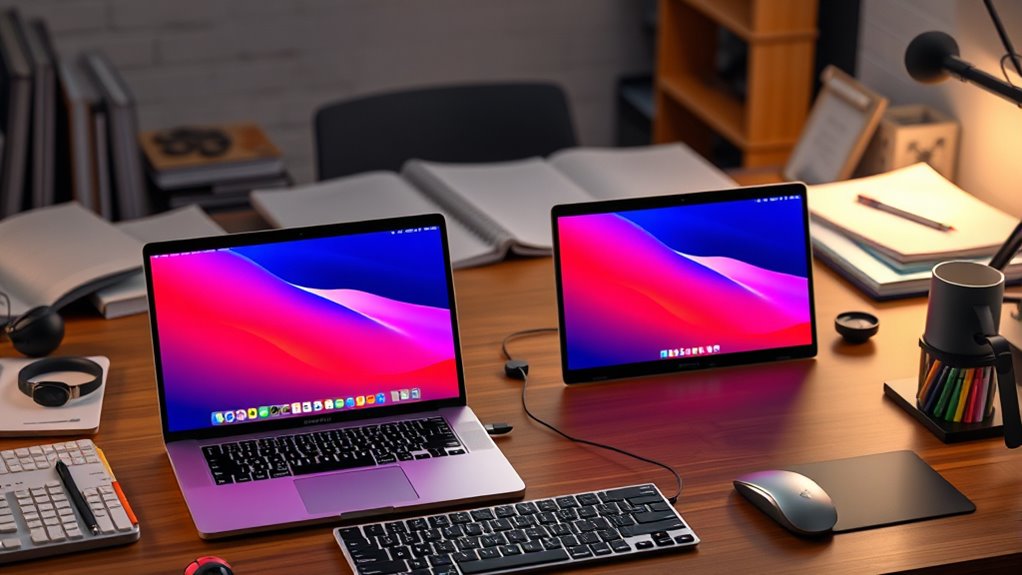

For college power users, I’d put the 14-inch MacBook Pro with M5 Pro and 48GB of memory first: it pairs a portable size with room for demanding creative and technical work. The 16-inch M5 Pro with 48GB is a stronger fit if a larger screen matters more than carrying weight, while the 14-inch M5 with 24GB suits students who want capable everyday performance without a Pro chip. The main tradeoffs are portability versus screen space, memory headroom versus a lighter workload, and new hardware versus renewed older models. Keep reading for how the 10 configurations differ and which one fits your classes and projects.

Get business pricing on tools and workshop supplies
- Business-only prices and quantity discounts
- Tax-exempt purchasing
- Multiple users, one account, clear invoices
Complete the kit



Key Takeaways
- The 14-inch M5 Pro with 48GB RAM is the most balanced power-user pick: it combines a backpack-friendly size with substantial memory and a 1TB SSD.
- The 16-inch M5 Pro with 48GB favors workspace over portability: its larger display and memory make it a better match for extended editing, coding, and multitasking at a desk.
- The M5 Max is a specialist choice: its 128GB memory and 40-core GPU target unusually demanding graphics and compute work, beyond what most college workloads need.
- For less demanding courses, an M5 with 24GB can be the more sensible fit: extra memory over the 16GB M5 configuration gives more room for many open apps and larger projects.
- The renewed M1 Pro and M4 Pro models trade newer hardware for older configurations: check condition, warranty, and expected support before choosing them over newer M5 options.


| macbook pro for college power user | Display | Storage | Memory | Chip |
|---|---|---|---|---|
| Apple MacBook Pro 14-inch | 14-inch Liquid Retina XDR | 512GB SSD | 16GB RAM | — |
| Apple MacBook Pro 14-inch | 14-inch Liquid Retina XDR | 1TB SSD | 16GB | Apple M1 Pro |
| Apple 2026 MacBook Pro Laptop | 16.2-inch Liquid Retina XDR | 1TB SSD | 24GB unified memory | — |
| Apple MacBook Pro 16-inch | 16-inch Liquid Retina XDR | 512GB SSD | 16GB | — |
| Apple MacBook Pro 16.2-inch wi | 16.2-inch Liquid Retina XDR | 2TB SSD | 128GB unified memory | Apple M5 Max |
| Apple 2025 MacBook Pro Laptop | 14.2-inch Liquid Retina XDR | 1TB SSD | 16GB unified memory | Apple M5 |
| Apple 2024 MacBook Pro 14-inch | 14.2-inch Liquid Retina XDR | 512GB SSD | 24GB RAM | Apple M4 Pro |
| Apple MacBook Pro 14.2-inch wi | 14.2-inch Liquid Retina XDR | 1TB SSD | — | Apple M5 |
| Apple 16.2-inch MacBook Pro wi | 16.2-inch Liquid Retina XDR | 1TB SSD | 48GB unified memory | Apple M5 Pro |
| Apple 14-inch MacBook Pro with | 14-inch | 1TB SSD | 48GB unified memory | — |
More Details on Our Top Picks
Apple MacBook Pro 14-inch (2021) with M1 Pro, 16GB RAM, 512GB SSD, Space Gray (Renewed)
The renewed 14-inch M1 Pro gives college power users a smaller, port-rich MacBook Pro for demanding coursework, coding, and video projects. Its Liquid Retina XDR display and ProRes acceleration suit media work, while six-speaker audio and the 1080p camera support presentations and calls. Compared with the newer 2026 MacBook Pro with M5 Pro, this 2021 model has less memory and a smaller SSD, so it offers less headroom for large AI or creative workloads. Its 512GB drive also leaves less room for project files than the 1TB M1 Pro configuration in this roundup. The tradeoff is its renewed condition: battery capacity and port types are not specified, so buyers should confirm the unit details before choosing it.
Pros:- 14-inch Liquid Retina XDR display in a more portable size than the 16-inch models
- M1 Pro chip includes ProRes acceleration for video workflows
- Six-speaker system supports spatial audio
- Description says it includes a range of connectivity ports
Cons:- Renewed condition may mean more uncertainty about battery health and wear
- 512GB SSD offers less room for large class projects than the 1TB M1 Pro model
- Port types and battery capacity are not specified
Best for: Students who want a compact MacBook Pro for coding, design coursework, or moderate video editing and are comfortable buying renewed.
Not ideal for: Students with large media libraries or sustained heavy workloads who need more than 16GB of memory, 512GB of storage, or clearly specified battery condition.
- Model year:2021
- Display:14-inch Liquid Retina XDR
- Processor:Apple M1 Pro
- Memory:16GB RAM
- Storage:512GB SSD
- Condition:Renewed
- Camera:1080p FaceTime HD
- Audio:Six-speaker sound system with spatial audio support
Our verdict“Choose this renewed 14-inch model for capable, portable coursework if you can verify its condition and can work within 16GB of memory and 512GB of storage.”
Apple MacBook Pro 14-inch (2021, M1 Pro, 16GB RAM, 1TB SSD, Space Gray)
The 1TB SSD is the practical edge of this 14-inch M1 Pro configuration: students can keep more code repositories, creative files, and course materials on the laptop than on the renewed 512GB 14-inch model. Its listed 10-core CPU and 16-core GPU remain suited to demanding academic work, and the XDR screen, 1080p camera, and six-speaker audio make it a capable campus workstation. Against the newer 2026 16.2-inch M5 Pro, it gives up newer connectivity and the larger memory allocation, so it is less suited to cutting-edge AI workloads or projects that need ample memory. The 16GB RAM ceiling in this configuration is the main constraint for multitasking with large datasets or complex creative apps. It is the stronger older pick when local storage matters more than the newest chip.
Pros:- 1TB SSD holds more projects and media than the 512GB renewed 14-inch configuration
- 10-core CPU and 16-core GPU support demanding coursework
- 14-inch Liquid Retina XDR display
- Listed battery life of up to 17 hours
Cons:- 16GB memory can constrain large datasets and intensive multitasking
- Older M1 Pro platform lacks the newer connectivity listed for the M5 Pro models
Best for: Students who want a 14-inch MacBook Pro with 1TB of local storage for code, research files, and moderate creative work.
Not ideal for: AI researchers, 3D creators, and students running several memory-heavy apps who would benefit from newer chips and more than 16GB of memory.
- Model year:2021
- Display:14-inch Liquid Retina XDR
- Chip:Apple M1 Pro
- CPU:10-core
- GPU:16-core
- Memory:16GB
- Storage:1TB SSD
- Battery life:Up to 17 hours
- Camera:1080p FaceTime HD
Our verdict“Pick this configuration if a 1TB drive and portable 14-inch format matter more to you than the newer performance and memory headroom of the M5 Pro models.”
Apple 2026 MacBook Pro Laptop with M5 Pro Chip, 16.2-inch Liquid Retina XDR Display, 24GB RAM, 1TB SSD, Space Black
This 2026 16.2-inch MacBook Pro is the most balanced choice here for a student whose workload spans AI tasks, coding, and creative software. Its M5 Pro with an 18-core CPU and 20-core GPU, 24GB of unified memory, and 1TB SSD provide more room for demanding projects than either 2021 M1 Pro configuration. Three Thunderbolt 5 ports, HDMI, and SDXC make it easier to connect lab or production gear without relying on a narrow port selection. Compared with the M5 Max 16.2-inch model, it has less memory and graphics capacity, which keeps the Max better suited to professional-scale rendering and multi-display work. The large display and 4.71-pound weight also make this a less convenient daily carry than the 14-inch options. For students who need substantial capability on campus, that balance is the reason to rank it first.
Pros:- M5 Pro with 18-core CPU and 20-core GPU targets demanding creative and AI workloads
- 24GB unified memory gives more multitasking headroom than the 16GB M1 Pro options
- 16.2-inch Liquid Retina XDR display provides a spacious workspace
- Thunderbolt 5, HDMI, SDXC, and MagSafe 3 support a broad range of connections
Cons:- At 4.71 pounds, it is heavier to carry than the 14-inch options
- M5 Max configurations offer substantially more memory and GPU capacity for specialized workloads
Best for: Engineering, computer science, and media students who run demanding apps, value a large workspace, and need modern ports for peripherals.
Not ideal for: Students who carry their laptop between classes all day or need the extreme memory and graphics capacity of the M5 Max for specialized production work.
- Processor:Apple M5 Pro with 18-core CPU and 20-core GPU
- Display:16.2-inch Liquid Retina XDR
- Memory:24GB unified memory
- Storage:1TB SSD
- Battery life:All-day
- Wireless:Wi-Fi 7, Bluetooth 6
- Ports:Three Thunderbolt 5, MagSafe 3, SDXC, HDMI, headphone jack
- Weight:4.71 pounds
Our verdict“Choose this M5 Pro if you want a large-screen campus workstation with current performance and connectivity, and can accept the extra carrying weight.”
Apple MacBook Pro 16-inch (Late 2021), M1 Pro, 16GB RAM, 512GB SSD, Space Gray (Renewed)
The 16-inch renewed M1 Pro favors workspace over portability. Its 3456 x 2234 Liquid Retina XDR display gives students more room for timelines, code, and side-by-side documents than the 14-inch M1 Pro models. The listed battery life of up to 17 hours and 1080p camera also suit long study days and remote seminars. Compared with the newer 2026 16.2-inch M5 Pro, this machine has less memory, half the storage, and an older processor, so it is a less flexible choice for heavier AI and creative workloads. Its 4.6-pound weight and renewed status add practical compromises for a laptop that may travel daily. The main case for this model is getting a large XDR workspace in the older M1 Pro tier; students needing reliable condition details or more performance headroom should look elsewhere.
Pros:- 16-inch Liquid Retina XDR display with 3456 x 2234 native resolution
- M1 Pro chip is suited to demanding coursework
- Listed battery life of up to 17 hours
- 1080p FaceTime HD camera for classes and presentations
Cons:- Renewed condition may vary, including battery health and physical wear
- 4.6-pound weight is a burden for frequent campus travel
- 16GB memory and 512GB SSD offer less headroom than newer configurations
Best for: Students who keep their laptop mostly at a desk and want a large display for coding, reading papers, or editing timelines.
Not ideal for: Commuters who prioritize a light bag or students who need more than 16GB of memory and 512GB of storage for intensive projects.
- Model:MacBook Pro (Late 2021)
- Processor:Apple M1 Pro
- Memory:16GB
- Storage:512GB SSD
- Display:16-inch Liquid Retina XDR
- Native resolution:3456 x 2234 pixels
- Battery life:Up to 17 hours
- Weight:4.6 pounds
- Condition:Renewed
Our verdict“Choose this renewed 16-inch model if screen space matters more than portability and you can accept the older specs and variable condition.”
Apple MacBook Pro 16.2-inch with M5 Max, 18-core CPU, 40-core GPU, 128GB Memory, and 2TB SSD
The M5 Max configuration sits at the top of this group for students whose work resembles a professional studio workload: 3D rendering, large video projects, or several demanding apps at once. Its 128GB unified memory and 40-core GPU provide far more capacity than the 24GB M5 Pro model, while the 2TB SSD can hold larger local libraries and project assets. Four external displays are supported, and the bright 16.2-inch XDR screen offers a generous editing surface. That capacity is excessive for many college workloads, though, and the 16-inch chassis is less convenient to carry than the 14-inch MacBook Pros. Compared with the M5 Pro, this is the specialist pick for unusually intensive graphics and memory demands; students focused on typical coursework can choose a lighter, lower-capacity configuration without giving up a useful campus workstation.
Pros:- 128GB unified memory supports unusually large creative and technical workloads
- 40-core GPU and 18-core CPU target intensive rendering and processing
- 2TB SSD provides ample room for local project assets
- Supports up to four external displays and includes Thunderbolt 5, HDMI, and SDXC
Cons:- The 16.2-inch chassis is less convenient to carry than 14-inch models
- Its memory and graphics capacity can exceed the needs of most college coursework
Best for: Film, animation, and design students who work with large assets, complex renders, or multi-display setups and need substantial local memory.
Not ideal for: Students focused on general coursework, programming, and light editing who do not need 128GB of memory or a 40-core GPU.
- Chip:Apple M5 Max
- CPU:18-core
- GPU:40-core
- Display:16.2-inch Liquid Retina XDR
- Memory:128GB unified memory
- Storage:2TB SSD
- Peak brightness:1600 nits
- External displays:Up to four
- Wireless:Wi-Fi 7, Bluetooth 6
Our verdict“Pick the M5 Max when your creative or technical projects need unusually high memory and GPU capacity, and skip it for ordinary coursework.”
Apple 2025 MacBook Pro Laptop with M5 Chip, 14.2-inch Liquid Retina XDR Display, 16GB RAM, 1TB SSD, Space Black
The 14.2-inch M5 MacBook Pro suits students who need a capable machine for coding, photo work, and demanding coursework without carrying a 16-inch laptop. Its 1TB SSD leaves more room for project files than the 512GB drive in the renewed M4 Pro model, while the XDR display gives detailed creative work a bright, high-contrast canvas. Compared with the M5 model with 24GB memory, this configuration has less room for large projects and heavy multitasking; its advantage is a straightforward portable setup with ample local storage. The 16GB unified memory is the main constraint for power users running virtual machines or large creative projects. It also lacks the M4 Pro model’s Thunderbolt 5 ports, so buyers with high-speed accessory needs should compare connectivity before choosing.
Pros:- M5 10-core CPU and GPU for demanding study and creative workloads
- 1TB SSD provides generous room for local projects
- 14.2-inch Liquid Retina XDR display suits detailed visual work
- Thunderbolt 4, HDMI, SDXC, and MagSafe 3 reduce the need for adapters
Cons:- 16GB unified memory gives less headroom than the 24GB M5 configuration
- Thunderbolt 4 is a step behind the renewed M4 Pro model’s Thunderbolt 5 ports
Best for: College students who prioritize a portable 14-inch laptop and need 1TB of space for class files, code, and media projects.
Not ideal for: Students running memory-heavy virtual machines or large creative workflows who would benefit from 24GB or 48GB of memory.
- Chip:Apple M5
- CPU and GPU:10-core CPU and GPU
- Display:14.2-inch Liquid Retina XDR
- Memory:16GB unified memory
- Storage:1TB SSD
- Battery life:All-day
- Ports:Three Thunderbolt 4, MagSafe 3, SDXC card slot, HDMI, headphone jack
Our verdict“Choose this M5 model if you want a portable MacBook Pro with 1TB of storage and your workload fits within 16GB of memory.”
Apple 2024 MacBook Pro 14-inch with M4 Pro, 24GB RAM, 512GB SSD, Space Black (Renewed)
The renewed 14-inch M4 Pro is a strong fit for power users whose coursework involves compiling code, editing media, or connecting multiple displays. Its 24GB of memory gives more multitasking headroom than the 16GB M5 model, and its three Thunderbolt 5 ports offer newer high-speed connections than the M5 configurations with Thunderbolt 4. It supports up to two external displays, which can make a desk setup more useful for research and editing. The tradeoff is the renewed condition, which means buyers should weigh the condition details and coverage attached to the specific listing. Its 512GB SSD is also smaller than the 1TB drives in the M5 options, so students keeping large media libraries locally may prefer those models.
Pros:- M4 Pro chip targets demanding professional and creative workloads
- 24GB RAM supports heavier multitasking than the 16GB M5 configuration
- Three Thunderbolt 5 ports and support for up to two external displays
- Liquid Retina XDR display with up to 1600 nits peak brightness
Cons:- Renewed condition may not suit buyers who prefer a new device
- 512GB SSD offers less local storage than the 1TB M5 models
Best for: Students who connect fast external storage and up to two displays, and want 24GB of memory for coding or media work.
Not ideal for: Buyers who want a new-condition laptop or need 1TB of built-in storage for large projects.
- Chip:Apple M4 Pro
- Display:14.2-inch Liquid Retina XDR
- Peak brightness:Up to 1600 nits
- Memory:24GB RAM
- Storage:512GB SSD
- Condition:Renewed
- Camera:12MP Center Stage
- Ports:Three Thunderbolt 5, MagSafe 3, SDXC card slot, HDMI, headphone jack
- External displays:Supports up to two
Our verdict“Pick this renewed M4 Pro if Thunderbolt 5 and 24GB of memory matter more to your college workflow than new-condition status or 1TB storage.”
Apple MacBook Pro 14.2-inch with M5, 24GB Memory, 1TB SSD (Silver)
This 24GB M5 MacBook Pro balances current-generation performance with memory for keeping many demanding apps open. Compared with the 16GB M5 configuration, the extra 8GB of unified memory gives power users more room for coding tools, research, and creative software at the same time. Its 1TB SSD matches the larger M5 option’s storage, while the 14.2-inch XDR display keeps the laptop easier to carry between classes than the 16.2-inch M5 Pro model. The M5 Pro configurations are better suited to especially heavy CPU and GPU work, but this model offers a sensible middle ground for students who want more multitasking capacity without stepping up to that tier. The listed connectivity uses Thunderbolt 4, rather than the Thunderbolt 5 found on the renewed M4 Pro.
Pros:- 24GB unified memory provides more multitasking headroom than the 16GB M5 model
- M5 chip with 10-core CPU and 10-core GPU
- 1TB SSD for project files and media
- 12MP Center Stage camera and support for up to two external displays
Cons:- Thunderbolt 4 ports are older than the Thunderbolt 5 connections on the renewed M4 Pro
- M5 Pro models are better suited to sustained, highly demanding CPU and GPU workloads
Best for: Students who routinely keep development tools, browser research, and creative apps open together and want 1TB of storage.
Not ideal for: Students doing sustained high-end rendering or other workloads that call for the M5 Pro’s higher-tier processing hardware.
- Chip:Apple M5
- CPU:10-core
- GPU:10-core
- Display:14.2-inch Liquid Retina XDR
- Peak brightness:1600 nits
- Unified memory:24GB
- Storage:1TB SSD
- Camera:12MP Center Stage
- Ports:Three Thunderbolt 4, MagSafe 3, SDXC card slot, HDMI, headphone jack
Our verdict“Choose this configuration for a portable M5 MacBook Pro with 24GB of memory and 1TB storage for varied college workloads.”
Apple 16.2-inch MacBook Pro with M5 Pro, 18-core CPU, 20-core GPU, 48GB Memory, 1TB SSD, Wi-Fi 7 – Space Black
For students who treat a laptop as a mobile workstation, this 16.2-inch M5 Pro pairs a large XDR workspace with an 18-core CPU, 20-core GPU, and 48GB of unified memory. That combination is better suited to demanding creative projects and sustained multitasking than the 14-inch M5 models, whose smaller displays and lower memory configurations favor portability. The larger screen can reduce the need to carry an external monitor between home and campus. Wi-Fi 7 and Thunderbolt 5 add modern connectivity for compatible networks and accessories. The cost of that workspace is physical: at 4.71 pounds, it is substantially heavier than the 14-inch options. Students who spend most of the day moving between classes may find the 14-inch M5 Pro with 48GB easier to carry.
Pros:- M5 Pro with 18-core CPU and 20-core GPU for demanding workloads
- 48GB unified memory supports large projects and heavy multitasking
- 16.2-inch Liquid Retina XDR display provides a spacious work area
- Thunderbolt 5, Wi-Fi 7, HDMI, and SDXC support a broad accessory setup
Cons:- At 4.71 pounds, it is heavier to carry across campus than the 14-inch models
- Its large display and 48GB memory may be more than general coursework requires
Best for: Film, design, engineering, or computer science students who need a large built-in workspace and substantial memory for complex projects.
Not ideal for: Commuters who prioritize a light backpack or students who mostly work on standard coursework and do not need 48GB of memory.
- Chip:Apple M5 Pro
- CPU:18-core
- GPU:20-core
- Display:16.2-inch Liquid Retina XDR
- Memory:48GB unified memory
- Storage:1TB SSD
- Wireless:Wi-Fi 7 and Bluetooth 6
- Ports:Three Thunderbolt 5, MagSafe 3, SDXC card slot, HDMI, headphone jack
- Weight:4.71 pounds
Our verdict“Choose this 16-inch M5 Pro when a large screen and 48GB of memory matter more than carrying weight.”
Apple 14-inch MacBook Pro with M5 Pro Chip, 48GB RAM, 1TB SSD, Space Black
This 14-inch M5 Pro packs 48GB of memory and a 1TB SSD into a smaller format than the 16.2-inch M5 Pro model. For a college power user, that means substantial capacity for demanding applications and large files without committing to the 4.71-pound larger model’s carrying burden. Its 15-core CPU and 16-core GPU suit intensive work, though the 16-inch model’s 18-core CPU and 20-core GPU provide more processing and graphics cores alongside a larger screen. Against the 24GB M5 configuration, this model doubles the listed memory and steps up to M5 Pro, a better fit for heavier projects. The tradeoff is a 14-inch display, which leaves less room for timelines, code, and side-by-side windows. The listing specifies a 70W USB-C power adapter.
Pros:- M5 Pro chip with 15-core CPU and 16-core GPU
- 48GB unified memory for demanding apps and multitasking
- 1TB SSD for large coursework and creative projects
- 14-inch form factor is more portable than the 16.2-inch M5 Pro
Cons:- 14-inch display offers less workspace than the 16.2-inch M5 Pro
- The 16-inch M5 Pro has higher listed CPU and GPU core counts
Best for: Students who need 48GB of memory and M5 Pro performance in a more backpack-friendly 14-inch laptop.
Not ideal for: Students who want a large built-in canvas for editing or prefer the higher core counts and bigger screen of the 16-inch M5 Pro.
- Processor:Apple M5 Pro chip
- CPU:15-core
- GPU:16-core
- Display:14-inch
- Memory:48GB unified memory
- Storage:1TB SSD
- Color:Space Black
- Power adapter:70W USB-C
Our verdict“Pick this 14-inch M5 Pro if you need 48GB of memory and strong performance in a more portable format than the 16-inch alternative.”

How We Picked
I compared these MacBook Pro configurations through the needs of a student who runs demanding apps, keeps many tasks open, and carries a laptop between classes. The main factors were chip tier, memory capacity, storage, screen size, and the practical balance between sustained work and daily portability. More memory and a Pro or Max chip can help with large creative projects, development tools, and heavier multitasking; they add less value when coursework centers on documents, browsing, and standard productivity apps.
The ranking favors configurations that offer substantial headroom without imposing unnecessary size or specialization. That places the 14-inch M5 Pro with 48GB ahead as a flexible daily work machine, while the 16-inch M5 Pro earns its place for students who benefit from a larger built-in workspace. The M5 Max ranks as a premium specialist, and the M5 models suit less intensive workloads. Renewed M1 Pro and M4 Pro systems remain alternatives, but their age and condition deserve more scrutiny than a new M5 purchase.
| macbook pro for college power user | Chip | Ports |
|---|---|---|
| Apple MacBook Pro 14-inch | — | — |
| Apple MacBook Pro 14-inch | Apple M1 Pro | — |
| Apple 2026 MacBook Pro Laptop | — | Three Thunderbolt 5, MagSafe 3, SDXC, HDMI, headphone jack |
| Apple MacBook Pro 16-inch | — | — |
| Apple MacBook Pro 16.2-inch wi | Apple M5 Max | — |
| Apple 2025 MacBook Pro Laptop | Apple M5 | Three Thunderbolt 4, MagSafe 3, SDXC card slot, HDMI, headphone jack |
| Apple 2024 MacBook Pro 14-inch | Apple M4 Pro | Three Thunderbolt 5, MagSafe 3, SDXC card slot, HDMI, headphone jack |
| Apple MacBook Pro 14.2-inch wi | Apple M5 | Three Thunderbolt 4, MagSafe 3, SDXC card slot, HDMI, headphone jack |
| Apple 16.2-inch MacBook Pro wi | Apple M5 Pro | Three Thunderbolt 5, MagSafe 3, SDXC card slot, HDMI, headphone jack |
| Apple 14-inch MacBook Pro with | — | — |
Factors to Consider When Choosing Macbook Pro For College Power Users
For a college power user, the right MacBook Pro depends on the work behind the word “power.” I’d start with the software and project sizes you expect to handle, then decide how much weight, screen space, and upgrade headroom you can live with every day.
Match the chip tier to your actual workload
A Pro chip makes sense when your regular work includes demanding video editing, 3D tools, software builds, or several intensive apps at once. A standard M5 may handle a mix of coursework, coding, and lighter creative tasks without the added specialization of a Pro or Max configuration. The Max tier is most useful when graphics-heavy work is central to your studies, rather than an occasional project. Students often choose the highest chip tier as insurance, but a more powerful chip does not replace the need for enough memory or storage. Check the requirements of the apps and courses you expect to use, then judge whether their heaviest tasks are routine or rare. If they are rare, a balanced configuration can serve more of your college day.
Choose memory for the work you keep open
Memory affects how comfortably a laptop handles large projects and many active apps at once. For a student who routinely uses creative software, virtual machines, data tools, or large development environments, 24GB or 48GB gives more breathing room than 16GB. That extra capacity can matter even when the processor is fast, because memory and chip performance address different parts of a workload. Think about the applications you keep open together, not just the most demanding one you own. A common mistake is to prioritize a higher-tier chip while ignoring memory needs. If your projects are modest and your app use is light, more memory may bring less benefit than a larger SSD or a more portable setup.
Balance screen workspace with backpack comfort
A 16-inch screen gives editing timelines, code, and side-by-side windows more room without relying on an external monitor. That space can make long sessions easier, especially if most work happens at a desk or in a studio. A 14-inch model is easier to carry between classes and more practical for crowded lecture halls or smaller study spaces. Screen size is a daily choice: a larger display adds little if you mostly dock at a desk with a monitor, while a compact laptop can feel limiting if you work on complex layouts while moving around. Consider the places where you study, the length of your walks, and whether you already have access to a larger screen. Choose the size that fits your routine, not just the size that looks impressive in a specification list.
Plan storage around projects and backups
A 512GB SSD may be adequate for documents and applications, but video, audio, design, and research datasets can fill it quickly. A 1TB drive gives more space for active projects, which can be useful when campus internet or external storage is inconvenient. An external drive or cloud service can extend capacity, but it adds another item to manage and may not suit every class or workflow. Before buying, estimate how much space your current coursework occupies and whether you keep source files, media, and finished exports locally. Leave room for backups and system files rather than planning to use the entire drive. Choosing more internal storage can reduce day-to-day file juggling, while an external archive may make sense for work you rarely reopen.
Treat renewed models as a condition and support decision
Renewed older MacBook Pros can offer capable hardware, but the exact condition and seller terms are part of the purchase decision. Check the warranty, return window, battery condition information, and what parts or accessories are included. An older M1 Pro may still suit coursework, yet students planning to keep a laptop through several years of new software should weigh its age against a newer M5 configuration. A renewed M4 Pro sits closer to current hardware, though its exact memory and storage still matter more than the name alone. Do not assume every renewed unit has the same battery health or cosmetic state. Compare the actual configuration and protections offered before deciding that an older model is the better fit.
Spend for headroom only when your courses need it
Extra memory, a larger screen, and a higher-tier chip can make a laptop last longer for demanding work, but each should solve a real need. Students in film, design, engineering, and computer science may gain from more performance headroom than students whose coursework is mainly writing and research. Buying far beyond current needs can leave capacity unused, while buying too narrowly can force workarounds as projects grow. Look at upcoming course requirements, internship tools, and the kinds of personal projects you expect to pursue. If those needs are uncertain, favor a balanced configuration with useful memory and storage over a specialist GPU tier. The goal is a machine that supports your likely work across campus and at home.
Frequently Asked Questions
Is the 14-inch M5 Pro with 48GB a better college choice than the 16-inch M5 Pro with 48GB?
I’d choose the 14-inch model if you carry your laptop often and want strong performance in a smaller footprint. The 16-inch version makes more sense if you spend long hours editing, coding, or working across several windows on the built-in display. Both configurations offer 48GB of memory, so the main choice is daily portability versus screen workspace. If you usually connect to an external monitor, the 14-inch model may be easier to live with between classes. If you rarely use another display, the larger screen can be valuable throughout the day.
Can an M5 MacBook Pro handle demanding college work without a Pro chip?
It can be a good fit for many students whose demanding work means multitasking, coding, photo editing, or occasional creative projects. The 24GB M5 configuration offers more memory headroom than the listed 16GB M5 model, which can help when several apps and larger files are open together. A Pro chip is a better match when intensive editing, complex builds, or graphics-heavy tasks are frequent parts of your workload. Check the software requirements for your courses before choosing by chip name alone. The right answer depends on whether your heaviest tasks happen every week or only once in a while.
Should I buy a renewed M1 Pro MacBook Pro for several years of college?
A renewed M1 Pro may suit a student who needs a capable laptop for established coursework and can verify the unit’s condition and coverage. Its age makes battery condition, warranty terms, and software support more important parts of the decision than they are with a new M5 model. For a laptop you expect to use through several years of changing courses, newer hardware may offer a longer runway. Compare the renewed unit’s exact memory and storage with newer options instead of assuming the Pro label settles the question. If the purchase protections are unclear, a newer configuration is the less uncertain choice.
Is 16GB of memory enough for a college power user?
It can be enough for standard productivity, browsing, and some coding or creative work, especially if you avoid keeping many demanding apps open at once. Students using virtual machines, large datasets, video projects, or complex design files may appreciate the additional headroom in the 24GB and 48GB configurations. Memory is not a direct measure of processor speed, but running short on it can make multitasking less comfortable. Consider the largest project you expect to handle during a normal semester, not only your current workload. If you are unsure and plan to keep the laptop for years, more memory can provide flexibility.
Does a college student need the M5 Max with 128GB of memory?
Most students will not need that level of memory and graphics capacity for coursework, general development, or everyday creative projects. The M5 Max is aimed at unusually demanding graphics and compute workflows where its 40-core GPU and 128GB memory can be put to sustained use. A 14-inch or 16-inch M5 Pro with 48GB is a more balanced fit for many power users who need substantial capability. Before choosing the Max, identify a recurring task that depends on its added capacity, such as large 3D scenes or intensive media work. If you cannot name one, the Pro tier is likely the more practical match.
Conclusion
I’d recommend the 14-inch M5 Pro with 48GB as the best overall choice for students who need serious performance and still carry their laptop daily. For a larger built-in workspace, the 16-inch M5 Pro with 48GB is the better fit; for a specialized graphics workload, the M5 Max is the premium pick. Students with lighter workloads should look first at the 24GB M5 models, which make better beginner choices for demanding college use than jumping straight to Max-class hardware. The 16GB M5 is a simpler fit for less memory-intensive coursework, while renewed M1 Pro or M4 Pro models make sense only after checking condition, warranty, and support. Pick the configuration around the projects you expect to run and the size you are willing to carry.
Fall yard work Picks
leaf blowers
As an affiliate, we earn on qualifying purchases.