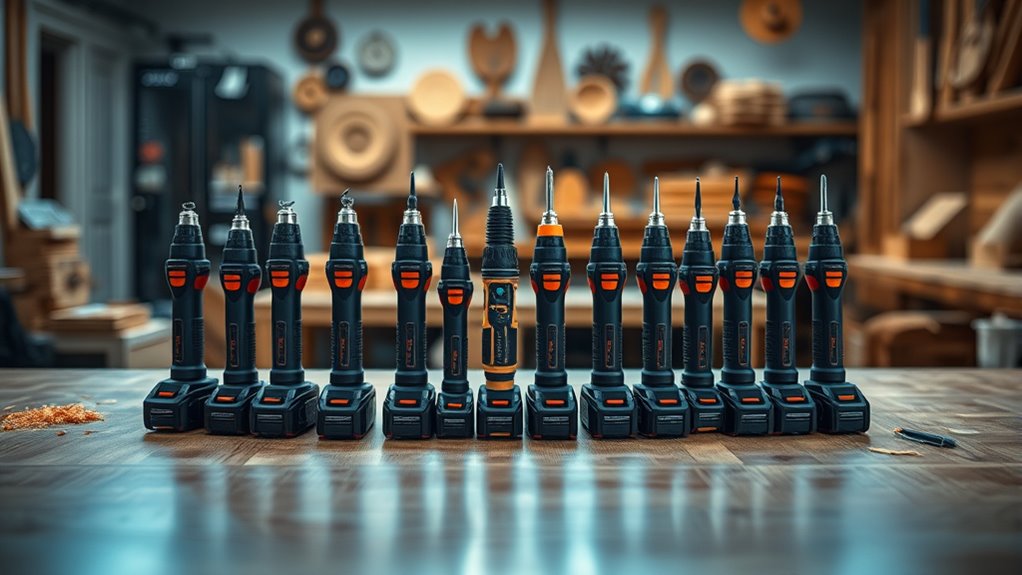
Cordless power carving tools range from compact rotary tools for detail work to dedicated electric chisels for shaping wood. My best overall pick is the RYOBI USB Lithium Cordless Power Carver Kit for its purpose-built carving format; the DEPSTECH 8V Rotary Tool Kit stands out for its higher-capacity battery and included guides, while the Arbortech Power Chisel Kit suits buyers who want a more specialized wood-carving tool. The main tradeoff is between rotary-tool versatility and the more direct carving action of a chisel or knife, with battery runtime, control, and accessory fit also shaping the choice. Large accessory bundles can be useful, but they do not guarantee better carving control or useful bits for your material. Read on for the full breakdown and help matching a tool type to your projects.

Get business pricing on tools and workshop supplies
- Business-only prices and quantity discounts
- Tax-exempt purchasing
- Multiple users, one account, clear invoices
Complete the kit



Key Takeaways
- Purpose-built carving tools and rotary tools serve different jobs: the RYOBI, Arbortech, Loodion, cordless carving chisel, and JIAN knife focus on wood removal, while rotary kits suit detail work, engraving, sanding, and mixed craft tasks.
- The DEPSTECH kit combines an 8V, 2.0Ah battery with a shield and cutting/drilling guide, giving it a more guided, accessory-rich setup than the smaller 3.7V mini rotary options.
- Accessory count is not a reliable measure of carving capability: the EWORK bundle has 448 pieces, but buyers should check whether the included attachments match their materials and intended cuts.
- The 12V brushless rotary kit emphasizes speed range and battery capacity, while compact options such as the Fanttik F2 Master prioritize a smaller accessory set and a mini-tool format.
- Dedicated chisels and knives trade multi-tasking for wood-focused control: choose them for direct carving work, and choose rotary tools when sanding, engraving, drilling, or polishing are also part of the workload.






| cordless power carving tool | Voltage | Accessories | Speed settings |
|---|---|---|---|
| 180W Rotary Tool Kit with 6-Sp | 1.5A | 139 pieces | 6 |
| RYOBI USB Lithium Cordless Pow | 4 V | — | — |
| HOTO 35-in-1 Cordless Rotary T | 4 V | 35 pieces | 5 |
| Hardell 12V Cordless Rotary To | 12 V | 94 pieces | 6 |
| Fanttik F2 PRO Cordless Rotary | 4 V | 55 pieces | 5 |
| Cordless Rotary Tool | 3.7V | 70 | 5 |
| 12V Cordless Rotary Tool Kit | — | 40 | — |
| EWORK 448PCS Cordless Rotary T | 4V | 448 | 5 |
| Fanttik F2 Master Mini Cordles | — | 35 | 5 |
| DEPSTECH Cordless Rotary Tool | 8V | 127 | 5 |
| HARDELL Mini Cordless Rotary T | 3.7V | 69 | 5 |
| Cordless Electric Wood Carving | 4.2V | — | — |
| Loodion Cordless Electric Wood | — | — | — |
| Arbortech Power Chisel Kit | — | — | — |
| JIAN Electric Wood Carving Kni | — | — | — |
More Details on Our Top Picks
180W Rotary Tool Kit with 6-Speed Adjustment and 139 Accessories
For buyers who want corded-style power and a large accessory selection, this rotary tool is the most adaptable pick here. Its 180W motor and six settings, spanning 8,000 to 32,000 RPM, let me match the speed to engraving, polishing, or cutting tasks; the flexible shaft also makes small curves and tight corners easier to reach than with a bulkier tool. Compared with the cordless Hardell 12V Rotary Tool, this kit offers more stated power and accessories, but gives up battery-powered freedom. That matters for carving sessions away from an outlet. The 139-piece assortment is useful for switching between jobs, though it can make setup and storage more involved. I’d also factor in the need to tighten its chuck with a spanner and handle it carefully to limit runout.
Pros:- 180W motor and six speeds provide a broad operating range for different rotary tasks.
- Flexible shaft helps reach corners and control fine detail.
- 139 accessories support a wide range of cutting, polishing, and engraving jobs.
- Low-noise and heat-dissipation design is suited to longer bench sessions.
Cons:- Requires an outlet, unlike the cordless RYOBI and Hardell options.
- Chuck must be tightened with a spanner, and careful setup is needed to limit runout.
- The large accessory assortment can make selection and storage less straightforward.
Best for: Bench-based hobbyists who want a high-speed rotary tool, a flexible shaft, and accessories for varied detail work near an outlet.
Not ideal for: Carvers who need cordless access around furniture or outdoors, or beginners who want a simple setup without a spanner-tightened chuck.
- Power:180W
- Voltage:1.5A
- Speed range:8,000–32,000 RPM
- Speed settings:6
- Accessories:139 pieces
- Compatible collets:1/8 in, 1/16 in, 3/32 in, 3/25 in
Our verdict“Choose this kit for varied, outlet-based detail work; skip it if cordless movement matters more than its power and accessory range.”
RYOBI USB Lithium Cordless Power Carver Kit with 2.0 Ah Battery
Unlike the rotary tools in this group, the RYOBI FVH51K is built around a reciprocating carving stroke rather than a spinning bit. Its 14,000 strokes per minute and 1 mm stroke length suit controlled wood removal, furniture restoration, and relief work, while the included straight chisel, U-gouge, and V-gouge give a beginner a useful starting set. Compared with the HOTO 35-in-1 Cordless Rotary Tool, it is less suited to sanding, drilling, or work across different materials, but its dedicated blades are more directly aimed at shaping wood. The 1.2-pound body and cordless battery help when moving around a project. The tradeoff is a narrower task range, and the three blade profiles may not cover specialized carving needs.
Pros:- Reciprocating 1 mm stroke is designed for wood carving rather than rotary-bit work.
- Includes straight chisel, U-gouge, and V-gouge blades for several common carving cuts.
- 2.0 Ah USB Lithium battery supports cordless use and USB-C charging.
- LED fuel gauge makes battery status easier to check during a project.
Cons:- Wood-focused design is less versatile than the HOTO and Hardell rotary tools.
- Only three blade types are included, limiting the range of carving profiles.
- A 1 mm stroke and 14,000 strokes per minute may not suit every material-removal preference.
Best for: Woodworkers and furniture restorers who want a compact cordless tool for controlled carving with chisel and gouge blades.
Not ideal for: Makers seeking one tool for metal, plastic, sanding, drilling, and carving, or carvers who need a broad selection of blade profiles.
- Model:FVH51K
- Voltage:4 V
- Battery capacity:2.0 Ah
- Stroke length:1 mm
- Speed:14,000 strokes per minute
- Included blades:Straight chisel, U-gouge, V-gouge
- Weight:1.2 lb
- Warranty:2-year manufacturer’s warranty
Our verdict“Pick the RYOBI for portable, blade-based wood carving, but choose a rotary tool if your projects call for broader material versatility.”
HOTO 35-in-1 Cordless Rotary Tool Kit
The HOTO is the precision-oriented cordless rotary pick for small carving, finishing, and craft work where a comfortable grip and a clear view of the work matter. Five speeds from 5,000 to 25,000 RPM provide a lower starting point than the Hardell 12V Rotary Tool, which may help with delicate finishing, while its built-in LED illuminates close-up work. The dust shield and charging base add practical touches for a home workbench, and the 35 accessories cover common rotary tasks without the scale of the 139-piece corded kit. Its limits are equally clear: the listed data does not specify battery capacity or runtime, and the 4 V format is aimed at compact DIY work rather than demanding material removal. The included pet nail attachment also adds versatility, but is not a carving advantage.
Pros:- Five speed settings start at 5,000 RPM for controlled detail work.
- Built-in LED helps illuminate small or recessed work areas.
- Dust shield and charging base support a tidier desktop setup.
- 35 accessories and support for two collet sizes broaden its small-project use.
Cons:- No battery capacity or runtime is provided in the product data.
- Its compact 4 V design is better suited to light DIY tasks than heavy carving.
- The 35-piece accessory set is smaller than the Hardell and corded 180W kits.
Best for: Desktop makers and 3D-printing hobbyists who want a compact cordless tool for detail carving, sanding, and finishing in a well-lit workspace.
Not ideal for: Users who need long runtime, heavy material removal, or a large accessory inventory for frequent work across many projects.
- Voltage:4 V
- Speed settings:5
- Speed range:5,000–25,000 RPM
- Accessories:35 pieces
- Collet compatibility:3.2 mm and 2.3 mm
- Charging:USB-C
- Included features:LED light, dust shield, charging base, carry pouch
- Additional attachment:Pet nail grinding attachment
Our verdict“Choose the HOTO for careful cordless detailing at a desk, not for sustained carving or high material removal.”
Hardell 12V Cordless Rotary Tool Kit with 94 Accessories, 6-Speed, 30,000 RPM
The Hardell combines a 12 V battery platform with six speeds and 94 accessories, giving it a broader task range than the purpose-built RYOBI wood carver. Its top speed of 30,000 RPM and included bits support carving as well as grinding, polishing, cutting, and drilling, so it makes sense for a DIY user who wants one cordless tool for several small jobs. At 1.1 pounds, it is also slightly lighter than the RYOBI, though the two tools work differently: Hardell spins accessories, while RYOBI uses carving blades for direct wood shaping. Compared with the smaller 4 V HOTO, the Hardell lists a higher voltage and more accessories, but the product data does not give battery capacity or runtime. That leaves extended sessions harder to plan, and its accessory count may call for separate storage.
Pros:- 12 V cordless design offers more headroom than the compact 4 V rotary tools listed here.
- Six speed settings support adjustment for different materials and attachments.
- 94 accessories cover carving, grinding, polishing, cutting, and drilling.
- 1.1-pound weight and ergonomic form support handheld detail work.
Cons:- Battery capacity and runtime are not specified in the product data.
- Rotary accessories do not replace the RYOBI’s dedicated carving chisels for direct wood shaping.
- The large accessory set may need extra organization or storage.
Best for: DIY hobbyists who want a lightweight cordless rotary tool for occasional carving, repair, polishing, and cutting tasks.
Not ideal for: Woodcarvers who want a dedicated chisel-style action, or users planning long sessions who need stated battery capacity and runtime.
- Voltage:12 V
- Power source:Battery powered
- Maximum speed:30,000 RPM
- Speed settings:6
- Accessories:94 pieces
- Battery:1 lithium-ion battery included
- Weight:1.1 lb
- Dimensions:10 × 1.9 × 2.7 in
Our verdict“Choose Hardell if you want a light, multi-task cordless rotary kit; choose the RYOBI instead for blade-based wood carving.”
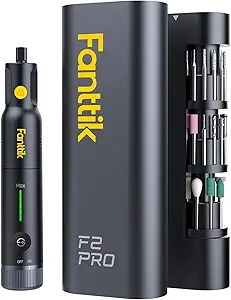
Fanttik F2 PRO Cordless Rotary Tool Kit with Magnetic Motor and 55 Accessories
The Fanttik F2 PRO stands out for low weight and tidy accessory storage: the tool weighs 220 g, and its 55 attachments sit in a magnetic holder inside a durable case. That makes it easier to carry between small projects than the 1.1-pound Hardell 12V Rotary Tool, which supplies more accessories and a higher stated voltage. Fanttik instead offers five speeds from 5,000 to 25,000 RPM and a 3,000 mAh battery rated for up to 120 minutes, making it a better fit for light engraving, polishing, and carving than demanding stock removal. Runtime can vary with speed and task, and its 4 V design is explicitly limited to light-duty work. Buyers choosing between it and the HOTO 35-in-1 should weigh Fanttik’s larger accessory count and stated battery capacity against HOTO’s LED and dust shield.
Pros:- 220 g body is easy to hold and carry between small projects.
- 3,000 mAh battery is rated for up to 120 minutes of use.
- Five speeds cover a useful range for engraving, polishing, and light carving.
- Magnetic accessory holder and durable case keep the 55-piece set organized.
Cons:- 4 V power is intended for light-duty tasks, not heavy carving.
- Actual battery life may vary with speed and workload.
- The Hardell offers a higher stated voltage and more accessories for broader DIY use.
Best for: Mobile crafters who want a lightweight rotary tool with organized accessories for short, light-duty carving and finishing jobs.
Not ideal for: Users tackling heavy carving, sustained high-speed work, or projects that need a higher-voltage tool and robust material removal.
- Voltage:4 V
- Speed settings:5
- Speed range:5,000–25,000 RPM
- Battery capacity:3,000 mAh
- Accessories:55 pieces
- Weight:220 g
- Dimensions:7.68 × 1.34 × 1.34 in
Our verdict“Pick the F2 PRO for portable light-duty detail work and organized storage, but choose a higher-voltage tool for more demanding carving.”
Cordless Rotary Tool, 5 Variable Speed Mini Rotary Tool Kit with 70 Accessories, 3.7V Type-C Charging
I’d choose this 3.7V mini tool for light carving and engraving where a slim, light grip matters more than cutting power. Its five speed settings and 70 included accessories give a beginner room to try sanding, polishing, and detail work without assembling a separate bit collection. The listed 240-minute battery life is unusually generous for this size, though actual runtime can vary with the task. Compared with the DEPSTECH 8V, this model is smaller and less suited to sustained material removal; DEPSTECH is the better fit for deeper cuts and more demanding DIY jobs. The tradeoff here is clear: portability and fine control over torque. I would keep it to small crafts and delicate work, since the 3.7V platform is not meant for heavy carving, and high-speed use calls for a steady hand.
Pros:- Light 4.8-ounce body can be easier to control during fine detail work.
- Five speed settings let users match rotation to delicate tasks and accessories.
- 70 included accessories support a variety of light DIY applications.
- USB Type-C charging and a listed battery life of up to 240 minutes suit occasional cordless projects.
Cons:- 3.7V power is not suited to sustained heavy carving or demanding material removal.
- Small, lightweight form requires a steady grip at high speeds.
- The listed accessory range does not make it a substitute for a dedicated wood-carving chisel.
Best for: Beginners and hobby crafters doing light engraving, polishing, and small-scale carving who prioritize a compact grip and a broad starter accessory set.
Not ideal for: Woodworkers making deep cuts or removing material across larger surfaces; the low-voltage mini format is better suited to light-duty detail work.
- Voltage:3.7V
- Maximum rotational speed:18,000 rpm
- Speed settings:5
- Accessories:70
- Weight:4.8 ounces
- Dimensions:6.8 x 1.3 x 1.2 inches
- Battery life:Up to 240 minutes per charge (listed)
- Charging:USB Type-C
Our verdict“Choose this compact kit for light craft carving and engraving, but move up to the DEPSTECH 8V if your work involves heavier cuts.”
12V Cordless Rotary Tool Kit, Brushless Motor, LCD Display, 8000-32000 RPM Variable Speed, 2.5Ah Battery, 40 Accessories for Wood Carving, Engraving, Grinding, Sanding and Cutting
Among these five rotary tools, this 12V brushless model has the strongest stated power platform and the widest listed speed range, making it the most compelling fit for users who move between delicate engraving and faster grinding or cutting. Its LCD display shows speed and battery status, which can help keep adjustments deliberate during detailed work. Compared with the lighter Fanttik F2 Master, this kit is aimed more at range and demanding tasks than at easy carry; compared with the DEPSTECH 8V, it offers a higher stated maximum speed but has no listed cutting guide or 127-piece accessory bundle. The included 40 accessories are a more restrained starting set, and the product data does not specify tool weight, charging time, or accessory compatibility. I’d pick it for varied workshop jobs, not as a dedicated carving chisel.
Pros:- 12V brushless motor is positioned for more demanding rotary-tool tasks than the 3.7V mini tools.
- 8,000–32,000 rpm range covers both lower-speed detail work and faster material removal.
- LCD reports speed settings and battery status while working.
- 2.5Ah rechargeable battery is included.
Cons:- Only 40 accessories are listed, fewer than the DEPSTECH 127-piece kit and EWORK 448-piece set.
- Product data does not provide weight, charging time, or compatible accessory-shank size.
- A rotary tool remains less specialized for wood shaping than a dedicated cordless carving chisel.
Best for: DIY woodworkers and makers who want one cordless rotary tool for carving details, engraving, grinding, and cutting at a range of speeds.
Not ideal for: Buyers who need a verified weight, a large accessory assortment, or a tool designed specifically for chisel-style wood carving.
- Motor:12V brushless
- Speed range:8,000–32,000 rpm
- Display:LCD speed and battery status
- Battery capacity:2.5Ah
- Accessories:40
- Power source:Rechargeable battery
- Listed applications:Wood carving, engraving, grinding, sanding, and cutting
Our verdict“Pick this model if you want a higher-powered, wide-speed-range rotary tool for mixed workshop tasks and can work with a modest accessory set.”
EWORK 448PCS Cordless Rotary Tool Kit, 4V 5-Speed Power Rotary Tool Accessories Kit for Drilling, Engraving, Sanding, Polishing, Cutting, Carving, Grinding and Cleaning
The EWORK’s main distinction is its 448-piece accessory assortment, not a claim to heavy carving power. It bundles bits for sanding, grinding, cutting, polishing, drilling, and precision carving, so a hobbyist can try several kinds of small projects without sourcing attachments one by one. The built-in LED can also help illuminate close-up work. At 4V, with a stated 8,000–23,000 rpm range, it sits between the 3.7V mini tool in this group and the higher-powered 12V model: more speed range than the smaller starter pick, but less headroom than the 12V brushless tool for sustained removal. Its 0.3-pound weight supports extended handheld detail work, though the sheer number of accessories may be more than a focused carver needs. I’d choose it for variety, not for power-first carving.
Pros:- 448 included pieces cover a wide range of light rotary-tool tasks.
- Five speeds span 8,000–23,000 rpm for adapting to different bits and materials.
- Built-in LED helps with visibility on close detail work.
- Listed 0.3-pound weight and USB-C charging suit portable craft use.
Cons:- 4V power is a limitation for deep carving and prolonged material removal.
- The accessory-heavy bundle may be less useful than a stronger tool for power-focused woodworkers.
- The supplied product data does not state battery capacity or runtime.
Best for: Craft hobbyists and beginners who want a cordless tool and a broad selection of bits for trying engraving, sanding, polishing, and light carving.
Not ideal for: Carvers who need higher torque for sustained wood removal, or experienced users who already own the accessories they rely on.
- Voltage:4V
- Speed range:8,000–23,000 rpm
- Speed settings:5
- Accessories:448
- Weight:0.3 lb
- Lighting:Built-in LED
- Charging:USB-C
Our verdict“Choose EWORK when accessory variety and light craft versatility matter more than the higher carving headroom of the 12V cordless tool.”
Fanttik F2 Master Mini Cordless Rotary Tool Kit with 35 Accessories
For a small kit meant to travel between a craft bench and a project site, I’d favor the Fanttik F2 Master. Its 0.22-pound weight, brushless motor, five speeds, and magnetic accessory stand make it a tidy choice for detail tasks where control and organization matter more than a large accessory collection. The listed 60-minute charging time is useful for planning short sessions, but the product data gives no runtime figure, so it is hard to judge how long it will work away from a charger. Compared with EWORK’s 448-piece bundle, Fanttik is far more compact but includes only 35 accessories; compared with the 12V brushless kit, it is easier to carry but less clearly suited to demanding removal work. Its 3/32-inch compatibility also narrows bit choices. I’d buy it for portable, light-duty detailing rather than broad workshop use.
Pros:- At 0.22 lb, it is the lightest listed option in this group.
- NeoPulse brushless motor and five speed settings suit controlled detail tasks.
- Magnetic accessory stand keeps the small included set organized.
- USB-C charging with a listed 60-minute charging time supports quick turnaround.
Cons:- Only 35 accessories are included, far fewer than the EWORK kit.
- 3/32-inch accessory compatibility restricts bit selection.
- Battery is non-removable, and no runtime figure is provided.
Best for: Makers who travel with a small rotary tool for occasional engraving, polishing, or light carving and value low weight and organized accessories.
Not ideal for: Users needing long, uninterrupted sessions, replaceable batteries, or flexibility to use accessories outside the 3/32-inch size.
- Motor:NeoPulse brushless
- Speed settings:5
- Accessories:35
- Weight:0.22 lb
- Charging:USB-C rechargeable
- Charging time:60 minutes
- Accessory compatibility:3/32 in (2.3 mm)
- Battery:Non-removable
Our verdict“Pick the Fanttik F2 Master for a lightweight, organized detail tool, but choose a larger-battery model for longer or more demanding carving sessions.”
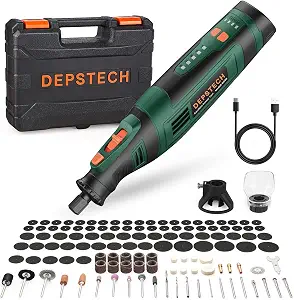
DEPSTECH Cordless Rotary Tool Kit, 8V 2.0Ah Rechargeable Battery, 30000RPM 5-Speed Multi Power Carving Tools, 127Pcs Accessories, Shield Attachment, Cutting/Drilling Guide for Handmade/DIY Creations
I’d rank the DEPSTECH 8V as the most balanced kit here for buyers who want more than delicate engraving but do not want to jump straight to the 12V model. Its five speeds run from 5,000 to 30,000 rpm, while the 2.0Ah battery and charge-level indicator help users plan cordless work. A cutting and drilling guide adds more control for jobs that need a stable depth, and the 127-piece set is substantial without approaching EWORK’s accessory-heavy 448-piece bundle. Compared with that 4V kit, DEPSTECH offers a higher stated maximum speed and a guide attachment; compared with the 12V brushless tool, it has a lower-voltage platform and a smaller battery capacity. At 0.82 pounds, it is also heavier than the Fanttik F2 Master. I see it as a versatile DIY rotary tool, not a replacement for a dedicated carving chisel.
Pros:- 8V platform and 5,000–30,000 rpm range cover a broad spread of rotary-tool jobs.
- 2.0Ah battery includes a charge indicator and USB Type-C charging.
- Cutting and drilling guide supports steadier, depth-conscious work.
- 127 accessories provide more variety than the Fanttik F2 Master’s 35-piece set.
Cons:- At 0.82 lb, it is heavier than the compact Fanttik and EWORK options.
- The 8V platform is less power-focused than the listed 12V brushless model.
- A rotary tool is not as specialized for wood shaping as an electric carving chisel.
Best for: DIY woodworkers and home crafters who want a middle-ground cordless rotary tool with a useful accessory set and guidance for controlled cutting or drilling.
Not ideal for: Users who need the lightest possible tool for prolonged fine detailing, or carvers who need a dedicated chisel-style power tool for shaping wood.
- Voltage:8V
- Battery capacity:2,000mAh (2.0Ah)
- Speed range:5,000–30,000 rpm
- Speed settings:5
- Accessories:127
- Weight:0.82 lb
- Charging:Type-C
- Included attachments:Shield attachment and cutting/drilling guide
Our verdict“Choose DEPSTECH for a well-equipped cordless rotary tool that balances light carving, cutting, and drilling without the 12V model’s power-first focus.”
HARDELL Mini Cordless Rotary Tool, 5-Speed and USB Charging Rotary Tool Kit with 69 Accessories, Multi-Purpose 3.7V Power Rotary Tool
For small carving and finishing jobs, the HARDELL Mini Cordless Rotary Tool offers a gentler entry point than a reciprocating wood chisel. Its five settings span 5,000 to 18,000 RPM, so a beginner can start slowly on fine sanding or engraving rather than immediately committing to a fast cut. The pen-like form, LED work light, and 69 accessories support detail work on resin and other craft pieces, while the stated runtime is far longer than the JIAN carving knife’s roughly 20-minute charge cycle. The tradeoff is power: at 3.7V, it is intended for light work, not fast wood removal. Unlike the Arbortech Power Chisel, it also lacks the force and chisel action for shaping larger wooden blanks. Choose it for careful surface work, not heavy carving.
Pros:- Five speed settings make it easier to control delicate engraving and sanding.
- Compact, lightweight form supports precise, pen-like handling.
- Includes 69 accessories for a range of small craft operations.
- LED lighting helps illuminate the work area around the tool tip.
Cons:- Low-voltage design is a poor fit for heavy wood removal.
- Rotary accessories are less suited to broad chisel cuts than the Arbortech Power Chisel.
- The wide accessory assortment may take time for beginners to sort and match to tasks.
Best for: New hobbyists making small resin or wood crafts who want adjustable speed, a light pen-style grip, and a broad accessory assortment.
Not ideal for: Carvers removing substantial wood or shaping hard timber, since this 3.7V rotary tool is explicitly not intended for heavy-duty projects.
- Voltage:3.7V
- Speed settings:5
- Speed range:5,000–18,000 RPM
- Accessories:69
- Charging:USB rechargeable
- Stated runtime:Up to 200 minutes
- Lighting:Built-in LED
Our verdict“Choose the HARDELL for beginner-friendly detail work on small crafts, but pick a dedicated power chisel for substantial wood carving.”
Cordless Electric Wood Carving Chisel with 20 Replaceable Blades
This Jieotwice tool takes a more direct carving approach than the HARDELL Mini Cordless Rotary Tool: it uses interchangeable cutter heads rather than rotary bits for sanding, grinding, and engraving. Its 20 cutter heads give detail-focused woodworkers a broad selection for shaping and cutting, and USB-C charging keeps the handle free of a cord while working. The lightweight, non-slip plastic grip is meant to support controlled handling, though the supplied details do not specify speed, runtime, or battery capacity, making it harder to judge how it will hold up during longer sessions. At 4.2V, it is also a light-duty option, not a substitute for the 960W Arbortech Power Chisel when a project calls for rapid removal from hard timber. Its appeal is variety and portability, with less evidence of sustained cutting power.
Pros:- Includes 20 interchangeable cutter heads for varied carving and shaping tasks.
- Cordless USB-C rechargeable design supports use away from an outlet.
- Lightweight non-slip handle is suited to controlled hand positioning.
- Copper-core motor is described as stable and heat resistant.
Cons:- The 4.2V specification points to light-duty work rather than heavy wood removal.
- Runtime and speed details are not provided, limiting planning for longer jobs.
- Plastic handle may be less durable with extensive use than a more robust tool body.
Best for: Detail-oriented wood hobbyists who want many interchangeable cutter heads in a compact, USB-C rechargeable chisel.
Not ideal for: Woodworkers tackling large pieces or hard timber who need known runtime and strong, sustained material removal.
- Brand:Jieotwice
- Model:J-1751
- Voltage:4.2V
- Power source:Cordless, USB-C rechargeable
- Battery type:Lithium
- Cutter heads:20 replaceable
- Handle material:Plastic
- Dimensions:196 × 37 mm
Our verdict“Pick this Jieotwice chisel for portable, light-duty carving with plenty of cutter choices, not demanding or extended timber removal.”
Loodion Cordless Electric Wood Carving Tool Set with 5 Chisel Blades
The Loodion’s strength is a straightforward wood-carving setup rather than a large assortment of cutting heads. It comes with five interchangeable chisel blades, a sharpening stone, wrench, collet, and storage case, so the core tools for changing and maintaining blades travel together. A built-in battery display also gives a clearer charge check than the Jieotwice chisel, whose supplied description does not mention a charge indicator. Compared with the 20-blade JIAN carving knife, Loodion offers fewer blade options, but its included sharpening stone and case make it a tidier choice for someone who values a compact kit over maximum variety. The maker limits its intended use to suitable wood, and the workpiece must be secured and tested on scrap. Battery capacity and runtime are not specified, so I would not choose it for long sessions without access to charging.
Pros:- Five interchangeable chisel blades cover common shaping and detail tasks.
- Battery display makes charge status visible while working.
- Storage case keeps the tool and supplied accessories together.
- Includes a sharpening stone, wrench, and collet for blade care and changes.
Cons:- Five blades provide less choice than the 20-blade JIAN and Jieotwice sets.
- Battery capacity and runtime are not specified.
- Designed for wood, and safe use requires securing the workpiece and testing on scrap.
Best for: Woodworking hobbyists who want a compact, organized cordless kit for shaping, grooving, trimming, and detail carving.
Not ideal for: Carvers who need a broad range of blade shapes, long-session runtime information, or a tool for materials beyond suitable wood.
- Brand:Loodion
- Model:A071045
- Power source:Battery powered
- Charging:USB-C
- Blade type:Interchangeable chisel blades
- Blade count:5
- Special feature:Battery display
- Included accessories:Collet, wrench, sharpening stone, storage case, USB-C cable
Our verdict“Choose Loodion if you want a neatly packed, wood-focused carving kit with charge visibility more than a large blade assortment.”
Arbortech Power Chisel Kit – Electric Chisel for Carving Wood with 7 Wood Chisels
Among these five options, the Arbortech is the clear choice when carving means removing substantial wood rather than engraving small details. Its 960W motor and stated rate of 11,000 strokes per minute give it a major power advantage over the battery-powered Loodion, Jieotwice, and JIAN tools. That makes it better suited to hard timber and larger shaping jobs, while the seven high-carbon-steel chisels cover different cuts. A quick-change button reduces interruptions between chisels, and the lockable safety switch adds a useful control feature. The tradeoff is fundamental to this roundup: it is not cordless, so it does not offer the portability of the other carving tools here. Its fixed speed also gives less flexibility for delicate work than the HARDELL’s five-speed rotary setup. Choose it for force and productivity at a powered workbench, not portable carving.
Pros:- 960W motor is suited to demanding timber removal.
- Stated 11,000 strokes per minute supports fast, continuous chisel action.
- Seven high-carbon-steel chisels provide options for different cuts.
- Quick-change mechanism, lockable safety switch, and included carry bag add practical utility.
Cons:- Mains-powered design does not meet the portability needs of a cordless carving tool.
- No variable speed control for adapting the tool to delicate work.
- More power and a chisel-focused format are excessive for small engraving or resin tasks.
Best for: Woodworkers with access to mains power who need a powerful chisel for shaping hard timber and removing wood efficiently.
Not ideal for: Carvers who need cordless portability, variable speed for delicate cuts, or a compact detail tool for small craft work.
- Brand:Arbortech
- Model:PCH.FG.900.20
- Motor power:8A (960W)
- Strokes per minute:Up to 11,000
- Chisels included:7
- Blade material:High-carbon steel
- Speed control:No variable speed control
- Included accessories:Lubricant, extra brush set, spare felt pad, chisel pouch, carry bag
Our verdict“Choose the Arbortech for demanding bench-side wood removal if corded power matters more than cordless freedom.”
JIAN Electric Wood Carving Knife Set with 20 Blades
The JIAN is a cordless carving knife kit for people who want a broad blade selection without moving up to a full-size powered chisel. Its 20 SK5 carbon steel blades offer more variety than Loodion’s five-blade kit, while the power display makes the remaining charge easier to monitor. Charging takes about an hour, but the stated runtime is only about 20 minutes, so this is better for short, planned sessions than extended carving. The tool can run while charging, though the motor area may heat up and the maker recommends a five-minute rest after every ten minutes of work. Compared with the HARDELL rotary tool, JIAN is more directly aimed at wood carving, but it gives up rotary sanding and engraving versatility. Its value lies in blade choice and compact, focused use—not uninterrupted work.
Pros:- Twenty SK5 carbon steel blades offer a broad selection for different carving cuts.
- Power display shows remaining charge.
- USB-C charging takes about one hour.
- Can operate while connected to charging, according to the product description.
Cons:- About 20 minutes of stated runtime limits uninterrupted work.
- Motor area may heat during extended use, and the recommended work cycle includes rest breaks.
- Wood-carving knife format lacks the sanding and engraving range of the HARDELL rotary tool.
Best for: Wood-carving hobbyists who work in short sessions and want a cordless tool with many blade shapes and a visible charge indicator.
Not ideal for: Carvers planning long continuous jobs or heavy timber removal, given the roughly 20-minute runtime and recommended rest breaks.
- Brand:JIAN
- Model:TH-188
- Blade count:20
- Blade material:SK5 hardened carbon steel
- Charging port:USB Type-C
- Charging time:About 1 hour
- Stated runtime:About 20 minutes
- Included components:Main unit, wrench, sharpening stone, Type-C cable, storage case
Our verdict“Pick the JIAN for short wood-carving sessions where blade variety matters more than long runtime or all-purpose rotary functions.”

How We Picked
I compared these 15 tools by the work their designs appear suited to: wood carving with a chisel or knife, or multi-purpose detail work with a rotary tool. I gave more weight to a clear match between tool format and carving task than to accessory quantity alone. Battery voltage and stated capacity, speed range, charging approach, included guides or shields, blade or bit selection, and the likely ease of controlling the tool all informed the comparison.
The ranking favors useful fit and flexibility for cordless carving over a long feature list. Rotary kits rank well when their speed, battery, and attachments support varied craft tasks; purpose-built carving tools rise when their format better suits shaping wood. Tradeoffs matter throughout: mini rotary tools may be easier to handle for small details but are not equivalent to a dedicated chisel, while specialized chisels can be less adaptable for sanding or engraving. Product details supplied for this roundup vary, so I avoid treating unlisted runtime, compatibility, or performance as proven facts.
Factors to Consider When Choosing Cordless Power Carving Tools
Before choosing, decide what “carving” means for your projects. A rotary tool with a carving bit can etch, shape, and finish small areas, while a reciprocating chisel or carving knife removes wood in a different way. The distinctions below help prevent buying a tool based on a headline spec or bundle size that does not fit your work.
Match the tool motion to the cut
Rotary tools spin a bit, making them suited to small details, shallow shaping, engraving, and finishing; a chisel-style tool uses a back-and-forth motion to remove wood more directly. A carving knife offers another format, with blade choice and hand guidance shaping the cut. Do not assume every rotary kit is a substitute for a wood-carving chisel, or that a chisel can replace a rotary tool for sanding and polishing. If your projects mix lettering, edge cleanup, and surface finishing, a rotary kit may be the more useful first tool. If your main goal is shaping wood with chisel-like action, prioritize a dedicated carving tool and verify which blades it accepts. Buying for the motion you need matters more than choosing the most versatile-sounding listing.
Treat battery and voltage claims as clues, not runtime guarantees
Voltage and amp-hour figures help distinguish battery setups, but they do not by themselves tell you how long a tool will run under load. Material hardness, pressure, bit type, and speed can all affect power draw. A 2.0Ah or 2.5Ah battery may appeal for longer work sessions, but check whether the battery is removable or whether the tool charges as a single unit. For cordless work away from an outlet, charging time and access to a spare battery may matter more than a high no-load RPM figure. Mini tools with USB charging can be convenient for light craft sessions, yet may not suit sustained material removal. Check the maker’s stated runtime and charging details before planning extended work.
Choose speed control for the material and the finish
A wide speed range gives more room to adapt a rotary tool to different bits and tasks, but a high maximum speed is not automatically better for wood carving. Fine engraving and delicate edges often call for a controlled, manageable setting, while some accessories need higher speed to work as intended. Variable-speed controls are useful only if the tool is comfortable to hold and adjustments are easy to make during a task. For a dedicated chisel or knife, speed may be less informative than the blade shape, cutting action, and how securely the tool is guided. A common mistake is choosing by peak RPM without checking the lowest setting or how the tool handles. Match the range to the work you actually expect to do.
Look past accessory counts to useful compatibility
A large accessory bundle can cover many tasks, but counts may include pieces you rarely use or consumables that wear out. Check which bit shank sizes the tool accepts, what attachments are included, and whether replacement bits or blades are easy to source. For wood carving, identify the actual carving bits or blade profiles rather than relying on a general-purpose accessory total. Shields and guides can help manage cutting tasks, but they do not replace safe handling or a stable workpiece. If you already own accessories, verify compatibility before paying extra for another mixed kit. A smaller, relevant set can be more useful than a large assortment with uncertain fit.
Weigh control, grip, and work duration together
Carving asks for steady hand control, so tool weight, grip shape, balance, and vibration can affect the result as much as raw power. Compact rotary tools may suit short detail tasks and smaller hands, while a larger battery or body can change how the tool feels during longer sessions. A dedicated chisel may reduce the need to push a rotary bit through the wood, but its cutting action still calls for secure workholding and controlled handling. If possible, compare the tool’s dimensions and weight with the way you plan to hold it, including whether you need a two-handed grip. Do not confuse a lightweight body with a tool that can handle every demanding cut. For sustained use, also check whether the tool can be held comfortably without frequent pauses.
Pay more for a better match, not a longer feature list
Extra battery capacity, more complete guides, a brushless motor, or a dedicated carving mechanism can justify choosing a different class of tool when those features address a real need. They add less value if you only make occasional shallow details or already own compatible accessories. Beginners often benefit more from a manageable tool, clear instructions, and a suitable starter selection than from the largest bundle. Experienced makers may prefer a specialized chisel or a higher-capacity rotary setup when their work demands repeated cuts or a specific motion. Set aside money and storage for replacement blades, bits, and basic workholding as well as the tool itself. This approach avoids paying for capabilities that do not support your projects.
Frequently Asked Questions
Can a cordless rotary tool replace a dedicated wood-carving chisel?
Not for every job. A rotary tool removes material with a spinning bit, which suits detail shaping, engraving, and surface cleanup; a powered chisel uses a different cutting action for more direct wood removal. A rotary kit can be the more flexible choice if you also need to sand, polish, or drill. If your work centers on shaping wood with chisel-like cuts, a dedicated carving tool is the closer match. Choose based on the cut you need rather than assuming one tool format covers both equally well.
Is a larger accessory bundle a better choice for a beginner?
Not automatically. A high piece count may include many items that are not useful for your projects, and it does not tell you how well the tool handles or whether attachments are compatible with future purchases. A beginner may get more from a comfortable tool, accessible speed control, clear safety guidance, and a few suitable carving or finishing accessories. Before choosing a bundle, identify the bits or blades you expect to use and check whether replacements are available. A focused kit can be easier to learn than a box of miscellaneous pieces.
What should I check before buying a cordless carving tool for long sessions?
Look for battery capacity, charging method, manufacturer-stated runtime, and whether you can swap in a charged battery. Also consider tool weight and grip, since fatigue can make steady carving harder even when the battery lasts. A higher voltage or amp-hour figure alone does not establish how long the tool will run under load. Check the charging time and whether your work involves sustained cutting or brief detail tasks. If the listing does not state runtime, avoid planning a long session around an assumed battery life.
Should I choose a high-RPM rotary tool for wood carving?
Maximum RPM is only one part of the decision. A variable-speed tool lets you select a setting that better suits the bit, the cut, and the finish you want, while comfortable handling helps keep that cut controlled. Check the usable lower speed as well as the maximum, and confirm that the accessories are intended for the material and task. For deeper wood removal, a dedicated chisel-style tool may suit the work better than a fast rotary bit. Do not treat a larger RPM number as a guarantee of better carving results.
Which type should I buy if I carve wood but also engrave and sand?
A cordless rotary kit is usually the more practical single-tool format when engraving and sanding are regular tasks alongside light carving. A carving chisel or knife is more specialized for wood shaping and may not provide the same range of finishing functions. Think about how much time you spend on each task: if carving dominates, a dedicated tool may deserve priority, with a rotary tool added later. If the jobs are mixed and mostly small-scale, prioritize variable speed and compatible attachments. Check that the kit includes suitable bits rather than assuming every rotary accessory works well on wood.
Conclusion
For the strongest all-around fit among these options, I’d start with the RYOBI USB Lithium Cordless Power Carver Kit if dedicated wood carving is the priority. For a value-minded rotary setup, compare the smaller cordless kits by the accessories you will actually use rather than their total piece count; the Fanttik F2 Master is a compact option with a more limited 35-piece set. Beginners who want one tool for several light craft tasks may prefer a variable-speed rotary kit, while the DEPSTECH is a stronger match for buyers who want an 8V battery plus a shield and cutting/drilling guide. For a premium, wood-focused choice, the Arbortech Power Chisel Kit is the specialist pick, though it is less suited to buyers seeking an all-purpose rotary tool. Choose a dedicated cordless chisel or knife when blade-based wood shaping is the main need, and a rotary tool when carving shares space with engraving, sanding, drilling, or polishing.