
If you’re looking for top 130mm triplet APO refractors for stunning astrophotos, I recommend models with high-quality ED glass like FPL-51 or FCD100, excellent coatings, and sturdy yet lightweight designs. These scopes deliver sharp, color-accurate images across planetary and deep-sky objects. Compatibility with mounts and accessories is also key. Keep exploring to discover specific models, their features, and what makes each ideal for your astrophotography journey.
Key Takeaways
- High-quality 130mm triplet APO refractors utilize ED glass with advanced coatings for minimal chromatic aberration and sharp, color-accurate images.
- These scopes feature precise focusers, optimized focal lengths, and high-resolution optics, ideal for detailed planetary and deep-sky astrophotography.
- Lightweight, durable materials like aluminum and carbon fiber ensure portability and stability during field imaging sessions.
- Compatibility with various mounts and included accessories makes them versatile for both amateur and advanced astrophotographers.
- Superior optical performance combined with environmental sealing and high-contrast coatings results in stellar imaging quality.
SVBONY SV550 Triplet APO Telescope (122mm F7 ED Refractor)

If you’re looking for an affordable yet high-quality triplet APO refractor for astrophotography, the SVBONY SV550 122mm F7 ED Refractor is an excellent choice. Its 122mm aperture and F7 focal ratio gather ample light, delivering sharp, high-contrast images of planets and deep-sky objects. The FPL-51 triplet lens effectively reduces chromatic aberration, ensuring crisp, clear visuals. With a smooth dual-speed focuser, a portable design, and a sturdy build, this scope balances performance and affordability. Whether you’re capturing stunning astrophotos or enjoying visual observation, the SVBONY SV550 offers excellent value and top-tier optical quality in a compact package.
Best For: amateur astronomers and astrophotographers seeking a portable, high-quality triplet APO refractor for detailed planetary and deep-sky imaging.
Pros:
- Excellent optical quality with minimal chromatic aberration and sharp, high-contrast images
- Robust build with a smooth dual-speed focuser and lightweight, portable design
- Versatile compatibility with various mounts and accessories for astrophotography and visual use
Cons:
- Slightly heavier than some comparable refractors, requiring a sturdy mount
- Initial manufacturing imperfections like dirt between lens elements may occur, requiring inspection or returns
- Support services and after-sales experience can vary depending on the retailer or manufacturer
Explore Scientific ED102 Apochromatic Refractor Telescope

Looking for a high-performance refractor that delivers stunning astrophotography results? The Explore Scientific ED102 Apochromatic Refractor combines genuine FCD1 HOYA ED glass with multi-layer coatings on all surfaces, ensuring high-contrast, detailed views. Its air-spaced triplet design virtually eliminates chromatic aberrations, making it ideal for capturing sharp, color-accurate images of the Moon, planets, nebulae, and star clusters. With a 102mm aperture and f/7 focal ratio, it offers excellent image detail. Its portable design includes a retractable dew shield and a cradle ring with a handle for easy transport. Precise collimation is simple with push-pull adjustments on the front cell.
Best For: amateur astronomers and astrophotographers seeking a portable, high-quality refractor for capturing detailed images of celestial objects with minimal chromatic aberration.
Pros:
- Combines genuine FCD1 HOYA ED glass with multi-layer coatings for high-contrast, sharp images.
- Air-spaced triplet design effectively eliminates chromatic aberrations, ideal for astrophotography.
- Portable with a retractable dew shield and a handle-equipped cradle ring for easy transport and setup.
Cons:
- May be priced higher than entry-level refractors, requiring a larger investment.
- Requires precise collimation via push-pull adjustments, which may be challenging for beginners.
- Limited aperture size compared to larger telescopes, possibly restricting deep-sky object viewing under light-polluted skies.
Explore Scientific ED80 Refractor Telescope for Astrophotography
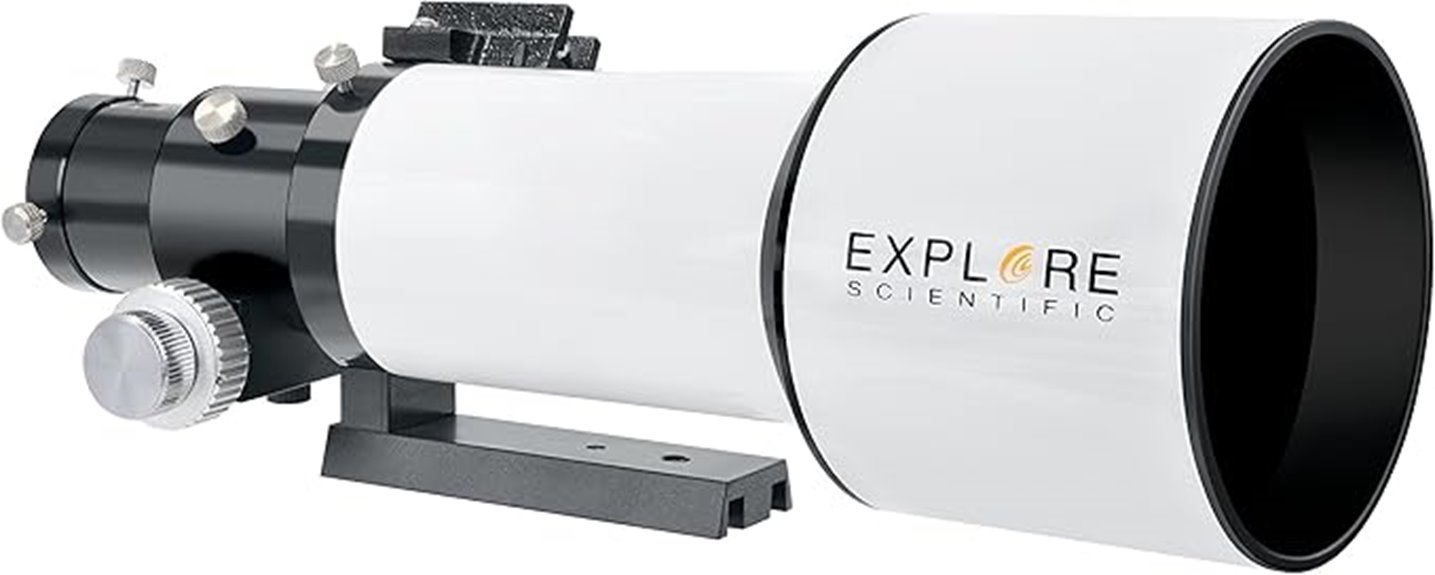
The Explore Scientific ED80 Refractor Telescope stands out as an excellent choice for astrophotographers seeking high-quality, portable optics. Its genuine FCD1 HOYA ED glass and multi-layer coatings deliver sharp, high-contrast images with minimal chromatic aberration. The 80mm aperture and f/6 focal ratio make it versatile for capturing planets, nebulae, and star clusters, while its compact 480mm length and lightweight design facilitate easy transport. The scope’s robust optics, combined with flexible back focus and compatibility with auto-guiders, enable detailed astrophotography. Although some mounting modifications are advised, its superb image quality and portability make it a top pick for both beginners and experienced stargazers.
Best For: amateur and intermediate astrophotographers seeking a portable, high-quality refractor telescope for capturing detailed celestial images.
Pros:
- High-contrast, sharp images thanks to genuine FCD1 HOYA ED glass and multi-layer coatings
- Compact and lightweight design for easy transport and quick setup
- Excellent optical performance with minimal chromatic aberration, suitable for astrophotography
Cons:
- Mounting foot may slip and require modifications or additional adapters for secure attachment
- Proprietary finder scope mount can limit compatibility, prompting the need for upgrades
- Slight manufacturing defects or mounting challenges reported by some users, requiring adjustments
Explore Scientific FCD100 Series 80mm Refractor Telescope for Astrophotography
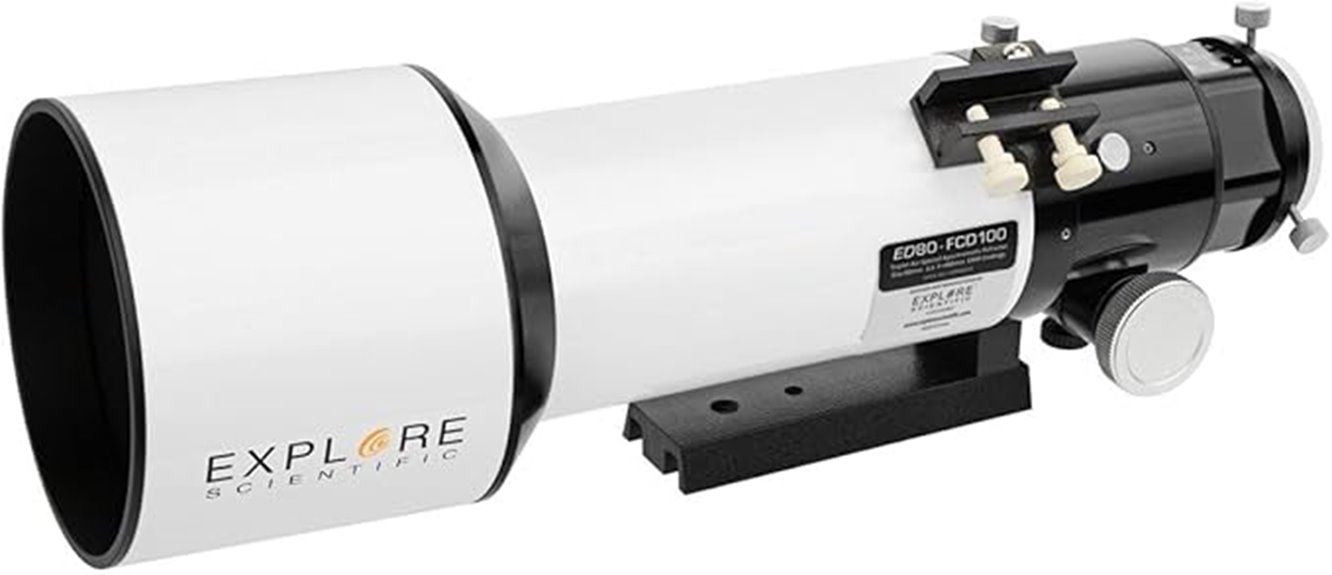
The Explore Scientific FCD100 Series 80mm Refractor Telescope stands out as an excellent choice for astrophotographers seeking high contrast and sharp detail in their images. Its air-spaced triplet design, combined with genuine Hoya FCD100 ED glass and multi-layer coatings, virtually eliminates chromatic aberrations, delivering stunning planetary and deep-sky views. With a versatile f/6 focal ratio and a 480mm focal length, it gathers ample light while remaining portable. The integrated dew shield, dual-speed focuser, and Vixen-style dovetail make setup and focusing precise and straightforward. Overall, this telescope offers exceptional optical performance and user-friendly features perfect for capturing detailed, high-contrast astrophotos.
Best For: astrophotographers and amateur astronomers seeking high-contrast, detailed images of celestial objects with a portable and versatile refractor telescope.
Pros:
- Virtually eliminates chromatic aberrations thanks to air-spaced apochromatic triplet design and FCD100 ED glass
- High light-gathering capability with an 80mm aperture and f/6 focal ratio, ideal for deep-sky imaging
- User-friendly features like integrated dew shield, dual-speed focuser, and Vixen-style dovetail enhance setup and precise focusing
Cons:
- Relatively lightweight build may require additional stabilization for astrophotography
- Discontinued model status could limit availability of accessories or replacement parts
- At a higher price point, may be less accessible for casual hobbyists on a tight budget
Celestron StarSense Explorer DX 130AZ Telescope
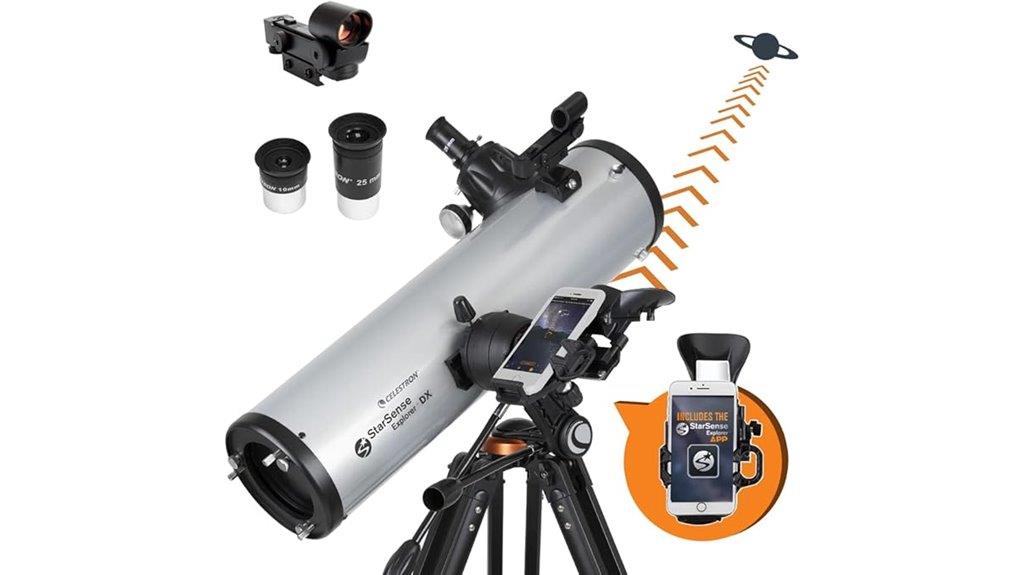
Ideal for beginners enthusiastic to explore the night sky, the Celestron StarSense Explorer DX 130AZ combines ease of use with advanced smartphone integration. Its 130mm Newtonian reflector delivers sharp views of the Moon, planets, and deep-sky objects like the Orion Nebula and Andromeda Galaxy. The manual altazimuth mount features smooth dual-axis controls for easy target tracking. Using the StarSense Explorer app, I simply dock my phone, follow on-screen arrows, and let the sky recognition technology pinpoint objects accurately. This intuitive setup makes stargazing accessible, even in light-polluted areas, while the generous aperture ensures bright, detailed images for beginners to enjoy and learn from.
Best For: beginners and amateur astronomers seeking an easy-to-use telescope with smartphone integration for exploring the night sky.
Pros:
- User-friendly setup with simple manual altazimuth mount and on-screen guidance
- Smartphone app with StarSense technology for accurate object location and navigation
- Delivers bright, detailed views of the Moon, planets, and deep-sky objects like Orion Nebula and Andromeda Galaxy
Cons:
- Manual mount may require some practice for precise tracking during extended observations
- Limited to visual observation; not suitable for astrophotography
- App dependency means functionality may be affected by smartphone compatibility or updates
Explore Scientific FCD100 Series ED102 Refractor Telescope (OTA Only)
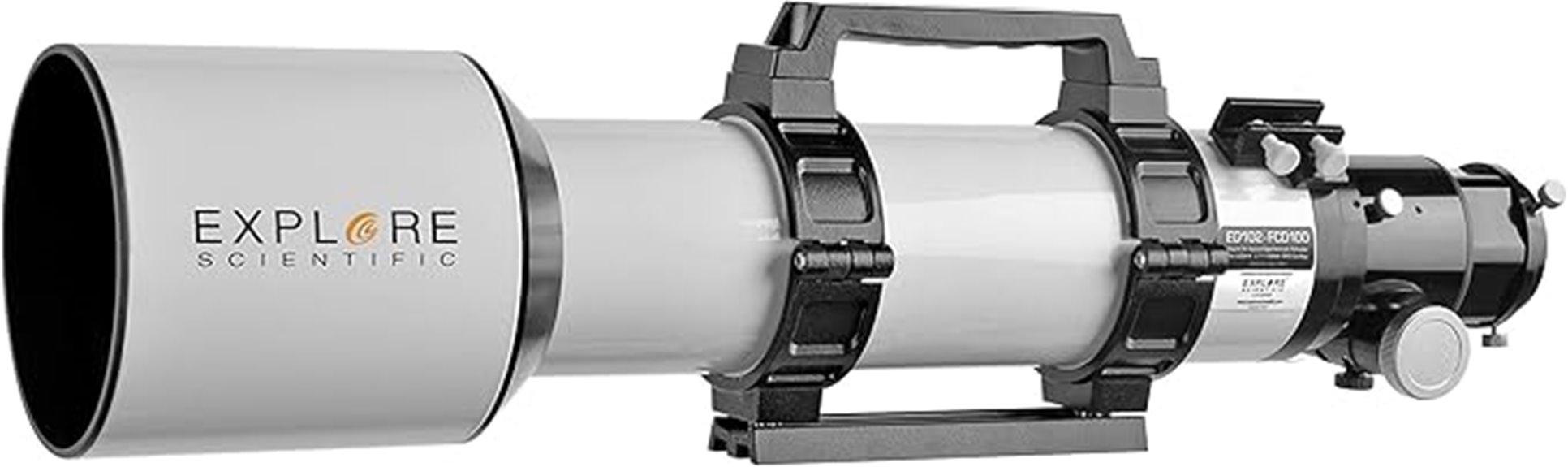
If you’re seeking a portable yet high-performance refractor for astrophotography, the Explore Scientific FCD100 Series ED102 stands out as a top choice. With a 102mm aperture and f/7 focal ratio, it offers sharp, color-accurate images thanks to genuine HOYA FCD100 ED glass and multi-layer coatings. Its advanced chromatic aberration correction minimizes distortion, delivering crisp stellar views. Weighing just under 11 pounds, it’s lightweight and easy to handle for field work. Designed for high-precision observation, this OTA combines excellent optical quality with durable construction, making it a versatile and reliable option for astrophotographers seeking quality in a portable package.
Best For: astrophotographers and amateur astronomers seeking a lightweight, high-quality refractor telescope for portable and precise celestial observations.
Pros:
- Features genuine HOYA FCD100 ED glass for sharp, color-accurate images
- Advanced multi-layer coatings reduce glare and enhance contrast
- Lightweight at just under 11 pounds, ideal for field use and portability
Cons:
- Limited to OTA only, requiring separate mounting and accessories
- Focal length of 714mm may require additional accessories for deep-sky imaging
- Higher cost compared to basic refractor models with similar aperture
SVBONY SV105 Telescope Camera, 1.25-inch CMOS Astrophotography Camera

Looking for an entry-level astrophotography camera that’s easy to use and delivers impressive results? The SVBONY SV105 Telescope Camera fits the bill perfectly. It’s designed for beginners, functioning as an electronic eyepiece for lunar, planetary, and terrestrial imaging. The 1/2.8-inch IMX307 CMOS sensor captures high-quality 1080p videos at 30 fps and 2K recordings at high speed. Its dark light compensation guarantees clear images even in low-light conditions. With plug-and-play compatibility across Windows, Linux, and Android, it’s simple to set up—perfect for those starting out or wanting quick, stunning captures of celestial objects.
Best For: beginners and amateur astronomers seeking an easy-to-use, high-quality astrophotography camera for lunar, planetary, and terrestrial imaging.
Pros:
- Simple plug-and-play setup compatible with Windows, Linux, and Android systems.
- Captures high-definition 1080p videos at 30 fps and 2K recordings at high speed.
- Compact design with dark light compensation technology for clear images in low-light conditions.
Cons:
- Not compatible with iOS devices such as iPhones or iPads.
- Requires specific software (Sharpcap, AstroDMx, or USB Camera app) for imaging and recording.
- Designed primarily for beginners, which may limit advanced astrophotography functionality.
Celestron Omni XLT 120 Refractor Telescope
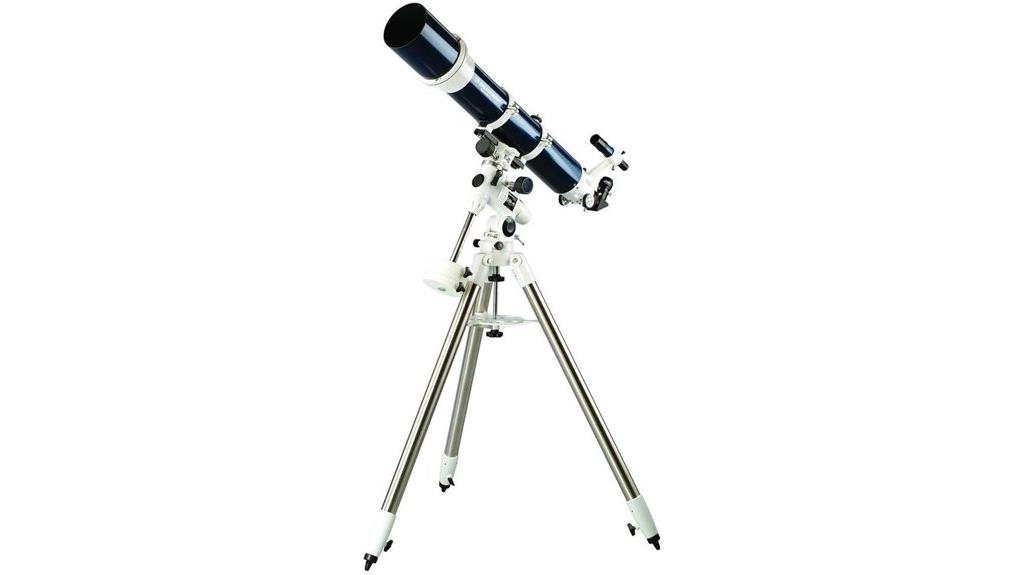
The Celestron Omni XLT 120 Refractor Telescope stands out as a versatile choice for amateur astronomers seeking sharp, high-quality images of the Moon, planets, and bright deep-sky objects. Its hand-selected optical glass and StarBright XLT multi-coated surfaces maximize light transmission, delivering crisp, clear views. The manual German equatorial mount offers smooth movement with slow-motion controls and setting circles, making tracking easier. Included accessories like a finderscope, sturdy tripod, and wide-field eyepiece make setup straightforward. While its 4.75-inch aperture limits deep-sky viewing, it’s perfect for planetary and lunar observation, with potential upgrades for astrophotography.
Best For: amateur astronomers and hobbyists seeking a portable, high-quality telescope for planetary and lunar observation with easy setup and upgrade options.
Pros:
- High-quality optics with StarBright XLT multi-coating for crisp, clear images
- Sturdy German equatorial mount with smooth tracking and slow-motion controls
- Portable design with included sturdy tripod and wide-field eyepiece
Cons:
- Limited deep-sky viewing due to 4.75-inch aperture
- Finding objects can be challenging with the upside-down, mirror-image view from the finderscope
- Length of the telescope may require a low stool for comfortable overhead viewing
SVBONY SV550 Telescope with 80mm F6 APO Triplet Refractor and Accessories
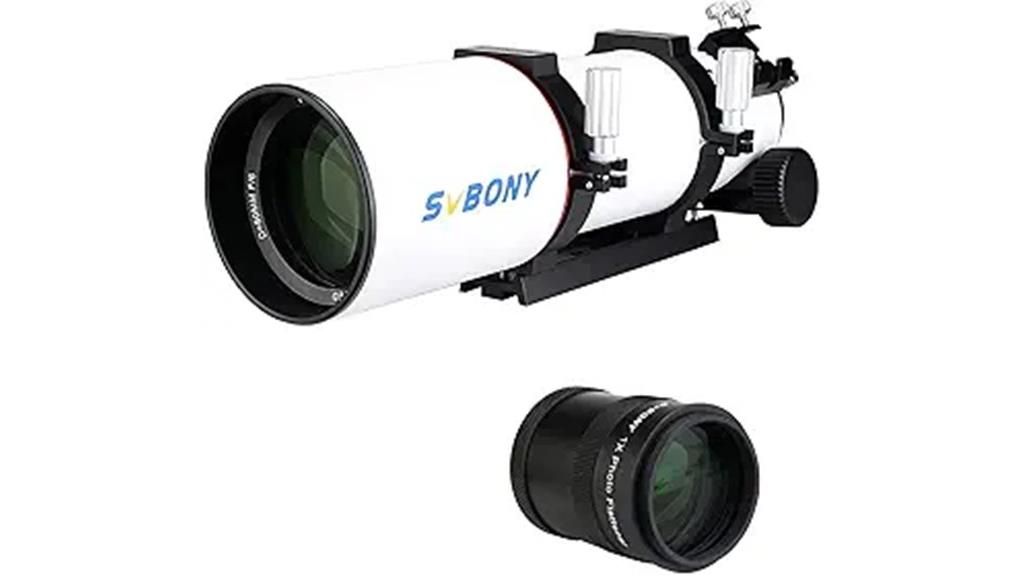
For astrophotographers seeking a portable yet high-performance telescope, the SVBONY SV550 offers an excellent option with its 80mm F6 APO triplet refractor. Its advanced internal light barriers minimize light pollution and enhance image contrast, while the lightweight magnesium alloy focusing seat reduces weight by over 20%, making it easy to carry. The included 180mm hollow dovetail plate ensures stable accessory mounting, and the SV209 field flattener supports full-frame cameras with a 45mm field of view, delivering sharp, vibrant images across the frame. Despite its affordable price, the SV550 consistently provides high-quality deep sky images, making it a versatile choice for both beginners and experienced astronomers.
Best For: amateur and professional astronomers seeking a portable, high-quality telescope for deep sky astrophotography with sharp, vibrant images.
Pros:
- Advanced internal light barriers for minimal light pollution and high contrast images
- Lightweight magnesium alloy focusing seat reduces weight by over 20%, enhancing portability
- Supports full-frame cameras with the included field flattener, providing a wide 45mm field of view
Cons:
- Sensitive focusing mechanism may shift if bumped, requiring careful handling
- Low-profile mount rail can bump into the focuser when balancing, needing additional clearance
- Internal dust may be present but can be easily cleaned, indicating quality control considerations
Askar 120APO Telescope for Astrophotography and Viewing
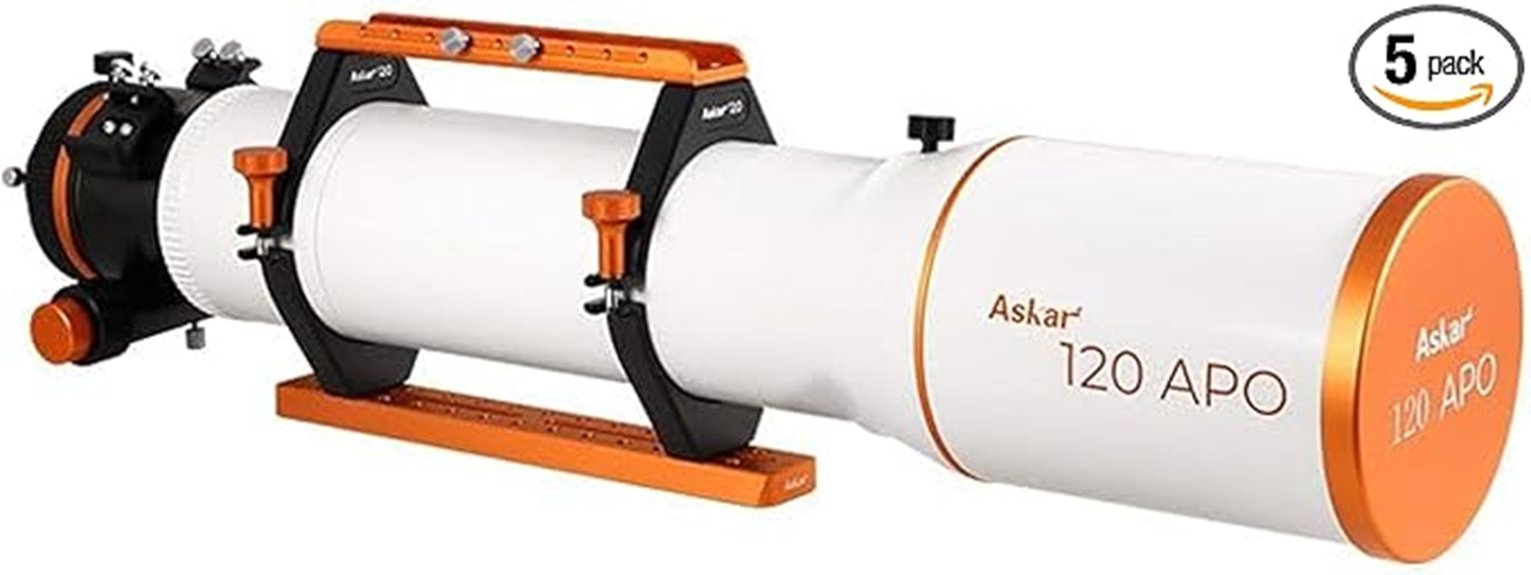
If you’re seeking a portable yet high-performing telescope for astrophotography and viewing, the Askar 120APO stands out with its 120mm APO triplet design. It features an F7 focal ratio and air-spaced ED glass, delivering sharp, chromatic aberration-free images. Its compact size—722mm retracted—makes it easy to transport, while weighing just 5.7kg, perfect for fieldwork. The 840mm focal length ensures detailed planetary and deep-sky views. Comes with essential accessories like tube rings, a dovetail plate, and a carrying case. Overall, it’s a versatile, high-quality scope tailored for astrophotographers seeking portability without sacrificing optical performance.
Best For: amateur astrophotographers and stargazing enthusiasts seeking a portable, high-quality APO telescope for detailed planetary and deep-sky observation.
Pros:
- Compact and lightweight design, ideal for field portability and easy transportation
- High optical performance with triplet air-spaced ED glass for sharp, chromatic aberration-free images
- Comes with comprehensive accessories including tube rings, dovetail plate, and carrying case for versatile setup
Cons:
- Slightly limited aperture size compared to larger telescopes for extremely faint deep-sky objects
- May require additional accessories or mounts for specialized astrophotography setups
- Higher price point relative to entry-level telescopes, which might be a consideration for beginners
Explore Scientific FCD100 127mm f/7.5 Carbon Fiber Triplet ED APO Refractor Telescope
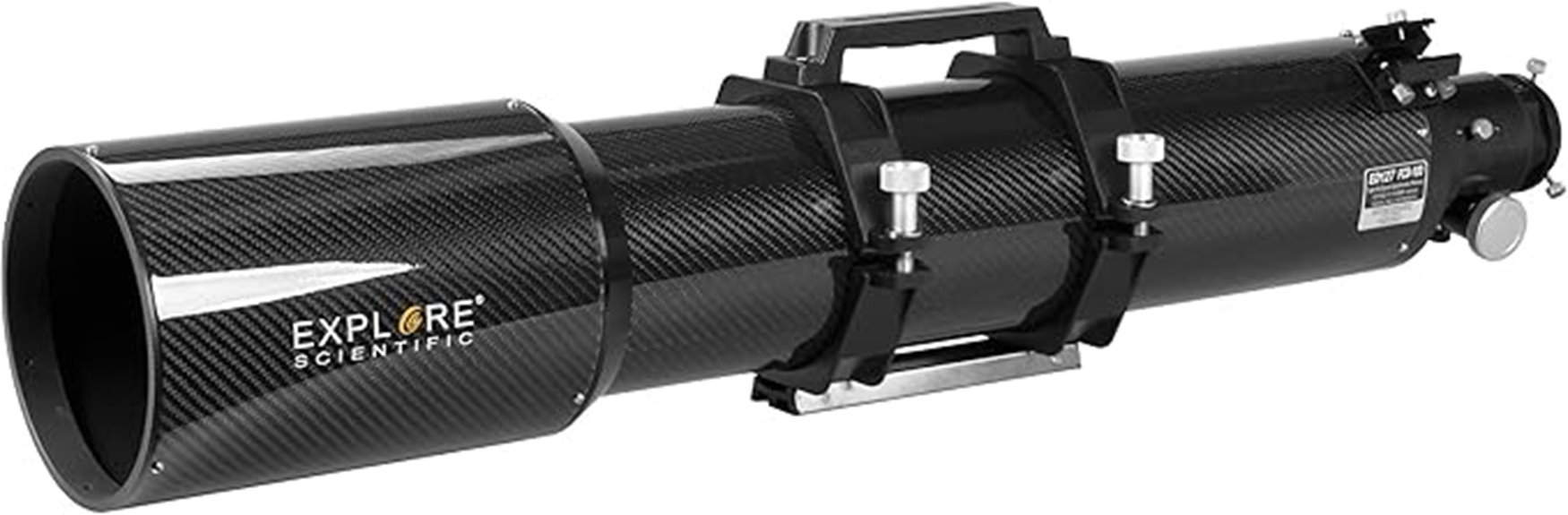
Astrophotographers seeking a lightweight yet high-quality triplet APO refractor will appreciate the Explore Scientific FCD100 127mm f/7.5 Carbon Fiber model. It features a 127mm aperture, 952mm focal length, and a fast f/7.5 ratio, making it suitable for capturing detailed images. The telescope uses ED glass in a triplet configuration to deliver sharp, color-accurate results, with a limiting magnitude of 13. Despite its advanced optics and portable design weighing just 14 pounds, some users report that its optical performance and build quality don’t quite match expectations. Customer support has also been criticized, which may influence its value for serious astrophotographers.
Best For: amateur astrophotographers seeking a portable, high-quality triplet APO refractor for detailed imaging and celestial observation.
Pros:
- Lightweight and portable at only 14 pounds, ideal for travel and field use
- High-quality ED glass triplet design delivers sharp, color-accurate images
- Fast f/7.5 focal ratio suitable for astrophotography and deep-sky imaging
Cons:
- Mixed reviews on optical performance, with some users dissatisfied with image quality
- Customer service and warranty support are reported to be unresponsive and inadequate
- Build quality and accessories such as the focuser and diagonal may not meet expectations for the price
Factors to Consider When Choosing 130MM Triplet APO Refractors for Astrophotography
When selecting a 130mm triplet APO refractor for astrophotography, I consider several key factors to guarantee I get the best results. These include optical performance quality, portability, focal length, focuser stability, and mount compatibility. Understanding these points helps me choose a scope that meets my imaging needs and setup preferences.
Optical Performance Quality
Optical performance is essential when selecting a 130mm triplet APO refractor for astrophotography, as it directly impacts image clarity and detail. High-quality scopes use ED or FCD glass elements to minimize chromatic aberration, ensuring sharp, color-accurate images. The optical design must include precise air-spaced triplet elements to effectively eliminate spherical and chromatic aberrations, especially at high magnifications. Multilayer coatings on all surfaces boost light transmission, contrast, and brightness, enhancing overall image quality. A scope’s resolution, typically around 0.8 to 1 arcsecond, indicates its ability to resolve fine planetary and deep-sky details. Consistent performance depends on tight collimation, high-quality lens fabrication, and low wavefront error, resulting in pinpoint stars and sharp planetary features across the field.
Portability and Weight
Choosing a 130mm triplet APO refractor involves more than just optical quality; portability plays a key role in how easily I can set up and enjoy astrophotography sessions in the field. These refractors typically weigh between 10 and 15 pounds, which influences how manageable they are during transport and setup. Lighter models often use materials like magnesium alloy or carbon fiber to cut weight without sacrificing image quality. The length of these telescopes ranges from 20 to 30 inches, affecting how I handle transportation and mounting. Portability isn’t just about weight; size matters too. Compact designs make traveling easier and setup faster, especially when I add accessories like heavy mounting rings or dovetails that can add to the overall weight and handling complexity.
Focal Length and Ratio
Focal length and ratio are essential factors that directly impact the versatility and performance of a 130mm triplet APO refractor for astrophotography. The focal length, typically between 714mm and 952mm, influences the field of view and magnification. Shorter focal lengths (~714mm) provide wider views, perfect for large deep-sky objects, while longer focal lengths (~952mm) offer higher magnification for detailed planetary images. The focal ratio, around f/6 to f/7.5, balances wide-field imaging with high-resolution planetary detail, affecting exposure times. Lower ratios (f/6) require shorter exposures and are more forgiving for wide-field shots, whereas higher ratios (f/7.5) suit high-magnification planetary work. When choosing, consider your target objects and imaging setup to optimize image quality and coverage.
Focuser Precision and Stability
A high-quality focuser is essential for sharp, accurate astrophotography images, especially at high magnifications. A two-speed focuser with a 10:1 ratio allows for precise adjustments, which is critical for fine-tuning focus on detailed images. A robust, well-constructed focuser minimizes flexure and prevents image shift during delicate focusing, maintaining image stability. Smooth, backlash-free mechanisms enable seamless focusing without vibrations or instability that could blur images. When using heavy eyepieces or cameras, the focuser must have sufficient load capacity to avoid sagging and ensure consistent focus. Additionally, fine focusing capabilities and locking mechanisms help lock in focus during long exposures, preventing drift and ensuring stellar images remain sharp throughout your astrophotography session.
Mount Compatibility Ease
Ensuring your telescope mounts securely and compatibly is vital for successful astrophotography, especially with a 130mm triplet APO refractor. First, check that the mounting foot or dovetail plate matches your existing mount, whether Vixen or Losmandy style. Confirm that the telescope’s weight—around 12-15 pounds—stays within your mount’s payload capacity to guarantee stability during imaging. It’s also important that the mounting system allows for easy attachment and quick balancing, which are essential for precise tracking. Make sure the mount’s saddle or clamp can firmly hold the dovetail without slipping or needing extra adapters. Finally, consider the telescope’s dimensions to ensure it fits comfortably on your mount and in your setup, avoiding any awkward or unstable configurations.
Price and Value
Choosing the right 130mm triplet APO refractor often comes down to balancing price and value. Prices can vary considerably, with high-end models exceeding $2,000, while more affordable options are under $1,000. It’s crucial to compare optical quality, features, and included accessories to guarantee you’re getting the best performance for your investment. Higher-priced models usually feature superior ED glass, better build quality, and upgraded accessories, which can be worth the extra cost for serious astrophotographers. However, budget-friendly options might compromise on some features but still provide excellent results for beginners or casual users. Considering long-term durability, customer support, and warranty coverage alongside price helps determine whether a more expensive refractor offers better overall value for your needs.
Accessories and Support
When selecting a 130mm triplet APO refractor for astrophotography, it’s important to pay attention to the accessories and support options that come with it. Essential accessories like field flatteners, extension tubes, and dovetail plates ensure the best imaging quality and compatibility with your gear. Reliable customer support and a solid warranty are critical for help with collimation, repairs, and technical guidance. Make sure the mount and accessories can handle heavy cameras and astrophotography equipment to maintain stability during long exposures. Brands offering detailed manuals, tutorials, and responsive technical support make setup, calibration, and troubleshooting much easier. Additionally, check for upgrade options like autofocus systems and specialized adapters, which can enhance your imaging capabilities over time.
Build Durability
A durable 130mm triplet APO refractor relies on high-quality materials like magnesium alloy or carbon fiber for its tube, which resist deformation and corrosion over time. These materials ensure the telescope maintains structural integrity during transport and use, even in harsh conditions. Reinforced lens cell assemblies and internal light barriers protect optical elements from dust, moisture, and shocks, preserving alignment and image quality. Robust focusing mechanisms, with precision-machined knobs and metal components, deliver stable, accurate adjustments without flex or slipping. The mounting hardware, including dovetails and rings, should be made from corrosion-resistant metals like anodized aluminum or stainless steel for long-term reliability. Proper sealing, such as O-rings and weather-resistant coatings, further shields the scope from environmental elements, ensuring consistent performance in outdoor astrophotography sessions.
Frequently Asked Questions
What Is the Optimal Focal Length for Astrophotography With a 130MM Triplet APO?
For astrophotography with a 130mm triplet APO, I find that a focal length around 650mm to 800mm works best. This range balances detailed planetary and lunar shots with wide-field deep-sky imaging. Longer focal lengths give more magnification but can be tricky to manage, while shorter ones offer better field coverage. I recommend starting within this range and adjusting based on your specific targets and camera setup.
How Does Chromatic Aberration Affect Astrophotography Quality?
Chromatic aberration can really impact the clarity of my astrophotography by causing color fringing around stars and celestial objects. It blurs details and reduces overall image sharpness, making it harder to capture crisp, accurate images. That’s why I prefer apochromatic refractors—they minimize this issue, giving me cleaner, more vibrant photos. Reducing chromatic aberration truly makes a significant difference in achieving stunning, professional-looking astrophotos.
Are There Specific Accessories Recommended for 130MM Triplet APOS?
They say “the devil is in the details,” so I always recommend specific accessories for my 130mm triplet APO. A high-quality field flattener helps guarantee sharp, edge-to-edge images. A reliable off-axis guider improves tracking accuracy. Additionally, a sturdy mount and a good dew shield prevent issues during long exposures. These accessories enhance your astrophotography experience and help you capture stunning, crisp celestial images with your refractor.
What Maintenance Is Required for These Telescopes to Ensure Stellar Images?
To keep my 130mm triplet APO in top shape, I regularly clean the lenses with a blower and lens tissue to remove dust and fingerprints. I check and tighten any screws or fittings periodically, and store it in a dust-free, dry environment. I also guarantee the mount and tripod are stable and well-maintained. Proper care keeps my images sharp and my telescope performing at its best.
Can These Triplet APOS Be Used Effectively for Planetary Imaging?
Yes, I find these triplet APOs excellent for planetary imaging. Their high-quality optics deliver sharp, detailed images, especially with good magnification and atmospheric stability. I make sure to use a high frame rate to capture steady images and employ focusers that allow precise adjustments. Properly cooled and collimated, these telescopes excel at revealing planetary details, making them a reliable choice for planetary astrophotography.
Conclusion
Choosing the right 130mm triplet APO refractor is like finding the perfect lens to capture a fleeting starburst—every detail matters. With options ranging from budget-friendly to premium, you can craft your celestial masterpiece. Remember, the right telescope isn’t just gear; it’s your trusted telescope partner in revealing the universe’s hidden wonders. So, pick the one that sparks your curiosity, and let your astrophotography journey shine brighter than ever.