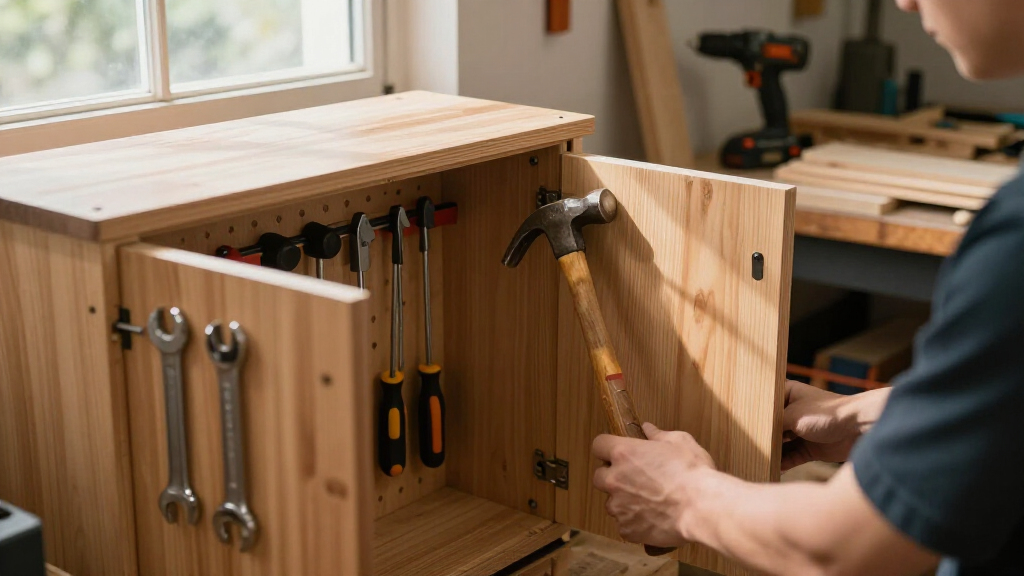

The best woodworking tool storage solutions keep frequently used tools visible, protected, and close to the work area without consuming valuable bench space. My best overall pick is the POKIPO Large Power Tool Organizer because it combines high-capacity shelving, drill holders, and an integrated charging station in one wall-mounted unit. The F-Style Clamp Modular Rack 3 Pack is the stronger value choice for distributing clamps around a shop, while the Rockler 24-Inch Parallel Clamp Rack offers a more purpose-built premium setup for wide parallel clamps. The main tradeoffs are broad utility versus tool-specific fit, fixed capacity versus modular expansion, and storage density versus fast access. Continue reading for my full breakdown of which solution fits each tool collection and workshop layout.

Get tools and workshop supplies delivered free — and shop member deals
- Fast, free delivery on millions of items
- Access to Prime Big Deal Days deals on October 6–7
- Prime Video, Amazon Music and more included
Complete the kit


Key Takeaways
- The POKIPO organizer earns the top position because it handles several power-tool storage jobs at once, though its size and charging features are excessive for shops centered on hand tools.
- Specialized racks provide better tool density: the WoodRiver turning rack and O’SKOOL chisel rack fit their intended tools more securely than a general shelf, but neither solves broader workshop clutter.
- Fulton’s modular clamp systems offer the best expansion path, while the fixed Quick-Release and Rockler racks trade future flexibility for a simpler, more defined storage arrangement.
- The F-Style Clamp Rack 3 Pack is the value standout because three separate racks can create storage zones near different benches, although it lacks the refined single-station approach of the Rockler rack.
- Wall structure matters more than headline capacity: nearly every leading option shifts weight onto the wall, so stud placement, fasteners, tool shape, and balanced loading can determine whether a rack works well.
| Quick-Release Bar Clamp Rack |  | Best Value Clamp Rack | Rack length: 24-3/8 inches | Material: Galvanized steel | Storage capacity: Up to 15 clamps | VIEW LATEST PRICE | See Our Full Breakdown |
| Fulton Woodworking Tools Pipe Clamp Modular Clamp Rack |  | Best Modular Clamp System | Number of racks: 3 | Length per rack: 16 inches | Material: Heavy-duty steel | VIEW LATEST PRICE | See Our Full Breakdown |
| POKIPO Large Power Tool Organizer with Charging Station |  | Best Overall Power-Tool Station | Load capacity: Up to 600 pounds | Number of shelves: 4 | Drill slots: 8 | VIEW LATEST PRICE | See Our Full Breakdown |
| WOODRIVER Turning Tool Storage Rack |  | Best for Turning Tools | Tool capacity: Up to 6 tools | Retention material: EVA foam | Length: 16-1/4 inches | VIEW LATEST PRICE | See Our Full Breakdown |
| Fulton Woodworking Tools Bar/Parallel Clamp Modular Rack |  | Best for Bar and Parallel Clamps | Number of racks: 3 | Length per rack: 16 inches | Material: Heavy-duty steel | VIEW LATEST PRICE | See Our Full Breakdown |
| O’SKOOL Modular Chisel Storage Rack |  | Best Modular Chisel Storage | Primary material: Birch plywood | Additional materials: Carbon steel and plastic | Fence blocks: 10 | VIEW LATEST PRICE | See Our Full Breakdown |
| Rockler 24-Inch Parallel Clamp Rack |  | Best Dedicated Parallel Clamp Rack | Rack length: 24 inches | Clamp capacity: 12 clamps | Clamp compatibility: Parallel woodworking clamps | VIEW LATEST PRICE | See Our Full Breakdown |
| F-Style Clamp Modular 16 Inch Clamp Rack 3 Pack |  | Best High-Capacity Clamp System | Number of racks: 3 | Length per rack: 16 inches | Material: Heavy-duty steel | VIEW LATEST PRICE | See Our Full Breakdown |
| WoodRiver Tilt-Out Bins |  | Best for Small Woodworking Hardware | Number of bins: 5 | Bin width: 4-1/4 inches | Bin depth: 4-1/2 inches | VIEW LATEST PRICE | See Our Full Breakdown |
| woodworking tool storage solution | Material |
|---|---|
| Quick-Release Bar Clamp Rack | Galvanized steel |
| Fulton Woodworking Tools Pipe | Heavy-duty steel |
| POKIPO Large Power Tool Organi | Heavy-duty metal |
| WOODRIVER Turning Tool Storage | — |
| Fulton Woodworking Tools Bar/P | Heavy-duty steel |
| O’SKOOL Modular Chisel Storage | — |
| Rockler 24-Inch Parallel Clamp | Galvanized steel |
| F-Style Clamp Modular 16 Inch | Heavy-duty steel |
| WoodRiver Tilt-Out Bins | Plastic |
More Details on Our Top Picks
Quick-Release Bar Clamp Rack
I rank the Quick-Release Bar Clamp Rack as the value pick because its simple, single-piece design stores up to 15 clamps without consuming shelf or floor space. Its 24-3/8-inch galvanized-steel rail is less flexible than the three-piece Fulton Woodworking Tools Bar/Parallel Clamp Modular Rack, but it also involves fewer parts to align. The 16-inch stud spacing suits common workshop framing and helps transfer clamp weight into the wall. This makes more sense for a focused collection than a shop with several clamp styles. Compatibility with most quick-release clamps adds some latitude, although unusually shaped heads may not sit correctly. I place it below broader organizers because it stores only clamps, and installation may require separate lag bolts or adapted hardware.
Pros:- Stores as many as 15 quick-release clamps on one wall rail
- Galvanized steel resists workshop wear
- Pre-drilled spacing matches studs placed 16 inches on center
- Single-piece format requires less alignment than modular racks
Cons:- Lag bolts are required for a secure installation
- Pre-drilled mounting points may not suit every wall layout
- Fixed slots cannot be rearranged for different clamp collections
Best for: Budget-minded woodworkers with up to 15 quick-release bar clamps and exposed or easily located wall studs
Not ideal for: Shops with mixed clamp styles or nonstandard wall spacing, since the fixed rail offers little configuration flexibility
- Rack length:24-3/8 inches
- Material:Galvanized steel
- Storage capacity:Up to 15 clamps
- Clamp compatibility:Most quick-release bar clamps
- Mounting type:Wall mounted
- Mounting-hole spacing:16 inches on center
- Required fasteners:Lag bolts
Our verdict“I recommend this rack for an economical, straightforward way to move a modest quick-release clamp collection onto the wall.”
Fulton Woodworking Tools Pipe Clamp Modular Clamp Rack
I give the Fulton Woodworking Tools Pipe Clamp Modular Clamp Rack the modular-system role because its three 16-inch steel racks can be arranged around a mixed clamp collection rather than forcing every tool onto one long rail. Its listed configurations cover 21 pipe clamps, 30 F-clamps, or 21 bar and parallel clamps, giving it a broader organizing scope than the Quick-Release Bar Clamp Rack. Angled lips help keep heavy clamps from sliding forward, while included hardware reduces extra purchasing. That flexibility comes with more planning: each section must be positioned and aligned, and actual capacity changes with clamp size. I rank it ahead of the Fulton Bar/Parallel model for mixed clamp storage, but buyers devoted mainly to parallel clamps may prefer that more focused option.
Pros:- Three separate racks support flexible workshop layouts
- Heavy-duty steel is suited to weighty clamp collections
- Angled lips reduce the chance of clamps slipping forward
- Pre-drilled racks and mounting hardware simplify setup
Cons:- Correct alignment across three rack sections takes added installation work
- Usable capacity varies with clamp dimensions
- The system has no practical storage role for non-clamp tools
Best for: Woodworkers building a wall-based system for pipe, F-style, bar, and parallel clamp collections
Not ideal for: Renters or small-tool owners who cannot drill into walls and need storage for more than clamps
- Number of racks:3
- Length per rack:16 inches
- Material:Heavy-duty steel
- Mounting locations:Wall studs or drywall
- Mounting hardware:Included
- Pipe-clamp capacity:Up to 21 clamps
- F-clamp capacity:Up to 30 clamps
- Bar/parallel-clamp capacity:Up to 21 clamps
Our verdict“I recommend this system for a growing, mixed clamp collection that benefits more from configurable sections than one fixed rail.”
POKIPO Large Power Tool Organizer with Charging Station
I rank the POKIPO Large Power Tool Organizer highest for broad power-tool storage because it combines four shelves, eight drill slots, hooks, and charging in one wall station. The four-outlet strip and 6.5-foot cord keep batteries near their tools, a practical advantage the clamp-focused Fulton racks cannot offer. A stated 600-pound capacity provides room for a substantial cordless collection, although the wall structure and fasteners still govern how safely that weight can be supported. Its size also makes installation more demanding than mounting the compact WOODRIVER Turning Tool Storage Rack; some buyers may need help lifting and aligning it. I favor this model for consolidating bulky equipment, but it is excessive for a hand-tool bench or a shop that prefers mobile cabinets over fixed wall storage.
Pros:- Combines tool storage and four-outlet charging in one station
- Four shelves and eight drill slots separate bulky tools from drivers
- Stated 600-pound capacity accommodates a large collection
- Hooks add accessible storage for smaller accessories
Cons:- Large, heavy assembly may require two people to mount
- Safe loading depends on wall structure and installation quality
- Fixed wall installation offers no mobility around the workshop
Best for: Cordless-tool owners who need centralized storage and charging for multiple drills, batteries, and bulky accessories
Not ideal for: Renters, lightly equipped hobbyists, or anyone unable to support a large and potentially heavy organizer on the wall
- Load capacity:Up to 600 pounds
- Number of shelves:4
- Drill slots:8
- Power-strip outlets:4
- Power-cord length:6.5 feet
- Material:Heavy-duty metal
Our verdict“I recommend this as the broadest wall-mounted choice for buyers who want cordless tools and charging equipment gathered in one place.”
WOODRIVER Turning Tool Storage Rack
I choose the WOODRIVER Turning Tool Storage Rack for lathe-focused storage because its EVA foam fingers separate and grip up to six long-handled turning tools without requiring individual holders. At just 2-3/8 inches deep, it projects far less from the wall than the POKIPO power-tool station, making it better beside a lathe where clear working space matters. Multiple racks can be joined as a collection grows, and included mounting hardware adds convenience. The tradeoff is narrow usefulness: this rack does not organize drills, clamps, or small loose accessories, and six slots fill quickly in a well-equipped turning shop. I rank it as a specialist rather than a general workshop solution, but its compact, expandable format is a better match for gouges and chisels than a broad metal shelf.
Pros:- EVA foam fingers hold turning tools separately
- Shallow 2-3/8-inch depth preserves workspace around the lathe
- Multiple racks can be joined for a growing collection
- Mounting hardware is included
Cons:- One rack holds only six tools
- Specialized slot design has little use beyond turning tools
- Expanding capacity requires purchasing additional racks
Best for: Woodturners who want six frequently used gouges, scrapers, or similar long-handled tools within reach of the lathe
Not ideal for: General woodworkers seeking one organizer for power tools, clamps, hardware, and accessories
- Tool capacity:Up to 6 tools
- Retention material:EVA foam
- Length:16-1/4 inches
- Height:1-3/8 inches
- Depth:2-3/8 inches
- Mounting hardware:Included
- Expansion method:Multiple racks can be joined
Our verdict“I recommend this compact rack for woodturners who value quick tool access more than multi-purpose storage.”
Fulton Woodworking Tools Bar/Parallel Clamp Modular Rack
I assign the Fulton Woodworking Tools Bar/Parallel Clamp Modular Rack the dedicated-clamp role because its three modular steel sections can be spaced around wide clamp heads and long bars. Compared with the single 24-3/8-inch Quick-Release Bar Clamp Rack, this system gives buyers more freedom to match an awkward wall or separate clamps by size. It is also more focused than the Fulton Pipe Clamp Modular Rack, making the buying case strongest for shops built around bar and parallel clamps. Heavy-duty steel suits substantial clamp weight, and the supplied hardware removes one installation expense. Still, precise tab and rack alignment takes patience, while locating studs may require extra tools. I rank it below the mixed Fulton system for versatility, but ahead of fixed rails when custom placement matters most.
Pros:- Three modular sections can be configured around clamp sizes and wall obstacles
- Heavy-duty steel supports large bar and parallel clamps
- Included hardware reduces additional setup purchases
- Wall mounting frees floor and bench space
Cons:- Precise alignment of the modular sections adds setup time
- Stud location may limit the preferred rack arrangement
- Dedicated clamp design provides no storage for other tool categories
Best for: Furniture makers with a sizable bar or parallel clamp collection and wall space that benefits from a split-rack layout
Not ideal for: Woodworkers who mainly own pipe or F-style clamps, or who want storage that also accommodates hand and power tools
- Number of racks:3
- Length per rack:16 inches
- Material:Heavy-duty steel
- Mounting locations:Wall studs or drywall
- Mounting hardware:Included
- Assembly format:Modular tabs
- Available style variants:Pipe clamp, F-clamp, and bar/parallel clamp
Our verdict“I recommend this rack for bar and parallel clamp owners who need more layout flexibility than a single fixed rail provides.”
O’SKOOL Modular Chisel Storage Rack
I rank the O’SKOOL Modular Chisel Storage Rack as the strongest choice for woodworkers who want chisel organization that can change with their collection. Its 10 movable fence blocks can be repositioned without dismantling the rack, while angled lips help keep sharp tools from slipping forward. That flexibility gives it a broader organizational role than the fixed WOODRIVER Turning Tool Storage Rack. It also keeps cutting tools more accessible than the enclosed WoodRiver Tilt-Out Bins, which are intended for loose hardware. The limitation is tool size: the 5/16-inch thickness ceiling rules out many broad or unusually thick tools. Its open tabletop format also consumes bench space and leaves edges exposed to dust. I see this as a specialized, adjustable system rather than an all-purpose storage rack.
Pros:- Ten movable fence blocks allow customized spacing
- Compartments can be reconfigured without dismantling the rack
- Angled lips help retain sharp tools securely
- Birch plywood and carbon-steel components provide a sturdy structure
Cons:- Maximum tool thickness of 5/16 inch excludes larger tools
- Open storage exposes chisels to dust and debris
- Needs assembly and adjustment before the layout is dialed in
Best for: Chisel-focused woodworkers whose small cutting-tool collections change frequently and who want adjustable tabletop storage
Not ideal for: Owners of thick carving tools or crowded workbenches, since tools over 5/16 inch may not fit and the rack occupies work surface
- Primary material:Birch plywood
- Additional materials:Carbon steel and plastic
- Fence blocks:10
- Maximum tool thickness:5/16 inch
- Shelf type:Step shelf
- Number of shelves:1
- Mounting type:Tabletop
- Finish:Lacquered
- Warranty:30-day return guarantee
Our verdict“This is my pick for woodworkers who value adaptable chisel spacing more than enclosed storage or broad tool compatibility.”
Rockler 24-Inch Parallel Clamp Rack
The Rockler 24-Inch Parallel Clamp Rack earns its place by giving a dozen parallel clamps a simple, sturdy home without consuming floor space. Its galvanized-steel construction is better matched to heavy clamp heads than lightweight plastic organization, and mounting holes spaced 16 inches apart line up with common stud spacing. Compared with the F-Style Clamp Modular 16 Inch Clamp Rack 3 Pack, Rockler offers less configuration freedom and lower listed capacity, but its single-piece layout is easier to understand and better focused on parallel clamps. That narrow focus is also its main weakness: clamps wider than 24 inches are outside its stated range, and installation requires lag bolts into a suitable wall structure. I rank it ahead of more flexible racks for buyers who prefer straightforward access over expansion options.
Pros:- Stores up to 12 parallel clamps in one organized row
- Galvanized steel resists workshop wear
- Sixteen-inch mounting-hole spacing matches common wall studs
- Wall placement frees valuable bench and floor space
Cons:- Stated compatibility stops at 24-inch-wide clamps
- Lag-bolt installation requires a strong wall and suitable studs
- Fixed 24-inch layout is less adaptable than modular rack sets
Best for: Furniture makers with up to 12 parallel clamps who have open wall-stud space and want a fixed, easy-to-scan arrangement
Not ideal for: Shops built around clamps wider than 24 inches or renters who cannot install lag bolts into wall studs
- Rack length:24 inches
- Clamp capacity:12 clamps
- Clamp compatibility:Parallel woodworking clamps
- Maximum clamp width:24 inches
- Material:Galvanized steel
- Mounting type:Wall mounted
- Mounting-hole spacing:16 inches on center
- Required fasteners:Lag bolts
Our verdict“I recommend this rack for a modest parallel-clamp collection when structural simplicity matters more than modular expansion.”
F-Style Clamp Modular 16 Inch Clamp Rack 3 Pack
I place the F-Style Clamp Modular 16 Inch Clamp Rack 3 Pack highest for clamp-heavy shops because three connectable sections let buyers spread storage across a wall or build one continuous station. The listed capacities—up to 30 F-clamps or 21 pipe, bar, or parallel clamps—make it more accommodating than the 12-clamp Rockler 24-Inch Parallel Clamp Rack. An angled front lip helps prevent clamps from sliding out, and included hardware reduces extra shopping before installation. This system asks more of the wall, however: careful alignment is needed across multiple racks, and finding studs is the safer route for a loaded setup. Its clamp-only design also lacks the mixed-tool utility of the POKIPO Large Power Tool Organizer. I favor it for capacity and layout freedom, not for compact simplicity.
Pros:- Three modular racks can be joined or separated
- Listed capacity reaches 30 F-clamps
- Heavy-duty steel supports demanding workshop use
- Angled retaining lip and mounting hardware are included
Cons:- Multiple sections require careful placement and alignment
- Stud-supported installation may require a stud finder
- Dedicated clamp format offers little value for other tool categories
Best for: Busy cabinet and furniture shops with large mixed clamp collections and enough wall space for three configurable sections
Not ideal for: Small workshops needing mixed-tool storage or users unwilling to locate studs and align several wall-mounted sections
- Number of racks:3
- Length per rack:16 inches
- Material:Heavy-duty steel
- Mounting locations:Wall studs or drywall
- Mounting hardware:Included
- F-clamp capacity:30
- Pipe-clamp capacity:21
- Bar or parallel-clamp capacity:21
- Retention feature:Angled front lip
Our verdict“This three-rack system makes the most sense when I prioritize clamp capacity and configurable wall coverage over multipurpose storage.”
WoodRiver Tilt-Out Bins
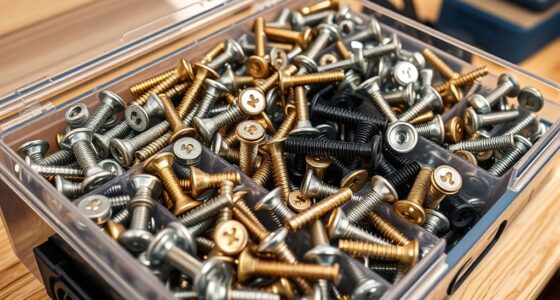
The WoodRiver Tilt-Out Bins fill a storage gap the clamp and tool racks cannot: keeping dowels, biscuits, tenons, and other loose parts separated but visible. Five individual compartments tilt forward for access, while customizable label tabs reduce time spent opening bins to find the right hardware. Compared with the O’SKOOL Modular Chisel Storage Rack, this unit protects small components more effectively and can be stacked, but it cannot accommodate chisels or other long tools. Each bin measures only 4.25 by 4.5 by 5.5 inches, so bulk boxes of fasteners will overwhelm it quickly. The plastic frame is also a poorer match for dense metal hardware than the steel construction used by the Rockler clamp rack. I rank it as a focused parts organizer, not a substitute for a cabinet.
Pros:- Five separate bins keep small components sorted
- Tilt-out access makes frequently used hardware easy to retrieve
- Customizable tabs support clear labeling
- Stackable format can expand vertically
Cons:- Small compartments cannot hold bulk supplies or larger tools
- Plastic construction is poorly suited to very heavy contents
- Only five categories can be separated per unit
Best for: Joinery-focused woodworkers who need labeled separation for dowels, biscuits, tenons, and small quantities of fasteners
Not ideal for: Production shops storing bulk hardware or heavy metal parts, since the bins are small and the frame is plastic
- Number of bins:5
- Bin width:4-1/4 inches
- Bin depth:4-1/2 inches
- Bin height:5-1/2 inches
- Material:Plastic
- Included fasteners:4 screws and anchors
- Included labels:5 customizable tabs
- Configuration:Stackable tilt-out bins
Our verdict“I would choose these bins for labeled joinery parts and light hardware, while looking elsewhere for heavy, bulky, or long tools.”
How We Picked
I ranked these products by tool fit, storage density, and everyday access. A rack received more credit when it held tools securely without making users remove several items to reach one, and I weighed claimed capacity against the space occupied on the wall. I also examined mounting demands, material choice, expandability, and protection for cutting edges or finished clamp bars. For powered storage, cord routing and charging convenience carried added weight because they change how the station functions during daily work.
The order reflects both versatility and the severity of each compromise. Broadly useful systems rank higher when they can replace several smaller organizers, while narrow products earn a place by solving one storage problem unusually well. I separated similar clamp racks by clamp compatibility, modularity, and placement flexibility rather than treating them as interchangeable. Value was judged by usable capacity and adaptability, not price alone, since workshop layouts and existing tool collections can change which purchase delivers the better return.
| woodworking tool storage solution | Material |
|---|---|
| Quick-Release Bar Clamp Rack | Galvanized steel |
| Fulton Woodworking Tools Pipe | Heavy-duty steel |
| POKIPO Large Power Tool Organi | Heavy-duty metal |
| WOODRIVER Turning Tool Storage | — |
| Fulton Woodworking Tools Bar/P | Heavy-duty steel |
| O’SKOOL Modular Chisel Storage | — |
| Rockler 24-Inch Parallel Clamp | Galvanized steel |
| F-Style Clamp Modular 16 Inch | Heavy-duty steel |
| WoodRiver Tilt-Out Bins | Plastic |
Factors to Consider When Choosing Woodworking Tool Storage Solutions
I recommend choosing storage around the tools already creating friction in the shop, rather than filling an empty wall with whichever rack holds the largest number. Tool geometry, access frequency, and available mounting points shape the decision more than a raw capacity figure. A good setup should also leave room for collection growth without making current tools harder to retrieve. The sections below explain the tradeoffs that can change which style belongs at the top of a buyer’s list.
Match the Organizer to the Actual Tool Inventory
I would begin by listing each tool type, its dimensions, and how often it leaves storage. Nominal capacity can be misleading because thick clamp handles, battery packs, and unusually wide tools may occupy more than one advertised position. Measuring the largest item is more useful than measuring an average one. Buyers should also separate tools that need shaped holders from those that can rest safely on flat shelving. A general rack gives better flexibility for a changing power-tool collection, while fitted slots provide denser and more stable storage for clamps, chisels, or turning tools. I suggest allowing some unused capacity, but not so much that the organizer becomes an oversized fixture serving a small collection.
Plan Around Wall Structure and Load Paths
Wall-mounted storage transfers the combined weight of the organizer and every tool into a small number of fasteners. I would locate studs or solid masonry before choosing the rack position, then compare that layout with the product’s mounting-hole spacing. Drywall anchors alone are a poor match for heavy tool stations, even when individual anchors carry impressive ratings. Long shelves also create leverage when weight sits far from the wall, so balanced placement matters alongside total load. A claimed high weight limit does not describe every installation; fastener type, wall material, and mounting accuracy remain part of the system. Renters or buyers with unsuitable walls may get more dependable results from a freestanding cabinet or mobile cart.
Balance Storage Density Against Fast Access
The rack that stores the most tools in the smallest area is not always the easiest one to live with. Tightly packed clamps can catch on neighboring handles, and deep shelves may hide smaller accessories behind larger cases. I give priority to open layouts for tools used during nearly every project, since visibility reduces search time and makes missing items obvious. Less frequently used gear can tolerate denser storage or placement above eye level. Buyers should map the retrieval path as well: a clear lift-out motion is better than a complicated sideways maneuver near a bench or machine. Leaving a little breathing room often delivers more practical capacity than filling every available slot.
Choose Between Fixed and Modular Systems
Fixed racks are appealing because the mounting plan and finished footprint are easy to understand. Their weakness appears when a collection grows beyond the provided slots or changes to tools with different dimensions. Modular storage supports gradual expansion and can spread weight across several wall sections, but extra components can raise the final cost and create a less unified layout. I would favor modularity for clamp collections, since woodworkers often add lengths and styles over time. Fixed storage makes more sense when the inventory is stable or when a clean single-purpose station matters more than future reconfiguration. Buyers should check whether expansion parts are sold separately and whether new modules can share the original mounting pattern.
Treat Charging as Part of the Workstation
An integrated power strip can turn a storage rack into a practical charging hub, but it also concentrates batteries, adapters, and cables in one area. I would check outlet spacing because bulky chargers may block adjacent sockets and reduce the usable count. Ventilation around batteries and chargers matters, particularly when several packs charge on a loaded shelf. Cord routing should keep leads away from drill holders, sharp edges, and paths where tools are lifted out. A powered organizer has the most value for buyers with several cordless tools in regular rotation; hand-tool users pay for complexity they may rarely use. The wall outlet and circuit capacity also need to suit the combined charger load.
Know When Better Materials Justify the Cost
Paying more makes sense when the rack carries expensive tools, handles substantial leverage, or receives constant use. Thicker steel and rigid mounting plates can reduce flex, while smoother contact surfaces help prevent scratches on clamp bars and tool handles. A premium rack offers less benefit when it holds a few lightweight tools that rarely move. I would also inspect how replaceable parts, coatings, and exposed edges affect long-term upkeep. Chipped paint can invite corrosion in humid shops, and unprotected metal contact may mark finished tools. Buyers should direct more of the budget toward structural strength and tool protection, rather than decorative details that do not improve storage performance.
Frequently Asked Questions
Can a Heavy Tool Organizer Be Mounted Directly to Drywall?
I would not mount a heavily loaded organizer to drywall alone. Fastening into wall studs or solid masonry gives the rack a more dependable load path, especially when cordless tools and batteries extend away from the wall. The manufacturer’s capacity figure usually describes the organizer, not every possible combination of wall, anchor, and screw. Buyers should account for dynamic force when tools are removed or replaced, since that movement can stress the mounting points beyond the static weight. If the hole pattern misses the studs, a properly secured plywood backer can create a broader mounting surface.
Is One Large Organizer Better Than Several Tool-Specific Racks?
One large organizer works well when a buyer wants a central station for cordless tools, batteries, and chargers. Several specialized racks make more sense when clamps, chisels, and turning tools are used at different work areas or need shaped supports. I prefer a hybrid layout for mixed shops: a main power-tool station plus dedicated holders near the bench, lathe, or assembly table. This approach improves access but requires more wall planning and installation work. Buyers with limited wall space may prefer one versatile organizer, accepting that it will not fit every tool as precisely.
How Much Extra Storage Capacity Should I Allow?
I suggest leaving roughly 20 to 30 percent of the usable positions open when future purchases are likely. That margin accommodates wider handles, replacement tools, and new clamp sizes without forcing an immediate second installation. Leaving half the rack empty, however, may waste wall space that could support lumber storage or a cabinet. Modular systems let buyers start closer to current needs and add sections later. Fixed racks deserve a larger growth allowance because their capacity cannot be expanded as neatly.
Will Metal Racks Damage Clamps, Chisels, or Turning Tools?
A metal rack can mark tools when bare edges rub against finished bars, wooden handles, or sharpened surfaces. I would look for smooth bends, protective coatings, and contact points away from cutting edges. Adhesive padding can help on clamp racks, but it must not interfere with fit or trap moisture against steel. Chisels and turning tools need enough separation to prevent edge-to-edge contact during retrieval. A purpose-shaped holder usually provides better protection than a generic shelf, provided each slot matches the tool’s dimensions.
Is a Built-In Charging Station Worth Paying More For?
A charging station is worthwhile when several cordless tools share the same work area and batteries cycle frequently. It reduces loose extension cords and keeps chargers beside the tools, creating one clear charging location. The feature offers less value for buyers committed to hand tools or a single battery platform with only one charger. I would check ventilation, cord routing, outlet spacing, and access to the power switch before paying more. A separate strip may provide easier replacement and layout flexibility, while an integrated strip gives the station a cleaner footprint.
Conclusion
For most power-tool-focused shops, my best overall choice is the POKIPO Large Power Tool Organizer because it combines shelves, eight drill holders, and charging in a single high-capacity station. The F-Style Clamp Modular Rack 3 Pack is my best-value pick for buyers who want to divide clamp storage across several work zones, though it is less polished than a dedicated premium rack. For wide parallel clamps, the Rockler 24-Inch Parallel Clamp Rack is the premium choice, offering a focused layout at the cost of narrower compatibility. Beginners building their first clamp station should look at the Quick-Release Bar Clamp Rack for its straightforward fixed format, provided a 15-clamp layout matches the collection.
For specialized needs, I would choose the Fulton Pipe Clamp Modular Rack for pipe clamps and the Fulton Bar/Parallel Clamp Modular Rack for a collection expected to grow or change; both offer more expansion flexibility than the fixed Quick-Release rack. The WoodRiver Turning Tool Storage Rack is the clear lathe-side choice, while the O’SKOOL Modular Chisel Storage Rack is better suited to protecting and separating bench chisels. The WoodRiver Tilt-Out Bins belong in shops where small accessories create more disorder than large tools, but they should supplement rather than replace a primary tool rack. I would base the final choice on the tool category causing the most daily friction, then confirm wall strength, retrieval clearance, and room for growth before buying.
Halloween Picks
halloween
As an affiliate, we earn on qualifying purchases.