Finding the best 2 stage dust collector requires balancing power, filtration, and ease of use. The top pick, JET Cyclone Dust Collector, offers excellent filtration at a solid price, making it ideal for serious woodworkers. The DEWALT Dust Separator stands out for its high efficiency and durability, perfect for workshop environments demanding clean air. Meanwhile, models like the WEN DC1300 provide larger capacity for those with bigger dust collection needs but may sacrifice some portability. Readers face tradeoffs between power, size, filtration quality, and budget—continue reading for a full breakdown of these options.
Key Takeaways
- The top-performing models combine high CFM airflow with advanced filtration to handle heavy-duty woodworking dust.
- Size and capacity vary significantly, influencing whether a dust collector is suited for small workshops or larger setups.
- Filtration efficiency, especially at 2-micron or better, is a key factor for cleaner air and healthier work environments.
- Ease of maintenance, such as easy-to-empty bags and accessible filters, impacts long-term usability.
- Higher-priced models often provide more durable components and better filtration, but some budget options still deliver solid performance.


More Details on Our Top Picks
JET Cyclone Dust Collector, 2-Micron Filter, 2 HP, 230V 1Ph (Model JCDC-2)
This JET cyclone model stands out for its impressive two-stage separation, providing more consistent airflow compared to single-stage units like the DEWALT DXVCS002. Its large 30-gallon drum allows for extended operation without frequent emptying, making it ideal for demanding workshops. The inclusion of a remote RF control from up to 50 feet enhances convenience, especially during long sessions. Compared with smaller units, this model handles both fine dust and heavy debris efficiently, but its substantial weight and size require a dedicated space and robust shop infrastructure. The pleated filter down to 1 micron captures fine dust, reducing health hazards and cleanup time. However, the 235-pound weight and higher price tag mean it’s best suited for serious hobbyists or professionals with ample space. Tradeoffs include its bulk and cost versus unmatched capacity and filtration.
Pros:- Excellent 2-stage separation for consistent airflow
- Large 30-gallon drum reduces frequent emptying
- Remote RF control from 50 feet improves usability
- Captures particles down to 1 micron for fine dust
Cons:- Heavy at 235 pounds, requiring permanent placement
- Higher investment compared to smaller units
- Size may be impractical for compact spaces
Best for: Large workshops or professional woodshops needing high capacity and advanced dust separation.
Not ideal for: Small hobbyists or those with limited space due to its size and weight.
- Power Voltage:230V
- Horsepower:2 HP
- Capacity:30 gallons
- Filter Type:Pleated cartridge
- Particle Filtration:Down to 1 micron
- Controls:Remote RF
- Item Weight:235 pounds
Bottom line: Ideal for serious woodshops looking for durability, capacity, and top-tier filtration, despite its size and cost.
VEVOR Dust Collector, 1200 CFM 2.5 Micron Vortex Cone Dust Collectors, 2.0HP Sawdust Collection System with 35-Gallon Dusts Collector Bag & 42-Gallon Filter Bag, 3400 RPM High Speed, for Wood Chips
This VEVOR model delivers a strong airflow of 1200 CFM, making it suitable for medium-sized workshops. Its vortex cone design improves chip separation and reduces filter clogging, comparable to the Vortex Cone technology in the DEWALT DCVCS002 but at a more accessible price point. The inclusion of a 42-gallon filter bag and 35-gallon dust collection bag minimizes interruptions during operation, streamlining workflow. The system’s 2.0 HP motor provides reliable suction at 3400 RPM, and its portable design with four wheels enhances mobility. While it excels at handling wood chips and fine dust, its slightly lower filtration of 2.5 microns means it may not trap the finest particles as effectively as the 1-micron filters in premium models. Its affordability and capacity make it a strong choice for budget-conscious hobbyists or small professional shops. Tradeoff includes slightly less fine dust filtration versus higher airflow and volume.
Pros:- High airflow of 1200 CFM for effective dust capture
- Vortex cone design reduces filter clogging
- Large 42-gallon filter bag and 35-gallon dust bag for extended use
- Portable with four wheels for mobility
Cons:- Filtration down to 2.5 microns, less effective for ultrafine dust
- Less suited for very small or delicate dust particles
- Requires regular bag maintenance at high capacity
Best for: Medium-sized woodworking shops that need high airflow and good dust separation without premium costs.
Not ideal for: Very fine dust collectors or workshops requiring sub-micron filtration for health reasons.
- Airflow:1200 CFM
- Particle Filtration:2.5 microns
- Motor Power:2.0 HP
- Maximum RPM:3400 RPM
- Dust Collection Capacity:35 gallons
- Filter Bag Capacity:42 gallons
- Wheels:4
Bottom line: Best for mid-sized workshops prioritizing airflow and volume over ultra-fine dust filtration, with a good cost-performance balance.
DEWALT Dust Separator with 6 Gallon Poly Tank, 99.5% Efficiency Cyclone Dust Collector, High-Performance Cycle Powder Collector Filter, DXVCS002, Yellow
The DEWALT DXVCS002 stands out for its high efficiency capturing up to 99.5% of debris before reaching your vacuum, greatly extending filter life. Its wide application range—from wood chips to drywall dust—makes it highly versatile for various workshop needs. Its 6-gallon poly tank is easy to empty and durable, suitable for small to medium projects. The unit is compact and lightweight at 12 pounds, making it easily portable and ideal for smaller shops or mobile setups. While its single-stage design lacks the absolute separation efficiency of two-stage systems like JET or VORTEX models, it provides reliable dust collection for general-purpose use. The 115V power supply and simple controls make it accessible for most DIYers and hobbyists. The main tradeoff is that it’s less effective at capturing ultrafine dust particles, which might be a concern for health-sensitive environments. Tradeoffs include its portability and versatility versus slightly lower fine dust filtration.
Pros:- Captures up to 99.5% of debris before reaching vacuum
- Versatile for multiple material types
- Lightweight at 12 pounds with easy portability
- Durable 6-gallon poly tank for easy emptying
Cons:- Less effective for ultrafine dust below 2.5 microns
- Single-stage design offers lower separation efficiency than cyclone models
- Limited capacity for continuous heavy use
Best for: Small to medium workshops or mobile setups needing versatile debris handling without high capacity requirements.
Not ideal for: Heavy-duty industrial environments or fine dust health-critical applications requiring sub-micron filtration.
- Capacity:6 gallons
- Filtration Efficiency:99.5%
- Particle Filtration:Up to 2.5 microns
- Power Voltage:115V
- Motor Power:1-1/2 HP
- Item Weight:12 pounds
- Control Method:Simple switch
Bottom line: Best suited for small shops or mobile setups needing reliable debris separation with versatile material compatibility, accepting slightly less fine dust capture.
JET Vortex Cone Dust Collector, 2-Micron Canister Filter, 2 HP, 230V 1Ph (DC-1200VX-CK1)
The JET DC-1200VX with its Vortex Cone technology offers improved chip separation and greater filter bag packing efficiency compared to non-cone models like the DC-1100VX. Its powerful 2 HP motor ensures high airflow at 1200 CFM, capable of handling demanding shop environments. The canister filter down to 2 microns captures a broad range of dust particles, making it suitable for both fine dust and larger debris. The unit’s durable construction and industrial controls support long-term, trouble-free operation. Its portability is enhanced by four casters, which allow easy movement around the workshop. However, the slightly lower filtration of 2 microns compared to 1-micron filters means it might not trap the finest dust particles, which is a consideration for health-focused environments. The system is ideal for professional shops that need reliable, continuous operation with high airflow. Its main tradeoff is slightly less fine dust filtration than top-tier models, but it excels at volume and durability. Tradeoffs include robust airflow and durability versus ultrafine dust filtering.
Pros:- High airflow of 1200 CFM for demanding applications
- Vortex cone improves chip separation and filter bag efficiency
- Durable construction with four casters for mobility
- Reliable 2 HP motor for continuous operation
Cons:- Filtration down to 2 microns, less effective for ultrafine dust
- Slightly less filtration precision than 1-micron systems
- Size may be large for limited shop space
Best for: Pro workshops requiring high airflow and continuous operation for mixed debris types.
Not ideal for: Environments needing ultra-fine dust filtration or very compact setups.
- Airflow:1200 CFM
- Particle Filtration:2 microns
- Motor Power:2 HP
- Canister Type:Canister filter
- Filter Material:Cartridge
- Wheels:4
- Item Weight:Approximately 262 pounds
Bottom line: Best for professional environments demanding high airflow, durability, and continuous operation, with acceptable fine dust filtration.
JET Vortex Cone Dust Collector, 2-Micron Canister Filter, 1-1/2 HP, 115/230V 1Ph (DC-1100VX-CK)
This JET model is a compact and affordable choice, featuring the Vortex Cone technology for better chip separation than traditional single-stage units like the WEN DC1300. Its 1-1/2 HP motor provides sufficient suction for small to medium workshops, with airflow around 1100 CFM. The 115V power makes it compatible with standard outlets, and the unit’s lightweight design at 15.9 pounds allows for easy repositioning. Its 2-micron filter captures fine dust, making it suitable for general woodworking and hobby projects, but it may fall short in ultrafine dust environments, where the DEWALT DXVCS002 with 99.5% efficiency excels. The 1.5-gallon poly tank is smaller but adequate for light-duty use. Its lower capacity and slightly less refined filtration mean it’s best for small shops or hobbyists prioritizing space and budget. The main tradeoff is less capacity and filtration efficiency compared to larger, more advanced systems. Tradeoffs include its compact size and cost versus capacity and maximum filtration efficiency.
Pros:- Compact and lightweight for easy repositioning
- Affordable price point for small workshops
- Vortex cone improves chip separation over basic models
- Operates on standard 115V outlets
Cons:- Smaller 1.5-gallon tank limits continuous use
- Less effective at capturing dust below 2 microns
- Lower airflow compared to larger models
Best for: Hobbyists or small shops needing a space-saving, cost-effective dust collector with decent filtration.
Not ideal for: Heavy-duty or health-sensitive environments requiring ultra-fine dust removal or large capacity.
- Capacity:1.5 gallons
- Filtration Efficiency:2 microns
- Motor Power:1.5 HP
- Voltage:115/230V
- Item Weight:15.9 pounds
- Control Method:Manual switch
- Filter Type:Canister filter
Bottom line: Best for hobbyists or small workshops with limited space and budget, accepting some filtration compromise.
4″ Wall-Mount Cyclone Dust Separator – Space-Spacing Cyclone Dust Collectors for Woodworking – Two-stage System Sawdust Collector for Airflow – Easy-to-Assemble Dust Collection Fittings
This wall-mount cyclone separator is designed to convert a standard dust collection system into an efficient two-stage setup, capturing large particles before they reach the main bag. Its space-saving wall-mounted design offers stability and reduces clutter, making it ideal for smaller workshops. Compared with larger standalone cyclones like the DEWALT Dust Separator, this model is more suitable when floor space is limited, though it doesn’t handle huge volumes of dust on its own. The easy assembly, transparent 20-gallon bag, and compatibility with standard 4″ ports make it a practical upgrade. A key tradeoff is that its capacity and airflow are less suited for high-volume, heavy-duty applications, so larger systems might outperform it in demanding environments.
Pros:- Space-efficient wall-mount design saves floor space
- Effective cyclonic separation reduces main bag clogging
- Easy to assemble and detach with ergonomic twist bag
Cons:- Limited capacity—20-gallon bag may fill quickly in heavy use
- Less effective for high-volume, continuous dust collection
- Requires wall mounting—less portable for mobile setups
Best for: Woodworkers with limited space seeking a simple upgrade to improve airflow and reduce main bag clogging.
Not ideal for: Large commercial shops or users with high dust output, as its capacity and airflow may be insufficient for heavy workloads.
- Dust Collection Capacity:20 Gallon
- Material:Metal Frame with Bag
- Connection Size:4 inches
- Mounting:Wall-Mounted
- Design:Two-stage cyclonic separation
- Included Components:Separator, 20-gallon bag, hardware
- Assembly:Easy to assemble with hardware provided
- Compatibility:Standard 4″ dust ports
Bottom line: This separator makes the most sense for small workshops that need a space-efficient way to extend their dust collection system’s lifespan.
WEN Woodworking Dust Collector, 7.4-Amp Induction Motor with 15-Gallon Bag, Mobile Base, and Optional Wall Mount (DC3474)
This WEN model offers a powerful 7.4-amp motor with a 15-gallon bag, designed for flexibility and mobility. Its compact size and included mobile base with swivel casters make it easy to move around the shop, unlike the larger DEWALT or JET systems. The optional wall-mount feature adds to its versatility, providing a semi-permanent setup when needed. While it delivers solid airflow for smaller to medium tasks, it doesn’t match the high-volume capacity of heavy-duty models like the DEWALT 1300 CFM. Its smaller size and portability are perfect for hobbyists or small shops but may limit performance during prolonged, intense use.
Pros:- Compact size with convenient mobile base and swivel casters
- Optional wall-mount capability for flexible setup
- Powerful 7.4-amp motor with 600 CFM airflow
Cons:- Smaller 15-gallon bag fills faster during high-volume use
- Less robust than larger, dedicated stationary systems
- Limited scalability for bigger workshops or continuous operation
Best for: Home woodworkers who need a portable, space-saving system that can be easily stored or mounted when not in use.
Not ideal for: Large, continuous production environments where higher airflow and capacity are necessary, as it might fill too quickly or struggle with heavy dust loads.
- Motor Power:7.4 Amp
- Airflow:600 CFM
- Collection Bag Capacity:15 Gallon
- Mobility Features:Swivel casters, handle
- Mounting Options:Optional wall mount
- Dimensions:43.3 x 17.7 x 20.1 inches
- Weight:41.1 pounds
- Power Source:120V corded
Bottom line: Ideal for hobbyists or small shops needing portability and space efficiency over raw capacity.
WEN DC1300 1,300 CFM 14-Amp 5-Micron Woodworking Dust Collector with 50-Gallon Collection Bag and Mobile Base , Black
This WEN model stands out for its impressive airflow of 1,300 CFM and large 50-gallon collection bag, making it suitable for demanding workshops. Its 14-amp motor and steel impeller deliver consistent performance, surpassing smaller units like the WEN DC3474 in capacity. The mobile base with swivel casters facilitates easy repositioning, essential for larger spaces. However, its size and weight mean it’s less ideal for tight spaces or frequent relocation. The high capacity allows for longer continuous operation, but it also requires more power and space, which could be a drawback in smaller or less equipped workshops.
Pros:- High airflow of 1,300 CFM for heavy-duty dust collection
- Large 50-gallon collection bag reduces emptying frequency
- Mobile base with swivel casters for easy repositioning
Cons:- Bulky size and weight limit flexibility in small shops
- Higher power consumption and setup requirements
- More expensive than smaller models
Best for: Medium to large woodworking shops needing a high-capacity, mobile dust collector capable of handling multiple tools simultaneously.
Not ideal for: Small workshops or hobbyists with limited space, as its size and capacity may be overkill and hard to maneuver in tight spots.
- Airflow:1300 CFM
- Motor Power:14 Amp
- Collection Capacity:50 Gallon
- Filter Type:5-Micron
- Mobility:Four swivel casters
- Dimensions:Not specified
- Weight:Not specified
- Power Supply:120V
Bottom line: Best suited for larger workshops that prioritize capacity and mobility over compactness.
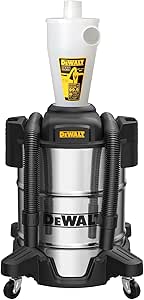
DEWALT Dust Separator with 10 Gallon Stainless Steel Tank, 99.5% Efficiency Cyclone Dust Collector, High-Performance Cycle Powder Collector Filter, DXVCS003, White
This DEWALT cyclone separator is engineered for maximum filtration efficiency, capturing 99.5% of dust and debris before they reach your vacuum or dust collector. Its stainless steel tank offers durability and easy emptying, making it a reliable choice for demanding environments. Compared to the WEN DC1300, which focuses on high airflow, the DEWALT emphasizes filtration quality, reducing filter clogging and maintaining suction longer. Its 10-gallon tank is smaller than the 50-gallon capacity but provides a high level of dust separation efficiency. This makes it ideal for users who prioritize filter longevity and cleaner operation over sheer volume.
Pros:- Captures 99.5% of dust, reducing filter clogging
- Stainless steel tank resists corrosion and is durable
- Easy to empty and clean, prolonging equipment lifespan
Cons:- Smaller capacity compared to larger systems like the WEN 1300 CFM
- Less airflow for heavy-duty, high-volume applications
- Higher cost relative to basic cyclone separators
Best for: Pro users or serious hobbyists focused on maintaining filtration efficiency and reducing filter costs in their dust collection systems.
Not ideal for: High-volume, continuous use in large workshops where larger capacity and higher airflow are needed, as its smaller tank and airflow may limit throughput.
- Dust Capture Efficiency:99.5%
- Tank Capacity:10 Gallon Stainless Steel
- Material:Stainless Steel
- Filtration:High-performance cyclone
- Compatibility:Vacuum and dust collection systems
- Durability:Heat resistant, corrosion resistant
- Included Components:Separator, tank, hose holders
- Warranty:Manufacturer’s warranty
Bottom line: This cyclone dust separator excels at filtration efficiency, making it suitable for users who want cleaner operation and less filter maintenance.

How We Picked
We evaluated each dust collector based on performance metrics like airflow (CFM), filtration efficiency, and motor power to ensure they can handle demanding woodworking tasks. Build quality and ease of maintenance were also critical, as durable construction and simple filter access save time over the long run. We considered versatility, including capacity and size, to match different workshop needs. Price-to-performance ratio played a key role, helping identify models that offer real value while meeting essential performance standards. Our ranking emphasizes products that strike the best balance between power, filtration, and usability for a range of users.Factors to Consider When Choosing Best 2 Stage Dust Collector
Choosing the right 2 stage dust collector depends on several factors that go beyond just horsepower or airflow. Understanding your workshop size, dust types, and future expansion plans can help narrow your options. Considering filtration quality ensures a healthier environment, especially in enclosed spaces. Ease of maintenance and noise levels also affect daily usability. Lastly, balancing budget with features prevents overspending on features you may not need while avoiding underpowered models that struggle with dust collection.Performance and Airflow Capacity
CFM (cubic feet per minute) measures how much air the dust collector can move, directly impacting its ability to capture dust effectively. For larger workshops or more demanding tools, look for models with higher CFM ratings—typically above 1,200 CFM. However, higher airflow often comes with increased noise and power consumption, so consider your workspace environment. Smaller setups may find models with 900-1,200 CFM sufficient, especially if they prioritize quieter operation or lower energy use. Matching airflow capacity to your tools and workshop size prevents underperformance or overspending.
Filtration Efficiency and Filter Type
Filtration determines how well the dust collector removes fine particles, impacting air quality and health. Two-micron filters are standard, but some premium models offer even finer filtration at 1 micron or less. Cyclone separators help reduce filter clogging by pre-separating larger debris, extending filter life. Choosing a model with easily accessible, washable, or replaceable filters simplifies maintenance and ensures consistent performance. Keep in mind that better filtration often means higher upfront costs but results in cleaner air and less frequent filter replacements.
Size, Capacity, and Portability
Size and capacity influence where and how you can use your dust collector. Larger units with bigger collection bags or bins suit bigger workshops or continuous use, but they can be bulky and harder to move. Compact models are more portable and easier to fit into tight spaces but may require more frequent emptying. Consider how much dust your tools produce and whether mobility or stationary installation better fits your workflow. Balancing capacity with size ensures your dust collection system integrates smoothly into your workspace without becoming a burden.
Ease of Maintenance and Noise Levels
Regular maintenance, such as filter cleaning or replacement and emptying collection bins, impacts long-term usability. Models with tool-free filter access or quick-release bags make routine tasks less cumbersome. Noise levels vary widely; quieter units improve comfort, especially if your workshop is shared or indoors. If noise is a concern, look for models with sound-dampening features or lower decibel ratings. Prioritizing ease of maintenance and manageable noise can significantly enhance your overall experience with the dust collector.
Price and Value
While higher-priced models often offer better durability and filtration, they may exceed your actual needs or budget. Conversely, budget options can perform well for small workshops but might lack longevity or efficiency under heavy use. Evaluate what features matter most—like airflow, filtration, or capacity—and compare costs accordingly. Sometimes investing a bit more upfront saves money over time by reducing replacement parts and maintenance. A balanced approach ensures you get a reliable system that suits both your current needs and future growth.
Frequently Asked Questions
How do I know if a 2 stage dust collector is suitable for my workshop?
Assess your workshop size, the type of tools you use, and the volume of dust generated. A 2 stage system offers better filtration and higher airflow than single-stage models, making it suitable for medium to large workshops or heavy-duty woodworking. If your space produces a lot of fine dust or you need cleaner air, a 2 stage collector provides a significant upgrade. Smaller workshops with minimal dust may find a single-stage or lower capacity system sufficient, but for most serious woodworkers, investing in a 2 stage system improves safety and cleanliness.
Can I upgrade my existing dust collection system to a 2 stage model later?
Upgrading to a 2 stage dust collector can be straightforward if your current setup is compatible in terms of ducting and electrical requirements. Many units are modular, allowing you to replace or retrofit components. However, larger capacity models may require more space or higher power circuits, so it’s important to verify your workshop’s infrastructure. Upgrading typically involves more than just swapping machines; consider the compatibility of ductwork and whether additional modifications are needed for optimal performance. Planning ahead can make future upgrades smoother and more cost-effective.
What maintenance tasks are essential for keeping my 2 stage dust collector working effectively?
Regularly emptying collection bins or bags prevents airflow restrictions, maintaining performance. Cleaning or replacing filters according to the manufacturer’s schedule keeps filtration efficient and prolongs filter life. Inspecting hoses and ductwork for leaks or blockages ensures dust doesn’t escape or clog the system. Some models feature washable filters, reducing ongoing costs. Keeping the motor and moving parts lubricated and free of dust buildup also extends the lifespan of your dust collector. Consistent maintenance maximizes efficiency and helps avoid costly repairs.
Is a higher CFM always better for my dust collection needs?
Higher CFM ratings generally mean more powerful airflow, which can handle larger volumes of dust and debris more effectively. However, excessively high CFM may lead to increased noise and energy consumption, and in some cases, unnecessary for small workshops. The key is matching the CFM to your tools and workspace size—too low, and dust escapes; too high, and you might overspend or create an overly loud environment. Consider your specific needs and choose a model that provides sufficient airflow without excess that you won’t utilize.
How important is filtration efficiency compared to airflow in choosing a dust collector?
Filtration efficiency directly impacts air quality and health, especially when capturing fine dust particles. While high airflow ensures dust is effectively moved away from your tools, poor filtration can lead to dust escaping into the air, negating the benefits of high CFM. Ideally, a balance between airflow and filtration is best—high airflow with efficient filters provides both performance and cleaner air. Investing in a system with at least 2-micron filtration or finer helps protect your lungs and keeps your workshop cleaner, making it a priority alongside airflow capacity.
Conclusion
For woodworking enthusiasts with small to medium workshops, the WEN DC1300 offers a budget-friendly, capable option that balances power and capacity. Serious hobbyists or professionals needing the best overall performance should consider the JET Cyclone Dust Collector, which provides excellent filtration and airflow. Those seeking durability and high efficiency might prefer the DEWALT Dust Separator, especially for continuous use in demanding environments. Beginners or those with limited space should look at compact, easy-to-maintain models, while large workshops benefit from higher-capacity systems. Ultimately, your choice hinges on your specific needs, budget, and workspace size, but this list ensures you’ll find a reliable match regardless of your situation.