The best woodworking dust collection system for most small-shop owners is the WEN DC1300, whose 1,300 CFM rating and mobile base suit multiple stationary tools. For limited floor space, the VEVOR wall-mount collector offers 560 CFM and a 21-gallon bag, while the Dustopper Pro is a separator for reducing debris reaching a compatible shop vacuum—not a standalone collector. The central tradeoff is between higher airflow and capacity on one hand, and space, filtration, and setup demands on the other. Compact and wall-mounted models can fit tighter shops, but they may not match a larger collector’s ability to serve several machines. Read on for the full breakdown and help matching a system to your tools and shop layout.

Get business pricing on tools and workshop supplies
- Business-only prices and quantity discounts
- Tax-exempt purchasing
- Multiple users, one account, clear invoices
Complete the kit



Key Takeaways
- The WEN DC1300 leads on stated airflow and capacity: its 1,300 CFM rating and 50-gallon bag make it the clearest fit here for a larger stationary-tool setup, though it needs more room than wall-mounted picks.
- Wall mounting is the main space-saving split: VEVOR and POWERTEC both list 560 CFM and a 21-gallon bag, while the POWERTEC model specifies a 1-micron filter bag and VEVOR lists 2.5-micron filtration.
- Filter ratings distinguish similar-size collectors: the POWERTEC 1 HP mobile model lists 800 CFM and 1-micron filtration, while the VEVOR wall-mount model lists 560 CFM and 2.5-micron filtration.
- The Dustopper Pro serves a different job: it separates debris ahead of a compatible shop vacuum, so it should not be compared with the motorized collectors as a complete dust-collection system.
- Compact WEN and SHOPMAX models trade capacity for a smaller footprint: their smaller bags and stated motor ratings better suit limited-space or lighter-duty setups than a shop needing one collector for several machines.


| woodworking dust collection system | Airflow | Motor | Dimensions | Impeller |
|---|---|---|---|---|
| VEVOR Wall-Mount Dust Collecto | 560 CFM | — | 40.94 × 13.78 × 15.75 in | — |
| WEN DC1300 1,300 CFM Woodworki | Up to 1,300 CFM | 14 amps | — | 10-inch steel |
| POWERTEC 1 HP Dust Collector | 800 CFM | — | — | — |
| WEN 15-Gallon Woodworking Dust | Up to 600 CFM | 7.4-amp induction motor | 43.3 × 17.7 × 20.1 in | 9 inches |
| WEN DC3401 Woodworking Dust Co | Up to 660 CFM | 5.7-amp brushed | 34.25 × 13 × 14.2 in | 6 inches |
| Dustopper Pro Cyclone Dust Sep | — | — | 13 x 13 x 7 inches | — |
| SHOPMAX SC0075 20-Gallon Dust | — | 6.3 amps, 120 V | — | 12 inches |
| POWERTEC 1 HP Wall-Mount Dust | — | 1 HP induction motor | — | — |
More Details on Our Top Picks
VEVOR Wall-Mount Dust Collector, 1 HP, 560 CFM, 2.5-Micron Filtration, 21-Gallon Bag
The VEVOR suits a workshop where floor space is limited and a fixed collector is more useful than a mobile one. Its 560 CFM airflow and 2.5-micron filtration make it a practical match for a single machine’s sawdust and sanding debris, while the 21-gallon bag means fewer interruptions to empty it than the WEN DC3401’s 12-gallon bag. A bottom-zipper bag also simplifies disposal without taking the bag off the collector. The tradeoff is that its airflow is well below the WEN DC1300’s 1,300 CFM, so it is not the choice for a larger setup drawing from multiple tools. Its listed dimensions also call for a generous section of wall, and noise can reach 90 dB.
Pros:- 560 CFM airflow suits dust collection at a single woodworking machine.
- Filters particles down to 2.5 microns.
- 21-gallon bag reduces emptying frequency compared with smaller-capacity options.
- Bottom zipper allows debris removal without detaching the bag.
Cons:- Airflow is substantially lower than the WEN DC1300’s listed maximum of 1,300 CFM.
- Noise can reach 90 dB.
- The listed dimensions require substantial wall space.
Best for: Woodworkers with a dedicated machine and enough clear wall space who want a sizable collection bag without using floor area.
Not ideal for: Shops that need to serve several tools at once, or small rooms without space for a 40.94-inch-tall wall-mounted unit.
- Motor power:1 HP
- Airflow:560 CFM
- Filtration:2.5 microns
- Collection bag capacity:21 gallons (80 L)
- Bag material:Non-woven fabric
- Noise level:≤ 90 dB
- Voltage:120 V
- Dimensions:40.94 × 13.78 × 15.75 in
Our verdict“Choose the VEVOR if you want a wall-mounted collector with a generous bag for one machine, not the greater airflow or mobility of the WEN DC1300.”
WEN DC1300 1,300 CFM Woodworking Dust Collector with 50-Gallon Collection Bag and Mobile Base
Among these five options, the WEN DC1300 is the clear choice for a larger workshop that needs more airflow and a bigger collection bag. Its up to 1,300 CFM capacity and dual 4-inch inlets allow connections to as many as two tools, unlike the single-port POWERTEC 1 HP collector. The 50-gallon bag can also cut down on emptying stops during regular shop work. Mobility is another advantage: four swivel casters let you reposition the unit rather than dedicating wall space to a fixed collector like the VEVOR. That scale comes with practical limits. It is intended for indoor use, and dual inlets only help when your tools and hoses have compatible 4-inch connections; this is a larger-shop pick, not the most compact way to collect dust from one machine.
Pros:- Up to 1,300 CFM airflow is the highest listed among these five products.
- Dual 4-inch inlets support connections to up to two tools.
- 50-gallon collection bag reduces how often it needs emptying.
- Four swivel casters make it easier to reposition around the shop.
Cons:- Designed for indoor use.
- Two-tool connections require compatible 4-inch hoses and tool ports.
- Less suited to a compact shop than the smaller WEN DC3401.
Best for: Woodworkers with a roomy indoor shop who want high listed airflow, a large bag, and the option to connect two compatible tools.
Not ideal for: Small workshops or buyers needing a compact single-machine collector; its larger capacity and mobile base may be more than they need.
- Model:DC1300
- Airflow:Up to 1,300 CFM
- Motor:14 amps
- Inlets:Two 4-inch inlets
- Collection bag capacity:50 gallons
- Impeller:10-inch steel
- Impeller speed:Up to 3,450 RPM
- Base:Four swivel casters
- Warranty:Two years
Our verdict“Pick the WEN DC1300 for an indoor shop that can make use of its higher airflow, dual inlets, and 50-gallon bag.”
POWERTEC 1 HP Dust Collector, 800 CFM, Mobile Base, 1-Micron Filter Bag
The POWERTEC stands out for combining 1-micron filtration with a wheeled, single-port design. That finer listed filtration sets it apart from the VEVOR’s 2.5-micron rating and the WEN DC3474’s 5-micron bag, making it a stronger fit for buyers who put finer-dust capture high on their list. Its 800 CFM airflow also exceeds the VEVOR’s 560 CFM, while the 4-inch intake keeps the setup straightforward for one compatible machine. A steel base with four casters helps move the 55-pound collector around the shop, though that weight can make lifting it into place awkward. Compared with the WEN DC1300, this POWERTEC has lower listed airflow and no dual inlets; its appeal is the balance of mobility and finer filtration, not multi-tool capacity.
Pros:- 1-micron filter bag has a finer listed rating than the VEVOR and WEN DC3474 bags.
- 800 CFM airflow exceeds the VEVOR’s listed 560 CFM.
- Four casters make it easier to roll between machines.
- Quick-release clamps simplify collection-bag removal and attachment.
Cons:- At 55 pounds, lifting the unit can be cumbersome.
- One 4-inch intake does not match the WEN DC1300’s dual-inlet arrangement.
- Designed for indoor woodworking use.
Best for: Woodworkers who want a mobile collector for one 4-inch machine and prefer a 1-micron filter bag.
Not ideal for: Buyers who need to connect two machines or move a collector by lifting it frequently; the unit weighs 55 pounds and has one 4-inch intake.
- Motor power:1 HP
- Airflow:800 CFM
- Filtration:1 micron
- Intake port:4 inches
- Motor voltage:120V/240V
- Motor phase:Single phase
- Base dimensions:15-1/4 × 25-1/2 in
- Wheels:Four casters
- Item weight:55 lb
Our verdict“Choose this POWERTEC if finer listed filtration and mobility matter more than dual-tool connections or easy lifting.”
WEN 15-Gallon Woodworking Dust Collector with 7.4-Amp Motor and Optional Wall Mount
The WEN DC3474 is a useful middle ground for buyers who want a standard 4-inch collector that can work on the floor or be mounted on a wall. Its up to 600 CFM airflow is close to the VEVOR’s 560 CFM, but this WEN adds swivel casters and an optional built-in wall mount, giving a shop more flexibility about placement. The 15-gallon, 5-micron bag offers less capacity than the VEVOR’s 21-gallon bag and much less than the WEN DC1300’s 50-gallon bag, so it will need more frequent emptying in a busy shop. Its listed filtration is also coarser than the POWERTEC’s 1-micron bag. This is a practical placement-focused choice, not the strongest option for finer filtration or high-capacity collection.
Pros:- Up to 600 CFM airflow is comparable to the VEVOR’s listed 560 CFM.
- Can be used on swivel casters or mounted to a wall.
- 15-gallon zippered bag provides more capacity than the WEN DC3401’s 12-gallon bag.
- Induction motor is described as quieter and maintenance-free.
Cons:- The 5-micron bag has a coarser listed rating than the POWERTEC’s 1-micron filter bag.
- Wall mounting requires removing the wheels.
- Its 15-gallon capacity is much smaller than the WEN DC1300’s 50-gallon bag.
Best for: Small-shop woodworkers who need a 4-inch collector that can be rolled between machines or mounted to free floor space.
Not ideal for: Buyers prioritizing finer listed filtration, a large collection capacity, or wall mounting without first removing the wheels.
- Model:DC3474
- Motor:7.4-amp induction motor
- Impeller:9 inches
- Airflow:Up to 600 CFM
- Dust port:4 inches
- Collection bag:15 gallons, 5-micron, zippered
- Dimensions:43.3 × 17.7 × 20.1 in
- Weight:41.1 lb
- Mounting:Swivel casters or optional built-in wall mount
Our verdict“Choose the WEN DC3474 if flexible floor-or-wall placement matters more than finer filtration or a very large collection bag.”
WEN DC3401 Woodworking Dust Collector, 5.7-Amp Motor, 12-Gallon Bag, Mobile Base, Optional Wall Mount
For a crowded garage or a small shop that needs a movable collector, the WEN DC3401 is the easiest fit in this group. At 17 pounds, with a carrying handle and lockable swivel casters, it is far easier to reposition than the 41.1-pound WEN DC3474 or 55-pound POWERTEC. Its listed up to 660 CFM airflow is also slightly higher than the DC3474’s 600 CFM, though that figure alone does not make it a better match for every machine. The compromise is a smaller 12-gallon bag and 5-micron filtration, compared with the DC3474’s 15-gallon bag and the POWERTEC’s 1-micron rating. A wall mount is available, but it is optional. This is a space-saving, movable choice for one 4-inch connection, not a high-capacity shop system.
Pros:- At 17 pounds, it is lighter than the WEN DC3474 and POWERTEC units.
- Up to 660 CFM airflow is higher than the DC3474’s listed 600 CFM.
- Lockable swivel casters and a carrying handle support easy repositioning.
- Optional wall mounting can free up floor space.
Cons:- The 12-gallon bag has less capacity than the WEN DC3474’s 15-gallon bag.
- Its 5-micron bag has a coarser listed rating than the POWERTEC’s 1-micron filter.
- The wall mount is optional, and the unit uses a single 4-inch dust port.
Best for: Garage woodworkers with limited floor space who need a lightweight collector they can roll between machines or mount with an optional wall bracket.
Not ideal for: Busy shops that need a large collection bag, finer listed filtration, or connections for more than one tool.
- Model:DC3401
- Motor:5.7-amp brushed
- Impeller:6 inches
- Airflow:Up to 660 CFM
- Dust port:4 inches
- Collection bag:12 gallons, 5-micron, zippered
- Dimensions:34.25 × 13 × 14.2 in
- Weight:17 lb
- Mounting:Lockable swivel casters; optional wall mount
Our verdict“Choose the WEN DC3401 for a lightweight, compact collector for one machine, and skip it if bag capacity or finer filtration is your priority.”
Dustopper Pro Cyclone Dust Separator with High-Flow Elbows
I’d choose the Dustopper Pro when a shop vacuum already handles cleanup but its filter and bag fill too quickly during woodworking. Rather than acting as a standalone collector like the SHOPMAX SC0075 or POWERTEC 1 HP Wall-Mount Dust Collector, it separates dust upstream and sends the remaining airflow to a compatible vacuum. Its preinstalled EPDM gasket is made to fit a standard 5-gallon pail, while the included sweep elbows are designed to limit turbulence and restriction. Third-party testing reported separation of fine and coarse sawdust as well as drywall powder. The tradeoff is that this setup depends on a separate pail and a shop vacuum rated 5 HP or higher per the listed compatibility, so it is not a replacement for a dedicated collector serving machines with larger dust ports.
Pros:- Separates dust before it reaches the vacuum, helping reduce filter and bag use.
- Preinstalled hollow-core EPDM gasket is designed for a leak-resistant fit on standard 5-gallon pails.
- Two high-flow sweep elbows are designed to reduce turbulence and airflow restriction.
- Third-party testing reported strong separation of fine and coarse dust.
Cons:- Requires a separate standard 5-gallon pail.
- Listed compatibility limits it to shop vacuums rated 5 HP or higher.
- Adds a separator-and-pail setup rather than providing a standalone machine collector.
Best for: Woodworkers who already own a compatible high-rated shop vacuum and want to reduce how much sawdust reaches its filter and bag.
Not ideal for: Buyers seeking a complete dust collector, those without a standard 5-gallon pail, or users whose shop vacuum does not meet the listed 5 HP minimum.
- Material:Anti-static resin
- Dimensions:13 x 13 x 7 inches
- Weight:1.63 kg
- Outside diameter:2.25 inches
- Pail compatibility:Standard 5-gallon pails
- Vacuum compatibility:Shop vacuums rated 5 HP and higher
- Gasket:Preinstalled hollow-core EPDM
- Included components:Dust separator and two high-flow sweep elbows
Our verdict“Choose the Dustopper Pro if you want to protect a compatible shop vacuum from woodworking dust, not if you need a standalone collector.”
SHOPMAX SC0075 20-Gallon Dust Collector, 6.3-Amp
The SHOPMAX SC0075 is the more self-contained choice here: its 20-gallon collection capacity and stated airflow of up to 677 CFM suit a shop that wants one wheeled collector to move among woodworking machines. Five hose adapters broaden connection options, unlike the POWERTEC 1 HP Wall-Mount Dust Collector, which is built around a 4-inch inlet and a space-saving fixed installation. The SHOPMAX’s wheels and carrying handle help reposition it, though its 55-pound weight makes lifting less convenient than rolling it. Its plastic construction is another tradeoff against a more substantial-feeling machine, and the listing does not specify filtration fineness. I’d favor it over the Dustopper Pro for dedicated machine collection, but the Dustopper is the simpler add-on if a shop vacuum is already the main tool.
Pros:- Up to 677 CFM airflow from a 6.3-amp motor.
- 20-gallon capacity reduces how often the collection bag needs attention.
- Five hose adapters support connections to a range of woodworking machines.
- Wheels and an onboard handle aid movement around the workshop.
Cons:- At 55 pounds, it can be awkward to lift despite its wheels and handle.
- Plastic construction may not suit buyers seeking a more robust-feeling collector.
- The supplied product data does not state a filtration micron rating.
Best for: Small-shop woodworkers who want a wheeled, larger-capacity collector with several adapters for moving between machines.
Not ideal for: Buyers who need a lightweight unit to carry frequently, prefer a wall-mounted footprint, or require a stated fine-dust filtration rating.
- Motor:6.3 amps, 120 V
- Maximum airflow:677 CFM
- Impeller:12 inches
- Capacity:20 gallons (75 liters)
- Hose adapters:5
- Weight:55 pounds
- Mobility:2 wheels and onboard carrying handle
- Warranty:2-year limited
Our verdict“Pick the SHOPMAX SC0075 for mobile, higher-capacity machine collection when you can roll the 55-pound unit rather than carry it.”
POWERTEC 1 HP Wall-Mount Dust Collector, 560 CFM, with 1-Micron Filter Bag
For a workshop where floor space matters more than moving the collector from machine to machine, I’d shortlist this POWERTEC 1 HP. Its wall, workbench, or floor mounting gives it more installation flexibility than the mobile SHOPMAX SC0075, while the reusable 1-micron filter bag offers a finer stated filtration level than the VEVOR wall-mount model’s 2.5-micron bag. The viewing window and bottom zipper also make it easier to check the bag and empty it without removing the whole filter. At 560 CFM, it is a smaller-airflow option than the SHOPMAX’s stated maximum of 677 CFM, and the 4-inch inlet limits it to compatible machine ports. I’d also keep that inlet clear: the product data warns that debris buildup can reduce performance.
Pros:- Wall, workbench, or floor mounting lets buyers adapt the installation to their shop.
- Reusable 1-micron cloth bag has a viewing window and bottom zipper.
- 560 CFM airflow and a 1 HP induction motor provide a dedicated machine-collection setup.
- Vortex Base is designed to reduce turbulence and improve dust removal.
Cons:- The 4-inch inlet limits compatibility to machines with a matching dust port.
- Debris buildup at the inlet can reduce performance and calls for regular checking.
- Its 560 CFM rating is below the SHOPMAX SC0075’s stated maximum airflow.
Best for: Woodworkers with compatible 4-inch machine ports who want a fixed, space-saving collector and a reusable filter bag with a stated 1-micron rating.
Not ideal for: Shops needing frequent mobility, greater stated airflow than 560 CFM, or connections for machines without compatible 4-inch dust ports.
- Motor:1 HP induction motor
- Voltage:120 V / 240 V
- Current:12 A at 120 V; 6 A at 240 V
- Motor speed:3450 RPM
- Airflow capacity:560 CFM
- Inlet size:4 inches
- Filter:Reusable 1-micron cloth bag
- Mounting options:Wall, workbench, or floor
- Height:44 inches with bag inflated
Our verdict“Choose this POWERTEC when a fixed, compact installation and 1-micron bag filtration matter more than higher airflow or easy relocation.”
How We Picked
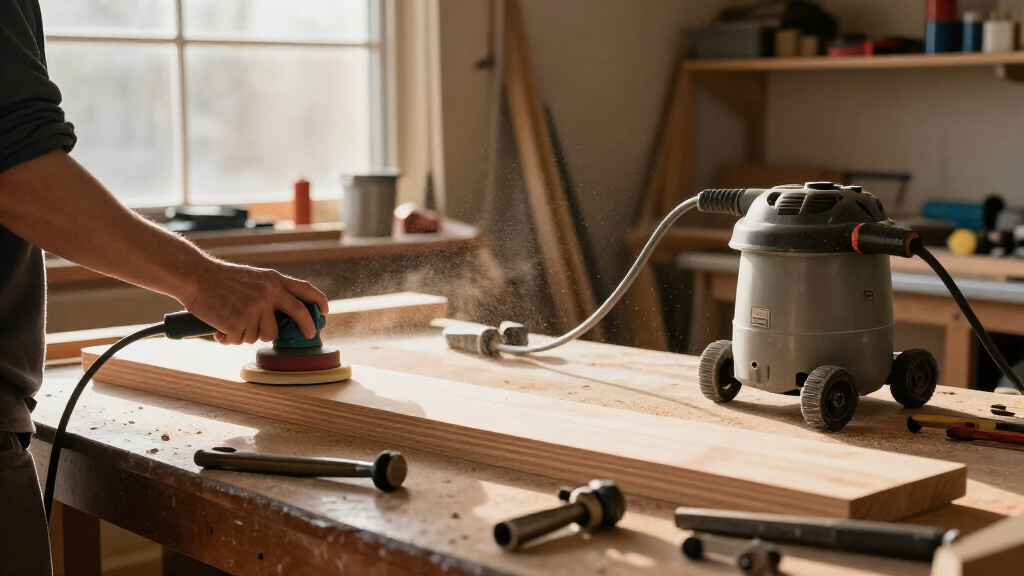
I ranked these options by how well their stated specifications address common woodworking dust-collection needs: airflow, collection capacity, filtration information, placement, mobility, and the role each product can realistically play. A system that can serve larger stationary tools and hold more debris ranks ahead of compact options when versatility is the priority, while wall-mounted and mobile designs earn credit for fitting shops where floor space or tool access matters more.
I also separated complete motorized collectors from the Dustopper Pro, which is a cyclone separator used with a compatible vacuum. Published specifications do not establish real-world airflow at a tool hood, so I treat CFM figures as comparison points rather than guarantees. Where product details are limited or filtration ratings differ, I avoid assuming equivalent performance. This ranking favors broad workshop usefulness first, then space efficiency, filtration detail, and specialized value.
Factors to Consider When Choosing Woodworking Dust Collection Systems
Choosing a collector starts with the machines, duct path, and shop routine—not just the largest CFM number. These factors help you judge what a specification can tell you, where it falls short, and when a less powerful or differently configured setup may serve you better.
Match Airflow to the Tool and Duct Path
CFM is useful for comparing collectors, but it does not tell the whole story of airflow at the machine. Long hose runs, narrow fittings, sharp bends, and restrictive tool ports can reduce the air reaching the pickup point. Check the port size on your tools and plan the shortest practical route before choosing a collector. A high published rating may be wasted if you connect it through undersized ducting. For several machines, also think about whether you will move a hose between tools or build a duct network with blast gates. Treat the collector’s stated airflow as a starting point, not a promise of capture at every tool.
Choose Filtration for the Dust You Make
Bag capacity and filter rating answer different questions: capacity affects how often you empty the collector, while filtration describes the size of particles the listed filter is intended to capture. Sanding and fine machining create dust that can remain airborne after larger chips settle, so filtration deserves more attention if those tasks are frequent. Compare stated ratings only when the products specify them on a similar basis; a missing rating does not prove a filter is poor, but it leaves less information for your decision. A collector bag is not a substitute for suitable room ventilation or respiratory protection during dusty work. Check replacement-filter availability and fit before buying, since maintenance costs and access can shape long-term usability.
Plan for Chip Volume and Emptying
A larger bag can reduce interruptions during planing or repeated machine work, but it also takes more room and becomes heavier to handle when full. Smaller containers may be easier to store and empty, yet frequent changes can interrupt short shop sessions. Think about the mix of chips and fine dust your tools produce, as well as where you can safely remove and dispose of collected material. A separator ahead of a shop vacuum can catch much of the larger debris before it reaches the vacuum, but it adds another container to empty and does not replace a dedicated collector for every tool. Choose capacity around your working habits rather than assuming the biggest bag is always the easiest option.
Balance Mobility Against a Fixed Duct Setup
A mobile base helps when one collector must serve machines placed around a small shop, but moving it can mean reconnecting hoses and managing cords each time. Wall-mounted collectors free floor space and can keep a permanent hose point ready, though their position needs to suit the machines they serve. Before choosing either style, measure the footprint, ceiling or wall clearance, bag access, and route from the collector to the tools. A fixed duct layout can reduce daily setup but requires planning for gates, bends, and future tool changes. Avoid placing a collector where a full bag or filter cannot be reached without moving other equipment.
Decide Whether You Need a Collector or a Separator
A powered dust collector moves air and stores debris, while a cyclone separator sits between a tool or hose and a vacuum to intercept material. Those products solve related but different problems, so comparing their airflow numbers or bag sizes as if they were interchangeable leads to a poor fit. A separator makes sense when you already own a compatible vacuum and want to reduce how much debris reaches its filter or container. A dedicated collector is the more direct route for connecting larger stationary tools, subject to the tool’s airflow needs. Check connection sizes and compatibility before choosing a separator, and account for the extra hose joints it adds to the system.
Know When Paying for More Capacity Makes Sense
More capacity and airflow are most useful when several stationary machines generate chips or when frequent emptying disrupts long work sessions. They bring costs in floor space, noise exposure, electrical demand, and possibly more involved duct planning, so a larger unit is not automatically a better fit. For occasional use or a compact shop, a smaller collector can leave room for the work itself and still serve a limited set of tools. Consider your likely next machine purchase before settling on a system that only fits today’s layout. If you work mainly with a single tool, prioritize a suitable connection and manageable storage over unused capacity.
Frequently Asked Questions
Can the Dustopper Pro replace a woodworking dust collector?
No. The Dustopper Pro is a cyclone separator intended to work with a compatible shop vacuum, not a powered collector with its own motor and collection bag. It can intercept debris before it reaches the vacuum, which may be useful for shop-vac-based work. It does not provide a standalone airflow source for stationary woodworking machines. Check that its fittings match your hose and vacuum before buying, and treat it as part of a setup rather than the whole system.
Is a 1-micron filter bag automatically better than a 2.5-micron bag?
A lower stated particle-size rating suggests the filter is intended to capture finer particles, but the number alone does not tell you how the complete system performs. Air leaks, filter condition, tool capture, and duct restrictions also affect the dust that reaches the collector and escapes into the shop. The POWERTEC wall-mount and mobile models list 1-micron filtration, while the VEVOR wall-mount model lists 2.5-micron filtration. Compare ratings alongside airflow and your typical work, especially if sanding is common. Do not treat a filter rating as a substitute for personal protection or general shop ventilation.
How much CFM do I need for my woodworking tools?
There is no single CFM figure that suits every tool, because pickup design, port size, duct length, and the kind of debris all affect collection needs. Use the tool maker’s dust-collection guidance where available, then compare that requirement with the collector’s specifications. The WEN DC1300 has the highest stated airflow among these picks, while the 560 CFM wall-mount models are aimed at a different, more space-conscious setup. A large rating cannot compensate for a poorly fitted hood or restrictive hose. If you plan to run multiple machines, check whether your setup will use one tool at a time or a designed duct network.
Should I choose a wall-mounted collector or a mobile model?
A wall-mounted unit suits a shop where floor space is scarce and the collector can stay near the tools it serves. A mobile model makes more sense when machines are spread around the room or you need to reposition the collector between jobs. Wall mounting can limit where hoses reach, while mobility adds the work of moving the unit and reconnecting it. Measure bag clearance and hose paths before deciding; both can be awkward if the collector is placed without room for maintenance. The right choice depends more on your layout and routine than on mounting style alone.
Is a 50-gallon bag worth choosing over a smaller collector?
A larger bag is useful when your tools create substantial debris or you run longer sessions between cleanouts. The WEN DC1300’s 50-gallon capacity is a strong fit for that pattern, but the collector also needs more room than compact or wall-mounted picks. A smaller bag can be easier to store, reach, and empty in a limited shop, even if it requires more frequent attention. Consider how quickly your usual work fills a container and whether you can handle a full bag comfortably. Capacity should follow your workload and available space, not serve as a stand-alone measure of suitability.
Conclusion
For one collector to serve a broader stationary-tool setup, I would start with the WEN DC1300: its 1,300 CFM rating and 50-gallon bag give it the strongest stated capacity in this group, provided you have room for it. My best value pick is the POWERTEC 1 HP mobile collector for shops that want a mobile base, a stated 800 CFM, and 1-micron filtration without stepping up to the largest unit. For beginners with limited space, the WEN DC3401 offers a smaller bag, mobile base, and optional wall mounting; check that its capacity and motor rating suit your tools. If floor space is the priority, choose between the POWERTEC wall-mount model for its listed 1-micron filter bag and the VEVOR wall-mount model if its stated specifications better fit your needs. For a premium-capacity setup, the DC1300 is the standout on listed airflow and collection volume, while the Dustopper Pro is the specific choice for someone who already has a compatible shop vacuum and wants a separator rather than a standalone collector.