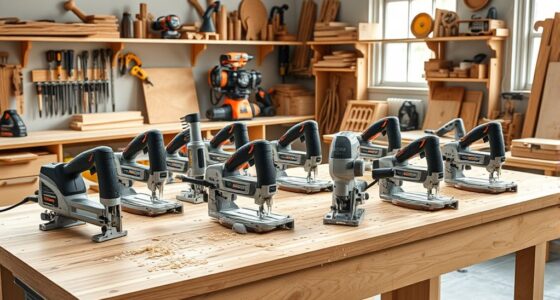
For woodworking scroll saws, I’d put the WEN LL2156 first for its 21-inch capacity and dual-bevel table, while the DEWALT DW788 stands out as a capable 20-inch option and the WEN 3922 offers a practical 16-inch alternative. The main choice is between a larger work area and a smaller saw that takes up less room and can suit occasional craft work. Blade changes, speed control, table tilt, and dust handling also shape how smoothly a saw fits into detailed projects. No single model is right for every shop or cutting style. Continue reading for my full comparison of all 15 woodworking scroll saws and guidance on choosing the right fit.

Get business pricing on tools and workshop supplies
- Business-only prices and quantity discounts
- Tax-exempt purchasing
- Multiple users, one account, clear invoices
Complete the kit


Key Takeaways
- The WEN LL2156 leads on capacity and table flexibility: Its 21-inch throat and dual-bevel table make it the clearest fit here for larger workpieces and angled cuts.
- The 20- and 22-inch models suit buyers prioritizing workspace: The DEWALT DW788, Delta 40-694, and JET JWSS-22B offer alternatives to the LL2156, with the JET adding a foot switch.
- Most of the lineup centers on 16-inch saws: Models from WEN, SKIL, Ryobi, PioneerWorks, Hoteche, and other brands provide more compact choices, but buyers should compare blade access and table features rather than assume all are equivalent.
- Blade changes are a meaningful point of separation: The WEN 3922 is identified by its easy-access blade-change design, a practical advantage for projects that require frequent interior cuts.
- Lights, dust ports, and tilting tables answer different shop needs: Work lights can help with close detail work, while a dust port or a tilting table matters more when those features match the buyer’s setup and typical cuts.
| WEN LL2156 21-Inch 1.6-Amp Variable Speed Parallel-Arm Scroll Saw with Extra-Large Dual-Bevel Steel Table (Black/Orange) |  | Best for Large, Angled Work | Power: 1.6 A; 192 W | Speed range: 550–1,600 SPM | Throat capacity: 21 inches | VIEW LATEST PRICE | See Our Full Breakdown |
| PioneerWorks 16-Inch Variable-Speed Scroll Saw with LED Light |  | Best for a Compact, Illuminated Setup | Motor: 0.9 A | Throat depth: 16 inches | Speed range: 400–1,600 SPM | VIEW LATEST PRICE | See Our Full Breakdown |
| Delta 40-694 20-Inch Variable Speed Scroll Saw |  | Best for Long-Term Shop Use | Power: 1.3 A; 156 W | Speed range: 400–1,750 SPM | Capacity: 20 inches | VIEW LATEST PRICE | See Our Full Breakdown |
| WEN 3922 16-Inch Variable Speed Scroll Saw |  | Best Value for Everyday Detail Work | Throat depth: 16 inches | Speed range: 550–1,600 SPM | Stroke length: 9/16 inch | VIEW LATEST PRICE | See Our Full Breakdown |
| JET 22-Inch Variable-Speed Scroll Saw with Foot Switch (JWSS-22B) |  | Best for Hands-Free Control and Long Reach | Throat capacity: 22 inches | Speed range: 400–1,550 SPM | Table dimensions: 12-7/8 × 23 inches | VIEW LATEST PRICE | See Our Full Breakdown |
| Hoteche 16-Inch Power Scroll Saw with Tilting Table and Dust Port |  | Best for Angled Craft Cuts | Cutting capacity: 16 inches | Cutting depth: 50 mm (2 inches) | Motor power: 85 W | VIEW LATEST PRICE | See Our Full Breakdown |
| DEWALT DW788 20-Inch Variable-Speed Scroll Saw |  | Best for Low-Vibration Precision | Model: DW788 | Throat capacity: 20 inches | Motor: 1.3 amp | VIEW LATEST PRICE | See Our Full Breakdown |
| SKIL 1.2 Amp 16-Inch Variable Speed Scroll Saw with LED Work Light |  | Best for Beginners | Model: SS9503-00 | Motor: 1.2 amp | Wattage: 144 watts | VIEW LATEST PRICE | See Our Full Breakdown |
| Ryobi 1.2 Amp Corded 16″ Scroll Saw SC165VS |  | Best for Straightforward Bench Use | Model: SC165VS | Motor: 1.2 amp, 144 W | Power source: Corded electric, 120 V | VIEW LATEST PRICE | See Our Full Breakdown |
| DeWalt 18-Inch Variable-Speed Scroll Saw |  | Best for Mid-Size Workpieces | Motor: 1.6 amp | Throat capacity: 18 inches | Variable speed: 500–1,500 strokes per minute | VIEW LATEST PRICE | See Our Full Breakdown |
| WEN 16-Inch Variable Speed Two-Direction Scroll Saw with Work Light (3921) |  | Best for Flexible Blade Orientation | Power source: Corded electric, 120 V | Speed: 400–1,600 strokes per minute | Stroke length: 9/16 inch | VIEW LATEST PRICE | See Our Full Breakdown |
| Garvee 16-Inch Variable-Speed Scroll Saw | | Best for Multi-Material Craft Projects | Blade size: 16 inches | Speed range: 500–1,600 SPM | Worktable tilt: 0–45 degrees left | VIEW LATEST PRICE | See Our Full Breakdown |
| 16-Inch Variable-Speed Scroll Saw with Adjustable Tilting Work Table |  | Best for Buyers Prioritizing a Lighter Footprint | Power source: Corded electric | Cutting speed: 400–1,600 strokes per minute | Maximum table tilt: 45 degrees | VIEW LATEST PRICE | See Our Full Breakdown |
| JET 18-Inch Variable-Speed Scroll Saw, 120V (JWSS-18B) |  | Best for Larger Workpieces and Frequent Blade Changes | Power source: Corded electric, 120 V | Wattage: 50 W | Speed range: 400–1,550 strokes per minute | VIEW LATEST PRICE | See Our Full Breakdown |
| WEN 16-Inch Variable Speed Scroll Saw with Work Light (3923) |  | Best Equipped 16-Inch Starter Package | Power source: Corded electric | Speed: 550–1,600 strokes per minute | Stroke length: 9/16 inch | VIEW LATEST PRICE | See Our Full Breakdown |
| woodworking scroll saw | Weight | Power source | Warranty |
|---|---|---|---|
| WEN LL2156 21-Inch 1.6-Amp Var | 53.8 pounds | — | 2-year limited |
| PioneerWorks 16-Inch Variable- | 26 pounds | Corded electric | — |
| Delta 40-694 20-Inch Variable | — | — | 5-year limited |
| WEN 3922 16-Inch Variable Spee | 24.9 pounds | — | 2 years |
| JET 22-Inch Variable-Speed Scr | 68.2 pounds | — | 5 years; 2 years for commercial or industrial use |
| Hoteche 16-Inch Power Scroll S | — | Corded electric, 120 V | — |
| DEWALT DW788 20-Inch Variable- | 56 pounds | — | 3-year limited |
| SKIL 1.2 Amp 16-Inch Variable | 24.7 pounds | Corded electric, 120 V | 3-year limited |
| Ryobi 1.2 Amp Corded 16" Scrol | 27 pounds | Corded electric, 120 V | 30-day limited |
| DeWalt 18-Inch Variable-Speed | 34.2 pounds | Corded electric, 120 V | 3-year limited |
| WEN 16-Inch Variable Speed Two | — | Corded electric, 120 V | Two years |
| Garvee 16-Inch Variable-Speed | 26.8 pounds | Corded electric | — |
| 16-Inch Variable-Speed Scroll | 24.3 pounds | Corded electric | — |
| JET 18-Inch Variable-Speed Scr | 54 pounds | Corded electric, 120 V | — |
| WEN 16-Inch Variable Speed Scr | — | Corded electric | — |
More Details on Our Top Picks
WEN LL2156 21-Inch 1.6-Amp Variable Speed Parallel-Arm Scroll Saw with Extra-Large Dual-Bevel Steel Table (Black/Orange)
I’d put the WEN LL2156 near the top for woodworkers who need room to maneuver broad projects and make bevel cuts without turning the workpiece over. Its 25.6-by-16-inch steel table tilts 45° left and 30° right, a more generous working platform than the WEN 3922’s 16.25-by-10-inch table. The parallel-arm design and 1.6-amp motor suit steady, detailed cutting, while tool-free blade changes reduce setup friction. Variable speed from 550 to 1,600 SPM gives control across different materials. The tradeoff is its 53.8-pound weight: it is better as a dedicated bench saw than a machine to move between work areas. Compared with the Delta 40-694, it has a lighter listed weight and faster blade-change features, but the Delta offers a longer warranty and wider speed range.
Pros:- Large 25.6-by-16-inch steel table supports broader workpieces.
- Dual bevels allow cuts up to 45° left and 30° right.
- Variable speed from 550 to 1,600 SPM offers control for different cutting tasks.
- Tool-free blade changes and an adjustable air pump simplify setup and help clear the cutting line.
Cons:- At 53.8 pounds, it is difficult to relocate frequently.
- Corded power limits use away from a suitable outlet.
- The right-side bevel range is smaller than the left.
Best for: Woodworkers with a permanent shop bench who cut larger pieces and want a roomy table for left- and right-bevel work.
Not ideal for: Makers who need to carry a saw between locations or want a compact, easy-to-store machine; its nearly 54-pound build and large footprint make that awkward.
- Power:1.6 A; 192 W
- Speed range:550–1,600 SPM
- Throat capacity:21 inches
- Table size:25.6 × 16 inches
- Table bevel:45° left; 30° right
- Blade length:5 inches
- Weight:53.8 pounds
- Warranty:2-year limited
Our verdict“Choose the LL2156 for a stable shop setup and a large bevel-capable table, but skip it if portability matters more than workspace.”
PioneerWorks 16-Inch Variable-Speed Scroll Saw with LED Light
The PioneerWorks 16-inch offers a practical feature mix for smaller woodworking spaces: a 26-pound body, a tilting table, and an integrated LED work light for seeing fine layout lines. Its 400–1,600 SPM range starts slower than the WEN 3922’s 550 SPM minimum, which gives buyers another speed setting for controlled work. The table tilts to 45° for angled cuts, and a dust port helps manage debris. It is a simpler, lighter alternative to the 21-inch WEN LL2156, but its 16-inch throat and 0.9-amp motor make it a less suitable choice for larger, demanding projects. Product details also provide little performance history, so I’d choose it for its listed features rather than assume it matches established heavier machines.
Pros:- LED work light helps illuminate the blade and cut line.
- Variable speed spans 400–1,600 SPM.
- Table tilts up to 45° for bevel work.
- At 26 pounds, it is easier to reposition than the Delta 40-694 or JET JWSS-22B.
Cons:- The 16-inch throat is less accommodating for broad projects than the 20- and 22-inch saws in this group.
- Its 0.9-amp motor is less substantial than the WEN LL2156’s 1.6-amp motor.
- Available product information offers limited evidence about performance over extended use.
Best for: Hobby woodworkers with limited bench space who want a lighter 16-inch saw, adjustable speed, and built-in task lighting.
Not ideal for: Frequent makers of large workpieces or buyers seeking a proven heavy-duty saw; its 16-inch capacity and 0.9-amp motor are more modest than the WEN LL2156’s.
- Motor:0.9 A
- Throat depth:16 inches
- Speed range:400–1,600 SPM
- Worktable tilt:0°–45°
- Blade material:Alloy steel
- Dimensions:25.98 × 12.99 × 14.37 inches
- Weight:26 pounds
- Power source:Corded electric
Our verdict“Pick the PioneerWorks for compact projects and added cut-line lighting, not for large workpieces or demanding shop workloads.”
Delta 40-694 20-Inch Variable Speed Scroll Saw
The Delta 40-694 is a substantial shop saw built around a cast-iron table, 20-inch capacity, and a five-year limited warranty. Its 400–1,750 SPM range reaches a faster top speed than the WEN LL2156, while the table tilts 45° in either direction. Front-mounted controls and a dust blower keep adjustments and cut-line clearing close at hand; the upper arm can also lock raised to make interior cuts easier to set up. Against the JET JWSS-22B, the Delta gives up two inches of throat capacity and a foot switch, but its bidirectional table tilt and upper-arm lock add useful flexibility. Weight is the major drawback: the listing gives both 60 and 70 pounds, so I would plan for a fixed bench location.
Pros:- Cast-iron table provides a substantial work surface measuring 16 × 24 inches.
- Speed range of 400–1,750 SPM exceeds the listed ranges of the WEN LL2156 and JET JWSS-22B.
- Table tilts up to 45° left and right.
- Upper arm locks raised, and blade tensioning is tool-free.
Cons:- Product data lists two different weights: 60 and 70 pounds.
- Heavy construction makes frequent relocation difficult.
- Unlike the JET JWSS-22B, it does not include a foot switch.
Best for: Committed shop woodworkers who want a cast-iron work surface, broad speed range, bidirectional beveling, and a longer stated warranty.
Not ideal for: People who need to move their saw regularly or want hands-free speed control; the listed weight is inconsistent, and this model has no foot switch.
- Power:1.3 A; 156 W
- Speed range:400–1,750 SPM
- Capacity:20 inches
- Stroke length:3/4 inch
- Cutting capacity at 90°:2-1/8 inches
- Cutting capacity at 45°:1-5/8 inches
- Table size:16 × 24 inches
- Table tilt:0°–45° left and right
- Warranty:5-year limited
Our verdict“Choose the Delta for a permanent shop that benefits from a cast-iron table, wide speed range, and raised-arm access, provided its weight uncertainty is acceptable.”
WEN 3922 16-Inch Variable Speed Scroll Saw
I’d choose the WEN 3922 when a woodworker wants useful shop features without moving up to a heavy, larger-capacity machine. Its 16-inch throat, 2-inch cutting thickness, and 550–1,600 SPM range cover many small and mid-sized patterns. The cast-iron base helps resist movement, while the air pump and dust port help keep the work area clearer. Tool-free blade changes and a side-panel holder make setup less fiddly than on a basic saw. Compared with the PioneerWorks 16-inch model, the 3922 includes more specified cutting details and a supplied selection of three blades, though PioneerWorks starts at a slower 400 SPM and adds an LED light. The WEN’s table is smaller than the LL2156’s, and only one included blade is pinless.
Pros:- Variable speed from 550 to 1,600 SPM suits a range of detail-cutting tasks.
- Cast-iron base helps limit movement during cutting.
- Air pump and dust port help keep the cut line visible.
- Tool-free blade changes and a side-panel blade holder simplify setup.
Cons:- Maximum cutting thickness is 2 inches.
- Only one of the three included blades is pinless.
- The 16.25-by-10-inch table is much smaller than the WEN LL2156’s.
Best for: Home-shop woodworkers cutting patterns and small projects who want a manageable 16-inch saw with dust-clearing features and easier blade changes.
Not ideal for: Makers who regularly cut thick stock beyond 2 inches, need a large work surface, or rely on pinless blades and want several included.
- Throat depth:16 inches
- Speed range:550–1,600 SPM
- Stroke length:9/16 inch
- Maximum cutting thickness:2 inches
- Table size:16.25 × 10 inches
- Maximum bevel:45°
- Weight:24.9 pounds
- Included blades:Three: one 15 TPI pinned, one 18 TPI pinned, and one 18 TPI pinless
- Warranty:2 years
Our verdict“The 3922 suits everyday small-shop scrollwork when manageable size and practical setup features matter more than large capacity.”
JET 22-Inch Variable-Speed Scroll Saw with Foot Switch (JWSS-22B)
The JET JWSS-22B pairs the longest throat in this group with a foot switch, making it a strong fit for intricate work where a hand may need to steady or guide the material. Its 22-inch capacity exceeds the Delta 40-694’s 20 inches, and the one-step upper blade clamp and tension mechanism can shorten blade-change adjustments. A large cast-iron table supports the work, while the spring-loaded lift arm aids access during setup. Its speed range tops out at 1,550 SPM, below both the Delta’s 1,750 and the WEN LL2156’s 1,600. The 68.2-pound weight also makes this a stationary-shop choice, not a portable one. The arm tilts farther right than left, so buyers doing frequent left bevels should note the 40° limit.
Pros:- 22-inch throat capacity accommodates larger workpieces than the Delta 40-694.
- Foot switch allows hands-free operation of the saw.
- One-step upper blade clamping and tensioning simplify blade setup.
- Cast-iron table provides a stable support surface.
Cons:- At 68.2 pounds, it is difficult to move between work areas.
- Arm tilt is asymmetric: 40° left and 45° right.
- Its 1,550 SPM maximum is lower than the Delta 40-694’s 1,750 SPM.
Best for: Experienced scroll-saw users cutting larger patterns who want foot-operated control and a long throat capacity in a fixed shop setup.
Not ideal for: Woodworkers who need a light or mobile saw, want equal bevel range in both directions, or prioritize the highest top speed in this group.
- Throat capacity:22 inches
- Speed range:400–1,550 SPM
- Table dimensions:12-7/8 × 23 inches
- Table material:Cast iron
- Arm tilt:40° left; 45° right
- Voltage:120 V
- Weight:68.2 pounds
- Included blades:Five
- Warranty:5 years; 2 years for commercial or industrial use
Our verdict“Choose the JET for long-reach cutting and foot-operated control in a permanent shop, but skip it if portability or equal bevel angles matter.”
Hoteche 16-Inch Power Scroll Saw with Tilting Table and Dust Port
The Hoteche makes the most sense for small-shop woodworkers who want a tilting table and basic dust management without moving up to a larger saw. Its 16-inch cutting capacity suits fretwork and decorative pieces, while the table tilts up to 45 degrees for bevels. Compared with the SKIL SS9503-00, it offers a stated 85W motor and tool-free blade clamp, but the SKIL lists electronic variable-speed control and an LED work light—useful advantages when adjusting for different materials or following fine pattern lines. Hoteche’s integrated blower and vacuum port help clear the cut area, though the product information does not specify how well the port collects dust. I’d also factor in an unresolved speed discrepancy: the description says 1,450 rpm, while the specifications list 1,650 rpm.
Pros:- 16-inch capacity fits many decorative woodworking projects
- Table tilts up to 45 degrees for angled cuts
- Tool-free blade clamp simplifies blade changes
- Integrated blower and vacuum port support cut-line cleanup
Cons:- Speed is listed as both 1,450 rpm and 1,650 rpm
- 85W motor is modest compared with higher-powered options in the roundup
- No variable-speed range is specified
Best for: Woodworkers making small fretwork or craft pieces who want a tilting table, quick blade changes, and a dust-port option.
Not ideal for: Buyers who need clearly documented speed settings or electronic variable-speed control, since the listed speed figures conflict and no speed range is given.
- Cutting capacity:16 inches
- Cutting depth:50 mm (2 inches)
- Motor power:85 W
- Listed speed:1,650 rpm in specifications; 1,450 rpm in description
- Table dimensions:375 × 250 mm (14.8 × 9.8 inches)
- Maximum cutting angle:45 degrees
- Power source:Corded electric, 120 V
Our verdict“Choose the Hoteche for modest-size angled craft work if its conflicting speed data is not a deal-breaker.”
DEWALT DW788 20-Inch Variable-Speed Scroll Saw
The DW788 earns its place for woodworkers who prioritize steadier control over portability. Its double parallel-link arm is designed to reduce vibration, which can help keep intricate curves on course, and the 20-inch throat gives more room for larger patterns than the Ryobi SC165VS with its 16-inch blade length. The cast-iron table adds a solid work surface and bevels 45 degrees in either direction, while the 400–1,750 strokes-per-minute range gives more flexibility than a model with no stated variable-speed range. The tradeoff is its 56-pound weight: this is better treated as a dedicated bench tool than a saw to move between work areas. Its 1.3-amp motor is also not presented as a heavy-duty cutting solution.
Pros:- Double parallel-link arm is designed to reduce vibration
- 20-inch throat accommodates larger workpieces than 16-inch options
- Cast-iron table bevels up to 45 degrees left and right
- Variable speed from 400 to 1,750 strokes per minute
Cons:- At 56 pounds, it is inconvenient to move frequently
- The 1.3-amp motor may be limiting for heavier-duty work
- Larger capacity and weight call for a stable, dedicated bench space
Best for: Scroll-saw users who keep a dedicated workstation and want a larger throat, reduced-vibration arm design, and two-way beveling.
Not ideal for: Woodworkers who regularly carry their saw between locations or need a model specified for heavy-duty cutting.
- Model:DW788
- Throat capacity:20 inches
- Motor:1.3 amp
- Speed:400–1,750 strokes per minute
- Stroke length:3/4–2 inches
- Table material:Cast iron
- Table bevel:45 degrees left and right
- Weight:56 pounds
- Warranty:3-year limited
Our verdict“Pick the DW788 for a stationary setup where low-vibration detail work and 20-inch capacity matter more than easy relocation.”
SKIL 1.2 Amp 16-Inch Variable Speed Scroll Saw with LED Work Light
The SKIL is a beginner-friendly choice for learning pattern work because it combines electronic variable speed with an LED work light and keyless blade changes. The light can help keep a drawn cut line visible, while the speed control gives new users a way to adapt the saw’s pace to the work. Compared with the Ryobi SC165VS, the SKIL adds a stated integrated dust-removal system and on-tool blade storage, making routine setup more organized. Both are 16-inch-class corded saws, but SKIL’s feature set is more clearly geared toward convenience. Its 24.7-pound weight is still substantial for a benchtop tool, and the plastic handle may feel less robust than metal construction. I’d favor it for guided practice and detailed projects, not for buyers focused on a particularly light or rugged machine.
Pros:- Electronic variable-speed control supports different cutting tasks
- Integrated LED light helps illuminate the work area
- Keyless blade changes reduce setup friction
- Dust-removal system and on-tool blade storage add convenience
Cons:- 24.7-pound weight is substantial for a benchtop saw
- Plastic handle may feel less durable than metal alternatives
- Blade length is listed as 16 inches, but throat capacity is not specified
Best for: New scroll-saw users working on patterns and small woodworking projects who value a lit work area, variable speed, and convenient blade storage.
Not ideal for: Buyers who need a lightweight saw for frequent transport or prefer a tool with more metal construction.
- Model:SS9503-00
- Motor:1.2 amp
- Wattage:144 watts
- Power source:Corded electric, 120 V
- Blade length:16 inches
- Cutting angle:0–45 degrees
- Dimensions:26.38 × 12.99 × 15.16 inches
- Weight:24.7 pounds
- Warranty:3-year limited
Our verdict“Choose the SKIL for a feature-rich introduction to pattern cutting if you can leave it set up on a bench.”
Ryobi 1.2 Amp Corded 16″ Scroll Saw SC165VS
The Ryobi suits woodworkers who want a compact 16-inch-class saw with practical basics rather than a long feature list. Its tool-free blade changes make setup simpler, and the integrated dust blower can keep debris from obscuring the cut line. At 27 pounds, it is close in weight to the SKIL SS9503-00, but SKIL specifies an LED light, electronic speed control, and on-tool blade storage; Ryobi’s supplied data does not document those extras. That makes the Ryobi a more straightforward pick for users who mainly cut wood and want a saw that fits a typical bench. The short 30-day limited warranty is a notable drawback beside SKIL’s stated three-year limited warranty, and Ryobi’s wood-focused specification makes it a poor match for buyers cutting other materials.
Pros:- Tool-free blade changes simplify setup
- Integrated dust blower helps clear the work area
- 144W motor with a 1.2-amp draw
- Dimensions suit many workshop benches
Cons:- Listed warranty is only 30 days
- 27-pound weight makes frequent transport less convenient
- Specified for wood rather than metal or acrylic
Best for: Woodworkers seeking a corded, bench-sized saw for routine wood scrolling who value quick blade changes and a built-in dust blower.
Not ideal for: Buyers who want a longer stated warranty, documented lighting and variable-speed features, or a saw suited to metal and acrylic.
- Model:SC165VS
- Motor:1.2 amp, 144 W
- Power source:Corded electric, 120 V
- Blade length:16 inches
- Cutting angle:45 degrees
- Dimensions:26.57 × 12.99 × 15.15 inches
- Weight:27 pounds
- Warranty:30-day limited
Our verdict“Choose the Ryobi for basic wood scrolling at a fixed bench, but favor the SKIL if lighting, documented speed control, or a longer warranty matters.”
DeWalt 18-Inch Variable-Speed Scroll Saw
This DeWalt fills the gap between 16-inch benchtop saws and larger 20-inch models: its 18-inch throat capacity offers more room for broad patterns than the SKIL SS9503-00, without the DW788’s 56-pound heft. At 34.2 pounds, it is not a lightweight portable tool, but it is more manageable than that larger DeWalt. The front-mounted controls make speed adjustments accessible, and the 500–1,500 strokes-per-minute range supports varied work. Its bevel range is asymmetric—45 degrees left but only 15 degrees right—so users who regularly need matching bevel angles in both directions should look at the DW788 instead. The description also does not confirm tool-free blade changes or dust-collection performance, leaving two everyday conveniences less certain.
Pros:- 18-inch throat capacity accommodates larger patterns than 16-inch options
- Variable speed ranges from 500 to 1,500 strokes per minute
- Front-mounted controls are easy to reach
- 34.2-pound weight is below the DW788’s listed 56 pounds
Cons:- Bevel range is asymmetric: 45 degrees left and 15 degrees right
- At 34.2 pounds, it is still cumbersome for frequent transport
- Blade-change method and dust-collection performance are not specified
Best for: Woodworkers who need more pattern room than a 16-inch saw offers but want a lighter alternative to a 20-inch, 56-pound machine.
Not ideal for: Buyers who need equal bevel capacity in both directions or want confirmed tool-free blade changes and dust collection.
- Motor:1.6 amp
- Throat capacity:18 inches
- Variable speed:500–1,500 strokes per minute
- Table material:Die-cast aluminum
- Cutting angle:45 degrees left to 15 degrees right
- Power source:Corded electric, 120 V
- Dimensions:30 × 14 × 15 inches
- Weight:34.2 pounds
- Warranty:3-year limited
Our verdict“Pick this DeWalt for mid-size projects that need an 18-inch throat, provided its limited right-side bevel and undocumented blade-change details fit your workflow.”
WEN 16-Inch Variable Speed Two-Direction Scroll Saw with Work Light (3921)
The WEN 3921 is the distinctive pick here for blade setup flexibility: it accepts pinned and pinless blades and lets the blade cut in standard or 90-degree directions. That can help when a project calls for unusual workpiece positioning, while the 400–1,600 SPM range gives room to adjust for different materials and detail work. Its work light, adjustable air pump, dust port, and cast-iron base make it a more fully equipped choice than the Garvee 16-Inch Variable-Speed Scroll Saw, whose listed package details leave blades and lighting unclear. The tradeoff is modest cutting capacity: it handles wood up to 2 inches thick, and the table bevels left only. Choose it for versatile hobby work, not for thick stock or two-way bevel flexibility.
Pros:- Blade can be set for standard or 90-degree cutting directions
- Accepts both pinned and pinless blades
- Variable speed from 400 to 1,600 SPM
- Includes a work light, adjustable air pump, dust port, and cast-iron base
Cons:- Maximum wood cutting thickness is 2 inches
- Table bevels left only
Best for: Woodworkers and craft hobbyists who want both pinned and pinless blade compatibility plus the option to change cutting direction.
Not ideal for: Buyers who regularly cut wood thicker than 2 inches or need a table that bevels in both directions.
- Power source:Corded electric, 120 V
- Speed:400–1,600 strokes per minute
- Stroke length:9/16 inch
- Throat depth:16 inches
- Maximum cutting thickness:2 inches
- Table dimensions:16 × 10 inches
- Bevel capacity:45 degrees left
- Blade compatibility:Pinned and pinless
- Warranty:Two years
Our verdict“Choose the WEN 3921 if blade orientation flexibility matters more to your projects than extra cutting depth or a two-way bevel.”
Garvee 16-Inch Variable-Speed Scroll Saw
The Garvee 16-Inch earns a place for buyers who move between wood, acrylic, model components, and other craft materials. Its 500–1,600 SPM variable speed lets the user adapt the cutting pace, and the table tilts up to 45 degrees for bevel work. Compared with the WEN 3921, it has a similar 16-inch format and left-tilting table, but its listed details do not confirm blade compatibility, included blades, or an onboard work light. The vacuum-ready dust port can help manage debris, though it is only useful for extraction when connected to a separate vacuum. This is a straightforward fit for mixed-material hobby work; buyers seeking a more clearly specified accessory package should favor the WEN instead.
Pros:- Variable speed from 500 to 1,600 SPM
- Table tilts up to 45 degrees for bevel cuts
- Dust port can connect to a shop vacuum
- Designed for wood, acrylic, model making, and craft projects
Cons:- Dust extraction requires a separate vacuum
- Product details do not specify included blades or a work light
Best for: DIY makers who cut a mix of wood and acrylic and already have a shop vacuum for dust collection.
Not ideal for: Beginners who want confirmed included blades, lighting, or a more fully documented accessory package.
- Blade size:16 inches
- Speed range:500–1,600 SPM
- Worktable tilt:0–45 degrees left
- Power source:Corded electric
- Dust port:Connects to a vacuum
- Dimensions:24.02 × 12.6 × 9.84 inches
- Weight:26.8 pounds
- Blade material:Stainless steel
Our verdict“Pick the Garvee for varied wood-and-acrylic craft work if you already own a vacuum and can verify the blade setup you need.”
16-Inch Variable-Speed Scroll Saw with Adjustable Tilting Work Table
At 24.3 pounds, the SierraSquad is the lightest listed option among these three 16-inch saws with specified weights, making it a sensible choice for a bench setup that may need to be moved. Its 400–1,600 SPM speed range and 0–45-degree table tilt cover the core needs of intricate scroll work, while the dust port accepts a shop-vac connection. Compared with the WEN 3921, it has a similar speed range and bevel capacity but does not list the WEN’s work light, air pump, or pinned-and-pinless compatibility. The product description mentions low-vibration performance, but the available data gives fewer concrete details about the included setup; an LED light appears only on some configurations. It suits buyers who value a lighter machine over a confirmed accessory bundle.
Pros:- Variable speed from 400 to 1,600 SPM
- Table tilts up to 45 degrees
- Dust port can connect to a shop vacuum
- Listed weight is 24.3 pounds
Cons:- LED work light is included only with some configurations
- Product details do not specify blade compatibility or cutting thickness
Best for: Home woodworkers with limited bench space who want a lighter 16-inch saw for occasional intricate cutting.
Not ideal for: Buyers who need a confirmed work light, specified blade compatibility, or a clearly listed blade package.
- Power source:Corded electric
- Cutting speed:400–1,600 strokes per minute
- Maximum table tilt:45 degrees
- Dimensions:25.79 × 12.99 × 14.17 inches
- Weight:24.3 pounds
- Blade material:Stainless steel
- Dust port:Connects to a shop vacuum
- Included component:Case
Our verdict“Choose this SierraSquad model if lower listed weight matters more than the WEN 3921’s clearer accessory and blade-compatibility details.”
JET 18-Inch Variable-Speed Scroll Saw, 120V (JWSS-18B)
The JET JWSS-18B is the step-up choice for work that benefits from more room: its 18-inch throat and broad steel table accommodate larger pieces than the 16-inch WEN and Garvee models. Its upper blade mechanism clamps and tensions the blade in one step, a practical advantage for projects with frequent interior cuts and blade changes. The spring-loaded arm stays raised, while the 400–1,550 SPM range and substantial table support controlled work. Unlike the lighter SierraSquad 16-inch saw, this JET weighs 54 pounds, so it is better suited to a dedicated bench than a portable setup. Beveling is versatile, but the left side reaches 45 degrees only after removing the dust port; that extra step matters for repeated angled cuts.
Pros:- 18-inch throat capacity and large steel table
- Upper blade mechanism clamps and tensions in one step
- Spring-loaded arm stays raised during setup
- Five-year warranty for non-commercial or non-industrial use
Cons:- At 54 pounds, it is cumbersome to move
- Left tilt reaches 45 degrees only when the dust port is removed
- Larger footprint needs a dedicated work area
Best for: Experienced woodworkers cutting larger panels or intricate projects that require frequent blade changes at a stationary bench.
Not ideal for: Small-shop users who need to move their saw often or expect unrestricted 45-degree beveling to the left with the dust port installed.
- Power source:Corded electric, 120 V
- Wattage:50 W
- Speed range:400–1,550 strokes per minute
- Throat capacity:18 inches
- Table dimensions:11-5/8 × 21 inches
- Arm tilt:45 degrees right, 30 degrees left; 45 degrees left with dust port removed
- Dust port:2-1/2 inches, removable
- Dimensions:30.7 × 15.7 × 17.3 inches
- Weight:54 pounds
Our verdict“Choose the JET if your projects need an 18-inch throat and efficient blade changes, and you can leave the heavier saw set up in one place.”
WEN 16-Inch Variable Speed Scroll Saw with Work Light (3923)
The WEN 3923 is the most clearly equipped starter package among these 16-inch picks: it includes three blades, a work light, air pump, dust port, hold-down clamp, and tool-free blade changes. That gives a new scroll-saw owner more of the basic setup in one machine than the Garvee 16-Inch, whose listed information does not confirm included blades or lighting. Its 550–1,600 SPM range and 45-degree table bevel cover common craft and woodworking tasks, though the lower speed limit is higher than the 3921’s 400 SPM starting point. Both WEN models are limited to 2-inch-thick wood and a 16-inch throat, so neither is the choice for larger stock. Pick the 3923 for its specified accessories, not for extra capacity.
Pros:- Includes three pinned and pinless blades
- Tool-free blade changes
- Work light, air pump, dust port, and hold-down clamp are included
- Variable speed from 550 to 1,600 SPM
Cons:- Maximum cutting thickness is 2 inches
- 16-inch throat limits workpiece capacity compared with the JET 18-inch model
Best for: First-time scroll-saw owners who want included blades, lighting, dust-management features, and tool-free blade changes for small projects.
Not ideal for: Woodworkers cutting stock thicker than 2 inches or seeking a larger throat and broader bevel flexibility.
- Power source:Corded electric
- Speed:550–1,600 strokes per minute
- Stroke length:9/16 inch
- Throat depth:16 inches
- Maximum cutting thickness:2 inches
- Table dimensions:16.25 × 10 inches
- Maximum bevel:45 degrees
- Dust port:1.5 inches
- Included blades:Three: one 15 TPI pinned, one 18 TPI pinned, and one 18 TPI pinless
Our verdict“Choose the WEN 3923 for a well-specified, accessory-rich start to detailed woodworking, provided its 16-inch throat and 2-inch cutting limit fit your projects.”

How We Picked
I compared these woodworking scroll saws around the jobs buyers actually need them to do: cut intricate patterns, manage different material thicknesses, support work securely, and make blade changes without adding needless friction. I looked at stated throat capacity, variable-speed control, table angle options, work lighting, dust features, and controls such as foot switches. I also considered how the saw’s size and feature set fit a home shop, a dedicated craft bench, or more demanding repeat work.
The ranking gives more weight to useful capability than to a long feature list. Larger capacity and a flexible table can justify a higher place for buyers handling bigger or more varied projects, while an accessible blade-change system can make a smaller saw more appealing for intricate work. Compact 16-inch models remain valuable, but they rank lower when the listed details offer fewer points of differentiation. I treat model names and listed features as the basis for comparison, not as proof of cutting accuracy, durability, or included accessories.
| woodworking scroll saw | Power source |
|---|---|
| WEN LL2156 21-Inch 1.6-Amp Var | — |
| PioneerWorks 16-Inch Variable- | Corded electric |
| Delta 40-694 20-Inch Variable | — |
| WEN 3922 16-Inch Variable Spee | — |
| JET 22-Inch Variable-Speed Scr | — |
| Hoteche 16-Inch Power Scroll S | Corded electric, 120 V |
| DEWALT DW788 20-Inch Variable- | — |
| SKIL 1.2 Amp 16-Inch Variable | Corded electric, 120 V |
| Ryobi 1.2 Amp Corded 16" Scrol | Corded electric, 120 V |
| DeWalt 18-Inch Variable-Speed | Corded electric, 120 V |
| WEN 16-Inch Variable Speed Two | Corded electric, 120 V |
| Garvee 16-Inch Variable-Speed | Corded electric |
| 16-Inch Variable-Speed Scroll | Corded electric |
| JET 18-Inch Variable-Speed Scr | Corded electric, 120 V |
| WEN 16-Inch Variable Speed Scr | Corded electric |
Factors to Consider When Choosing Woodworking Scroll Saws
I’d choose a scroll saw by starting with the workpiece and cutting routine, then matching the saw’s capacity and controls to those needs. These factors can prevent paying for unused capacity or ending up with a machine that slows down detailed work.
Match Throat Capacity to Your Work
Throat capacity describes the distance from the blade to the rear frame, which sets the practical limit for how far a piece can reach into the saw. A larger number can help with bigger panels and patterns, but it does not automatically improve cut quality on small ornaments. Many projects fit comfortably on a 16-inch machine, so measure your typical blanks before choosing a larger model. Also account for the room the saw and workpiece need on the bench. A common mistake is buying for a rare oversized project while sacrificing valuable shop space every day.
Think Through Blade Changes Before You Buy
Intricate scrollwork often requires removing and reinstalling the blade to cut an interior opening. If a pattern has many enclosed areas, blade access can affect the pace of a project as much as motor power. Check how the saw handles blade tensioning and whether its design makes threading the blade through a small opening manageable. Pinless blades are common for fine work, but compatibility and clamp design should be confirmed for the specific saw. Buyers who mostly cut open shapes may not benefit as much from paying extra for faster blade changes.
Choose Speed Control for the Material and the Cut
Variable speed gives you room to adapt the blade’s pace to the material, blade choice, and level of detail. Slower cutting can make delicate work easier to guide, while a faster setting may suit less intricate cuts when the blade and stock allow it. Speed control is not a substitute for a sharp, appropriate blade or steady feed. Beginners can benefit from a broad, usable speed range, but should avoid treating the highest setting as the default. Compare control placement too: adjustments are more convenient when they are easy to reach during setup.
Check Table Tilt, Support, and Clearance
A tilting table supports bevel cuts, but the stated angle range is only part of the decision. Look at how the table locks, whether it feels suited to supporting your workpiece, and whether the blade stays accessible at the angle you need. A dual-bevel design can let you tilt the table in either direction, which may simplify certain setups; it is most useful when angled work is a regular part of your projects. For flat pattern cutting, a stable, clear work surface may matter more than extra tilt options. Avoid paying for table flexibility that your project plans rarely call for.
Treat Lighting and Dust Collection as Shop-Fit Features
A work light can make a fine pattern easier to follow, especially if the saw sits in a dim corner, but it cannot correct poor blade visibility or awkward posture. Dust ports can connect a saw to a collection setup, yet their usefulness depends on hose compatibility and how your shop manages fine debris. Check where the port sits and whether a hose would interfere with the workpiece or controls. If you already have bright task lighting and a reliable dust system, these built-in features may carry less weight. Prioritize the features that solve a real limitation in your workspace.
Account for Bench Space, Controls, and Maintenance
A scroll saw needs enough room not only for its base but also for the workpiece, your hands, and blade changes. Larger-capacity machines can be less convenient in a crowded shop, so check the footprint and the location of switches and speed controls before committing. A foot switch can keep hands free to guide material, though some buyers may prefer a conventional control arrangement. Ask how readily blades and other routine supplies can be sourced, and follow the manual’s cleaning and lubrication schedule. A saw that fits your habits and bench is often more useful than one with specifications you rarely use.
Frequently Asked Questions
Is a 16-inch scroll saw enough for most home woodworking projects?
For many ornaments, small signs, toys, and interior cutouts, a 16-inch throat is sufficient. The measurement matters most when the pattern extends far from the edge of the workpiece, not simply because the board is wide. If you often cut large panels or need more room to rotate stock, a 20-inch or larger model can reduce that limitation. I’d use the size of your usual project blanks, rather than occasional ambitions, to make the call. Also check the saw’s table and bench footprint before moving up in capacity.
Should I choose a larger saw over one with easier blade changes?
That depends on whether your projects are limited more by workpiece size or by repeated interior cuts. Larger capacity helps when you need to reach farther into a blank, but it does not speed up threading a blade through many openings. For dense fretwork, easy blade access can save repeated setup effort and make a smaller saw more satisfying to use. If most of your cuts start at an outside edge, capacity may matter more. Decide based on the pattern shapes you cut most often, not on one feature in isolation.
Do I need a tilting table for scroll saw work?
A tilting table is useful for bevels and angled cuts, but many detailed scrollwork projects use a flat table throughout. If your plans include beveled edges or angled surfaces, table tilt can reduce the need to change the workpiece setup. Check whether the table locks securely and whether its adjustment suits the angles you expect to cut. A dual-bevel table offers more setup options, though it may be unnecessary for a shop focused on flat pattern cutting. For many buyers, blade handling and a stable work surface deserve attention first.
Can a work light or dust port replace separate shop equipment?
A built-in light can improve visibility at the blade, but it may not provide the direction or brightness you want for every setup. A dust port can support extraction, yet it only helps when it connects to suitable collection equipment and does not obstruct your work. Neither feature replaces safe habits, a clear view of the cut line, or routine cleanup. If your bench already has task lighting and dust collection, built-in versions should be a bonus rather than your main buying reason. If not, check their position and compatibility before relying on them.
Which features should a first-time scroll saw buyer prioritize?
I’d start with variable-speed control, a manageable table, straightforward blade setup, and enough throat capacity for the projects you expect to make. These traits support learning different materials and patterns without demanding that you buy the largest saw available. Check whether the manual clearly explains blade installation and tensioning, since setup affects both control and cut results. A work light can be helpful, but it is secondary to a clear view and comfortable working position. Choose a machine that fits your workspace and budget for blades and supplies, rather than paying for capacity you may not use.
Conclusion
My best overall pick is the WEN LL2156 for buyers who want a 21-inch throat and dual-bevel table in one saw. For a best value direction, compare the WEN 3922 and other 16-inch models against the features you will actually use; the 3922’s accessible blade changes give it a distinct advantage for interior cuts. The best premium choices for buyers seeking more capacity include the JET JWSS-22B, DEWALT DW788, and Delta 40-694, with the JET standing apart for its foot switch. For beginners, a 16-inch variable-speed model such as the WEN 3922 or SKIL offers a more compact starting point than a larger machine. If your specific need is angled work, focus on the WEN LL2156 or a listed model with a tilting table; if you need a light or dust port, prioritize those features only when they fit your shop. Choose by project size and blade-changing routine first, then use the remaining features to break the tie.