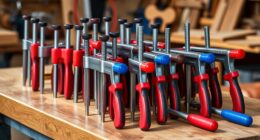
For most woodworking shops, I’d start with the Klein Tools 935DGGP: its magnetic base suits checking and setting angles against compatible metal surfaces. The Neoteck 16-Inch stands out when a longer arm helps transfer or measure angles, while the GemRed 82305 offers a compact stainless-steel ruler format. The main tradeoff is between a short, portable gauge and a longer protractor, with magnets, display visibility, and extra laser or level functions adding further choices. This roundup compares all 15 tools by how well their designs fit common woodworking tasks, not by feature count alone. Read on for the full breakdown and a guide to choosing the right style for your shop.

Get business pricing on tools and workshop supplies
- Business-only prices and quantity discounts
- Tax-exempt purchasing
- Multiple users, one account, clear invoices
Complete the kit



Key Takeaways
- The Klein Tools 935DGGP leads for general shop use because its magnetic base targets quick angle checks on compatible metal machinery, while a ruler-style gauge is more useful for measuring or transferring angles away from a machine.
- The Neoteck 16-Inch fills a different role from the 7-inch models: its longer arm can span broader work and help transfer angles, but it takes up more room and is less convenient for tight setups.
- Several picks share the compact 7-inch format, including the GemRed 82305, LEXIVON, S&F Stead & Fast, and UNIPEC; differences in construction and added functions matter more than arm length between them.
- Laser features are not a substitute for a reliable reference surface. The Coobeast laser models add alignment aids, while a basic digital gauge may be simpler for checking a blade or setting a bevel.
- Magnetic bases and magnetic bodies are specialized conveniences. They can hold a tool against compatible metal surfaces, but they do not help when measuring wood directly or when the workpiece cannot accept a magnetic attachment.
| Klein Tools 935DGGP Digital Angle Finder with Magnetic Base | 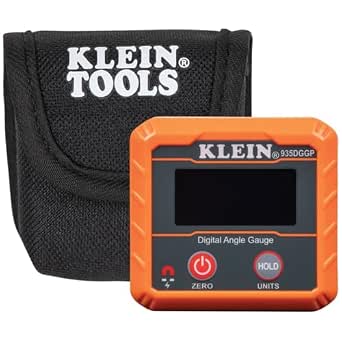 | Best for Magnetic, Hands-Free Checks | Model: 935DGGP | Dimensions: 2.36 × 1.2 × 2.2 inches | Weight: 4.2 ounces | VIEW LATEST PRICE | See Our Full Breakdown |
| Neoteck 16-Inch Digital Angle Finder, 225° Aluminum Protractor with Backlit LCD |  | Best for Long-Span Angle Transfers | Model: NTK230 | Length: 16 inches | Measurement range: 0°–225° | VIEW LATEST PRICE | See Our Full Breakdown |
| Coobeast Digital Angle Finder with Laser |  | Best for Laser-Assisted Alignment | Measurement range: 360° (4 × 90°) | Stated accuracy: ±0.2° | Resolution: 0.05° | VIEW LATEST PRICE | See Our Full Breakdown |
| JORGENSEN Digital Angle Finder and Protractor |  | Best for Miter-Cut Planning | Model: 51001 | Protractor range: 0°–220° | Protractor stated accuracy: ±0.5° | VIEW LATEST PRICE | See Our Full Breakdown |
| S&F Stead & Fast Digital Angle Finder, 7-Inch / 200 mm |  | Best for Full-Range Miter Work | Model: ME-AG-007 | Size: 7 inches / 200 mm | Measurement range: 0–360° | VIEW LATEST PRICE | See Our Full Breakdown |
| WORKPRO Digital Angle Finder with 7-Inch Stainless Steel Rulers |  | Best for Angle Measuring Plus Marking | Measurement range: 360° | Accuracy: ±0.3° | Display resolution: 0.05° | VIEW LATEST PRICE | See Our Full Breakdown |
| Coobeast Digital Angle Finder with Dual Lasers and Four-Sided Magnets |  | Best for Magnetic Alignment and Leveling | Measurement range: 360° (4 × 90°) | Accuracy: ±0.2° | Resolution: 0.05° | VIEW LATEST PRICE | See Our Full Breakdown |
| POWERTEC 71828 Digital Angle Finder with Magnetic Base | 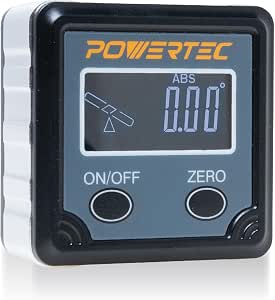 | Best Compact Magnetic Pick | Measuring range: 4 × 90° | Accuracy: ±0.2°; ±0.1° at 0° and 90° | Resolution: 0.05° | VIEW LATEST PRICE | See Our Full Breakdown |
| Klein Tools 935DAF Digital Angle Finder |  | Best for Miter Saw Setup | Accuracy: ±0.2° | Display: White LED | Functions: Inside and outside angle measurement, length measurement, and miter-saw angle calculation | VIEW LATEST PRICE | See Our Full Breakdown |
| GemRed 82305 Digital Angle Finder and Protractor, 7-Inch Stainless Steel |  | Best for Crown Molding and Angle Transfer | Material: Stainless steel | Accuracy: ±0.3° | Folded length: About 7.5 inches (220 mm) | VIEW LATEST PRICE | See Our Full Breakdown |
| 7-Inch Digital Protractor Angle Finder |  | Best for Long, Ruler-Style Measurements | Material: ABS | Folded length: About 7.5 inches / 220 mm | Total length: 400 mm | VIEW LATEST PRICE | See Our Full Breakdown |
| Coobeast Digital Angle Finder with Four Lasers and Magnetic Octagonal Body |  | Best for Laser-Aided Alignment | Laser lines: Four red lines: up, down, left, and right | Laser class: Class II, output <5 mW | Angle range: Two 0–45° measuring steps | VIEW LATEST PRICE | See Our Full Breakdown |
| LEXIVON Digital Angle Finder Gauge, 7-Inch/180 mm |  | Best Metal-Ruler Pick | Rule length: 7 inches / 180 mm | Rule material: Anodized aluminum | Measurement range: 360° | VIEW LATEST PRICE | See Our Full Breakdown |
| Klein Tools 935DAG Digital Level and Angle Gauge |  | Best for Leveling and Relative Angles | Model: 935DAG | Measurement ranges: 0–90° and 0–180° | Display: Reverse-contrast, auto-rotating | VIEW LATEST PRICE | See Our Full Breakdown |
| UNIPEC Digital Angle Finder Protractor, 7-Inch (200 mm) |  | Best Simple ABS Ruler-Protractor | Length: 7 inches / 200 mm | Material: ABS | Measurement resolution: 0.1° | VIEW LATEST PRICE | See Our Full Breakdown |
| digital angle finders for woodworking | Accuracy |
|---|---|
| Klein Tools 935DGGP Digital An | — |
| Neoteck 16-Inch Digital Angle | — |
| Coobeast Digital Angle Finder | — |
| JORGENSEN Digital Angle Finder | — |
| S&F Stead & Fast Digital Angle | — |
| WORKPRO Digital Angle Finder w | ±0.3° |
| Coobeast Digital Angle Finder | ±0.2° |
| POWERTEC 71828 Digital Angle F | ±0.2°; ±0.1° at 0° and 90° |
| Klein Tools 935DAF Digital Ang | ±0.2° |
| GemRed 82305 Digital Angle Fin | ±0.3° |
| 7-Inch Digital Protractor Angl | ±0.3° |
| Coobeast Digital Angle Finder | ±0.2° |
| LEXIVON Digital Angle Finder G | ±0.3° |
| Klein Tools 935DAG Digital Lev | — |
| UNIPEC Digital Angle Finder Pr | — |
More Details on Our Top Picks
Klein Tools 935DGGP Digital Angle Finder with Magnetic Base
The Klein Tools 935DGGP is a compact pick for woodworkers who often check angles on a saw, blade, or other steel surface and value hands-free positioning. Its magnetic base holds to ferromagnetic material, while the V-groove edges help it sit against rounded stock or pipes. It also measures relative angles and works as a digital level, with readings available in degrees and three slope formats. Compared with the longer Neoteck 16-Inch Digital Angle Finder, this Klein is easier to keep in a tool kit but gives you less reach when spanning a wide workpiece. Its small body may also be harder to read or handle than a full-length protractor. Choose it for quick setup checks; skip it if your work surfaces are mostly wood or you need long arms for transferring angles.
Pros:- Magnetic base can hold the gauge hands-free on ferromagnetic surfaces.
- Measures and sets angles, checks relative angles, and functions as a digital level.
- V-groove edges help position it against rounded stock and conduit.
- Displays readings in degrees, percent grade, mm/m, and in/ft.
Cons:- The magnetic base cannot attach to wood or other non-ferromagnetic surfaces.
- Compact dimensions can make the display and handling less comfortable.
- Its short body is less suited to spanning broad workpieces than the Neoteck 16-inch model.
Best for: Woodworkers who frequently check or set angles directly on ferromagnetic saw tables, blades, or fixtures and want a compact tool with slope-unit conversions.
Not ideal for: Woodworkers who need to measure across wide panels or attach the gauge to nonmetallic surfaces, where its short body and magnetic base offer less utility.
- Model:935DGGP
- Dimensions:2.36 × 1.2 × 2.2 inches
- Weight:4.2 ounces
- Base:Magnetic
- Alignment feature:V-groove edges
- Unit conversions:Degrees, percent grade, mm/m, in/ft
Our verdict“Choose the Klein 935DGGP for compact, hands-free angle checks on metal woodworking equipment, not for measuring across large panels.”
Neoteck 16-Inch Digital Angle Finder, 225° Aluminum Protractor with Backlit LCD
The Neoteck 16-Inch Digital Angle Finder favors reach over pocketability. Its long aluminum arm can span larger woodworking surfaces and transfer angles across longer edges than the compact Klein Tools 935DGGP. A 0°–225° range, 0.1° increments, locking knob, and data hold make it useful for setting and recording angles; the backlit display also helps in dim shop areas. The stated accuracy is ±0.5°, so buyers seeking tighter stated accuracy may prefer the S&F Stead & Fast 7-Inch, rated ±0.2°. Its bubble level is a visual aid rather than a digital level reading, and the long arm needs careful handling—the instructions caution against excessive force when rotating it. I’d pick this for transferring angles over distance, not for compact everyday carry.
Pros:- 16-inch arm reaches across larger workpieces better than compact gauges.
- Measures from 0° to 225° in 0.1° increments.
- Backlit LCD, data hold, and locking knob support reading and recording angles.
- Includes a carrying bag and a bubble level for visual horizontal or vertical checks.
Cons:- Stated accuracy of ±0.5° is looser than the ±0.2° stated for the S&F Stead & Fast.
- The bubble level does not provide a digital reading.
- The long arm requires careful rotation, and excessive force is discouraged.
Best for: Cabinetmakers and furniture builders who regularly transfer angles across long edges or larger panels and want a readable display with a locking arm.
Not ideal for: Woodworkers who prioritize compact storage, tighter stated accuracy, or a digital level reading from the built-in bubble level.
- Model:NTK230
- Length:16 inches
- Measurement range:0°–225°
- Measurement increment:0.1°
- Stated accuracy:±0.5°
- Material:Aluminum
- Display:Backlit LCD
- Battery:One included 9V zinc-carbon battery
- Included:Carrying bag and user manual
Our verdict“Choose the Neoteck when long reach matters more than compact storage or the tighter stated accuracy of shorter alternatives.”
Coobeast Digital Angle Finder with Laser
The Coobeast Digital Angle Finder with Laser adds a visual alignment aid that the other gauges here lack: its laser lines help project a reference for leveling or symmetrical positioning. Four-sided magnets can secure it to compatible metal surfaces, while the backlit display rotates automatically as the tool changes orientation. Its 360° range, ±0.2° stated accuracy, and 0.05° resolution make it more feature-rich on paper than the magnetic-base Klein Tools 935DGGP, which is smaller and simpler but does not project laser lines. The tradeoff is that the laser is a supplementary alignment guide, not a substitute for measuring the workpiece directly. The rechargeable 400 mAh battery avoids disposable cells, though frequent use may mean more charging. I’d choose it for layout tasks where projected references are useful, rather than for buyers who want a straightforward angle gauge.
Pros:- Laser lines provide a projected visual aid for leveling and symmetrical alignment.
- Four-sided magnets help secure the gauge to compatible metal surfaces.
- Measures a full 360° with stated ±0.2° accuracy and 0.05° resolution.
- Backlit, automatically rotating display and rechargeable battery support flexible use.
Cons:- The 400 mAh rechargeable battery may need frequent charging with regular use.
- Laser lines assist alignment but do not replace direct measurement of a workpiece.
- Its added laser functions may be unnecessary for buyers who only need angle readings.
Best for: Woodworkers who align or level parts on metal fixtures and can use projected laser lines as a visual reference during setup.
Not ideal for: Buyers who want a simple angle gauge without laser functions, or who need long battery intervals between charges during frequent use.
- Measurement range:360° (4 × 90°)
- Stated accuracy:±0.2°
- Resolution:0.05°
- Laser:Class II, output under 5 mW
- Battery capacity:400 mAh, rechargeable
- Water resistance:IP54
- Magnets:Four-sided magnetic body
- Included components:Angle finder, bag, and laser
Our verdict“Pick the Coobeast with Laser if projected alignment references are useful in your woodworking setup; otherwise, the Klein 935DGGP is a simpler compact gauge.”
JORGENSEN Digital Angle Finder and Protractor
The JORGENSEN Digital Angle Finder and Protractor is aimed at woodworkers who want one tool for angle measurement, leveling, and miter planning. Its protractor measures up to 220°, while the digital level covers 0°–90° with stated ±0.1° precision. The ability to calculate simple and compound miter cuts gives it a more direct role in saw setup than the laser-focused Coobeast Digital Angle Finder with Laser, which emphasizes visual alignment instead. An illuminated flip-up display, data hold, and four inclination units support shop use, and the hanging hook helps with storage. The arms do need firm tightening at the locking knob to stay stable, so quick one-handed adjustments may feel less convenient. I’d favor this JORGENSEN for cut planning, while the S&F is a stronger fit for buyers prioritizing a full-circle range and stated ±0.2° accuracy.
Pros:- Combines a protractor with a digital level for angle and inclination checks.
- Supports simple and compound miter calculations for woodworking cut setup.
- Illuminated flip-up display, data hold, and four selectable inclination units aid shop use.
- Hanging hook and soft-touch components support portable handling and storage.
Cons:- The arms require firm tightening with the locking knob for stable measurements.
- Its protractor range ends at 220°, unlike the S&F Stead & Fast’s 360° range.
- The digital level covers 0°–90°, so it does not replace the wider protractor range for every check.
Best for: Woodworkers who frequently calculate simple or compound miters and want a combined protractor and digital level for saw setup.
Not ideal for: Users who need a full 360° measuring range or prefer not to tighten a locking knob firmly to stabilize the arms.
- Model:51001
- Protractor range:0°–220°
- Protractor stated accuracy:±0.5°
- Digital level range:0°–90°
- Digital level precision:±0.1°
- Selectable units:Degrees, percent, mm/m, in/ft
- Materials:Aluminum alloy, ABS, TPE, and silicone
- Included:Digital angle finder and AA alkaline batteries
Our verdict“Choose the JORGENSEN for integrated miter planning and leveling, especially if those functions matter more than a full-circle range.”
S&F Stead & Fast Digital Angle Finder, 7-Inch / 200 mm
The S&F Stead & Fast Digital Angle Finder makes a strong case for woodworking tasks that combine angle transfer with miter setup. Its 0–360° range, stated ±0.2° accuracy, and compound-cut calculation function cover more than the 220° protractor range of the JORGENSEN Digital Angle Finder. Stainless steel arms, a locking knob, etched inch and metric ruler markings, and an IP54-rated body make it a practical choice for shop or jobsite handling. The 7-inch size is easier to store than the 16-inch Neoteck, though it cannot span as much distance across a panel. It also needs an AAA battery, and its three-minute auto-shutoff may interrupt longer measuring sessions. I’d choose it for broad angle coverage and miter calculations in a compact arm-style tool, not for maximum reach.
Pros:- Measures 0–360° and includes compound miter calculation.
- Stated ±0.2° accuracy and 0.1° resolution support detailed angle setup.
- Stainless steel arms, locking knob, and IP54-rated body suit workshop and jobsite handling.
- Large LCD and etched inch and metric ruler markings aid reading and measurement.
Cons:- The 7-inch arms offer less reach than the Neoteck 16-inch model.
- Requires an AAA battery.
- Three-minute auto-shutoff can interrupt longer measuring sessions.
Best for: Woodworkers who need full-circle angle measurement and compound miter calculations in a durable, portable 7-inch tool.
Not ideal for: Cabinetmakers who regularly measure across wide panels and would benefit more from the Neoteck’s 16-inch reach.
- Model:ME-AG-007
- Size:7 inches / 200 mm
- Measurement range:0–360°
- Stated accuracy:±0.2°
- Resolution:0.1°
- Material:Stainless steel
- Ingress protection:IP54
- Power source:AAA alkaline battery
- Auto shutoff:3 minutes
Our verdict“Choose the S&F for full-circle readings and miter calculations in a compact metal gauge, but pick the Neoteck if long reach is your priority.”
WORKPRO Digital Angle Finder with 7-Inch Stainless Steel Rulers
The WORKPRO suits woodworkers who want one folding tool for checking angles and laying out short marks. Its stainless steel rulers extend to 400 mm, and the lock and hold functions help keep a reading steady while transferring it to a workpiece. Compared with the Klein Tools 935DAF, it offers a spare battery and storage pouch, but the Klein adds a miter-saw angle calculation feature that may matter more for repeatable saw setup. WORKPRO’s ±0.3° accuracy is adequate for general fit-up and trim work, though it is less precise on paper than the Klein’s ±0.2°. The rulers are designed for basic length measurement rather than full measuring-tool duty, and their machined edges call for careful handling. I’d choose it for versatile layout, not as a substitute for a dedicated rule.
Pros:- Measures inside and outside angles across a 360° range.
- Lock and hold functions help retain a reading during marking.
- Stainless steel rulers have deep-etched scales and extend to 400 mm.
- Includes a spare battery and an Oxford storage pouch.
Cons:- ±0.3° accuracy is less precise than the Klein Tools 935DAF’s stated ±0.2°.
- Extended rulers are intended for basic measuring, not as a full substitute for a dedicated rule.
- Machined edges require attentive handling.
Best for: Woodworkers who want a folding angle gauge that can also handle basic layout and short measurements.
Not ideal for: Cabinetmakers who need a dedicated precision rule or the added miter-saw calculation feature found on the Klein Tools 935DAF.
- Measurement range:360°
- Accuracy:±0.3°
- Display resolution:0.05°
- Extended length:400 mm
- Material:Stainless steel
- Functions:Lock, hold, and unit switching
- Power and accessories:Pre-installed battery, spare battery, and Oxford pouch
- Weight:10.2 ounces
Our verdict“Choose the WORKPRO if you want angle checking and basic layout in one folding tool and can accept its modest accuracy and ruler limitations.”
Coobeast Digital Angle Finder with Dual Lasers and Four-Sided Magnets
The Coobeast is the most alignment-focused option here: four-sided magnets, a digital level, and dual red laser lines make it suited to positioning or checking ferrous parts from more than one orientation. Its ±0.2° accuracy is tighter than the WORKPRO’s ±0.3°, while the backlit display with automatic flip is helpful when the tool is inverted or awkwardly placed. Unlike the POWERTEC 71828, it adds lasers and a rechargeable battery rather than relying on replaceable AAA cells. That extra functionality comes with a tradeoff: the 400 mAh battery may need charging during extended sessions, and the magnets only help on surfaces they can attach to. The Class II lasers are useful for visual alignment, but they are not a substitute for a dedicated layout or measuring system. I’d pick it for setup and positioning, not simple angle transfers alone.
Pros:- Four-sided magnets support attachment in multiple orientations on suitable surfaces.
- Combines an angle finder, digital level, and dual laser lines.
- ±0.2° accuracy and 0.05° resolution support detailed setup work.
- Backlit display flips automatically for inverted readings.
Cons:- The 400 mAh rechargeable battery may need charging during extended use.
- Magnets cannot attach to nonferrous materials such as most wood surfaces.
- Laser lines add alignment utility but do not replace a dedicated measuring tool.
Best for: Woodworkers who frequently align or check ferrous blades, fences, and workpieces while also needing a digital level.
Not ideal for: Users who need long runtimes without charging or mainly measure angles on nonmagnetic wood surfaces.
- Measurement range:360° (4 × 90°)
- Accuracy:±0.2°
- Resolution:0.05°
- Laser:Dual red laser lines, Class II, output under 5 mW
- Ingress protection:IP54
- Battery:Rechargeable 400 mAh
- Display:Backlit LCD with automatic display flip
- Functions:Hold and zero
Our verdict“Choose the Coobeast when magnetic positioning and leveling matter as much as angle readings, and skip it if you need a simple, long-running gauge.”
POWERTEC 71828 Digital Angle Finder with Magnetic Base
The POWERTEC 71828 is a compact choice for checking angles directly on ferrous saw or machine surfaces. Its magnetic base frees a hand and can attach to curved ferrous surfaces, while absolute and relative modes let a woodworker read against a reference or zero the gauge to a local surface. The stated accuracy reaches ±0.1° at 0° and 90°, with ±0.2° elsewhere—more precise at those key positions than the WORKPRO’s ±0.3°. The tradeoff is that the POWERTEC is a gauge, not a folding ruler: unlike the GemRed 82305, it does not provide extended arms for transferring an angle or measuring along a board. It also needs two AAA batteries, which are not included, and its magnetic mounting is useful only on ferrous materials. I’d favor it for compact machine setup over general-purpose layout.
Pros:- Magnetic base attaches to suitable ferrous surfaces, including curved ones.
- Absolute and relative modes suit both reference readings and local zeroing.
- Compact, lightweight format fits tight work areas.
- Nylon case helps protect the tool during storage and transport.
Cons:- Requires two AAA batteries, which are not included.
- Magnetic attachment is unavailable on wood and other nonferrous surfaces.
- Does not provide ruler arms for transferring angles or taking basic length measurements.
Best for: Woodworkers who want a small magnetic gauge for checking saw blades, fences, and other ferrous machine surfaces.
Not ideal for: People who need folding arms for transferring angles across boards or who mostly work on nonmagnetic surfaces.
- Measuring range:4 × 90°
- Accuracy:±0.2°; ±0.1° at 0° and 90°
- Resolution:0.05°
- Base:Magnetic; attaches to ferrous surfaces
- Measurement modes:Absolute and relative
- Power:Two AAA batteries, not included
- Auto shutoff:After 5 minutes of inactivity
- Included accessory:Nylon fabric case
Our verdict“Choose the POWERTEC for compact, hands-free checks on ferrous machinery, but pick a folding ruler-style finder for transferring angles to wood.”
Klein Tools 935DAF Digital Angle Finder
The Klein Tools 935DAF earns its place for woodworkers who regularly set a saw to match an inside or outside angle. It measures angles and lengths, and its miter-saw angle calculation gives it a more direct role in cutting setup than the POWERTEC 71828, which focuses on compact magnetic angle readings. At ±0.2° accuracy, it is also more precise on paper than the WORKPRO, though it lacks the WORKPRO’s included spare battery and pouch. The bright white LED display and included AAA battery keep the basic setup straightforward. Its ruler-style form can transfer angles and take length readings, but the product data does not specify a folding-arm range or added holding features, so buyers wanting those details may prefer the GemRed 82305’s stated 400 mm total length and angle lock. This is a focused woodworking pick rather than a feature-heavy multi-tool.
Pros:- Calculates miter saw angles in addition to measuring inside and outside angles.
- Measures lengths as well as angles.
- Machined ruler edges are specified at ±0.2° accuracy.
- Bright white LED display and one included AAA battery.
Cons:- Requires a AAA battery, so continued use depends on replacing it when depleted.
- Does not list a magnetic base for attaching to saw blades or fences.
- Product data does not specify an extended measuring length or included storage case.
Best for: Woodworkers who frequently set miter saw angles from measured trim, joints, or workpiece corners.
Not ideal for: Buyers who want a magnetic base, documented long measuring reach, or included storage accessories.
- Accuracy:±0.2°
- Display:White LED
- Functions:Inside and outside angle measurement, length measurement, and miter-saw angle calculation
- Power:One included AAA alkaline battery
- Weight:6.9 ounces
- Dimensions:8.55 × 1.38 × 0.74 inches
- Materials:ABS plastic and stainless steel
- Model:935DAF
Our verdict“Choose the Klein 935DAF if miter-saw setup is your main task; look to the POWERTEC for magnetic mounting or the GemRed for a stated 400 mm reach.”
GemRed 82305 Digital Angle Finder and Protractor, 7-Inch Stainless Steel
The GemRed 82305 is a straightforward folding protractor and ruler for transferring inside or outside angles to trim, molding, and joinery. Its stainless steel arms extend to 400 mm, laser-etched markings support clear layout, and the angle lock holds a setting while it is read or transferred. Compared with the WORKPRO, it has a similar stated ±0.3° accuracy and the same 400 mm total length, but the WORKPRO adds a spare battery, pouch, and unit switching. The Klein Tools 935DAF is the stronger fit for buyers who want miter-saw angle calculations; GemRed instead keeps the job centered on measuring and transferring an angle. Its main limitation is the lack of a reverse-angle display, which can make some orientations less convenient to read. I’d choose it for manual trim layout rather than machine-focused setup.
Pros:- Measures both inside and outside angles with a folding ruler-and-protractor design.
- Stainless steel rulers extend to 400 mm.
- Laser-etched markings support readable layout measurements.
- Angle lock holds a setting for reading or transferring.
Cons:- ±0.3° accuracy is less precise than the Klein Tools 935DAF’s stated ±0.2°.
- No reverse-angle display function.
- The product data does not list a storage pouch or spare battery.
Best for: Woodworkers and trim installers who need a folding angle finder for crown molding, inside corners, and transferring cuts.
Not ideal for: Users who need a reverse-angle display, more precise stated accuracy, or a miter-saw calculation feature.
- Material:Stainless steel
- Accuracy:±0.3°
- Folded length:About 7.5 inches (220 mm)
- Total length:400 mm
- Battery:Included CR2032 lithium metal battery
- Weight:7.4 ounces
- Display function:No reverse-angle display
- Measurement:Inside and outside angles
Our verdict“Choose the GemRed for direct angle transfer on molding and trim, but pick the Klein 935DAF if saw-angle calculation matters more.”
7-Inch Digital Protractor Angle Finder
This model pairs an LCD protractor with a 400 mm ruler, giving woodworkers more reach for checking longer edges or laying out angles than the 7-inch LEXIVON Digital Angle Finder Gauge. Its inside- and outside-angle readings, lock, and zero reset suit marking and transferring angles between workpieces. The reverse display mode also makes the readout easier to view when the tool is turned around. At ±0.3° accuracy and 0.1° resolution, it is geared toward general layout rather than fine measurement where every fraction matters. The main tradeoff is its ABS construction: it is lighter, but lacks the sturdier feel of LEXIVON’s anodized aluminum rule. I’d choose it for extra measuring reach, not for a metal-bodied tool meant to take workshop knocks.
Pros:- Combines a digital protractor with a 400 mm ruler for longer layout work.
- Measures inside and outside angles.
- Lock, zero reset, and reverse display support angle transfer and easier reading.
- Two CR2032 batteries are included.
Cons:- ABS construction may be less durable than the anodized aluminum rule on the LEXIVON.
- 0.1° resolution is coarser than the 0.05° display resolution on the LEXIVON.
- Requires CR2032 batteries.
Best for: Woodworkers who want a long ruler for transferring and checking angles across larger panels or stock.
Not ideal for: Buyers who need a metal-bodied measuring tool or finer displayed increments than 0.1°.
- Material:ABS
- Folded length:About 7.5 inches / 220 mm
- Total length:400 mm
- Measuring range:0–999.9°
- Accuracy:±0.3°
- Resolution:0.1°
- Scale units:Millimeters and inches
- Display and power:LCD; two CR2032 batteries included
Our verdict“Choose this if you value long ruler reach and straightforward angle transfer more than a metal body or finer displayed increments.”
Coobeast Digital Angle Finder with Four Lasers and Magnetic Octagonal Body
The Coobeast’s defining advantage is not its angle readout but its four projected laser lines, which provide visual guides in horizontal and vertical directions while setting up a cut or aligning work. Four magnets help it attach to ferromagnetic surfaces, and the backlit, auto-flip display keeps readings legible when the body changes orientation. Compared with the Klein Tools 935DAG, this model adds laser guidance, while the Klein offers a V-groove for positioning on pipe and conduit. The key limitation is the Coobeast’s two 0–45° measuring steps; it does not provide the broad angle span of a conventional 360° protractor such as the LEXIVON. Its plastic body and IP54 protection also call for sensible handling around dust and splashes, not immersion or rough treatment.
Pros:- Four laser lines provide horizontal and vertical visual references.
- Four built-in magnets support attachment to metal surfaces.
- Backlit auto-flip display, Hold, and Zero functions aid setup.
- Includes a storage bag and two AAA batteries.
Cons:- Angle measurement is limited to two 0–45° steps.
- Plastic construction is less suited to rough handling than a metal rule.
- IP54 protection covers dust and splashes, not immersion.
Best for: Woodworkers who benefit from projected horizontal and vertical reference lines when aligning a setup or workpiece.
Not ideal for: Buyers who need a continuous wide-angle range, a metal-bodied tool, or protection against immersion.
- Laser lines:Four red lines: up, down, left, and right
- Laser class:Class II, output <5 mW
- Angle range:Two 0–45° measuring steps
- Accuracy:±0.2°
- Resolution:0.05°
- Magnets:Four built-in magnets
- Ingress protection:IP54
- Display and included items:Backlit auto-flip LCD; storage bag and two AAA batteries
Our verdict“Pick this for laser-assisted alignment on suitable surfaces, but choose the LEXIVON or Klein 935DAG if broad angle measurement matters more.”
LEXIVON Digital Angle Finder Gauge, 7-Inch/180 mm
For woodworking layout that calls for both a measuring edge and a digital angle readout, the LEXIVON offers a strong middle ground: its anodized aluminum rule feels more suited to workshop use than the ABS bodies of the 7-Inch Digital Protractor Angle Finder and UNIPEC. Its 360° range and zero, hold, flip, and reverse-angle functions also make it more adaptable than the Coobeast’s two 0–45° steps. The 0.05° resolution gives a finer displayed increment than the 0.1° readouts on those ABS ruler-protractor models, though the stated accuracy remains ±0.3°. That distinction matters: finer resolution does not mean the stated accuracy is tighter. The included pouch helps protect the rule in storage, but buyers seeking a level with a magnetic base may prefer the Klein Tools 935DAG.
Pros:- Anodized aluminum rule with laser-etched inch and millimeter markings.
- Measures across 360° and includes zero, hold, flip, and reverse-angle functions.
- 0.05° resolution with an extra-large LCD.
- Includes a heavy-duty zippered storage pouch.
Cons:- Stated accuracy is ±0.3°, despite the finer 0.05° resolution.
- Requires a 3-volt DC power source.
- Does not offer the magnetic base and level function of the Klein Tools 935DAG.
Best for: Woodworkers who want a 7-inch metal rule with a broad angle range for measuring and transferring angles.
Not ideal for: Buyers whose main need is a magnetic digital level or who expect accuracy tighter than ±0.3°.
- Rule length:7 inches / 180 mm
- Rule material:Anodized aluminum
- Measurement range:360°
- Accuracy:±0.3°
- Resolution:0.05°
- Markings:Laser-etched millimeter and inch
- Display:Extra-large LCD
- Power and included item:3 volts DC; heavy-duty zippered pouch
Our verdict“Choose the LEXIVON if a durable metal rule and broad angle coverage matter more than magnetic leveling features.”
Klein Tools 935DAG Digital Level and Angle Gauge
The Klein Tools 935DAG is the most level-focused choice here. It measures and sets angles, works as a digital level, and lets you zero the gauge to compare a surface against a reference rather than relying only on an absolute angle. Its magnetic base supports hands-free positioning on ferromagnetic surfaces, while the V-groove edges help hold alignment on pipe or conduit. Compared with the LEXIVON, it gives up the long ruler and 360° angle coverage but adds practical leveling and relative-angle functions. That makes it a better fit for setting a machine or checking a surface than for transferring an angle across a board. The magnetic attachment also depends on the work surface: it will not hold hands-free on wood, aluminum, or other nonferromagnetic materials.
Pros:- Combines angle measurement and setting with digital leveling.
- Zero calibration supports checking relative angles.
- Magnetic base allows hands-free use on ferromagnetic surfaces.
- V-groove edges help align the gauge on pipe and conduit.
Cons:- Magnetic attachment works only on ferromagnetic surfaces.
- Lacks the long ruler used for transferring angles across boards on the LEXIVON.
- Its listed angle ranges stop at 0–90° and 0–180°, rather than covering 360°.
Best for: Woodworkers who need a compact gauge for checking level, setting angles, and comparing a surface to a zeroed reference.
Not ideal for: Buyers who need a ruler-style angle finder for marking boards or magnetic attachment on nonferromagnetic workpieces.
- Model:935DAG
- Measurement ranges:0–90° and 0–180°
- Display:Reverse-contrast, auto-rotating
- Base:Magnetic
- Edges:V-groove
- Functions:Angle measurement, angle setting, level, and zero calibration
- Included components:Soft carrying case, instruction manual, and batteries
Our verdict“Choose the Klein if leveling and relative-angle checks are central to your shop work, rather than long-rule angle layout.”
UNIPEC Digital Angle Finder Protractor, 7-Inch (200 mm)
The UNIPEC keeps the layout-tool format uncomplicated: a 7-inch ruler and digital protractor handle inside and outside angles, while lock and hold functions help preserve a reading as it is transferred to a workpiece. Its large LCD is intended to remain readable in low light, and the included protective case gives it a straightforward storage option. Compared with the LEXIVON, it trades an anodized aluminum rule and 0.05° resolution for an ABS body and 0.1° resolution; the stated accuracy is ±0.3° on both. That makes the UNIPEC a simpler choice for general woodworking layout, not the stronger pick for buyers who prioritize a metal measuring edge. It also lacks the Klein 935DAG’s level and magnetic-base functions, so its appeal is specifically ruler-and-protractor work.
Pros:- Combines a ruler and protractor for inside and outside angle measurements.
- Large LCD is designed for readability in low light.
- Lock and hold functions preserve readings during layout.
- Includes a protective case and user manual.
Cons:- ABS body may be less durable than the LEXIVON’s anodized aluminum rule.
- 0.1° resolution is coarser than the LEXIVON’s 0.05° resolution.
- Stated accuracy is ±0.3°.
Best for: DIY woodworkers who want a basic ruler-protractor for measuring and transferring common inside and outside angles.
Not ideal for: Buyers who need an anodized metal rule, finer displayed increments, or a magnetic digital level.
- Length:7 inches / 200 mm
- Material:ABS
- Measurement resolution:0.1°
- Measurement accuracy:±0.3°
- Functions:Ruler and protractor; lock and hold
- Weight:4.6 ounces
- Package dimensions:11.34 × 4.84 × 1.34 inches
- Included components:Digital protractor, protective case, and user manual
Our verdict“Pick the UNIPEC for uncomplicated ruler-and-protractor layout if you do not need the metal construction or extra functions of the LEXIVON or Klein.”
How We Picked
I ranked these digital angle finders for woodworking by how clearly each design serves real shop tasks: checking a table-saw blade, setting a miter or bevel, transferring an angle, or measuring a workpiece. I weighed the usability of the form factor, display and controls, the practical value of magnets or lasers, and whether the tool’s construction and stated features suit repeated workshop handling. A longer arm can help with broad measurements, while a compact ruler-style tool is easier to store and use in confined spaces.
The order reflects task fit and versatility, not feature count. Magnetic and combination tools rank well when their added functions have a clear woodworking use, but extras do not automatically outrank a straightforward gauge. The list includes several similar 7-inch models, so their placement emphasizes differences in stated materials and capabilities rather than treating them as interchangeable. Because product specifications and included accessories can vary by listing, I recommend checking the current manufacturer details before buying.
| digital angle finders for woodworking | Accuracy |
|---|---|
| Klein Tools 935DGGP Digital An | — |
| Neoteck 16-Inch Digital Angle | — |
| Coobeast Digital Angle Finder | — |
| JORGENSEN Digital Angle Finder | — |
| S&F Stead & Fast Digital Angle | — |
| WORKPRO Digital Angle Finder w | ±0.3° |
| Coobeast Digital Angle Finder | ±0.2° |
| POWERTEC 71828 Digital Angle F | ±0.2°; ±0.1° at 0° and 90° |
| Klein Tools 935DAF Digital Ang | ±0.2° |
| GemRed 82305 Digital Angle Fin | ±0.3° |
| 7-Inch Digital Protractor Angl | ±0.3° |
| Coobeast Digital Angle Finder | ±0.2° |
| LEXIVON Digital Angle Finder G | ±0.3° |
| Klein Tools 935DAG Digital Lev | — |
| UNIPEC Digital Angle Finder Pr | — |
Factors to Consider When Choosing Digital Angle Finders For Woodworking
Before choosing a model, I’d match its shape and attachment method to the surfaces and cuts you measure most often. A tool that works neatly on a saw table may be awkward for transferring an angle from a cabinet panel, and extra functions only help when they fit your workflow.
Choose the arm length for the work, not the biggest number
A longer arm, such as the Neoteck 16-inch design, can bridge a wider span and make it easier to transfer an angle across a larger workpiece. A compact 7-inch tool is easier to keep beside a saw, carry to an installation, and maneuver around a small jig. Buyers sometimes assume the longer ruler is automatically more accurate, but length alone does not establish accuracy; hinge play, alignment, and a stable reference matter too. Think about the longest edge you routinely measure and the tightest space you routinely enter. If both are common, a compact gauge may be the better daily tool, with a separate straightedge used for long layouts. Choose reach only when the larger arm solves a recurring measuring problem.
Check whether the magnet matches your measuring surfaces
A magnetic base can keep an angle finder in place against compatible metal machine surfaces while you adjust a blade or fence. It will not attach to a wooden panel, and it may be unsuitable for surfaces where a magnet could collect filings or interfere with careful positioning. Do not treat magnetic retention as a replacement for checking that the tool sits flat and contacts the intended reference face. If most of your work involves wood-to-wood angle transfer, a hinged ruler or protractor may be more useful than a magnetic base. If machine setup is your priority, magnetic attachment can free a hand and reduce slipping during adjustment. Match the attachment feature to your shop materials rather than paying attention to the word “magnetic” by itself.
Decide whether lasers solve a real alignment problem
Laser-equipped models, including several Coobeast options in this roundup, add a way to project or indicate alignment beyond the gauge’s physical arms. That can help with visual reference work, but it does not replace a firm contact point or a measured angle when setting a blade or jig. More laser emitters and a distinctive body shape also mean more functions to learn and maintain than a simple protractor-style tool. Before choosing a laser model, identify the specific task where a projected line would save time or improve visibility. If you mainly check bevel angles against a machine surface, the laser feature may add little to your routine. Keep the basic measurement method central and treat the laser as an aid, not proof of accuracy.
Prioritize repeatable readings over extra modes
For woodworking, the useful question is whether you can place the tool consistently, read the display, and repeat the setup—not how many functions appear on the packaging. A backlit display, such as the one specified for the Neoteck, can be helpful in a shaded shop or when the screen is turned away from overhead light. A level function may suit users who check both angle and orientation, but it will not replace a dedicated measurement approach for every job. Learn how a model handles zeroing and reference changes before relying on it for repeated cuts. A common mistake is to compare digital readouts without first confirming that each tool is referenced from the same surface. Favor controls and a display you can use comfortably at the saw over a longer list of modes.
Treat construction and maintenance as part of accuracy
A digital angle finder’s reading is only useful when its arms, hinge, and contact edges remain aligned and clean. Stainless-steel ruler construction, as seen on several compact models, may appeal to buyers who want a metal measuring arm, while other designs emphasize a magnetic base or specialized body. Dust, resin, and small chips can stop a tool from sitting flush, so wipe the reference surfaces before taking a reading. Store hinged models so the arms are not bent or forced against other tools, and check the maker’s care guidance for the display and battery compartment. Do not assume that a tougher-looking housing guarantees a more accurate measurement. Good storage and consistent contact habits matter whichever model you select.
Pay for features that match your workflow
A basic angle gauge is often enough for checking a saw blade or setting a bevel, while a longer protractor, magnetic attachment, backlight, or laser can address a more specific need. Extra functions can make a tool more versatile, but they can also add bulk and create features you rarely use. Think through three regular tasks before buying: where the tool will sit, what angle you need to read or transfer, and whether you need to see or project that reference. Beginners may benefit more from a simple format with clear controls than from a feature-heavy design. A shop with several machines may justify a magnetic or combination tool if it moves between those setups. Choose the least complicated model that handles your actual work reliably.
Frequently Asked Questions
Is a magnetic digital angle finder a good choice for a table saw?
It can be a convenient choice when the tool’s magnet attaches securely to a compatible metal surface and the gauge sits flat against the blade or table reference. The Klein Tools 935DGGP and POWERTEC 71828 are the magnetic-base options in this roundup, while some Coobeast models use magnetic bodies. Check the tool’s placement and contact before trusting a reading; a magnet cannot correct for chips, dust, or a tilted reference. For wooden jigs or panels, a magnetic base offers no attachment advantage. If you use the gauge mostly on machinery, magnetic retention may simplify setup; if not, compare it with a ruler-style model.
Should I buy a 16-inch angle finder or a 7-inch model?
Choose a 16-inch model when you regularly measure broad workpieces or want more reach for transferring angles across a larger span. The Neoteck 16-Inch is the long-arm choice here, while many alternatives use a more compact 7-inch format. A shorter tool is easier to store and maneuver around saws, fences, and small assemblies. The longer arm is not automatically more accurate, so consider how well the tool’s hinge and contact edges suit your work. If you rarely need the extra reach, the compact format is likely the more practical shop companion.
Do I need laser features for woodworking angle measurements?
Most routine blade and bevel checks can be handled with a digital angle gauge that provides a stable reference and readable measurement. A laser can help with visual alignment or projecting a line, but it does not replace physical contact or a consistent reference surface. The Coobeast laser models stand apart from simpler gauges through those added alignment features. If you cannot name a recurring job where a projected reference would help, a standard model may be easier to use and store. For a laser-equipped tool, check how the beam is meant to support the measurement rather than assuming more lasers mean better angle readings.
Can one digital angle finder replace both a protractor and a digital level?
Some combination tools are designed to handle more than one kind of measurement, and the Klein Tools 935DAG is identified as both a digital level and angle gauge. That does not mean every angle finder includes the same functions or is equally convenient for every task. A hinged protractor can be useful for transferring an angle, while a compact gauge may be simpler for checking a machine setup. Read the manufacturer’s specifications for the exact functions and measurement range before treating one tool as a full replacement for another. If you need both capabilities frequently, compare how each tool is held and read during your actual work rather than relying on the product name alone.
What should a beginner prioritize when buying a digital angle finder?
I’d prioritize a format that is easy to place, has a display you can read in your shop, and offers controls you can understand without switching among rarely used functions. A straightforward 7-inch model can handle many common checks without the storage demands of a longer arm. New users should also build a consistent habit: clean the contact surfaces, place the tool against the same reference, and confirm the setup before cutting. Magnets or lasers can help in specific situations, but they are not substitutes for learning how the gauge references an angle. Choose a simple tool that matches your most common task, then add specialized features only if a real need appears.
Conclusion
For an all-around shop choice, I’d pick the Klein Tools 935DGGP for its magnetic-base design and machine-setup focus. For best value, I’d compare the simpler 7-inch options—such as the GemRed 82305, S&F Stead & Fast, and UNIPEC—against the functions you will actually use, since their compact ruler format is suited to everyday angle work without requiring a long arm. The Neoteck 16-Inch is my pick for buyers who need reach, while the Coobeast laser models suit specific alignment needs rather than routine gauge work. Beginners may find a straightforward 7-inch protractor-style tool easier to manage than a laser-heavy or combination model. For a premium-style feature set, consider the Klein Tools 935DAG if its digital-level function matches your workflow; verify the listed specifications before choosing. Match the tool to your surfaces and tasks, and the best fit becomes much clearer.