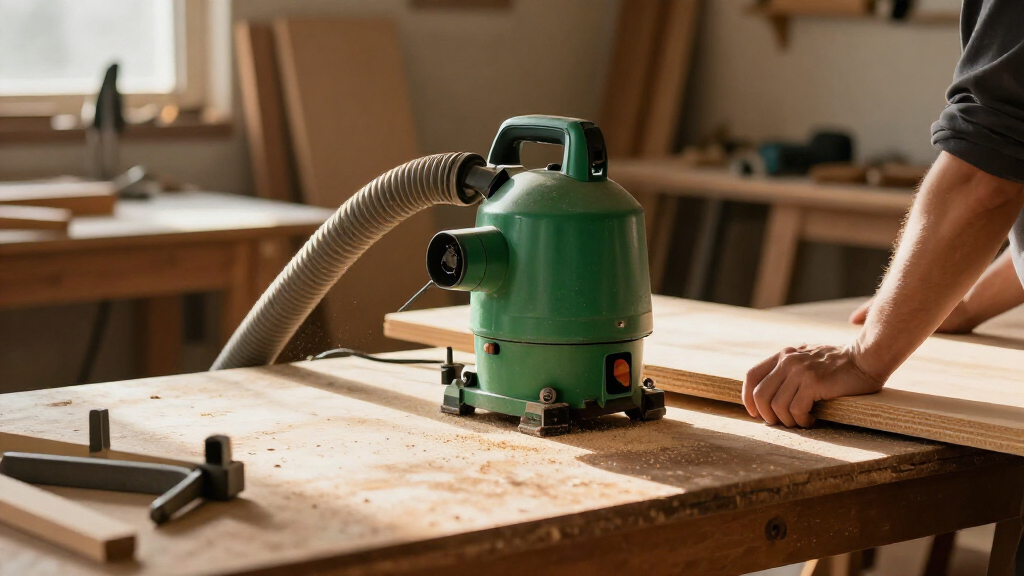
The best woodworking dust collector for most small shops is the POWERTEC 1 HP 800 CFM model with a mobile base, which balances stronger airflow with the ability to move it between machines. For a fixed workstation, the POWERTEC 1 HP wall-mount collector saves floor space, while the DYNAVEX portable extractor with HEPA filtration suits buyers prioritizing fine-particle capture. The main tradeoffs are source collection versus room filtration, airflow versus filtration level, and stationary capacity versus portability. A ceiling or room air cleaner can capture airborne dust, but it is not a substitute for a collector connected directly to a tool. Continue reading for the full breakdown of all 12 woodworking dust collectors and how to match one to your shop.

Get business pricing on tools and workshop supplies
- Business-only prices and quantity discounts
- Tax-exempt purchasing
- Multiple users, one account, clear invoices
Complete the kit



Key Takeaways
- The POWERTEC 800 CFM mobile collector is the strongest all-around fit in this group: it combines more stated airflow than the 560 CFM options with mobility, though it still needs suitable ducting and tool connections.
- The POWERTEC 560 CFM wall-mount model trades mobility for floor space: its wall-mounted format and 1-micron filter bag make it a better fit for a permanent collection point than a shared machine-to-machine setup.
- Air filtration systems solve a different problem: the WEN 3410, ALORAIR Purecare, and DEWALT DWXAF101 clean airborne shop dust rather than capturing chips at a tool port.
- Capacity and mobility separate the larger collectors from compact choices: the WEN DC1300’s 1,300 CFM rating and 50-gallon bag favor a bigger shop, while the WEN DC3401 is easier to place where space is limited.
- Filter labels do not tell the whole story: the DYNAVEX HEPA extractor emphasizes fine filtration, while several POWERTEC models use 1-micron bags; actual results also depend on tool fit, seals, and keeping filters clear.
| WEN 3410 3-Speed Remote-Controlled Air Filtration System, 300/350/400 CFM | 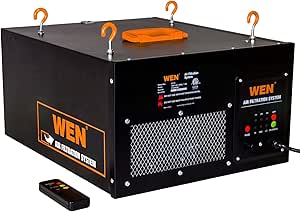 | Best for Small Workshops | Airflow: 300/350/400 CFM | Filter stages: 5-micron pre-filter and replaceable 1-micron filter | Coverage area: Up to 400 sq ft | VIEW LATEST PRICE | See Our Full Breakdown |
| ALORAIR Purecare 1350 360-Degree Intake Air Filtration System |  | Best for Large-Shop Air Filtration | Airflow: 1,050/1,350 CFM | Filter: MERV 11; captures 90% of 3–10 μm particles and 85% of 1 μm particles | Coverage: Up to 1,700 sq ft | VIEW LATEST PRICE | See Our Full Breakdown |
| POWERTEC 1 HP Wall-Mount Dust Collector with 1-Micron Filter Bag, 560 CFM |  | Best Wall-Mount Source-Capture Pick | Motor power: 1 HP | Airflow capacity: 560 CFM | Inlet size: 4 in | VIEW LATEST PRICE | See Our Full Breakdown |
| VEVOR Wall-Mount Dust Collector, 1 HP, 560 CFM, 2.5-Micron Filtration |  | Best for High-Capacity Coarse-Dust Collection | Mounting type: Wall mount | Motor power: 1 HP | Airflow: 560 CFM | VIEW LATEST PRICE | See Our Full Breakdown |
| POWERTEC 1 HP Dust Collector, 800 CFM, with Mobile Base and 1-Micron Filter Bag |  | Best Mobile Shop Pick | Motor power: 1 HP | Airflow: 800 CFM | Filtration: 1 micron | VIEW LATEST PRICE | See Our Full Breakdown |
| WEN DC3401 Woodworking Dust Collector, 5.7-Amp Motor, 12-Gallon Bag |  | Best Compact Pick | Motor: 5.7-amp brushed | Impeller: 6 inches | Airflow: Up to 660 CFM | VIEW LATEST PRICE | See Our Full Breakdown |
| WEN 15-Gallon Woodworking Dust Collector with 7.4-Amp Motor |  | Best for Longer Sessions | Model: WEN DC3474 | Motor: 7.4-amp induction | Impeller: 9 inches | VIEW LATEST PRICE | See Our Full Breakdown |
| DEWALT DWXAF101 Air Filtration System for Woodworking |  | Best for Overhead Air Filtration | Model: DWXAF101 | Filtration: Two-stage washable cotton pre-filter and H11 HEPA filter | Particle capture: Over 95% at 0.3 microns | VIEW LATEST PRICE | See Our Full Breakdown |
| VEVOR 1 HP Vortex Dust Collector, 800 CFM, 2.5-Micron Filtration, 16-Gallon Bag |  | Best for Higher Airflow and Capacity | Model: DC100 | Motor: 1 HP induction | Motor speed: 3400 RPM | VIEW LATEST PRICE | See Our Full Breakdown |
| POWERTEC Portable Dust Collector, 1 HP, 560 CFM, with 1-Micron Filter Bag |  | Best for Finer Bag Filtration | Motor: 1 HP induction | Voltage and current: 120V/240V; 12 A at 120V and 6 A at 240V | Motor speed: 3450 RPM | VIEW LATEST PRICE | See Our Full Breakdown |
| WEN DC1300 1,300 CFM Woodworking Dust Collector with 50-Gallon Bag and Mobile Base |  | Best for Larger Shops and Two-Tool Setups | Airflow: Up to 1,300 CFM | Motor: 14 amps | Impeller: 10-inch steel; up to 3,450 RPM | VIEW LATEST PRICE | See Our Full Breakdown |
| DYNAVEX 12-Gallon Portable Woodworking Dust Extractor with HEPA Filter |  | Best for Fine-Dust Tool Extraction | Motor: 1.5 HP, 10 amps | Airflow: 142 CFM | Tank capacity: 12 gallons | VIEW LATEST PRICE | See Our Full Breakdown |
| woodworking dust collector | Airflow | Weight | Motor |
|---|---|---|---|
| WEN 3410 3-Speed Remote-Contro | 300/350/400 CFM | 31 lb | — |
| ALORAIR Purecare 1350 360-Degr | 1,050/1,350 CFM | 27 lb | — |
| POWERTEC 1 HP Wall-Mount Dust | — | — | — |
| VEVOR Wall-Mount Dust Collecto | 560 CFM | — | — |
| POWERTEC 1 HP Dust Collector | 800 CFM | 55 lb | — |
| WEN DC3401 Woodworking Dust Co | Up to 660 CFM | 17 pounds | 5.7-amp brushed |
| WEN 15-Gallon Woodworking Dust | Up to 600 CFM | 41.1 pounds | 7.4-amp induction |
| DEWALT DWXAF101 Air Filtration | — | — | — |
| VEVOR 1 HP Vortex Dust Collect | 800 CFM | — | 1 HP induction |
| POWERTEC Portable Dust Collect | 560 CFM | 43.6 pounds | 1 HP induction |
| WEN DC1300 1,300 CFM Woodworki | Up to 1,300 CFM | — | 14 amps |
| DYNAVEX 12-Gallon Portable Woo | 142 CFM | — | 1.5 HP, 10 amps |
More Details on Our Top Picks
WEN 3410 3-Speed Remote-Controlled Air Filtration System, 300/350/400 CFM
I’d choose the WEN 3410 as an air-cleaning companion for a compact shop, not as a substitute for a collector connected to a machine. Its 5-micron pre-filter and replaceable 1-micron filter recirculate airborne dust, while three speeds let me trade airflow for lower noise during lighter work. The 26-foot RF remote can operate without a clear line of sight, and the timer is handy when I want circulation to continue after leaving the shop.
Compared with the ALORAIR Purecare 1350, this WEN moves less air and is rated for a much smaller area, but it is also lighter on listed noise and better suited to a room up to 400 square feet. I’d skip it for a large shop or as primary source capture: its 400 CFM maximum is not the same job as a machine-connected dust collector.
Pros:- Three airflow settings make it easier to balance circulation and noise.
- The 5-micron pre-filter and replaceable 1-micron filter provide two filtration stages.
- RF remote works up to 26 feet, including without direct line of sight.
- Programmable shutoff timer, carrying handle, and mounting eyebolts support convenient use.
Cons:- Rated for rooms up to 400 square feet, limiting its usefulness in larger shops.
- Listed noise level of 50–60 dB may be noticeable during quiet work.
- Air filtration does not capture dust at the tool like a duct-connected collector.
Best for: Woodworkers in shops up to 400 square feet who want overhead air filtration to supplement a machine-connected dust collector.
Not ideal for: Owners of large workshops or anyone seeking a collector that connects directly to a saw, planer, or sander.
- Airflow:300/350/400 CFM
- Filter stages:5-micron pre-filter and replaceable 1-micron filter
- Coverage area:Up to 400 sq ft
- Motor power:1/6 HP
- Noise level:50–60 dB
- Dimensions:17 × 20.5 × 10 in
- Weight:31 lb
- Remote range:Up to 26 ft
Our verdict“Choose the WEN 3410 for supplemental air cleaning in a smaller shop, but pick a source-capture collector for dust at the machine.”
ALORAIR Purecare 1350 360-Degree Intake Air Filtration System
The ALORAIR Purecare 1350 is the strongest fit here for circulating air across a large shop: its 360-degree intake and 1,350 CFM high setting are paired with a stated coverage area of up to 1,700 square feet. The MERV 11 filter has specified capture performance for particles from 1 to 10 microns, giving buyers more detail about filtration than the WEN 3410’s listed filter stages. A 1–9-hour timer and infrared remote add convenient control, and the unit can hang overhead or sit on a bench.
The tradeoff is that this is still ambient air filtration, not a replacement for collecting dust at a tool. It is also louder on its listed range than the WEN, and its two fan speeds offer less adjustment. I’d rule it out if shipping to California, where the product is restricted.
Pros:- 360-degree intake supports circulation across a broad shop area.
- High setting delivers 1,350 CFM, with stated coverage up to 1,700 square feet.
- MERV 11 filter includes specified capture rates for 1–10 μm particles.
- Can be ceiling-hung or placed on a workbench, with a timer and infrared remote.
Cons:- Cannot be shipped to California.
- Listed noise range of 60–69 dB may be intrusive in a working shop.
- Two speeds provide less airflow adjustment than the three-speed WEN 3410.
Best for: Woodworkers with a large garage or shop who already use source-capture dust collection and want broad room-air circulation.
Not ideal for: California buyers, small-shop owners, or anyone who needs a dust collector connected directly to woodworking machines.
- Airflow:1,050/1,350 CFM
- Filter:MERV 11; captures 90% of 3–10 μm particles and 85% of 1 μm particles
- Coverage:Up to 1,700 sq ft
- Fan speeds:2
- Timer:1–9 hours
- Noise level:60–69 dB
- Dimensions:20.5 × 20.5 × 9.8 in
- Weight:27 lb
- Mounting:Ceiling-hung with hooks and chains or placed on a workbench
Our verdict“Pick the ALORAIR for broad air filtration in a large shop, provided shipping restrictions and its higher listed noise are acceptable.”
POWERTEC 1 HP Wall-Mount Dust Collector with 1-Micron Filter Bag, 560 CFM
For a fixed machine station, I’d favor this POWERTEC because it combines wall-mount flexibility with a reusable 1-micron bag and a 4-inch inlet for direct connection. At 560 CFM, it is a more appropriate source-capture choice than either the WEN 3410 or ALORAIR Purecare 1350, which filter room air rather than pull dust from a machine port. The bag’s viewing window helps me check accumulation, and its bottom zipper makes emptying less dependent on removing the whole bag.
Its main compromise is reach: the single 4-inch inlet suits a connected tool, not a multi-machine duct network. The VEVOR wall-mount model offers the same listed airflow and a larger 21-gallon bag, but its 2.5-micron filtration is coarser than this POWERTEC’s stated 1-micron bag. Check clearance before buying, since the bag reaches 44 inches when inflated, and keep an eye on the inlet grate for clogs.
Pros:- 1-micron reusable cloth bag is specified for finer filtration than the VEVOR’s 2.5-micron bag.
- Wall, workbench, or floor mounting options fit different shop layouts.
- Bag viewing window and bottom zipper simplify monitoring and emptying.
- 560 CFM airflow and a 4-inch inlet support connection to a single woodworking machine.
Cons:- A single 4-inch inlet limits its suitability for multi-machine duct systems.
- The inflated bag reaches 44 inches and needs adequate vertical clearance.
- Protective inlet grate can collect debris and requires clog checks.
Best for: Woodworkers who want a wall-mounted collector for one nearby machine and value a reusable 1-micron filter bag.
Not ideal for: Shops needing a central collector for several machines, or spaces without room for the inflated bag and its clearance.
- Motor power:1 HP
- Airflow capacity:560 CFM
- Inlet size:4 in
- Filter:Reusable 1-micron cloth bag
- Motor speed:3,450 RPM
- Voltage:120V/240V
- Amperage:12 A at 120V; 6 A at 240V
- Height with bag inflated:44 in
- Mounting options:Wall, workbench, or floor
Our verdict“Choose this POWERTEC for a space-conscious, single-machine setup where a reusable 1-micron bag matters more than a larger collection bag.”
VEVOR Wall-Mount Dust Collector, 1 HP, 560 CFM, 2.5-Micron Filtration
The VEVOR suits a workshop that prioritizes less frequent bag emptying over finer stated filtration. Its 21-gallon collection bag is larger than the bag details provided for the POWERTEC 560 CFM model, while both list a 1 HP motor and 560 CFM airflow. The bottom zipper is a practical touch for clearing collected debris, and the overload-resistant motor design adds a layer of protection during operation.
The tradeoff is the 2.5-micron filtration: the POWERTEC’s 1-micron bag is the stronger choice on the stated particle rating for finer dust. The VEVOR’s noise rating can reach 90 dB, also making it a louder proposition than the WEN 3410 air filter’s listed 50–60 dB, though those products serve different jobs. I’d use this for sawdust and routine source capture, not as a fine-dust or room-air filtration solution.
Pros:- 21-gallon collection bag holds substantial debris between emptying sessions.
- Bottom zipper allows debris removal without detaching the bag.
- 560 CFM airflow and 1 HP motor are suited to source capture at a woodworking machine.
- Overload-resistant motor design is included.
Cons:- 2.5-micron filtration is coarser than the 1-micron bag on the POWERTEC 560 CFM model.
- Noise level is listed at up to 90 dB.
- Wall-mount format is less convenient to reposition than a collector on wheels.
Best for: Woodworkers who want a wall-mounted collector with a large bag for frequent sawdust-producing work and fewer emptying interruptions.
Not ideal for: Buyers prioritizing finer stated filtration, quieter operation, or ambient air cleaning rather than direct machine collection.
- Mounting type:Wall mount
- Motor power:1 HP
- Airflow:560 CFM
- Filtration:2.5 microns
- Collection bag capacity:21 gallons (80 L)
- Noise level:≤ 90 dB
- Voltage:120 V
- Item weight:24 lb
- Dimensions:40.94 × 13.78 × 15.75 in
Our verdict“Choose the VEVOR when bag capacity and wall-mounted sawdust collection matter more than finer filtration or low noise.”
POWERTEC 1 HP Dust Collector, 800 CFM, with Mobile Base and 1-Micron Filter Bag
This POWERTEC is the portable choice for moving source capture between machines without committing to a wall-mounted setup. Its 800 CFM rating exceeds the 560 CFM POWERTEC and VEVOR wall-mount models in this group, while the four-wheel steel base and handle make repositioning part of the design. A 1-micron filter bag, quick-release clamps, and 120V/240V support round out a setup aimed at workshop flexibility rather than a permanent collection line.
The cost of that mobility is a 55-pound unit that can still be awkward to lift, and its single 4-inch intake means it is best moved from tool to tool rather than treated as a central multi-branch system. Compared with the fixed POWERTEC wall-mount model, this one offers more listed airflow and easier repositioning, but takes up floor space. I’d skip it if the collector must stay overhead or out of the way.
Pros:- 800 CFM airflow is higher than the two 560 CFM wall-mount collectors in this group.
- Four-wheel base and handle make it practical to reposition around a shop.
- 1-micron filter bag is specified for finer filtration than the VEVOR wall-mount model.
- Quick-release clamps simplify collection-bag removal, and the unit supports 120V or 240V.
Cons:- At 55 pounds, it may be cumbersome to lift or load.
- The wheeled base occupies workshop floor space.
- Single 4-inch intake is not a multi-machine duct network.
Best for: Woodworkers who move a collector between benchtop and stationary machines and want more listed airflow than the 560 CFM wall-mount options.
Not ideal for: Small shops with little floor space, buyers who need a permanently mounted multi-machine duct system, or anyone who cannot maneuver a 55-pound unit.
- Motor power:1 HP
- Airflow:800 CFM
- Filtration:1 micron
- Intake port:4 in
- Voltage:120V/240V
- Motor speed:3,450 RPM
- Base dimensions:15-1/4 × 25-1/2 in
- Weight:55 lb
- Wheels:4
Our verdict“Pick this POWERTEC if you need a movable, higher-airflow collector for individual machines and have space for its wheeled base.”
WEN DC3401 Woodworking Dust Collector, 5.7-Amp Motor, 12-Gallon Bag
The WEN DC3401 suits a small shop where the collector needs to move between machines or tuck away between sessions. Its 17-pound frame, carrying handle, and lockable casters make repositioning easier than with the much heavier VEVOR DC100, while the optional wall mount offers another way to save floor space. The stated airflow reaches 660 CFM, more than the larger-bag WEN 15-Gallon model’s 600 CFM, but its 12-gallon bag means more frequent emptying during chip-heavy work. The 4-inch port also calls for compatible machine connections, and wall mounting requires a separate optional mount. I’d choose this for flexible, occasional-to-regular collection in a compact workshop, not as a substitute for a ceiling air filter or a larger central system.
Pros:- Up to 660 CFM airflow in a compact, 17-pound unit
- Carrying handle and lockable swivel casters simplify repositioning
- Optional wall mounting provides a floor-space-saving setup
- Zippered 12-gallon, 5-micron bag is included
Cons:- The 12-gallon bag needs more frequent emptying than the WEN 15-Gallon model’s bag
- The 4-inch port may not match some tool outlets
- Wall mounting requires an optional mount
Best for: Small-shop woodworkers who want a lightweight collector they can roll between compatible 4-inch-port machines or store on a wall.
Not ideal for: Woodworkers running long, chip-heavy sessions who want a larger bag, or anyone whose tools do not connect to a 4-inch port.
- Motor:5.7-amp brushed
- Impeller:6 inches
- Airflow:Up to 660 CFM
- Dust port:4 inches
- Collection bag:12-gallon, 5-micron, zippered
- Dimensions:34.25 × 13 × 14.2 inches
- Weight:17 pounds
- Mounting and mobility:Lockable swivel casters, carrying handle, optional wall mount
- Warranty:Two years
Our verdict“Choose the DC3401 if compact size and easy repositioning matter more than extended bag capacity.”
WEN 15-Gallon Woodworking Dust Collector with 7.4-Amp Motor
For a woodworker who would rather empty the bag less often than move the lightest collector around, the WEN DC3474 offers a useful middle ground. Its 15-gallon bag holds more than the WEN DC3401’s 12-gallon bag, though the DC3401 lists higher airflow at 660 CFM compared with this model’s 600 CFM. The DC3474 instead pairs its airflow rating with a larger 9-inch impeller and a 7.4-amp induction motor described as quieter and maintenance-free. At 41.1 pounds, it is far less convenient to lift than the DC3401, even with swivel casters and a carrying handle. It connects through a 4-inch port; wall mounting is possible, but requires removing the wheels. I’d pick it for a stationary or frequently repositioned shop where bag capacity matters more than a light carry.
Pros:- 15-gallon zippered bag provides more capacity than the WEN DC3401
- 7.4-amp induction motor is described as quieter and maintenance-free
- Swivel casters and carrying handle help with shop-floor movement
- Optional wall mounting offers an alternative to the mobile base
Cons:- At 41.1 pounds, it is substantially heavier than the WEN DC3401
- Listed airflow is 600 CFM, below the DC3401’s 660 CFM
- Wall mounting requires removing the wheels, and the 4-inch port limits connection options
Best for: Home-shop woodworkers who want a larger collection bag for longer machine-work sessions and can roll, rather than routinely lift, their collector.
Not ideal for: Users who need a very lightweight unit, higher listed airflow than the WEN DC3401, or wall mounting without removing the wheels.
- Model:WEN DC3474
- Motor:7.4-amp induction
- Impeller:9 inches
- Airflow:Up to 600 CFM
- Dust port:4 inches
- Collection bag:15-gallon, 5-micron, zippered
- Dimensions:43.3 × 17.7 × 20.1 inches
- Weight:41.1 pounds
- Warranty:Two years
Our verdict“Choose the DC3474 if you value a larger bag and induction motor over lighter weight and the DC3401’s higher stated airflow.”
DEWALT DWXAF101 Air Filtration System for Woodworking
The DEWALT DWXAF101 addresses airborne fine particles, not the chips and sawdust pulled directly from a machine. That makes it a complement to a collector such as the WEN DC3401, rather than a replacement: the WEN connects to a tool with a 4-inch port, while this DEWALT filters room air from a ceiling-mounted position. Its washable cotton pre-filter sits ahead of an H11 HEPA filter, with stated capture of over 95% of particles as small as 0.3 microns. Remote operation, AUTO mode, and selectable timers make it easier to run without reaching overhead. The tradeoff is installation: the included chains and hooks are for hanging, so this is not a floor-standing option. Its listed 64 dB noise level may also be noticeable in a quiet shop. Choose it for supplemental room-air cleanup, not source collection.
Pros:- Two-stage filtration includes a washable cotton pre-filter and H11 HEPA filter
- Stated to capture over 95% of particles as small as 0.3 microns
- Remote control, AUTO mode, and multiple timer settings support convenient operation
- Ceiling installation keeps the unit off the floor
Cons:- Must be suspended from the ceiling using the included chains and hooks
- Does not connect directly to woodworking machines to collect chips at the source
- Listed noise level is 64 dB
Best for: Woodworkers who already collect chips at the machine and want a ceiling-mounted system to filter fine airborne dust around the shop.
Not ideal for: Anyone seeking a machine-connected collector for chips and sawdust, or a filtration unit that can sit on the floor without ceiling installation.
- Model:DWXAF101
- Filtration:Two-stage washable cotton pre-filter and H11 HEPA filter
- Particle capture:Over 95% at 0.3 microns
- Modes:HI, MID, LO, AUTO
- Timer:1, 2, 4, and 8 hours
- Control:Remote control
- Power and noise:105 watts; 64 dB
- Dimensions and weight:10.2 × 15.9 × 20 inches; 20.9 pounds
- Warranty:Three years
Our verdict“Choose the DWXAF101 as supplemental airborne-dust filtration alongside a source collector such as the WEN DC3401.”
VEVOR 1 HP Vortex Dust Collector, 800 CFM, 2.5-Micron Filtration, 16-Gallon Bag
The VEVOR DC100 is the high-capacity choice in this group, with stated 800 CFM airflow and a 16-gallon bag. That airflow exceeds the WEN DC3401’s 660 CFM and the POWERTEC portable model’s 560 CFM, while its 2.5-micron filtration is finer than the WEN’s 5-micron bag. For a shop producing steady chips and sawdust, the larger bag can mean fewer interruptions to empty it. The tradeoffs are substantial: at 57.3 pounds and more than 60 inches tall, it is far less manageable than either WEN, and its operating noise is listed at up to 90 dB. The clip-style bag holders simplify removal, but the product data does not specify a dust-port size, so I would check tool and duct compatibility before choosing it.
Pros:- 800 CFM stated airflow exceeds the WEN DC3401 and POWERTEC portable model
- 16-gallon collection bag offers greater capacity than either WEN collector in this batch
- 2.5-micron filtration is finer than the WEN models’ 5-micron bags
- Clip-style holders allow tool-free bag removal, and casters aid movement
Cons:- At 57.3 pounds and 60.24 inches tall, it is cumbersome to lift and takes substantial space
- Listed noise level reaches 90 dB
- Dust-port size is not specified in the supplied product data
Best for: Woodworkers who want higher stated airflow, a larger collection bag, and a mobile collector for a chip-producing shop.
Not ideal for: Small-shop users who need a light or compact unit, noise-sensitive workers, or buyers who require a confirmed dust-port size before purchase.
- Model:DC100
- Motor:1 HP induction
- Motor speed:3400 RPM
- Airflow:800 CFM
- Filtration:2.5 microns
- Collection bag:16 gallons (60 L)
- Voltage:120 V
- Noise level:Up to 90 dB
- Dimensions and weight:30.71 × 22.83 × 60.24 inches; 57.3 pounds
Our verdict“Choose the VEVOR DC100 if airflow and bag capacity lead your priorities and you can accommodate its size and noise.”
POWERTEC Portable Dust Collector, 1 HP, 560 CFM, with 1-Micron Filter Bag
The POWERTEC portable dust collector prioritizes its reusable 1-micron filter bag over the higher airflow and larger capacity offered by the VEVOR DC100. Its 560 CFM rating is lower than the VEVOR’s 800 CFM and the WEN DC3401’s 660 CFM, so it is a better fit for a modest machine setup than a shop choosing on airflow alone. The 4-inch inlet gives it a clearly stated connection size, and the bag’s viewing window helps show when it is filling; a bottom zipper makes emptying more direct. At 43.6 pounds, it is lighter than the VEVOR, though still not a lightweight carry. The inlet grate can collect debris and needs regular checks, and this model is specified for indoor workshop use. I’d favor it when filter fineness and straightforward bag monitoring matter most.
Pros:- Reusable 1-micron cloth bag offers finer stated filtration than the WEN 5-micron bags
- Viewing window helps monitor how full the bag is
- Bottom zipper simplifies emptying
- Casters support moving the unit around an indoor workshop
Cons:- 560 CFM is below the VEVOR DC100’s 800 CFM and WEN DC3401’s 660 CFM
- Inlet grate can collect debris and needs regular clog checks
- Specified for indoor workshop use, with no collection-bag capacity provided
Best for: Indoor-shop woodworkers with compatible 4-inch machines who value a reusable 1-micron bag and an easy way to monitor collection.
Not ideal for: Buyers prioritizing high airflow, a larger stated collection capacity, or outdoor use; the supplied data does not specify bag capacity.
- Motor:1 HP induction
- Voltage and current:120V/240V; 12 A at 120V and 6 A at 240V
- Motor speed:3450 RPM
- Airflow:560 CFM
- Inlet:4 inches
- Filter:Reusable 1-micron cloth bag with viewing window and bottom zipper
- Weight:43.6 pounds
- Power source:AC
Our verdict“Choose the POWERTEC if a reusable 1-micron bag and clear fill monitoring matter more than maximum airflow or known bag capacity.”
WEN DC1300 1,300 CFM Woodworking Dust Collector with 50-Gallon Bag and Mobile Base
The WEN DC1300 is the stronger fit for a shop that needs a high-volume collector rather than a small extractor at one machine. Its 1,300 CFM airflow, 10-inch steel impeller, and two 4-inch inlets let it serve up to two compatible tools, while the 50-gallon bag means less frequent emptying than the 12-gallon tank on the DYNAVEX portable extractor. Four swivel casters also make it easier to reposition than wall-mounted options such as the POWERTEC 1 HP Wall-Mount Dust Collector. The tradeoff is a single speed and power level, so it offers less control than a variable setup. Its 5-micron filtration is also less fine than DYNAVEX’s 0.5-micron HEPA filter, and this model is designed for indoor use. I’d choose it for capacity and machine connections, not fine-particle filtration.
Pros:- Up to 1,300 CFM airflow supports higher-volume dust collection than the listed 560- and 800-CFM collectors.
- Two 4-inch inlets allow connection to as many as two tools.
- 50-gallon collection bag reduces how often the collector needs emptying.
- Four swivel casters make it easier to move around the shop.
Cons:- 5-micron filtration is less fine than the DYNAVEX extractor’s 0.5-micron HEPA filter.
- One speed and power level offer no adjustment for different tasks.
- Designed for indoor use, limiting where it can be operated.
Best for: Woodworkers with a larger indoor shop who want one high-airflow collector to serve two compatible tools and reduce bag-emptying interruptions.
Not ideal for: Small-shop users who need a compact extractor, adjustable speeds, or finer filtration for capturing very fine dust.
- Airflow:Up to 1,300 CFM
- Motor:14 amps
- Impeller:10-inch steel; up to 3,450 RPM
- Filtration:5 microns
- Inlets:Two 4-inch
- Collection bag capacity:50 gallons
- Mobility:Mobile base with four swivel casters
- Warranty:Two years
Our verdict“Choose the WEN DC1300 for high airflow, a large collection bag, and two-tool connections in an indoor workshop, but skip it if fine filtration or adjustable speed matters more.”
DYNAVEX 12-Gallon Portable Woodworking Dust Extractor with HEPA Filter
Where the WEN DC1300 prioritizes airflow and a large bag, the DYNAVEX portable extractor is built around fine-particle filtration and direct connection to a power tool. Its 0.5-micron HEPA filter is finer than the WEN’s 5-micron filtration, and the auto-start socket can switch extraction on with a connected tool, reducing the chance of running the tool without dust pickup. At 142 CFM, though, it is not a substitute for the DC1300 when a shop needs high-volume collection or two machine inlets. The 12-gallon steel tank is more compact than the WEN’s 50-gallon bag, but it will need emptying sooner during heavier work. The auto-start connection also has a 550-watt tool limit and a one-hour continuous-use limit, so I’d treat it as a focused, portable extractor rather than a whole-shop system.
Pros:- 0.5-micron HEPA filter captures finer particles than the WEN DC1300’s 5-micron filtration.
- Auto-start socket synchronizes extraction with a connected power tool within its stated limits.
- 12-gallon steel tank offers more capacity than a small handheld extractor.
- Includes a hose, adaptors, clamps, replacement paper filters, and wheel fittings.
Cons:- 142 CFM airflow is far below the WEN DC1300’s 1,300 CFM and suits tool-level extraction rather than high-volume shop collection.
- Connected tools must not exceed 550 watts, and linked-tool use is limited to one hour continuously.
- Wheel installation is optional, so mobility requires assembly.
Best for: Woodworkers who move a portable extractor between compatible power tools and prioritize fine-dust filtration and automatic tool-linked starting.
Not ideal for: Shops seeking high-volume collection for larger machines, long continuous linked-tool sessions, or a plug-in connection for tools over 550 watts.
- Motor:1.5 HP, 10 amps
- Airflow:142 CFM
- Tank capacity:12 gallons
- Filter:0.5-micron HEPA
- Material:Steel
- Power:AC, 120 volts, 1,200 watts
- Weight and dimensions:29.5 pounds; 15.75 x 15.75 x 24.4 inches
- Auto-start tool limit:550 watts; continuous use up to one hour
- Included components:Hose, hose clamps, connector fittings, filter cartridge, replacement paper filters, and wheel fittings
Our verdict“Pick the DYNAVEX for portable, fine-filtered extraction at compatible power tools, but choose the WEN DC1300 for much higher airflow and longer-running shop collection.”
How We Picked
I compared these 12 products by the jobs they are designed to do, rather than treating every machine as interchangeable. The main criteria were stated airflow and collection format, filtration claims, bag capacity, mobility, mounting needs, and how readily a unit could fit into a small or multi-machine shop. I also separated source collectors and extractors from ambient air filtration systems: those categories address different points in the dust-control process.
The order favors products that offer a useful balance of workshop fit, airflow, and flexibility, with specialized picks placed where their design better serves a narrower need. A higher CFM figure alone does not guarantee better collection at a tool; hose diameter, duct length, fittings, and the machine’s dust port all affect performance. Since the supplied product details do not establish noise levels, long-term durability, or independent filtration results, I do not use those as ranking claims.
Factors to Consider When Choosing Woodworking Dust Collectors
Before choosing a collector, decide where the dust should be captured and how the machine will connect to your tools. A collector at the source, an ambient air filter, and a HEPA extractor are not interchangeable; the right choice depends on your workflow, available space, and the kind of dust your tools produce.
Choose Source Collection or Room Filtration
Start by identifying whether you need to catch dust at a machine or clear particles that have already entered the room. A dust collector or extractor connects to a tool port, so it can collect chips and dust before they spread. An air filtration unit circulates workshop air and is better treated as a supporting measure, not a replacement for a tool connection. A common mistake is buying a ceiling-style filter for a table saw and expecting it to capture the material coming off the blade. If you use both, prioritize source collection for machines that produce substantial dust, then add room filtration if airborne particles remain a concern. Match the product category to the problem before comparing airflow numbers.
Match Airflow to the Tool and Duct Layout
CFM figures are useful for comparing stated capacity, but they do not describe performance at every tool. A long run, narrow hose, sharp bends, leaks, or an undersized adapter can reduce the airflow reaching the machine. Check the tool’s dust-port size and the collector’s inlet before purchase, and plan the shortest practical route with compatible fittings. If several machines share one collector, account for blast gates and the number of ports open at once; a large motor cannot compensate for a restrictive layout. Buyers often focus on the highest advertised CFM while overlooking the connection that determines whether that air can reach the dust source. Choose a system that fits your actual duct plan, not just the number on the product page.
Read Filtration Claims in Context
Filter ratings and bag ratings describe particle capture under particular conditions, but they do not by themselves establish how clean a workshop will be. The seal between filter, housing, and bag matters, as do damaged seams and dust escaping during emptying. A HEPA-labeled extractor may suit work that calls for finer particle capture, while a larger collector can be more practical for chips and routine machine collection. Do not assume that a finer filter always produces a better complete setup if it restricts airflow or is poorly matched to the machine. Check what the rating refers to, whether replacement filters are available, and how the collector handles dust during bag changes. For fine dust, combine suitable filtration with source capture and careful housekeeping.
Plan for Capacity, Emptying, and Maintenance
Bag or bin capacity affects how often work stops for emptying, but a larger container also takes up more room and may be harder to handle when full. Estimate how much material your tools create and how often you can pause to maintain the system. A smaller portable unit can be a sensible fit for occasional use or a compact shop; it may become tedious if it fills quickly during repeated cutting. Check how the bag attaches, whether filters can be cleaned or replaced, and whether the collector can be emptied without spilling dust. Clogged filters and full bags reduce usable collection, so maintenance access is part of performance. Leave space around the unit for servicing rather than wedging it into a corner.
Choose Between Fixed, Wall-Mounted, and Mobile Setups
A wall-mounted collector frees floor space and works well when one machine or a permanent duct run is the main collection point. A mobile-base model gives more flexibility when machines share one collector, but it needs clear paths and hose storage to be convenient. Portable extractors are easier to bring to a job or a single tool, though their capacity and intended use may differ from larger chip collectors. Buyers sometimes overlook the space needed to swing a bag off, open a housing, or maneuver a unit around benches. Consider where the collector will live during work and where it will go during maintenance. Pay more for mobility only if you will actually move the machine; otherwise, a fixed installation may be simpler.
Set a Realistic Dust-Control System Budget
The collector is only one part of the setup: hoses, adapters, blast gates, ducting, replacement bags, and filters can all affect the finished system. A bare machine that cannot connect cleanly to your tools may need more supporting parts than a collector with a fitting that already suits your shop. For a single machine, a direct and short connection can be more useful than a large collector feeding an improvised network. For several machines, plan the duct layout before buying so you can size ports and choose where gates belong. Do not spend on capacity you cannot use through your current connections, but avoid undersizing a system that will serve multiple high-dust tools. Comparing the full setup cost and maintenance needs gives a more useful picture than comparing machine features alone.
Frequently Asked Questions
Can an air filtration system replace a dust collector connected to my tool?
No. The WEN 3410, ALORAIR Purecare, and DEWALT DWXAF101 are air filtration systems intended to circulate and filter room air, while a tool-connected collector captures dust closer to its source. Room filtration can help with particles that escape into the shop, but it will not collect chips at a saw or planer port. For a machine that produces substantial dust, start with a compatible source-capture connection. Add ambient filtration as a supporting layer if your shop needs it. The two approaches complement each other rather than serving the same role.
Is a stated 800 CFM collector always better than a 560 CFM model?
Not automatically. The stated airflow helps compare products, but the amount reaching a tool depends on hose diameter, duct length, fittings, leaks, and how many ports are open. An 800 CFM unit connected through a restrictive hose may collect less effectively at a machine than its rating suggests. A 560 CFM collector can make more sense for a short, direct connection or a space where a larger system is awkward. Compare the collector with your tool ports and planned layout, not just the headline figure. For this lineup, the 800 CFM POWERTEC and VEVOR units offer more stated airflow than the 560 CFM choices, but installation still matters.
When should I choose the DYNAVEX HEPA extractor instead of a bag-style dust collector?
Consider the DYNAVEX when a portable extractor and its HEPA filtration emphasis fit your work better than a larger chip-collection setup. A bag-style collector is often a more natural match for routine collection from stationary woodworking machines, especially when capacity and airflow are priorities. The product descriptions here do not provide enough information to compare independent filtration results or tool-by-tool performance, so check compatibility and the meaning of the HEPA claim before choosing. Also consider the dust your tool produces and how the extractor connects to its port. Neither format removes the need to manage dust during emptying and filter maintenance.
Should I mount a collector on the wall or get one with a mobile base?
Choose a wall-mounted model if your collector will serve a fixed station or a permanent duct route and floor space is limited. A mobile-base model is more useful when one collector must move between machines, such as in a compact shop without a permanent network. Mobility only helps if the unit can pass between benches and its hose can reach each tool without excessive length or awkward bends. A fixed installation may be easier to keep organized, while a mobile setup asks for storage and routing discipline. Decide based on your machine layout and work sequence, not on portability as a feature by itself.
How much bag capacity do I need for a small woodworking shop?
Capacity depends on how often you use dust-producing tools, how much material they remove, and how willing you are to pause for emptying. A 12-gallon unit can suit limited space or intermittent work, while a larger bag such as the WEN DC1300’s 50-gallon capacity can reduce emptying interruptions in a busier setup. Bigger bags need room to fit and remove, and they can be less convenient to handle when full. Think about your most dust-intensive tasks rather than estimating from occasional hand-tool work. Leave enough access to empty the collector safely and keep filters from becoming overloaded.
Conclusion
For most small and mid-size shops, I would start with the POWERTEC 1 HP 800 CFM mobile collector as the best overall balance of stated airflow and flexibility. The POWERTEC 1 HP wall-mount model is my best value-style fit for a fixed station where floor space matters, while the WEN DC1300 is the premium-capacity choice for a larger shop that can use its 1,300 CFM rating and 50-gallon bag. Beginners with limited space may prefer the WEN DC3401 for a simpler compact starting point, while buyers focused on fine filtration and portability should compare the DYNAVEX HEPA extractor. Choose the WEN 3410, ALORAIR Purecare, or DEWALT DWXAF101 only when your priority is cleaning ambient shop air, not collecting directly from a tool. The best match is the one that fits your machines, connections, and maintenance routine—not simply the one with the largest airflow figure.
Evergreen bestsellers Picks

KitchenAid Artisan 5-Quart Tilt-Head Stand Mixer, Almond Cream

De'Longhi Magnifica Evo Automatic Espresso Machine with Milk Frother, Silver

Breville BES870XL Barista Express Espresso Machine, Brushed Stainless Steel
As an affiliate, we earn on qualifying purchases.